

P0117 on 2014-2018 Mazda 3: Engine Coolant Temp Sensor Causes and Fixes
P0117 on your Mazda 3 most often means the Engine Coolant Temperature (ECT) sensor has failed. This can cause overheating symptoms and poor engine performance. Replacing the sensor, located on the driver's side of the cylinder head, is a common and affordable DIY fix.
- P0117 on a 2014-2018 Mazda 3 is almost always a failed Engine Coolant Temperature (ECT) sensor.
- The code means the computer sees a short circuit, which it interprets as an extremely high temperature, causing fans to run constantly.
- The correct sensor to replace is on the driver's side of the cylinder head, not the one at the bottom of the radiator.
- Before rep
What's Unique About the 2014-2018 Mazda 3
For the 2014-2018 Mazda 3 with Skyactiv engines, the P0117 code almost always points to the primary ECT sensor (Sensor 1) located on the cylinder head. These vehicles also have a second ECT sensor (Sensor 2) at the bottom of the radiator, but it is typically associated with other codes like P2183. Mazda issued a TSB (01-011/17) for potential water intrusion into Sensor 2 on 2014-2017 models (specifically 2017 models with VINs lower than JM1BN**166010). Owners should be careful not to confuse the two when diagnosing P0117.
Generation note: The 2014-2018 model years all belong to the third generation (BM/BN) of the Mazda 3. The information provided is applicable across this entire generation for the specified engines.
Symptoms You May Notice
- Check Engine Light is on
- Temperature gauge reads extremely high or drops to zero suddenly.
- Engine cooling fans run constantly, even when the engine is cold
- Engine may be hard to start
- Rough or erratic idle
- Poor fuel economy
- Actual engine overheating and coolant boiling over
- Transmission may exhibit harsh shifting as it relies on correct temperature data.
- Replacing the thermostat when the issue is the sensor. A thermostat is a mechanical part, while P0117 is an electrical circuit code. While a bad thermostat can cause overheating, the sensor or wiring is the more direct cause of the code itself.
- Replacing the wrong ECT sensor. These cars have two ECT sensors. P0117 refers to Sensor #1 on the engine, not Sensor #2 on the radiator.
Most Likely Causes
- Faulty Engine Coolant Temperature (ECT) Sensor 🔴 High Probability The sensor is a common failure point over time due to constant exposure to heat cycles and is a frequently reported issue for this code.
How to confirm: With the engine cold, use a scan tool to check the live data for the ECT sensor. If it reads an abnormally high temperature (e.g., 250°F or higher), the sensor is bad. You can also test the sensor's resistance with a multimeter; at ~68°F (20°C), it should be between 2,000 and 3,000 ohms. If the sensor is faulty, it will not show a correct reading.
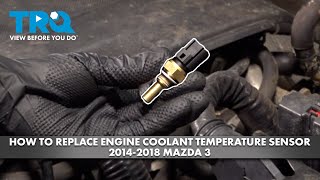
Typical fix: Replace the Engine Coolant Temperature sensor. On this Mazda 3, it is located on the driver's side of the cylinder head, below the vacuum line for the brake booster. 🎬 Watch: How to diagnose and fix the P0117 code
Est. part cost: $20-$50 - Damaged Wiring or Connector 🟡 Medium Probability The wiring harness is in the engine bay and exposed to heat and vibration, which can cause wires to become brittle, frayed, or shorted to ground over time.
How to confirm: Visually inspect the wiring and connector leading to the ECT sensor for any signs of damage, corrosion, or loose pins. Unplug the sensor; if the scan tool reading changes to a very low temperature (e.g., -40°F), it confirms the wiring is likely okay and the sensor is the issue. A low voltage reading (below 0.20V) at the PCM can also indicate a short to ground in the wiring.
Typical fix: Repair the damaged section of wiring or replace the connector pigtail.
Est. part cost: $10-$30 - Low Engine Coolant / Overheating ⚪ Low Probability While not a direct cause of the 'low circuit' fault, a severe overheating event due to low coolant can sometimes damage the sensor or trigger the code as the temperature exceeds its maximum reading range.
How to confirm: Check the coolant level in the reservoir and radiator (only when the engine is completely cool). If it is low, there is a leak that must be found and repaired. The code may be a symptom of the overheating, not the cause.
Typical fix: Find and repair the coolant leak, then properly fill and bleed the cooling system. The ECT sensor may still need to be replaced if it was damaged by the excessive heat.
Est. part cost: $15-$100+ (depending on the source of the leak)
Rare But Worth Checking
- Faulty Thermostat: A thermostat stuck closed can cause a genuine overheat condition, which might trigger the P0117 code if the temperature exceeds the sensor's range. However, this would usually be accompanied by other symptoms of overheating. A stuck-open thermostat is more likely to cause a P0128 code (Coolant Temperature Below Thermostat Regulating Temperature).
- Faulty Powertrain Control Module (PCM): This is extremely rare. The PCM is the last thing to suspect. All other possibilities, especially the sensor and wiring, must be exhaustively ruled out before considering a PCM failure.
Diagnosis Steps
- Verify the P0117 code is present using an OBD-II scanner.
- With the engine cold, access the scanner's live data and view the Engine Coolant Temperature reading. If it shows an impossibly high temperature (e.g., 250°F+), the sensor is almost certainly faulty or the circuit is shorted.
- Visually inspect the ECT sensor connector and nearby wiring for any obvious damage, corrosion, or loose connections. The sensor is on the driver's side of the cylinder head.
- Unplug the sensor's electrical connector. The temperature reading on the scan tool should drop to its lowest possible value (e.g., -40°F). If it does, this confirms the wiring and PCM are likely good, pointing to a failed sensor.
- If the reading does not change when unplugged, use a multimeter to check for a short to ground on the signal wire.
- Check the coolant level in the radiator and overflow tank (when the engine is cold) to rule out a low-coolant condition that could cause actual overheating.
- If all other tests pass, replace the Engine Coolant Temperature sensor.
Parts You'll Likely Need
- Engine Coolant Temperature (ECT) Sensor
(OEM #PE01-18-840, superseded by SH01-18-840)— This is the most common failure point for the P0117 code. It directly measures the coolant temperature and sends the signal to the PCM. The original part PE01-18-840 is listed for many 2014-2018 models, while SH01-18-840 is listed for later models and may be a superseding part.
Trusted brands: Mazda (OEM), Denso, NGK/NTK, Delphi, Standard Motor Products (SMP), Beck Arnley
OEM price range: $40-$65
Aftermarket price range: $20-$40
Related Codes That Often Appear With This One
- P011A: Engine Coolant Temperature Sensor 1 / 2 Correlation
Technical Service Bulletins (TSBs) & Recalls
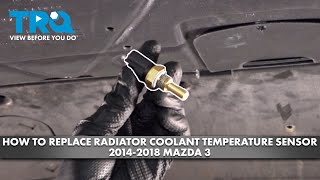
- TSB 01-011/17: Addresses a Check Engine Light with DTC P2183:00, caused by water intrusion into ECT Sensor No. 2 (at the bottom of the radiator). 🎬 See how to replace the radiator coolant temperature sensor This applies to 2014-2016 Mazda3s and 2017 models with VINs lower than JM1BN**166010. While not for P0117, it confirms the two-sensor setup and a known issue with the other sensor.
Platform-Specific Known Issues
- DIY Replacement Notes: Replacing the sensor is a straightforward DIY job. It is located on the driver's side of the engine. Access is improved by removing the engine cover and disconnecting a vacuum line. A 19mm deep socket is required to remove the sensor. The new sensor should be torqued to 15 ft-lbs. 🎬 Watch: Step-by-step Mazda 3 ECT sensor replacement guide Be prepared to lose a small amount of coolant and have new coolant on hand to top off the system afterward.
Mechanic-Grade Diagnostic Values
- ECT Sensor Resistance vs. Temperature — expected: Approx. 2.0-3.0 kΩ at 20°C (68°F); Approx. 0.2-0.3 kΩ at 90°C (194°F).. Failure: Resistance is near zero (shorted) or infinite (open) regardless of temperature. A reading of 0 Ω can indicate an internal short.
- ECT Sensor Signal Voltage (at connector, backprobed) — expected: With key on, engine off (cold), voltage should be between 2.0V and 3.0V. As the engine warms to operating temperature, voltage should drop smoothly to around 0.5V.. Failure: A reading below 0.2V, especially on a cold engine, indicates a short to ground in the sensor or wiring, triggering P0117.
- ECT Sensor Reference Voltage (at connector, unplugged) — expected: With the sensor unplugged and key on, one pin of the harness connector should show a ~5V reference voltage from the PCM.. Failure: No 5V reference suggests a wiring problem between the PCM and the sensor, or a fault within the PCM itself.
Wiring & Ground Locations
- G4 — Right side of engine compartment.. This is a primary engine ground point. While not exclusive to the ECT, a poor connection here can cause floating grounds and erratic readings for multiple sensors, including the ECT.
- G1 / G2 — Behind the left (driver's side) headlight assembly.. This is a major chassis ground point on the driver's side. The ECT sensor's ground path eventually leads to the chassis and battery negative. Corrosion or looseness at this point can cause intermittent and hard-to-diagnose electrical issues.
- ECT Sensor Connector Pins — On the ECT sensor itself, driver's side of the cylinder head.. The two pins are for the signal and the low reference (ground). Testing for voltage, ground, and resistance occurs here. A short between these two pins internally in the sensor or in the connector/wiring will cause a P0117.
Real Owner Repair Stories
- 2CarPros Forum User (2007 Mazda 3 (Note: Older generation, but same P0117 principle)) — Engine began to overheat after a short drive. Scan tool showed P0117 and a temperature reading of 285°F, while the dash gauge climbed to High then dropped to Low.
❌ Tried (didn't work) Replaced water outlet flange due to a leak., Replaced thermostat., Resetting the code temporarily made the car run normally before the issue returned.
✅ What actually fixed it The final diagnosis pointed towards an air lock in the cooling system after the initial repairs. An air pocket trapped around the ECT sensor can cause it to read an artificially high temperature (or steam temperature), triggering the P0117 code and mimicking a sensor failure. The recommended fix was to properly bleed the cooling system. - NHTSA ODI #11429692 (Mazda 6 - Cross-Manufacturer Reference) — An owner reported that a coolant leak led to the radiator overheating, which caused the engine to seize. The freeze frame data recorded "P0117 engine coolant temperature sensor 1 circuit low" during the event.
OEM Part Supersession History
PE01-18-840→SH01-18-840— Standard part revision and consolidation. The SH01-18-840 part is used across a wider range of Mazda vehicles from 2016 onwards, including the CX-3, CX-5, CX-9, and later Mazda3/6 models.
Heads up: None known. SH01-18-840 is the correct and current replacement for PE01-18-840 on this platform.
Diagnostic Flowchart
Other Known Issues on This Vehicle
Issues unrelated to this code that are worth knowing about as an owner of this generation:
- Infotainment 'Ghost Touch' and System Malfunctions 🟠 Medium — Very common on 2014-2016 models, less so on 2017-2018 but still occurs. The screen may delaminate or register phantom touches, causing random inputs. (Ref: Mazda issued a warranty extension program (SSPB6 / CSP13) for certain 2014-2016 models to address this. Some owners of newer models have had difficulty getting coverage.)
- Premature Rear Brake Wear 🟡 Low — Reported by a notable number of owners, sometimes requiring replacement of pads, rotors, and calipers before 100,000 miles. (Ref: Recall 17V393000 (Mazda's 1217F) was issued for 2014-2016 models for water entry into the parking brake actuator, which can cause corrosion and binding.)
- Intake Valve Carbon Buildup 🟡 Low — A potential long-term issue for all direct-injection (GDI) engines. While Mazda's Skyactiv design is considered more resistant than many competitors, buildup can still occur over high mileage (100k+ miles), potentially causing rough idle or reduced performance.
- Accessory Belt Tensioner Failure 🟠 Medium — The hydraulic tensioner is a known common failure point, with the internal seal leaking fluid, leading to a loss of belt tension, noise, and potential for the belt to come off.
- Cracked or Rattling Windshields 🟡 Low — Owners have reported that the windshield seems prone to chips and cracks, possibly due to its angle and the vehicle's height.
Used vs. New Parts: Buying Guide for This Vehicle
When a used part is the smart pick: For this specific repair, using a used Engine Coolant Temperature (ECT) sensor is not recommended. It is a low-cost electronic component that is critical for engine management. The potential for a used part to have a shortened lifespan or be out of calibration outweighs the minor cost savings.
What to inspect on the donor part:
- Not applicable as a used sensor is not advised.
OEM-only on this vehicle (don't cheap out):
- While not strictly 'OEM-only', using a known high-quality brand is crucial. The price difference between a quality aftermarket part and a questionable one is minimal.
Aftermarket brands forum-validated for this vehicle:
- Denso
- NGK/NTK
- Delphi
- Standard Motor Products (SMP)
Brands owners have reported issues with on this vehicle:
- Unnamed, no-brand sensors from online marketplaces should be avoided due to a high likelihood of premature failure or inaccurate readings.
Real Owner Stories
Aggregated from forums and TSBs cited above. Mileages and costs reflect what owners reported in those sources.
2014-2018 Mazda 3 Skyactiv-G
Symptoms: The temperature gauge would read extremely high or suddenly drop to zero; the engine cooling fans were running constantly even when the engine was cold.
What fixed it: Replacement of the Engine Coolant Temperature sensor located on the driver's side of the cylinder head.
Source hint: Mazda3Revolution
2014-2018 Mazda 3 Skyactiv-G
Symptoms: Check Engine Light on with P0117; the car experienced a rough or erratic idle and the transmission exhibited harsh shifting.
What fixed it: Replacing the faulty Engine Coolant Temperature (ECT) sensor.
Source hint: Mazdas247
2014-2018 Mazda 3 Skyactiv-G — ~105000 miles
Symptoms: The code was triggered during an actual overheating event where the coolant boiled over due to a leak.
What fixed it: Finding and repairing the coolant leak, then filling and bleeding the cooling system; the ECT sensor also required replacement due to heat damage.
Source hint: Reddit (r/MechanicAdvice)
Related OBD-II Codes
Frequently Asked Questions
Where is the Engine Coolant Temperature (ECT) sensor located on my 2014-2018 Mazda 3?
Does TSB 01-011/17 for the ECT sensor apply to my P0117 code?
What specific tools do I need to replace the ECT sensor on my Skyactiv-G engine?
What is the correct torque specification for the new ECT sensor?
Can I use a multimeter to test if my Mazda 3 sensor is actually bad?
Is P0117 related to the 'Ghost Touch' infotainment issue common on 2014-2016 models?
Helpful Videos
![How to Fix P0117 Engine Code in 3 Minutes [2 DIY Methods / Only $7.43]](https://img.youtube.com/vi/0PE930ETa4Y/mqdefault.jpg)

The information in this article is provided for general reference and educational purposes only. Vehicle specifications, procedures, and part compatibility can vary by production date, trim level, and region. Always consult your vehicle's factory service manual and verify part numbers before purchasing or performing repairs. Safety-critical components such as airbags, seat belts, and braking systems should be installed by a qualified professional.
- Mazda 3:
- 🎬 Helpful Videos
- What's Unique About the 2014-2018 Mazda 3
- Symptoms You May Notice
- Most Likely Causes
- Rare But Worth Checking
- Diagnosis Steps
- Parts You'll Likely Need
- Related Codes That Often Appear With This One
- Technical Service Bulletins (TSBs) & Recalls
- Platform-Specific Known Issues
- Mechanic-Grade Diagnostic Values
- Wiring & Ground Locations
- Real Owner Repair Stories
- OEM Part Supersession History
- Diagnostic Flowchart
- Other Known Issues on This Vehicle
- Used vs. New Parts: Buying Guide for This Vehicle
- Real Owner Stories
- 2014-2018 Mazda 3 Skyactiv-G
- 2014-2018 Mazda 3 Skyactiv-G
- 2014-2018 Mazda 3 Skyactiv-G — ~105000 miles
- Related OBD-II Codes
- Frequently Asked Questions
- 🎟️ Get 5% Off