

P0108 on 1996-2000 Volvo S70: MAP/Barometric Sensor Circuit High Guide
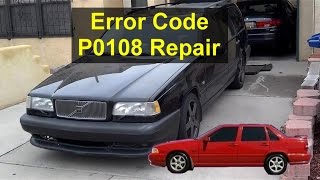
This code almost always points to a faulty pressure sensor or its wiring. On these Volvos, this can be either the Barometric Pressure (BARO) sensor (often near the passenger headlight) or, on turbo models, the Boost Pressure sensor on the intercooler pipe. The sensor is inexpensive ($40-$100 for an aftermarket part) and easy to replace.
- P0108 means the pressure sensor circuit is sending a continuous high voltage signal (>4.5V) to the computer.
- On a 1996-2000 S70, this could be the Barometric (BARO) sensor or the Turbo Boost sensor.
- The most likely cause is a failed sensor, which is a relatively cheap and easy part to replace for a DIYer.
- Before replacing, inspect the wiring/connector and consider cleaning the sensor with a proper electronics cleaner.
- If a new sensor doesn't fix it, suspect an intermittent wiring short or a defective new part; the code may take over 100 miles to reappear.
- Driving with this code can lead to poor performance, bad fuel mileage, and potential long-term damage to your catalytic converter.
What's Unique About the 1996-2000 Volvo S70
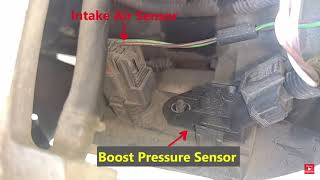
On the P80 platform (S70/V70/C70/850), the sensor associated with P0108 is often a Barometric Pressure sensor used for altitude correction, not a traditional MAP sensor that measures intake manifold vacuum. It is commonly located under the hood near the passenger-side latch, not on the manifold. 🎬 Watch: How to locate and replace the barometric pressure sensor. Turbo models have an additional 'Turbocharger Boost Sensor' (functionally a MAP sensor) on the intercooler outlet pipe 🎬 See this guide on turbo boost and air intake sensors. which can also cause this code. Owners often attempt to clean the sensor, as oil vapor from the PCV system can contaminate the sensing element.
Symptoms You May Notice
- Check Engine Light is on
- Rough or unstable idle
- Hesitation or sluggish acceleration
- Poor fuel economy
- Black smoke from the exhaust
- Engine stalling, especially when coming to a stop
- Hard starting
- Car may run perfectly fine for a period, then run poorly for a minute before returning to normal
- Replacing the Mass Airflow (MAF) sensor. Some owners confuse the MAP and MAF sensors. P0108 is specific to the pressure sensor circuit.
- Replacing the wrong pressure sensor. Owners of non-turbo models may mistakenly look for a sensor on the intercooler piping, or turbo owners may replace the BARO sensor when the boost sensor is the issue.
Most Likely Causes
- Faulty MAP/Barometric Pressure Sensor 🔴 High Probability The sensor, whether the BARO or turbo boost sensor, is a common failure point on P80 models due to age, heat cycles, and internal electronic failure.
How to confirm: With the key on and engine off, use a scan tool to check the MAP sensor reading. It should be close to the current barometric pressure. If the reading is stuck at a high, fixed value or the voltage reads above 4.5V, the sensor has likely failed. You can also test its voltage output with a multimeter. A working sensor should have a 5V reference, a good ground, and a signal that varies.
Typical fix: Replace the sensor. It is typically held in by one 8mm bolt and has a single electrical connector.
Est. part cost: $40-$120 - Wiring or Connector Issue 🟡 Medium Probability Engine heat and vibration can cause the 20+ year-old wiring insulation to become brittle and crack, leading to a short to power on the signal wire.
How to confirm: Visually inspect the wiring harness leading to the sensor for any signs of damage, fraying, or melting. Check the connector for corrosion or loose pins. Use a multimeter to test for a 5V reference and a good ground at the connector with the key on. Check for a short between the signal wire and the 5V reference line.
Typical fix: Repair the damaged section of the wiring harness or clean/replace the connector.
Est. part cost: $5-$50 - Contaminated Sensor 🟡 Medium Probability The P80 platform's PCV system can become clogged, increasing crankcase pressure and forcing oil vapor into the intake tract. This oil can coat the boost pressure sensor on turbo models, causing incorrect readings.
How to confirm: Remove the sensor and inspect the sensing element. If it is covered in oil or carbon buildup, it is contaminated.
Typical fix: Carefully clean the sensor using a dedicated Mass Airflow (MAF) sensor cleaner or electronics cleaner. Do not use aggressive solvents like brake cleaner. 🎬 Watch: A quick walkthrough on cleaning your pressure sensor. If cleaning does not resolve the issue, replacement is necessary. A full PCV system service may be required to prevent recurrence.
Est. part cost: $5-$15 for cleaner
Rare But Worth Checking
- Clogged Catalytic Converter: A severe exhaust restriction can alter intake pressure dynamics, but this would typically be accompanied by other exhaust-related codes (like P0420) and severe, non-intermittent power loss.
- Faulty Engine Control Module (ECM): This is very rare. The ECM's internal circuit for the sensor can fail, but this should only be considered after a known-good sensor and verified wiring do not solve the problem. One forum user's experience of swapping sensors between cars pointed to this as a possibility.
Diagnosis Steps
- Read the code with an OBD-II scanner to confirm P0108 is present.
- Using the scanner's live data, observe the MAP sensor voltage with the Key On, Engine Off (KOEO). A reading stuck above 4.5V indicates a 'hard fault'. The pressure reading should correspond to local atmospheric pressure.
- Start the engine. If it's a true MAP sensor (turbo models), the voltage should drop at idle. If the voltage remains high, proceed with diagnosis.
- Turn off the engine. Locate the sensor. On turbo models, check the sensor on the intercooler pipe near the throttle body. On all models, also check for the barometric sensor near the passenger side headlight/hood latch area.
- Inspect the sensor's electrical connector for corrosion or damage. Inspect the visible wiring for breaks, chafing, or signs of heat damage.
- Disconnect the sensor. With the key on, use a multimeter to verify you have a ~5-volt reference and a good ground at the connector pins.
- If wiring is confirmed good, remove the sensor (usually one 8mm or Torx bolt). Inspect it for oil or carbon contamination.
- Attempt to clean the sensor with electronics or MAF sensor cleaner. Reinstall, clear the code, and test drive. Note that the code may take up to 150 miles to return if the fault is intermittent.
- If cleaning fails or the live data readings were clearly incorrect, replace the MAP sensor. Be aware that even new parts can sometimes be defective.
- If a new sensor does not fix the issue, perform a thorough continuity and short-circuit test on the wiring harness between the sensor connector and the ECM. If wiring is perfect, the fault may lie within the ECM, which is rare.
Parts You'll Likely Need
- Manifold Absolute Pressure / Boost Sensor (For Turbo Models)
(OEM #9125462)— This is the most common component to fail for a P0108 code on turbo models, located on the intercooler pipe.
Trusted brands: Bosch (OEM supplier), Standard Motor Products, Delphi, Genuine Volvo
OEM price range: $130-$160
Aftermarket price range: $40-$100 - Barometric Pressure Sensor (All Models)
(OEM #1275342)— On non-turbo models, or as a secondary sensor on turbo models, this BARO sensor is a frequent cause of P0108.
Trusted brands: Bosch, Genuine Volvo
OEM price range: $130-$160
Aftermarket price range: $50-$110
Platform-Specific Known Issues
- Sensor Identity Crisis: There is significant community confusion about this code because Volvo used the sensor for different purposes. On cars with Motronic 4.4 ECU (typically 1998 and earlier), the primary sensor for P0108 is often the 'Atmospheric Pressure Sensor' (BARO) located away from the engine, while later ME7 ECU cars (typically 1999-2000) use a true 'Boost Pressure Sensor' on the intake piping. Both can throw a P0108 code.
- PCV System Link: A failing or clogged PCV system is a well-documented issue on P80 Volvos. This can cause excessive crankcase pressure, forcing oil into the intake and contaminating the boost pressure sensor on turbo models, leading to faulty readings.
Mechanic-Grade Diagnostic Values
- MAP/BARO Sensor Signal Voltage (Key On, Engine Off) — expected: ~3.2V at sea level (~90 kPa). The voltage should be between 0.5V and 4.5V.. Failure: A sustained reading above 4.5V indicates a circuit high fault.
- Boost Pressure Sensor Signal Voltage (Turbo Models, at Idle) — expected: ~1.0V to 2.0V.. Failure: Voltage remaining high (near 5V) at idle suggests a faulty sensor or circuit.
- Sensor Connector 5V Reference — expected: ~5V DC between the reference wire and ground.. Failure: No voltage or significantly lower/higher voltage points to a wiring or ECM issue.
- Sensor Ground Wire to Chassis Ground — expected: < 1k ohms, ideally near 0 ohms (continuity).. Failure: High resistance or an open circuit (OL) indicates a bad ground connection.
Scan Tool Commands That Help
- Volvo VADIS / VIDA: Read Signal from MAP sensor — The official Volvo diagnostic tool can be used to read the live signal from the manifold absolute pressure (MAP) sensor to verify its operation against specifications.
Wiring & Ground Locations
- Motronic 4.4 BARO Sensor Signal Pin — Pin #A26 on the Motronic 4.4 ECU connector.. This is the specific pin where the ECM receives the signal from the barometric pressure sensor. Testing for a short-to-voltage on the wire leading to this pin is a key diagnostic step.
- Motronic 4.4 Sensor Ground Pin — Pin #A42 on the Motronic 4.4 ECU connector (Signal Ground).. This is the shared signal ground for multiple sensors. A fault at this pin or its wiring could affect the BARO sensor and cause incorrect readings.
- ME7 Boost Sensor Connector Pins — 3-pin connector on the sensor located on the intercooler pipe. Pin 1: Signal, Pin 2: Ground, Pin 3: 5V Reference.. Knowing the pinout allows for direct testing of power, ground, and signal at the sensor connector, which is the fastest way to isolate a bad sensor from a wiring problem.
- Engine Bay Ground Points — Groups of ground wires are located on the inner fender/strut tower area next to each headlight. There is also a main engine block ground.. Poor grounding at these common points can introduce electrical noise or voltage offsets, potentially causing sensor circuit codes like P0108. Cleaning these grounds is a crucial preventative and diagnostic step.
Real Owner Repair Stories
- VolvoForums user 'FredMc' (Volvo S70 (year not specified, but in P0108 thread)) — Check Engine Light with code P0108.
❌ Tried (didn't work) Clearing the code; it would return after approximately 150 miles.
✅ What actually fixed it The user had a new MAP sensor installed, which fixed the code. However, the code returned in January after the part was installed in August. Taking it back to the shop, they replaced the (new) faulty sensor under warranty, which permanently resolved the issue. This highlights that new parts can be defective and that the fault can be intermittent, taking a specific drive cycle to reappear.
OEM Part Supersession History
9125462→N/A - Still active
Heads up: This part number is specifically listed for 1999-2000 S70 turbo models (GLT, T5, AWD) which use the ME7 engine management system. It is a 'Turbocharger Boost Sensor'. It is not the correct part for the BARO sensor (1275342) often found on earlier Motronic 4.4 cars.1275342→N/A - Still active
Heads up: This is the 'Barometric Pressure Sensor' located near the passenger headlight/hood latch area. It is the primary cause for P0108 on non-turbo models and earlier (pre-1999) turbo models with Motronic 4.4 engine management.
Model Year Variations Within This Range
- 1996-1998 (Motronic 4.4 ECU): For these model years, P0108 is almost always caused by the 'Barometric Pressure Sensor' (PN 1275342) located by the passenger side hood latch. This sensor's primary role is altitude compensation. The ECM uses its signal to adjust boost pressure and fuel injection timing for changes in air density. If it fails, the ECM defaults to a sea-level value.
- 1999-2000 (Bosch ME7 ECU): These later models use a more modern engine management system. For turbo models, P0108 is typically caused by the 'Turbocharger Boost Sensor' (PN 9125462) located directly on the intercooler pipe before the throttle body. This sensor functions as a true MAP sensor, providing primary engine load information to the ECU. While a BARO sensor may still be present, the boost sensor is the more common culprit for this code on ME7 cars.
Diagnostic Flowchart
Real Owner Stories
Aggregated from forums and TSBs cited above. Mileages and costs reflect what owners reported in those sources.
Volvo S70
Symptoms: Check engine light was on with a P0108 code, but the car drove and idled perfectly fine.
What fixed it: Replacing the MAP sensor twice. The first replacement sensor did not resolve the issue, and a second new MAP sensor had to be installed under warranty before the code stayed clear.
Source hint: volvoforums.com - Code p0108
1998 Volvo S70
Symptoms: Persistent P0108 code that would not clear even after swapping parts.
What fixed it: Swapped a known-good sensor from a donor car, but the code persisted in the S70 (while the original sensor worked fine in the donor car), proving the issue was a wiring or ECM fault rather than the sensor itself.
Source hint: volvoforums.com - Thread '98 s70 barometric sensor problem' (2009)
1998 Volvo V70 GLT
Symptoms: High Manifold Pressure code (P0108) causing the engine management to default to a sea-level fuel map.
What fixed it: Identified and addressed the 'barometric sensor' (altitude sensor) as the root cause, which is the specific sensor responsible for this code on 1998 Motronic 4.4 models.
Source hint: AnandTech Forums - Thread '1998 Volvo V70 GLT, High Manifold Pressure' (2014)
Volvo S70
Symptoms: Check engine light illuminated specifically for a P0108 code.
What fixed it: Unplugged the barometric pressure sensor (held in by an 8mm bolt) and sprayed cleaner into it to remove contamination.
Source hint: Robert DIY (YouTube comment)
Related OBD-II Codes
Frequently Asked Questions
Where is the MAP/BARO sensor located on my Volvo S70?
I replaced the MAP sensor on my S70 but the P0108 code came back. What else could it be?
Can a clogged PCV system cause a P0108 code on my turbo S70?
How do I test the MAP/BARO sensor wiring on my 1996-2000 Volvo S70?
Can I clean the MAP sensor on my S70 instead of replacing it?
Does the P0108 diagnosis for the S70 also apply to my 1998 Volvo V70?
Helpful Videos

We Have This Part in Stock



The information in this article is provided for general reference and educational purposes only. Vehicle specifications, procedures, and part compatibility can vary by production date, trim level, and region. Always consult your vehicle's factory service manual and verify part numbers before purchasing or performing repairs. Safety-critical components such as airbags, seat belts, and braking systems should be installed by a qualified professional.
- Volvo S70:
- 🎬 Helpful Videos
- 🛍️ Shop This Part
- What's Unique About the 1996-2000 Volvo S70
- Symptoms You May Notice
- Most Likely Causes
- Rare But Worth Checking
- Diagnosis Steps
- Parts You'll Likely Need
- Platform-Specific Known Issues
- Mechanic-Grade Diagnostic Values
- Scan Tool Commands That Help
- Wiring & Ground Locations
- Real Owner Repair Stories
- OEM Part Supersession History
- Model Year Variations Within This Range
- Diagnostic Flowchart
- Real Owner Stories
- Volvo S70
- 1998 Volvo S70
- 1998 Volvo V70 GLT
- Volvo S70
- Related OBD-II Codes
- Frequently Asked Questions
- 🎟️ Get 5% Off