

P0101 on 2011-2018 Chevrolet Camaro: MAF Sensor Range/Performance Causes and Fixes
P0101 on a 2011-2018 Camaro most often points to a dirty MAF sensor, an air intake leak (especially from aftermarket intakes), or a contaminated air filter. Cleaning the MAF sensor is a common first step. Also, check for vehicle-specific issues like a deteriorated hydrocarbon pad in the airbox or casting flash in the intake tube, as noted in GM Technical Service Bulletins, before replacing the sensor.
- P0101 on a 2011-2018 Camaro means the MAF sensor's readings are out of the expected range.
- Before replacing the sensor, always clean it with dedicated MAF sensor cleaner and inspect the entire air intake system for leaks.
- Check for Camaro-specific issues mentioned in TSBs: a degrading hydrocarbon pad in the airbox lid (TSB #PIP4813C) and plastic flashing in the intake tube (TSB #PIP5446A).
- A dirty or improperly oiled aftermarket air filter is a very common cause of this code on modified vehicles.
- If the code is accompanied by a severe loss of power, a clogged catalytic converter could be the underlying problem.
What's Unique About the 2011-2018 Chevrolet CAMARO

For the 5th and 6th generation Camaro, this code is frequently more than just a bad sensor. General Motors has issued specific Technical Service Bulletins (TSBs) pointing to unique manufacturing and design issues. These include plastic 'casting flash' inside the air intake tube that disrupts airflow (TSB PIP5446A) and a hydrocarbon absorber pad in the air filter lid that can degrade and contaminate the intake (TSB PIP4813C). Furthermore, the popularity of aftermarket cold air intakes on these cars is a major contributor to this code, as they can alter airflow characteristics or introduce oil contamination. A known issue on V8 SS models involves 'weak' vs 'strong' MAF sensors from different OEM suppliers, where the 'weak' sensor provides lower frequency readings that can cause hesitation and trigger P0101, especially with aftermarket intakes.
Diagnostic Flowchart

Tap your situation to follow the diagnostic path that matches what you're seeing on this vehicle.
Generation note: This guide covers the end of the fifth generation (2011-2015) and the beginning of the sixth generation (2016-2018) Chevrolet Camaro. The TSBs provided apply across both generations, suggesting the underlying causes are similar regardless of the specific engine (V6 or V8).
Symptoms You May Notice
- Check Engine Light is on
- Rough or unstable idle
- Engine hesitation, sputtering, or surging, especially on acceleration
- Lack of engine power
- Harsh shifting [TSB #PIP5446A].
- Poor fuel economy
- Black smoke from the exhaust
- Stalling or hard starting
- Replacing the MAF sensor without first cleaning it or checking for vacuum leaks. A dirty sensor or an air leak are far more common and cheaper to fix.
- Replacing oxygen sensors. While fuel trim codes (like P0171/P0174) can appear with P0101, the root cause is often the unmetered air or incorrect MAF reading, not the O2 sensors themselves.
Most Likely Causes

- Dirty or Contaminated MAF Sensor 🔴 High Probability Oiled aftermarket air filters are a common modification on Camaros and can deposit oil onto the MAF sensor element, causing incorrect readings. Standard road dust and dirt can also accumulate over time.
How to confirm: Visually inspect the MAF sensor's wire or filament. If it appears dirty, coated in oil, or has debris on it, it needs cleaning.
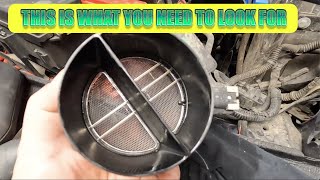
Typical fix: Remove the sensor and clean it carefully using only dedicated MAF sensor cleaner spray. Do not touch the sensitive wires. 🎬 Watch: A quick guide on how to clean your MAF sensor safely. Let it dry completely before reinstalling.
Est. part cost: $10-$15 for a can of MAF cleaner - Vacuum Leak 🔴 High Probability Any air that enters the engine after the MAF sensor is 'unmetered' and will cause the sensor's readings to be lower than the actual amount of air entering the cylinders. This is a common cause on many vehicles, including the Camaro. Forum users frequently report finding disconnected PCV hoses or loose intake clamps, especially after recent work.
How to confirm: Perform a visual inspection of all intake ducting, clamps, and vacuum hoses between the MAF sensor and the engine. A smoke test is the most effective way to pinpoint a leak's location. A Camaro6 forum member found a leak this way after getting P0101.
Typical fix: Tighten loose clamps or replace cracked/broken hoses or gaskets.
Est. part cost: $5-$50 depending on the hose or gasket - Aftermarket Cold Air Intakes (CAI) 🟡 Medium Probability Camaro owners frequently install CAIs. These can cause P0101 if the inner diameter of the intake tube around the MAF sensor is different from stock, or if the design creates air turbulence, both of which lead to inaccurate readings. Oiled filters that come with many kits are also a primary source of MAF contamination. 🎬 See how aftermarket filters often trigger the P0101 code.
How to confirm: The code appears shortly after installing a new intake. Check forums for other owners with the same intake having similar issues. Some intakes may require a specific tune to work correctly.
Typical fix: Ensure the MAF sensor is installed correctly and facing the right direction. Clean the MAF sensor. If the problem persists, a tune may be required, or you may need to reinstall the factory airbox.
Est. part cost: $0-$500 (cost of a tune if needed) - Damaged Air Cleaner Hydrocarbon Absorber Pad 🟡 Medium Probability TSB #PIP4813C specifically calls out that the hydrocarbon absorber pad inside the air cleaner lid can degrade, and pieces can break off, restricting airflow or contaminating the MAF sensor.
How to confirm: Open the air filter housing and inspect the inside of the lid. Check for a deteriorating black foam or carbon-like pad.
Typical fix: If the pad is damaged, replace the air cleaner lid or entire assembly as needed and clean any debris from the intake tract.
Est. part cost: $50-$150 for a new airbox lid - Casting Flash in MAF Tunnel ⚪ Low Probability TSB #PIP5446A identifies an issue where excess plastic flashing from the manufacturing process can be present in the intake tube near the MAF sensor, disrupting airflow and causing erratic readings.
How to confirm: Remove the MAF sensor and visually inspect the inside of the intake tube bore where the sensor sits. Look for any rough or excess plastic material. The TSB includes images for reference.
Typical fix: Carefully remove the excess flashing with a deburring tool or file, then clean the intake tube thoroughly to remove any plastic shavings. The TSB recommends replacing the air filter housing lid if flash is found.
Est. part cost: $0 if done DIY, or the cost of a new airbox lid. - Faulty MAF Sensor ⚪ Low Probability While less common than a dirty sensor, the sensor itself can fail electronically. A user on the Camaro6 forums replaced a seemingly bad MAF sensor only to have the P0101 code return, indicating other underlying issues are more common.
How to confirm: After confirming no vacuum leaks, a clean sensor, and no intake obstructions, monitor the MAF sensor's output in grams per second (g/s) with a scan tool. The reading should be stable at idle and increase smoothly with engine RPM. If readings are erratic or do not change, the sensor is likely faulty.
Typical fix: Replace the MAF sensor. For 2011-2015 V8 models, a common part is ACDelco 213-4222. For 2016-2018 models (V6/V8), a common part is GM 23262344.
Est. part cost: $70-$200
Rare But Worth Checking
- Clogged Catalytic Converter: A severely clogged catalytic converter can restrict exhaust flow, which in turn limits the amount of air the engine can draw in. This can cause the MAF reading to be lower than expected for a given engine speed and throttle position, triggering P0101. This is usually accompanied by a severe lack of power and potentially other codes like P0420.
- Wiring Issue: A damaged wire or a loose/corroded connector pin for the MAF sensor can cause an intermittent or complete loss of signal, leading to a P0101 code. Forum members suggest checking for bent pins in the connector or a pin that has backed out, especially after recent work on the intake system. Also check the ground wire for the sensor.
Diagnosis Steps
- Read all fault codes with an OBD-II scanner. Note any other codes present, especially P0171, P0174, or P0068.
- Inspect the air filter for dirt or contamination. Replace if necessary. If it's an oiled filter, check if it's over-oiled.
- Inspect the air intake tube between the air filter box and the throttle body for any cracks, loose connections, or disconnected hoses. Ensure all clamps are tight.
- Per TSB #PIP4813C, inspect the hydrocarbon absorber pad on the inside of the air filter housing lid for any signs of degradation or loose pieces.
- Remove the MAF sensor and inspect its sensing elements for dirt, oil, or debris. Clean it with dedicated MAF sensor cleaner spray and let it dry completely before reinstalling.
- Per TSB #PIP5446A, inspect the inside of the intake tube where the MAF sensor mounts for any plastic casting flash that could disrupt airflow.
- If the code persists, use a smoke machine to test the intake system for vacuum leaks that may not be visually apparent.
- With a scan tool, monitor the MAF sensor reading (in g/s) at idle and while gradually increasing engine RPM. The reading should be steady and rise smoothly. Compare this to known-good values if possible.
- If all other steps fail, test the MAF sensor's wiring for proper voltage, ground, and signal continuity back to the ECM. Check for bent or backed-out pins in the connector.
- If the sensor has been cleaned, the intake is clear of obstructions and leaks, and the wiring is good, the MAF sensor itself is likely faulty and should be replaced.
Parts You'll Likely Need
- Mass Air Flow Sensor Cleaner
- Mass Air Flow Sensor (2011-2015 V6/V8)
- Mass Air Flow Sensor (2016-2018 V6/V8)
- Engine Air Filter
Related Codes That Often Appear With This One
- P0171 — System Too Lean (Bank 1). This often appears with P0101 when there is a vacuum leak, as unmetered air is entering the engine, creating a lean condition. TSB PIP5446A also lists this code in conjunction with P0101.
- P0174 — System Too Lean (Bank 2). Similar to P0171, this indicates a lean condition on the opposite engine bank, reinforcing the likelihood of a vacuum leak affecting the entire intake. TSB PIP5446A also lists this code.
- P0068 — MAP/MAF - Throttle Position Correlation. This code indicates a disagreement between the airflow reported by the MAF sensor and the expected airflow based on throttle position and manifold pressure, which is the core issue of a P0101 fault.
Technical Service Bulletins (TSBs) & Recalls

- PIP5446A: Harsh Shift 1/2 and 2/3 and Sputter Applying Throttle Between 0 and 30%, Rough idle, P0101. Cause is casting flash near the MAF sensor.
- PIP4813C: SES Lamp, rough running, lack of power with P0101. Cause is a degraded hydrocarbon absorber pad in the air cleaner lid.
- PIP5529B: General diagnostic assistance for a combination of codes including P0101, P0068, P0106, P0171, etc.
- PI0746A: Addresses MIL on with multiple DTCs including P0101, often due to ice or oil deposits in the air inlet duct on 3.6L engines from PCV issues, especially in cold weather.
Platform-Specific Known Issues
- TSB #PIP5446A: Notes that P0101 can be caused by plastic casting flash inside the intake tube near the MAF sensor, which disrupts airflow. The fix is to manually remove the excess plastic.
- TSB #PIP4813C: Points to the hydrocarbon absorber pad inside the air cleaner lid degrading. Pieces can break off and either contaminate the MAF sensor or restrict airflow, causing P0101.
- TSB #PIP5529B: Lists P0101 as one of many potential codes that can be set due to an underlying electrical issue, indicating that diagnosis should not be isolated to only the MAF circuit if multiple unrelated codes are present.
Mechanic-Grade Diagnostic Values
- Mass Air Flow (MAF) Sensor Reading at Idle (Scan Tool) — expected: Approximately 3-7 g/s for a V6/V8 engine at normal idle. A common rule of thumb is that the g/s reading should be close to the engine's displacement in liters (e.g., a 6.2L engine should read around 6.2 g/s).. Failure: Significantly higher, lower, or erratic readings at a steady idle. A reading that is slow to rise with RPM can indicate a dirty sensor or an air leak.
- Mass Air Flow (MAF) Sensor Reading at 2500 RPM (Scan Tool) — expected: Should rise to between 15 to 25 g/s.. Failure: Reading does not increase smoothly and linearly with RPM.
- MAF Sensor Frequency at Idle (V8 SS Models) — expected: A 'strong' sensor reads around 1800 Hz at idle with the A/C off.. Failure: A 'weak' sensor may read between 1560-1670 Hz, which can cause hesitation and trigger P0101, especially with aftermarket intakes.
- MAF Connector - Ignition Voltage — expected: 10 to 12 Volts DC with key on, engine off.. Failure: No voltage or significantly low voltage indicates a wiring or fuse issue.
Wiring & Ground Locations

- MAF Connector (2011-2015 L99/LS3 V8) — On the air intake tube, between the air filter housing and the throttle body.. Provides power, ground, and signal paths for the MAF and IAT sensors. A bad connection at any pin can cause P0101. Pinout: Pin A (Yellow) = MAF Signal; Pin B (Black/White) = Ground; Pin C (Pink) = Ignition Voltage; Pin D (Tan) = Low Reference; Pin E (Light Blue) = IAT Signal.
- MAF Connector (V6 LLT Engine) — On the air intake tube, between the air filter housing and the throttle body.. Provides power, ground, and signal paths for the MAF and IAT sensors. A bad connection at any pin can cause P0101. Pinout: Pin 1 (Tan) = Low Reference; Pin 2 (Black/White) = Ground; Pin 3 (Light Blue) = IAT Signal; Pin 4 (Pink) = Ignition Voltage; Pin 5 (Yellow) = MAF Signal.
- Engine Ground — There are multiple ground points on the engine block. One common location for sensor grounds is a bolt with several black wires running to it, often near the firewall behind the fuel injectors.. The MAF sensor requires a solid ground reference to provide an accurate signal. A loose or corroded ground can cause erratic readings and trigger a P0101 code.
Real Owner Repair Stories
- Camaro6.com forum user (6th Gen Camaro ZL1) — Car felt sluggish, then would grab power/boost in higher RPMs, followed by P0101 code, reduced power mode, and random acceleration.
❌ Tried (didn't work) Cleaning the MAF sensor, Checking for leaks visually, Performing a smoke test
✅ What actually fixed it The user had a disconnected PCV pipe on the passenger side. Reconnecting the pipe and clearing the codes (which required several drive cycles) resolved the issue. - LS1.com forum user (2000 Camaro SS (Stock)) — Sudden rough running, felt like it wanted to shut off, huge loss of power. At idle, RPMs would bounce below 1000 and then stall. P0101 code eventually appeared.
❌ Tried (didn't work) Replacing the fuel filter, Cleaning the MAF sensor, Starting the car with the MAF unplugged (no change), Replacing the MAF sensor with a new AC Delco unit
✅ What actually fixed it The actual cause was a broken valve spring.
"I Checked Everything" — The Actual Cause
- In one documented case on a 2000 Camaro SS, the owner performed multiple standard fixes for P0101 including cleaning and replacing the MAF sensor, but the issue persisted. The final root cause was discovered to be a broken valve spring, which is a mechanical issue that would not be found by a smoke test or electrical diagnosis of the MAF circuit.
OEM Part Supersession History
GM 15865791→ACDelco 213-4222— Branding change. GM Genuine Parts are the OE parts, and some may have formerly been branded as ACDelco GM Original Equipment. They are often the same part.
Heads up: These parts are generally interchangeable for the specified applications, which includes the 2010-2015 Camaro.GM 22895480, 23144941→GM 23262344— Part revision/update.
Heads up: 23262344 is the direct replacement for the earlier numbers for 6th generation Camaros and other applicable GM vehicles.
Model Year Variations Within This Range
- 2011-2015 (V8 SS Models): GM used two different suppliers for the MAF sensor. One version is considered 'weak' and the other 'strong'. The 'weak' sensors read a lower frequency (Hz) at idle and are slower to respond to throttle changes, which can trigger P0101, especially when aftermarket air intakes are installed. A 'strong' sensor can be identified by a code in its window featuring a letter followed by a number, while a 'weak' one has only a single letter.
Helpful Videos

Used OEM Parts in Stock


New Aftermarket Parts Available


The information in this article is provided for general reference and educational purposes only. Vehicle specifications, procedures, and part compatibility can vary by production date, trim level, and region. Always consult your vehicle's factory service manual and verify part numbers before purchasing or performing repairs. Safety-critical components such as airbags, seat belts, and braking systems should be installed by a qualified professional.
- Chevrolet CAMARO:
- 🎬 Helpful Videos
- 🛍️ Shop This Part
- What's Unique About the 2011-2018 Chevrolet CAMARO
- Diagnostic Flowchart
- Symptoms You May Notice
- Most Likely Causes
- Rare But Worth Checking
- Diagnosis Steps
- Parts You'll Likely Need
- Related Codes That Often Appear With This One
- Technical Service Bulletins (TSBs) & Recalls
- Platform-Specific Known Issues
- Mechanic-Grade Diagnostic Values
- Wiring & Ground Locations
- Real Owner Repair Stories
- "I Checked Everything" — The Actual Cause
- OEM Part Supersession History
- Model Year Variations Within This Range
- 🎟️ Get 5% Off