

P0101 on 2015-2020 Audi S3: MAF Sensor, PCV Valve, and Vacuum Leak Causes
On the 2015-2020 Audi S3, code P0101 is most often caused by a failed PCV valve creating a large vacuum leak, not a bad Mass Airflow (MAF) sensor. Before buying a new MAF, check for a whistling sound from the engine or test the PCV system by checking for strong suction at the oil filler cap. A replacement PCV assembly costs around $150-$250.
- For a 2015-2020 Audi S3, P0101 is most likely caused by a failed PCV valve, not the MAF sensor itself.
- Always check for vacuum leaks using a smoke test or by listening for a whistling sound before replacing any parts.
- Cleaning the MAF sensor with a dedicated cleaner is a cost-effective diagnostic step.
- Do not replace the MAF sensor unless you have ruled out a faulty PCV valve and other vacuum leaks first.
What's Unique About the 2015-2020 Audi S3

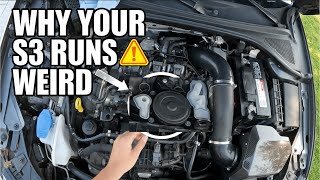
The EA888 Gen 3 engine in the Audi S3 has a well-documented weakness in its Positive Crankcase Ventilation (PCV) valve, also called the oil separator. The internal diaphragm of this valve frequently tears, creating a significant vacuum leak. This unmetered air enters the engine after the MAF sensor, causing the sensor's readings to be illogical compared to the actual air entering the cylinders. This PCV failure is the most common root cause for a P0101 code on this platform, often leading to the unnecessary replacement of a perfectly good MAF sensor. 🎬 Watch: Understanding P0101 causes, symptoms, and how to fix it. The PCV unit contains multiple internal valves and seals that can fail, making replacement of the entire assembly the only reliable fix.
Symptoms You May Notice

- Check Engine Light is on
- Rough or unstable idle
- Hesitation or stumbling during acceleration
- Reduced engine power or entering 'limp mode'
- Noticeably worse fuel economy
- Black smoke from the exhaust if running rich
- A whistling, squealing, or sucking sound from the engine bay at idle (indicating a PCV leak)
- Engine stalls during or after coming to a stop
- Replacing the Mass Airflow (MAF) sensor without first thoroughly checking for vacuum leaks, particularly from the PCV valve assembly. Many owners replace the sensor only to have the P0101 code return because the root cause was unmetered air.
Most Likely Causes

- Failed PCV Valve / Oil Separator 🔴 High Probability The diaphragm inside the PCV assembly is a known weak point on the EA888 Gen 3 engine and is a leading cause of unmetered air leaks that trigger P0101. Failure is common between 60,000 and 80,000 miles.
How to confirm: Listen for a distinct whistling or sucking noise from the engine bay at idle. A definitive test is to try to remove the oil cap while the engine is running; a failed PCV will create a strong vacuum, making the cap very difficult to remove and causing the engine to stumble or run rough when it's opened. A healthy engine should have only light vacuum, allowing the cap to be removed with little resistance. A smoke test is the most definitive professional method.
Typical fix: Replace the entire PCV valve assembly. The unit contains multiple non-serviceable internal diaphragms, making a full replacement necessary.
Est. part cost: $150-$250 - Dirty or Contaminated Mass Airflow (MAF) Sensor 🟡 Medium Probability Oil vapor from a failing PCV system or residue from an aftermarket oiled air filter can contaminate the sensor's hot wire, causing inaccurate readings.
How to confirm: Remove the sensor from the intake tube and visually inspect the small wires inside. If they are dirty, cleaning is the first step.
Typical fix: Clean the sensor element carefully using only dedicated MAF sensor cleaner spray. Do not touch the wires. Let it dry completely before reinstalling.
Est. part cost: $10-$15 for cleaner, $150-$250 for a new sensor - Vacuum or Boost Leak 🟡 Medium Probability As a turbocharged engine, the complex intake and charge pipe system has many connection points (hoses, gaskets, intercooler connections) that can develop leaks over time. A disconnected or cracked charge pipe is a common cause.
How to confirm: Perform a smoke test on the intake system. This involves feeding low-pressure smoke into the intake and watching for where it escapes.
Typical fix: Identify the source of the leak and replace the cracked hose, faulty gasket, or loose clamp.
Est. part cost: $20-$200 depending on the failed component - Clogged or Dirty Engine Air Filter ⚪ Low Probability
How to confirm: Visually inspect the engine air filter. If it is visibly dirty or clogged, it should be replaced.
Typical fix: Replace the engine air filter.
Est. part cost: $25-$50
Rare But Worth Checking
- Damaged MAF Sensor Wiring: Before replacing the sensor, always inspect the connector and wiring harness for any visible damage, corrosion, or loose pins.
- Cracked Intake Manifold: The plastic intake manifold can develop hairline cracks, creating a vacuum leak that is difficult to spot without a smoke test.
- Failed Rear Main Seal: A severely failed PCV valve can cause excessive crankcase pressure, leading to failure of the rear main seal. This creates a large vacuum leak at the transmission bell housing which can also trigger P0101.
Diagnosis Steps

- With the engine running, listen for a high-pitched whistling or sucking sound, a strong indicator of a failed PCV valve.
- Attempt to remove the oil filler cap while the engine is idling. If there is strong suction holding it down, making it difficult to lift, the PCV valve has likely failed.
- Perform a smoke test on the entire intake system to definitively locate any vacuum leaks from the PCV, hoses, or gaskets.
- If no leaks are found, remove the MAF sensor. Visually inspect the sensor elements for contamination from oil or dirt.
- Clean the MAF sensor using a dedicated MAF sensor cleaner spray. Let it dry completely before reinstalling.
- Inspect the engine air filter and replace it if it is dirty or clogged.
- Check the MAF sensor's electrical connector and wiring for any damage, corrosion, or loose connections.
- If all other steps fail to resolve the code, the MAF sensor itself may be faulty and require replacement.
Parts You'll Likely Need
- PCV Valve / Oil Separator Assembly
(OEM #06K103495BL (latest revision), supersedes 06K103495AS, 06K103495AF, 06K103495T)— This is the most common failure point on the EA888 Gen 3 engine that directly causes the P0101 code due to a torn internal diaphragm creating a vacuum leak.
Trusted brands: Audi (OEM), Vaico, Febi Bilstein
OEM price range: $200-$275
Aftermarket price range: $120-$180 - Mass Air Flow (MAF) Sensor
(OEM #06J906461D)— This part is replaced if it is confirmed to be faulty after cleaning and ruling out all vacuum leaks. It is often misdiagnosed as the primary culprit.
Trusted brands: Bosch, Denso, Continental/VDO
OEM price range: $200-$250
Aftermarket price range: $100-$180 - MAF Sensor Cleaner — Often, the sensor is just dirty from oil vapor. Cleaning it is a cheap and effective first step before considering replacement.
Trusted brands: CRC, Liqui Moly, WD-40 Specialist
OEM price range: $10-$15
Aftermarket price range: $10-$15
Related Codes That Often Appear With This One
- P0171 — System Too Lean (Bank 1). This code is common with P0101 because a vacuum leak allows unmetered air into the engine, creating a lean air-fuel mixture.
- P0507 — Idle Air Control System RPM Higher Than Expected. A vacuum leak can cause the engine idle speed to be higher than the ECM commands.
- P0299 — Turbocharger/Supercharger Underboost. A significant leak in the charge pipe system can cause both an underboost condition and an illogical MAF reading.
- P0300, P0301, etc. — Random or specific cylinder misfire codes. These can be triggered by the unstable air-fuel mixture caused by the vacuum leak.
Platform-Specific Known Issues
- The EA888 Gen 3 engine is known for a high failure rate of the PCV valve diaphragm. This is not a matter of 'if' but 'when' for many owners, and it is a primary cause of vacuum leaks that trigger air-metering codes like P0101.
- A severely failed PCV can cause enough crankcase pressure to damage other seals, most notably the rear main seal, leading to a much more expensive oil leak repair.
Mechanic-Grade Diagnostic Values
- Mass Airflow (MAF) Sensor Reading at Idle — expected: A healthy 2.0L EA888 engine at idle with no load (A/C off) should read approximately 3.4 to 3.8 g/s. A general rule of thumb is 1.7-1.9 g/s per liter of engine displacement.. Failure: A significantly lower reading (e.g., under 2.5 g/s) strongly suggests an unmetered air leak (like a bad PCV valve) is present after the MAF sensor. A higher reading could indicate a dirty sensor or intake restriction.
- Mass Airflow (MAF) Sensor Reading at 2500 RPM — expected: The reading should rise to between 15 to 25 g/s at a steady 2500 RPM.. Failure: Failure to increase smoothly or readings that are erratic or outside this range indicate a potential sensor or wiring issue.
- Long Term Fuel Trim (Additive) at Idle - Block 032 or Live Data — expected: Ideally close to 0%. A value up to +/- 5% is generally acceptable.. Failure: A large positive percentage (e.g., > +10%) indicates the ECU is adding significant fuel to compensate for extra, unmetered air, pointing towards a vacuum leak.
Hidden / Shadow Codes Worth Checking
- 16485: This is the VAG-specific fault code that corresponds directly to the generic OBD-II code P0101. It means "Mass Air Flow Sensor (G70): Implausible Signal". (see via This code is displayed when using VAG-specific diagnostic tools like VCDS (VAG-COM by Ross-Tech) or ODIS (dealership software).)
Scan Tool Commands That Help
- VCDS (VAG-COM) or similar VAG-specific tool: Live Data Logging (Advanced Measuring Values) — For the EA888.3 with its UDS protocol ECU, there are no 'groups' like older models. A technician must manually select and log 'Mass air flow sensor' (g/s) and fuel trim values (e.g., 'Lambda value for idle') to diagnose the P0101 code. This allows for checking the sensor's reading against expected values at idle and under load.
Wiring & Ground Locations
- MAF Sensor Connector (G70) — On the intake tube, immediately following the air filter box.. The MAF sensor wiring harness and connector pins are a potential point of failure. Check for 12V power, a good ground, and a 5V reference signal at the connector pins with the key on, engine off. A wiring diagram for the specific model year is required for accurate pinout testing. General VAG MAF pinouts are often: Pin 2 for 12V+, Pin 3 for Ground, and Pin 4 for the signal wire.
- Engine Block Ground Points — Multiple locations on the engine block and chassis. A common primary ground strap is located near the engine mount on the driver's side (LHD vehicles).. A corroded or loose main engine ground can cause erratic sensor readings across the entire engine management system, including the MAF sensor, leading to implausible signals.
"I Checked Everything" — The Actual Cause
- A leak in the intake tract between the MAF sensor and the turbocharger inlet. This section is before the pressurized 'boost' side of the system, so a standard boost leak test will not find it. However, it is *after* the MAF sensor, so any air drawn in through a crack (e.g., in the plastic turbo inlet pipe) is unmetered and will cause the MAF reading to be implausibly low compared to what the engine is actually consuming, triggering P0101. A smoke test must be introduced directly at the airbox outlet to find this type of leak.
OEM Part Supersession History
06K103495AF, 06K103495AS, 06K103495T, 06K103495AP→06K103495BL— The PCV valve assembly has undergone multiple revisions to improve the durability of the internal diaphragm and valve system to prevent premature failure and vacuum leaks.
Heads up: While older revisions will fit, installing anything other than the latest 'BL' or newer revision is not recommended due to the known failure rate of the earlier designs. The 'BL' version has visible design differences from early versions like 'AP', including changes to valve ports and protrusions on the housing.
Model Year Variations Within This Range
- 2015-2016 (Pre-Facelift): Pre-facelift models produced 221 kW (300 hp) and were equipped with a 6-speed DQ250 S tronic transmission. These models feature dual injection (both port and direct fuel injection).
- 2017-2020 (Facelift): Facelift models, starting mid-2016, have increased power at 228 kW (310 hp) and use the stronger 7-speed DQ381 S tronic transmission. Later facelift models may be equipped with a Gasoline Particulate Filter (GPF) and run on direct injection only, which changes the fueling strategy.
Diagnostic Flowchart
Real Owner Stories
Aggregated from forums and TSBs cited above. Mileages and costs reflect what owners reported in those sources.
2016 VW Golf R (EA888 Gen 3 Platform)
Symptoms: Check Engine Light with code P0101. Often seen with underboost code P0299.
What fixed it: The most common cause is a failed PCV valve diaphragm, creating a vacuum leak. Replacing the PCV valve is a common fix. Another potential fix is cleaning or replacing the MAF sensor.
Cost: $150-$250
Source hint: Go-Parts Article summarizing forum reports
Audi (EA888 Gen 3 Platform)
Symptoms: Coil light and Check Engine Light (CEL) on.
What fixed it: Owner decided to get a new MAF sensor, but the outcome was not reported in the snippet.
Source hint: Reddit r/Audi
Audi S3 (EA888 Gen 3 Platform)
Symptoms: Classic PCV failure symptoms including strong suction at the oil cap and a rough idle.
What fixed it: Diagnosed as a PCV failure based on the oil cap vacuum test and engine behavior.
Source hint: Audi-Sport.net - 'PCV is working correctly ?' thread
Related OBD-II Codes
Frequently Asked Questions
Why is my 2015-2020 Audi S3 throwing a P0101 code along with a whistling sound from the engine bay?
How can I test if the PCV valve is causing the P0101 code on my EA888 Gen 3 engine?
Should I just replace the MAF sensor right away if I get a P0101 code on my Audi S3?
At what mileage does the PCV valve typically fail on the Audi S3 2.0T?
Can a failed PCV valve cause other damage to my Audi S3 if I ignore the P0101 code?
Does the P0101 code affect other MQB platform cars like the Golf R or GTI similarly?
Helpful Videos
We Have This Part in Stock

The information in this article is provided for general reference and educational purposes only. Vehicle specifications, procedures, and part compatibility can vary by production date, trim level, and region. Always consult your vehicle's factory service manual and verify part numbers before purchasing or performing repairs. Safety-critical components such as airbags, seat belts, and braking systems should be installed by a qualified professional.
- Audi S3:
- 🎬 Helpful Videos
- 🛍️ Shop This Part
- What's Unique About the 2015-2020 Audi S3
- Symptoms You May Notice
- Most Likely Causes
- Rare But Worth Checking
- Diagnosis Steps
- Parts You'll Likely Need
- Related Codes That Often Appear With This One
- Platform-Specific Known Issues
- Mechanic-Grade Diagnostic Values
- Hidden / Shadow Codes Worth Checking
- Scan Tool Commands That Help
- Wiring & Ground Locations
- "I Checked Everything" — The Actual Cause
- OEM Part Supersession History
- Model Year Variations Within This Range
- Diagnostic Flowchart
- Real Owner Stories
- 2016 VW Golf R (EA888 Gen 3 Platform)
- Audi (EA888 Gen 3 Platform)
- Audi S3 (EA888 Gen 3 Platform)
- Related OBD-II Codes
- Frequently Asked Questions
- 🎟️ Get 5% Off