

P0089 on 2011-2019 Hyundai Sonata: Fuel Pressure Regulator Performance Causes and Fixes
On a 2011-2019 Sonata with a GDI engine, P0089 almost always points to a failing High-Pressure Fuel Pump (HPFP). A faulty Fuel Rail Pressure Sensor (FRPS) is a less common but possible cause. A key diagnostic sign of a failing HPFP is a gasoline smell in the engine oil. Expect to pay $600-$1,500 for an HPFP replacement at a shop.
- P0089 on a GDI Sonata strongly suggests a problem with the high-pressure fuel system, with the High-Pressure Fuel Pump (HPFP) being the most likely cause.
- Do not continue to drive the vehicle, as it poses a safety risk due to potential stalling.
- Diagnosis should involve using a scan tool to compare desired vs. actual fuel rail pressure.
- This is not a DIY-friendly repair. Due to the extreme pressures and fire risk, professional service is strongly recommended.
- Check for open recalls related to fuel lines (NHTSA campaigns 19V001000 and 20V121000) before paying for repairs.
What's Unique About the 2011-2019 Hyundai Sonata

The Theta II GDI engines in this generation of Sonata rely on a mechanically driven High-Pressure Fuel Pump (HPFP) to achieve pressures over 2,000 PSI. This pump is a widely documented weak point across the Hyundai/Kia lineup from this era, making it the primary suspect for any fuel pressure-related code. Internal seals on the pump can fail, causing fuel to leak into the crankcase and dilute the engine oil. While recalls (like #180 and #189) have addressed potential fuel line leaks, the root cause of P0089 is most often the mechanical failure of the HPFP itself.
Generation note: This guide covers the YF (2011-2014) and LF (2015-2019) generations of the Hyundai Sonata. The core causes, particularly the high failure rate of the High-Pressure Fuel Pump (HPFP), are common to the GDI engines in both generations.
Symptoms You May Notice
- Check Engine Light is on
- Engine hesitation or stumbling on acceleration
- Significant loss of engine power, sometimes referred to as 'limp mode'
- Engine stalling, especially when coming to a stop or at idle
- Extended cranking time before the engine starts
- Rough idle
- Poor fuel economy
- Strong smell of gasoline in the engine oil
- Loud ticking or buzzing noise from the HPFP on the engine
- Replacing the in-tank (low-pressure) fuel pump without diagnosing the high-pressure system first.
- Replacing fuel injectors when the pressure supply is the actual problem.
- Replacing spark plugs or ignition coils, which can cause similar drivability issues but will not set a P0089 code.
Most Likely Causes

- Failing High-Pressure Fuel Pump (HPFP) 🔴 High Probability The mechanical HPFP is a well-documented, high-failure item on Hyundai/Kia GDI engines from this period due to high mechanical stress. Internal wear or failure of its integrated control valve or seals is common, sometimes causing fuel to leak into the engine oil.
How to confirm: Use a scan tool to monitor 'Desired Fuel Rail Pressure' vs. 'Actual Fuel Rail Pressure'. If the actual pressure cannot keep up with, or wildly deviates from, the desired pressure under load, the HPFP is faulty. A definitive sign is checking the oil dipstick for a strong gasoline smell, which indicates a failed internal pump seal.
Typical fix: Replace the High-Pressure Fuel Pump. It is critical to also replace the single-use high-pressure fuel line that connects to it. Inspecting the cam follower (tappet) that drives the pump is also highly recommended and often replaced at the same time.
Est. part cost: $350-$700 - Faulty Fuel Rail Pressure Sensor (FRPS) 🟡 Medium Probability
How to confirm: With the key on but the engine off (KOEO), use a scan tool to read the fuel rail pressure. It should be very low, typically under 10 PSI. If the sensor reads a high value (e.g., hundreds of PSI) when the system is not pressurized, the sensor is faulty.
Typical fix: Replace the fuel rail pressure sensor. It is typically located on the end of the fuel rail.
Est. part cost: $50-$150 - Leaking or Restricted Fuel Lines ⚪ Low Probability Hyundai issued recalls for fuel line issues. Recall 180 addressed potential leaks at the high-pressure fuel pipe connection, and Recall 189 addressed cracking in the low-pressure feed line. A leak will cause a loss of pressure.
How to confirm: Visually inspect all fuel lines, especially the high-pressure pipe from the HPFP to the fuel rail and the low-pressure line feeding the HPFP. Check for any signs of wetness or the smell of gasoline. Refer to NHTSA recalls 19V001000 (Recall 180) and 20V121000 (Recall 189).
Typical fix: Replace the leaking fuel line or correct the connection as per the relevant recall procedure. This should be done by a professional due to fire risk.
Est. part cost: $50-$200
Rare But Worth Checking
- Worn Cam Follower (Tappet): The HPFP is driven by a small mechanical tappet that rides on a camshaft lobe. If this follower wears down or seizes, the pump's plunger won't have enough travel to build pressure. It's often replaced as a preventative measure when changing the HPFP. A worn follower can also damage the camshaft, leading to a much more expensive repair.
- Failing In-Tank Low-Pressure Fuel Pump: The HPFP can be starved of fuel if the low-pressure pump in the tank is weak or if its integrated filter is clogged. This is less common than HPFP failure but should be verified by checking low-side fuel pressure if high-side tests are inconclusive.
Diagnosis Steps
- Scan for Codes: Use an OBD-II scanner to confirm P0089 and check for any other related codes (e.g., P0087, P0088, P030x).
- Check for Recalls: Enter your VIN on the NHTSA website to see if your vehicle is affected by recalls for fuel lines (180, 189) or the engine settlement (Campaign 953).
- Check Engine Oil: Pull the dipstick and smell the oil. A strong smell of raw gasoline is a near-certain indicator of a failed internal seal on the High-Pressure Fuel Pump.
- Analyze Live Data (KOEO): With the Key On, Engine Off, view the 'Fuel Rail Pressure' reading. It should be near 0 PSI. A high reading points to a faulty Fuel Rail Pressure Sensor.
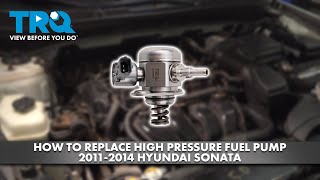
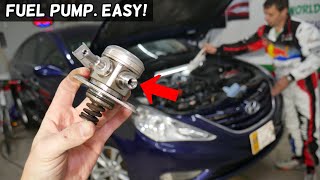
- Analyze Live Data (Engine Running): Start the engine. At idle, compare 'Desired Fuel Rail Pressure' to 'Actual Fuel Rail Pressure'. They should be very close. Rev the engine; the actual pressure should track the desired pressure. 🎬 See how to diagnose a failing GDI pump using live data. If the actual pressure lags, drops out, or is erratic, the HPFP is the primary suspect.
- Inspect for Leaks: Carefully perform a visual inspection of the engine bay for any signs of fuel leaks or strong gasoline odors, paying close attention to the HPFP and its connections.
- Inspect Cam Follower: If replacing the HPFP, always remove and inspect the cam follower (tappet) for wear, scoring, or a seized roller.
- Test Low-Pressure System: If high-side diagnosis is inconclusive, a technician can test the low-pressure fuel pump's output to ensure it's supplying adequate fuel to the HPFP.
Parts You'll Likely Need

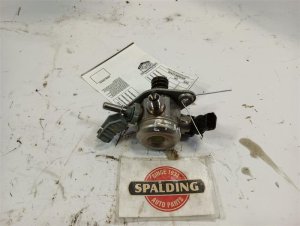
- High-Pressure Fuel Pump (HPFP)
(OEM #35320-2G720 (superseded by 35320-2G730, 35320-2G740). Verify by VIN.)— This is the most common failure point for P0089 on these engines due to high mechanical stress and a known history of reliability issues.
Trusted brands: Hyundai (OEM), Bosch
OEM price range: $450-$700
Aftermarket price range: $350-$550 - Fuel Rail Pressure Sensor (FRPS)
(OEM #35342-2E610 (Example, verify by VIN))— This is the second most likely cause, as an electronic failure can send false data to the ECM, incorrectly triggering the code.
Trusted brands: Hyundai (OEM), Bosch, Delphi
OEM price range: $100-$180
Aftermarket price range: $50-$120 - High-Pressure Fuel Pipe
(OEM #35305-2G700QQH (YF) / 35305-2GGA0QQH (LF) - Verify by VIN)— This is a mandatory one-time-use part that must be replaced anytime it is disconnected, such as during HPFP replacement, to prevent dangerous leaks.
Trusted brands: Hyundai (OEM)
OEM price range: $40-$70 - Cam Follower / Tappet
(OEM #35325-2G700 (Example, verify by VIN))— This small part takes the mechanical force from the camshaft to drive the HPFP. It is a wear item and should be inspected and likely replaced with the HPFP to prevent a repeat failure. 🎬 Watch: How to replace the pump and the cam follower together.
Trusted brands: Hyundai (OEM)
OEM price range: $30-$50
Related Codes That Often Appear With This One
- P0087 — Indicates 'Fuel Rail/System Pressure - Too Low'. This often appears when the HPFP fails and is unable to build sufficient pressure. Seeing both codes together strongly points to a fuel supply issue.
- P0088 — Indicates 'Fuel Rail/System Pressure - Too High'. This can appear if the internal regulator of the HPFP fails in a way that causes over-pressurization.
- P0300-P0304 — Cylinder misfire codes. Incorrect fuel pressure leads to a poor air/fuel mixture, causing misfires. There are also TSBs for ignition coil issues that can cause these codes.
Technical Service Bulletins (TSBs) & Recalls

- 19-01-001H (Recall 180): High Pressure Fuel Pipe Inspection and Replacement.
- 20-01-030H (Recall 189): Fuel Tube Inspection/Replacement.
Platform-Specific Known Issues
- Widespread High-Pressure Fuel Pump (HPFP) failures are the hallmark cause of P0089 on this platform. The issue is so common that many owners and technicians diagnose it based on symptoms alone, especially when accompanied by fuel in the oil.
- The Theta II engine itself is subject to a major class-action settlement for connecting rod bearing failure, which can cause stalling and other drivability issues. While this is a separate problem, it's critical context for any owner of this vehicle.
Mechanic-Grade Diagnostic Values
- Low-Pressure Fuel System Pressure (In-tank pump) — expected: 42 - 64 PSI (290 - 441 kPa). Some sources cite a tighter range of 64.5 - 66.0 PSI for the 2.4L.. Failure: Pressure below the specified range indicates a failing in-tank pump or clogged filter, which can starve the HPFP.
- High-Pressure Fuel System Pressure (GDI) — expected: 290 - 3,626 PSI (2,000 - 25,000 kPa), varies with engine load.. Failure: On a scan tool, if 'Actual Pressure' cannot meet or wildly deviates from 'Desired Pressure' under load, the HPFP is the primary suspect.
- Fuel Rail Pressure Sensor (FRPS) Voltage (Key On, Engine Off) — expected: ~0.5V.. Failure: A reading significantly higher than 0.5V (e.g., close to 5.0V) with the engine off indicates a failed sensor or a short in the signal wire.
- Fuel Rail Pressure Sensor (FRPS) Reference Voltage — expected: Steady 5.0V.. Failure: No voltage or voltage significantly below 5.0V points to a wiring issue or a problem with the ECM's 5V reference circuit.
Scan Tool Commands That Help

- Hyundai GDS (Global Diagnostic System): Fuel Pressure Test / Actuation Test — The dealer-level GDS tool can command the fuel pressure regulator and HPFP to specific duty cycles, allowing a technician to observe the system's response in real-time. This can isolate a lazy or non-responsive pump from a sensor or wiring issue more definitively than just observing live data during normal operation.
Wiring & Ground Locations
- Fuel Pump Relay — Located in the engine compartment fuse & relay box. It is often a green-colored relay.. This relay powers the low-pressure in-tank fuel pump. A failure here would starve the high-pressure pump, causing low pressure codes like P0087 and potentially P0089.
- Fuel Pump Control Module (FPCM) — On many modern vehicles, this module is located near the fuel tank, sometimes above the spare tire or on a frame rail. On some SUVs, it can be near the front crossmember.. The FPCM regulates the voltage to the in-tank fuel pump. A fault in the module or its wiring can lead to incorrect low-side pressure, which in turn affects the high-pressure system's performance and can trigger P0089.
- Engine Ground GE02 — A wiring diagram for a 2012 Sonata indicates a primary engine ground point 'GE02' on the left front of the engine compartment.. A poor engine ground can cause erratic behavior from various sensors, including the Fuel Rail Pressure Sensor, leading to incorrect readings and false trouble codes.
Real Owner Repair Stories
- Reddit user in /r/mechanic (2013 vehicle with P228d and P0089) — Car went into limp mode, touchy throttle.
❌ Tried (didn't work) Initial scan at an auto parts store.
✅ What actually fixed it The user reported, 'Hand to god, gas cap wasn't on. Put cap on, u plugged negative terminal from battery to clear codes, runs fine now.' While unusual for P0089, it highlights the importance of checking the basics.
OEM Part Supersession History
35320-2G720→35320-2G730, then 35320-2G740.— The supersessions indicate revisions and improvements made by Hyundai to address the high failure rate of the original pump, likely involving improved internal seals and materials to better withstand the high pressures and mechanical stress of the GDI system.
Heads up: While the parts may physically interchange, it is critical to use the latest available part number (35320-2G740) for the repair to benefit from the engineering improvements. Using an older, new-old-stock part is not recommended.
Model Year Variations Within This Range
- 2011-2014 (YF) vs 2015-2019 (LF): The YF generation (2011-2014) 2.4L engine was rated at 198-200 hp. For the LF generation (2015-2019), the 2.4L engine was revised and rated at 185 hp. The 2.0T also saw a power reduction from 274 hp to 245 hp. While they share the core Theta II GDI architecture and the same fundamental HPFP failure issue, some part numbers for sensors and pumps may differ, and software logic for fault detection may have been updated. Always verify parts by VIN.
- 2013-2014: There was a mid-cycle production change for the HPFP around July 2013. Parts catalogs show a cutoff date for the pump, reinforcing the importance of verifying the correct part number by VIN for these model years.
Diagnostic Flowchart
Other Known Issues on This Vehicle
Issues unrelated to this code that are worth knowing about as an owner of this generation:
- Catastrophic Engine Failure (Rod Bearing Wear) 🔴 High — Extremely common across 2011-2019 models with Theta II GDI engines. A class-action lawsuit led to a lifetime warranty and a software update (Campaign 953) for many VINs. (Ref: NHTSA Campaign 17V226000, Hyundai Service Campaign 953)
- Excessive Oil Consumption 🟠 Medium — Widespread issue on 2.4L and 2.0T GDI engines, often due to carbon buildup on piston rings. Can lead to engine damage if oil levels are not checked frequently. (Ref: TSB 23-EM-008H)
- Worn Steering Coupler 🟡 Low — Very common on the YF generation (2011-2014), causing a distinct clicking or clunking noise in the steering column when turning. The flexible rubber coupler disintegrates over time. (Ref: Warranty Extension TXX7 (10yr/100k miles))
- Timing Chain Tensioner Failure 🟠 Medium — Can occur on higher mileage vehicles, leading to a rattling noise on startup. If ignored, it can lead to timing chain jump and severe engine damage.
Used vs. New Parts: Buying Guide for This Vehicle
When a used part is the smart pick: For this specific repair, sourcing used parts is generally NOT recommended. The High-Pressure Fuel Pump (HPFP) is a known high-failure component, and a used pump from a salvage yard carries a very high risk of premature failure. A used Fuel Rail Pressure Sensor (FRPS) could be considered if from a low-mileage donor, but the labor to access it makes a new part a wiser investment.
Donor-vehicle mileage cap: roughly under 40000 miles for the part to have meaningful remaining life.
What to inspect on the donor part:
- For an FRPS, ensure the donor vehicle was not in a front-end collision.
- Check for any signs of corrosion on the electrical connector pins.
- Avoid parts from vehicles that show signs of sitting for a long time (e.g., heavy rust, water damage in the engine bay).
OEM-only on this vehicle (don't cheap out):
- High-Pressure Fuel Pump (HPFP): Given the extremely high failure rate and the critical function, using a genuine Hyundai OEM pump (latest revision) is strongly advised. Aftermarket pumps have a mixed reputation.
- High-Pressure Fuel Pipe: This is a one-time-use, torque-to-yield part. It MUST be replaced with a new OEM part anytime it is loosened to prevent catastrophic fuel leaks.
Aftermarket brands forum-validated for this vehicle:
- Bosch: Bosch is an OEM supplier for many fuel system components and is generally considered a reliable alternative for the Fuel Rail Pressure Sensor.
Brands owners have reported issues with on this vehicle:
- Unnamed/white-box brands: Avoid generic, unbranded HPFPs from online marketplaces. While the low price is tempting, they often have very high failure rates and do not last, leading to repeat repairs.
Real Owner Stories
Aggregated from forums and TSBs cited above. Mileages and costs reflect what owners reported in those sources.
2011 Hyundai Sonata 2.0T
Symptoms: Code P0089 and P0087, vehicle entering limp mode.
What fixed it: Replacement of the High-Pressure Fuel Pump (HPFP).
Source hint: Hyundai-Forums.com: 2011 Sonata 2.0T P0089 and P0087
2016-2018 Kia Optima (Platform Mate)
Symptoms: Rough start, decreased fuel mileage, and a strong smell of fuel in the engine oil.
What fixed it: Replacement of the High-Pressure Fuel Pump and inspection of the cam follower.
Source hint: YouTube: 2016-2018 Kia Optima High Pressure Fuel Pump Replacement
Related OBD-II Codes
Frequently Asked Questions
My 2011 Sonata 2.0T is in limp mode with P0089. Are there any recalls for the fuel system?
I smell gasoline when I check my oil dipstick on my 2.4L GDI Sonata. Is this related to P0089?
Can I just replace the High-Pressure Fuel Pump myself to fix P0089?
How can I tell if the P0089 code is the sensor or the actual pump on my Sonata?
Is the P0089 code related to the loud ticking noise coming from my engine bay?
Does the Theta II engine settlement cover P0089 issues?
Helpful Videos
Used OEM Parts in Stock


New Aftermarket Parts Available


The information in this article is provided for general reference and educational purposes only. Vehicle specifications, procedures, and part compatibility can vary by production date, trim level, and region. Always consult your vehicle's factory service manual and verify part numbers before purchasing or performing repairs. Safety-critical components such as airbags, seat belts, and braking systems should be installed by a qualified professional.
- Hyundai Sonata:
- 🎬 Helpful Videos
- 🛍️ Shop This Part
- What's Unique About the 2011-2019 Hyundai Sonata
- Symptoms You May Notice
- Most Likely Causes
- Rare But Worth Checking
- Diagnosis Steps
- Parts You'll Likely Need
- Related Codes That Often Appear With This One
- Technical Service Bulletins (TSBs) & Recalls
- Platform-Specific Known Issues
- Mechanic-Grade Diagnostic Values
- Scan Tool Commands That Help
- Wiring & Ground Locations
- Real Owner Repair Stories
- OEM Part Supersession History
- Model Year Variations Within This Range
- Diagnostic Flowchart
- Other Known Issues on This Vehicle
- Used vs. New Parts: Buying Guide for This Vehicle
- Real Owner Stories
- 2011 Hyundai Sonata 2.0T
- 2016-2018 Kia Optima (Platform Mate)
- Related OBD-II Codes
- Frequently Asked Questions
- 🎟️ Get 5% Off