

P0089 on 2015-2016 GMC Canyon 3.6L V6: Fuel Pressure Regulator Performance Causes and Fixes
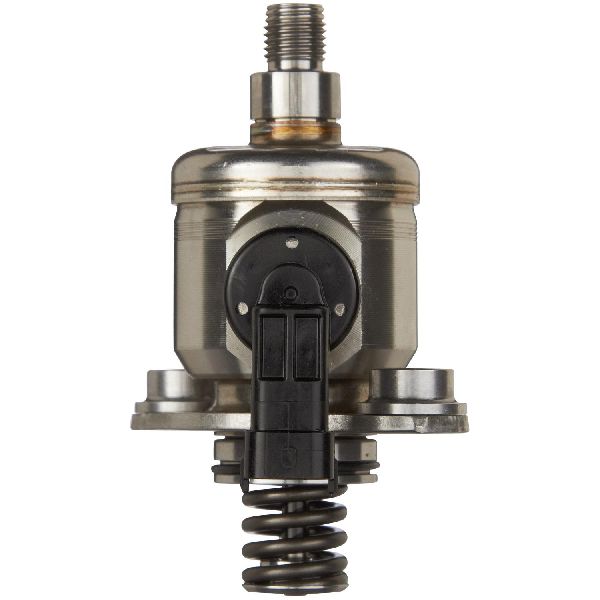
On a 2015-2016 Canyon with the 3.6L V6, code P0089 is most often caused by a failing High-Pressure Fuel Pump (HPFP). A key diagnostic clue is a strong gasoline smell in the engine oil, indicating an internal pump failure. Expect to pay $200-$500 for an OEM pump, with professional replacement costing $550-$1300. The OEM HPFP part number 12677329 has been superseded by 12691016.
- P0089 on your Canyon is a serious code that makes the truck unsafe to drive.
- The most likely cause is a failed High-Pressure Fuel Pump (HPFP); check your oil for a gasoline smell as the #1 diagnostic clue.
- The second most likely cause is the in-tank low-pressure fuel pump.
- Diagnosis requires a scan tool that can read both low-side and high-side fuel pressure to avoid replacing the wrong part.
- This is not a DIY-friendly repair due to the extreme pressures and fire risk; professional service is strongly recommended.
What's Unique About the 2015-2016 GMC Canyon
The 3.6L V6 engine family (LFX) used across many GM vehicles is known for issues with its high-pressure fuel system. For the 2015-2016 Canyon and its platform-mate, the Chevrolet Colorado, the most notable problem is the high failure rate of the High-Pressure Fuel Pump (HPFP). This pump can fail internally and leak fuel into the engine oil, a widely documented issue. Additionally, GM has issued recalls and service bulletins related to both the high-pressure and low-pressure fuel pumps on these trucks, making it critical to diagnose which part of the system is failing.
Symptoms You May Notice
- Check Engine Light is on
- Engine hesitation or stumbling during acceleration
- Reduced engine power or 'limp mode'
- Rough or unstable idle
- Engine stalling, sometimes unexpectedly
- Long crank times or difficulty starting
- Strong smell of gasoline in the engine oil
- Poor fuel economy
- Replacing only the fuel rail pressure sensor when the high-pressure pump is the actual cause.
- Replacing the high-pressure fuel pump when the in-tank low-pressure pump is the one that has failed.
Most Likely Causes
- Failing High-Pressure Fuel Pump (HPFP) 🔴 High Probability The HPFP on the 3.6L V6 is a widely documented failure point across the GM lineup. Internal seals can degrade, causing fuel to leak into the crankcase, or the pump may simply wear out and be unable to generate the required pressure. A recall (#18268) was also issued for some 2016 models for improperly welded pumps that could crack and leak externally.
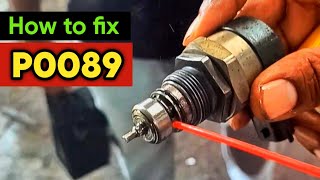
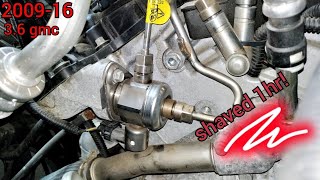
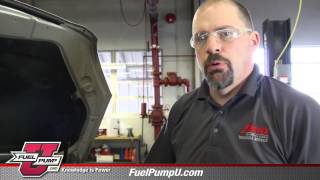
How to confirm: Check the engine oil on the dipstick for a strong smell of gasoline. If a fuel smell is present, the HPFP has failed internally and must be replaced. Also, use a scan tool to monitor 'Desired' vs. 'Actual' fuel rail pressure under load; if 'Actual' pressure cannot keep up, the HPFP is the primary suspect. 🎬 Watch: A professional guide to GM high pressure pump diagnosis.
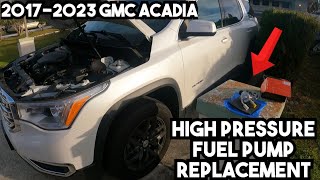
Typical fix: Replace the High-Pressure Fuel Pump and the single-use high-pressure fuel line. An oil change is mandatory if fuel has contaminated the oil. 🎬 See this walkthrough for replacing the high pressure fuel pump.
Est. part cost: $200-$500 - Failing In-Tank (Low-Pressure) Fuel Pump 🟡 Medium Probability The low-pressure pump is responsible for feeding the HPFP. GM has acknowledged issues with this pump failing, particularly in cold weather, which can starve the high-pressure side of the system and trigger a P0089 or P0087 code. TSB #18-NA-103 specifically mentions this pump's tendency to fail in cold weather, leading to no-starts or stalling.
How to confirm: Use a scan tool to monitor the 'Low Side Fuel Pressure' data PID. The pressure should be stable and within the typical GM specification of 45-65 PSI. If the pressure is low, erratic, or drops to zero, the in-tank pump is likely faulty.
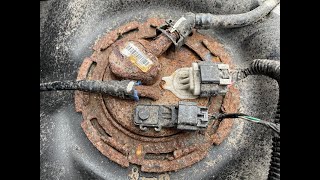
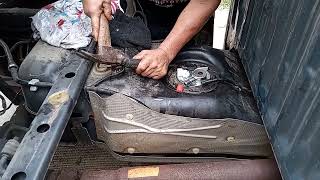
Typical fix: Replace the in-tank fuel pump module, which is accessed by removing the truck bed or dropping the fuel tank. 🎬 Watch: How to remove and replace the in-tank fuel pump.
Est. part cost: $150-$350 - Faulty Fuel Rail Pressure Sensor (FRPS) ⚪ Low Probability While less common than pump failure, the sensor that reads the high-side pressure can fail or provide incorrect readings. The electrical connector is also susceptible to corrosion, which can disrupt the signal to the ECM, as noted in TSB #20-NA-197.
How to confirm: With a scan tool, observe the 'Actual Fuel Rail Pressure' reading with the key on and engine off. It should show a low, near-zero reading. If it shows a high or erratic value, the sensor is likely bad. Inspect the sensor and its connector for any signs of corrosion or damage.
Typical fix: Replace the fuel rail pressure sensor. If the connector is corroded, it may also need to be replaced.
Est. part cost: $50-$150
Rare But Worth Checking
- Worn Camshaft Lobe: The HPFP is driven by a special lobe on one of the engine's camshafts. In very high-mileage cases, or cases of severe oil starvation, this lobe can wear down, reducing the pump's stroke and its ability to build pressure. This should be inspected when replacing the HPFP. Stretched timing chains can also alter the cam position enough to affect HPFP operation and trigger fuel pressure codes.
- Wiring Harness Damage: An engine wiring harness that has chafed against a bracket or another component can cause a short or open in the circuit for the fuel pressure sensor or pump, leading to this code. Manufacturer TSB #PIP6061 notes that electrical connection concerns at the high pressure fuel pump can set P0089, and technicians should manipulate the harness to see if the code can be duplicated.
- Clogged Fuel Filter: A severely clogged main fuel filter can restrict flow to the low-pressure pump, which in turn starves the high-pressure pump, triggering the code.
Diagnosis Steps
- Confirm the P0089 code is present using an OBD-II scanner. Note any other codes.
- Perform a critical safety check: pull the engine oil dipstick and smell it for gasoline. If a strong fuel odor is present, the High-Pressure Fuel Pump (HPFP) has failed internally. Do not start the engine again until the pump and oil are replaced.
- Connect a scan tool capable of reading live GM data.
- Monitor 'Low Side Fuel Pressure'. It should be stable, typically between 45-65 PSI. If it's low or unstable, suspect the in-tank fuel pump.
- If low-side pressure is good, monitor 'Desired Fuel Rail Pressure' and 'Actual Fuel Rail Pressure'.
- At idle, the values should be very close. Briefly rev the engine or drive under load. If 'Actual' pressure lags significantly behind 'Desired' pressure, the HPFP is the most likely cause. However, per TSB #PIP5988, technicians are sometimes advised to replace the fuel rail instead of the injection pump for P0089.
- If pressure readings are erratic or do not seem plausible, inspect the Fuel Rail Pressure Sensor and its electrical connector for damage or corrosion.
- Inspect the wiring harness leading to the HPFP and the fuel rail pressure sensor for any signs of chafing or damage.
Parts You'll Likely Need
- High-Pressure Fuel Pump
(OEM #12691016 (supersedes 12677329, 12641740, and others))— This is the most common failure item for code P0089 on this engine. It is responsible for generating the high pressure required for direct injection.
Trusted brands: ACDelco (GM Genuine Parts), Bosch
OEM price range: $200-$500
Aftermarket price range: $150-$350 - In-Tank Fuel Pump Module
(OEM #M100138)— This is the second most likely cause, especially if the vehicle has trouble starting or stalling in cold weather. It supplies fuel to the high-pressure pump.
Trusted brands: ACDelco
OEM price range: $250-$400
Aftermarket price range: $150-$250 - High-Pressure Fuel Pipe
(OEM #12639208)— This is a single-use, torque-to-yield part that MUST be replaced anytime the high-pressure fuel pump is disconnected to prevent dangerous leaks.
Trusted brands: ACDelco (GM Genuine Parts)
OEM price range: $30-$60
Related Codes That Often Appear With This One
- P0087 — This code for 'Fuel Rail/System Pressure - Too Low' is very common with P0089, as both point to the fuel system's inability to meet the pressure commanded by the ECM.
- P0191 — This code indicates a 'Fuel Rail Pressure Sensor Circuit Range/Performance' issue and can be triggered alongside P0089 if the sensor or its wiring is the root cause.
- P228D — This code for 'Fuel Pressure Regulator 1 Control Performance - High Pressure' may appear if the system pressure is too high, which can also be a symptom of a failing regulator or sensor.
- P006C — This code is mentioned in TSB #N252524760 and TSB #PIP5279A as appearing alongside P0089 in certain GM vehicles.
Technical Service Bulletins (TSBs) & Recalls
- 18-NA-103: While primarily for diesel gelling, this TSB is relevant as it acknowledges issues with the low-pressure fuel pump on this platform, particularly in cold weather, which can cause stalling and no-start conditions that may trigger fuel pressure codes.
- 16-NA-175: Addresses a transmission shudder issue, but is not directly related to code P0089.
- 20-NA-197: Details issues with corrosion at the fuel pressure sensor connector as a cause for P0089 and other related codes.
- Bulletin #PIP5279A: Provides information regarding vehicles that may have a Malfunction Indicator Lamp and codes P0089, P127C, P127D, P0192, P0193, P228C, P228D, and P006C.
- Bulletin #N252524760: States that certain vehicles may set DTCs P228C, P0089, and/or P006C, and dealers are to reprogram the Engine Control Module.
Platform-Specific Known Issues
- Recall 18268 (NHTSA 18V358): Affects some 2016 models where a replacement HPFP may have been installed with an improper weld that could crack, causing an external fuel leak and fire risk. The fix involves replacing the HPFP and the high-pressure fuel pipe.
- Internal HPFP Failure: A common, non-recall issue where the pump fails internally and contaminates the engine oil with gasoline, requiring immediate replacement of the pump and an oil change to prevent catastrophic engine damage.
Mechanic-Grade Diagnostic Values
- Low-Pressure Fuel System Pressure (In-tank pump) — expected: 45-65 PSI. Failure: Pressure is consistently below 40-45 PSI, is erratic, or drops out completely.
- High-Pressure Fuel System Pressure (HPFP) at Idle — expected: Approx. 500-600 PSI (Should closely match 'Desired' pressure on scan tool). Failure: Actual pressure is significantly lower than desired pressure.
- Fuel Rail Pressure Sensor (FRPS) Signal Voltage (Key On, Engine Off) — expected: 1.5V to 1.8V. Failure: Voltage is significantly outside this range, or is erratic.
- Fuel Rail Pressure Sensor (FRPS) Reference Voltage — expected: 5.0V. Failure: Voltage is low or absent, indicating a wiring or ECM issue.
Scan Tool Commands That Help
- GDS2 (GM Dealer/Professional Scan Tool): Fuel System Test — To perform an automated diagnostic routine on the fuel system, where the tool can command specific pressures to test the response of the HPFP and regulator.
- GDS2 (GM Dealer/Professional Scan Tool): Fuel Injector Balance Test / Active Fuel Injector Tester (AFIT) — To rule out a leaking or malfunctioning fuel injector that could be causing a loss of rail pressure, which might be misinterpreted as a pump or regulator issue.
- GDS2 (GM Dealer/Professional Scan Tool): Fuel Trim Reset — This must be performed after replacing fuel system components like injectors or the HPFP to clear the old learned fuel adjustments from the ECM.
Wiring & Ground Locations
- G112 — Rear of the engine, mounted to the rear of the cylinder head.. This is a primary engine ground. A loose or corroded connection here can cause a host of erratic sensor readings and engine control issues, including incorrect signals from the Fuel Rail Pressure Sensor.
- Fuel Rail Pressure Sensor Connector — On the high-pressure fuel rail, under the intake manifold.. This is the direct connection for the sensor. Testing here can isolate a bad sensor from a wiring problem. Wire colors are typically Green (Sensor Ground from ECM), Orange (Signal to ECM), and Red (5V Reference from ECM).
Real Owner Repair Stories
- Go-Parts summary of forum discussions (2012 GMC Acadia 3.6L V6 (LFX Engine)) — P0191 (Fuel Rail Pressure Sensor Performance), lean codes (P0171/P0174), and engine stalling.
❌ Tried (didn't work) Replacing the fuel rail pressure sensor.
✅ What actually fixed it The actual culprit was the High-Pressure Fuel Pump (HPFP), which was replaced. - YouTube - Nate Olson (via Go-Parts) (2014 GMC Acadia 3.6L V6 (LFX Engine)) — Engine cranks with no start, code P0191.
❌ Tried (didn't work) Replacing the Fuel Rail Pressure Sensor (FRPS)., Replacing the High-Pressure Fuel Pump (HPFP).
✅ What actually fixed it A chafed 5V reference wire in the wiring harness located under the driver's floorboard was found and repaired. - NHTSA ODI #11719289 — An owner reported that their vehicle wanted to shake and a diagnostic returned codes P0016, P0089, and P228D, noting these are well-known codes for this engine family.
"I Checked Everything" — The Actual Cause
- While not a smoke test, a similar pattern occurs where standard component replacement fails. In one documented case on a similar 3.6L engine, both the fuel rail pressure sensor and the high-pressure fuel pump were replaced without fixing a P0191 code. The actual cause was a chafed 5V reference wire in the harness under the driver's floorboard, a location far from the components themselves.
OEM Part Supersession History
12677329, 12641740, 12622475, and others→12691016— GM regularly updates service parts to integrate new materials, technologies, or design improvements for reliability.
Heads up: No incompatibility is noted. Part number 12691016 is the correct, current GM Genuine replacement for the earlier numbers on the LFX engine.
Model Year Variations Within This Range
- 2015-2016: There are no major mechanical differences in the 3.6L LFX engine or fuel system between the 2015 and 2016 model years. Both use the same LFX V6 and 6L50 transmission. The only notable variation is Recall 18268, which applies to certain 2016 models for a potentially faulty HPFP weld, but the replacement part and procedure are the same.
Diagnostic Flowchart
Other Known Issues on This Vehicle
Issues unrelated to this code that are worth knowing about as an owner of this generation:
- Transmission Torque Converter Shudder 🟠 Medium — Common issue on 6-speed and 8-speed automatics, often described as driving over rumble strips at light throttle. (Ref: Multiple TSBs exist, including 16-NA-175 and 18-NA-355, which often recommend a specific fluid flush procedure with updated Mobil 1 Synthetic LV ATF HP fluid.)
- Timing Chain Stretch 🔴 High — While improved from the earlier LLT V6, the LFX can still suffer from stretched timing chains, typically after 80,000-100,000 miles, especially with poor oil change history.
- Electrical System Problems 🟡 Low — The 2015-2016 models are noted for having various electrical gremlins, including issues with the infotainment system, power windows, and sensors.
Used vs. New Parts: Buying Guide for This Vehicle
When a used part is the smart pick: For this specific repair, obtaining used parts is strongly discouraged. The primary failure components (HPFP, FRPS) are high-wear or sensitive electronics. A used part carries a high risk of premature failure. The only exception might be a connector pigtail from a junkyard harness if the original connector is damaged.
What to inspect on the donor part:
- Not applicable, as used pumps and sensors are not recommended for this repair.
OEM-only on this vehicle (don't cheap out):
- High-Pressure Fuel Pump (HPFP): Given its high failure rate and critical function, using a new GM Genuine (ACDelco) or OEM-supplier (Bosch) part is essential for a lasting repair.
- High-Pressure Fuel Pipe: This is a torque-to-yield, one-time-use part. It must be replaced with a new OEM part whenever it is disconnected to prevent catastrophic fuel leaks.
Aftermarket brands forum-validated for this vehicle:
- ACDelco (GM Genuine)
- Bosch (Often the OEM supplier for GM fuel components)
Brands owners have reported issues with on this vehicle:
- No-name or 'white-box' brands from online marketplaces should be avoided. The risk of poor quality control, incorrect specifications, and early failure is too high for a GDI high-pressure fuel system.
Real Owner Stories
Aggregated from forums and TSBs cited above. Mileages and costs reflect what owners reported in those sources.
2015 GMC Canyon 3.6L V6
Symptoms: Owner reported issues with the fuel pressure regulator and was quoted for repairs involving high-pressure fuel lines.
What fixed it: Repair involved replacing the high-pressure fuel lines and regulator.
Cost: $2800
Source hint: Reddit r/chevycolorado - Fuel pressure regulator
2016 GMC Canyon 3.6L V6
Symptoms: Potential for external fuel leak and fire risk due to an improper weld on the pump housing.
What fixed it: Replacement of the High-Pressure Fuel Pump (HPFP) and the high-pressure fuel pipe under recall.
Source hint: Recall 18268 (NHTSA 18V358)
2015-2016 GMC Canyon 3.6L V6 — ~90000 miles
Symptoms: Engine hesitation, stalling, and a strong smell of gasoline in the engine oil.
What fixed it: Replacement of the High-Pressure Fuel Pump (HPFP), the single-use high-pressure fuel line, and a mandatory oil change.
Source hint: Internal HPFP Failure section
Related OBD-II Codes
Frequently Asked Questions
Is there a recall for the fuel pump on my 2016 GMC Canyon 3.6L?
Why does my engine oil smell like gasoline along with the P0089 code?
Does TSB 18-NA-103 apply to my gas Canyon if I'm having stalling issues?
Can a bad electrical connection cause P0089 on a 2015 Canyon?
What should the fuel pressure be for the low-side pump on my 3.6L V6?
Is the P0089 code related to the transmission shudder I'm feeling?
Helpful Videos


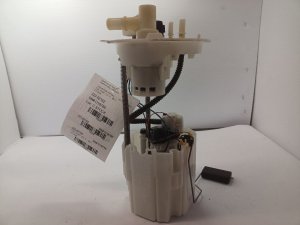
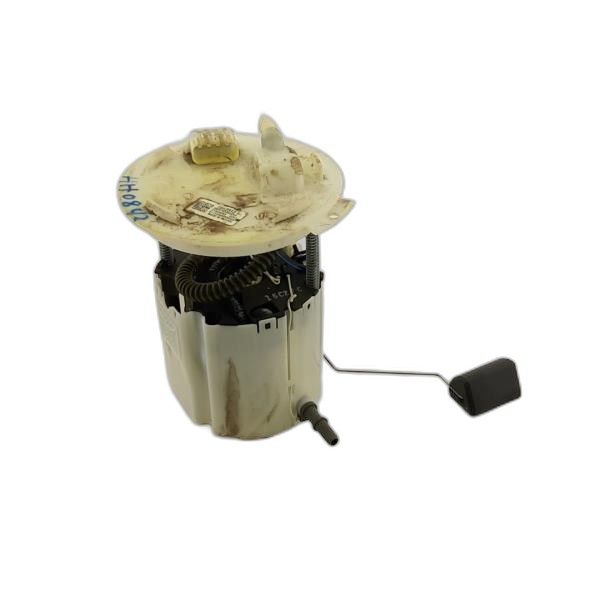
Used OEM Parts in Stock
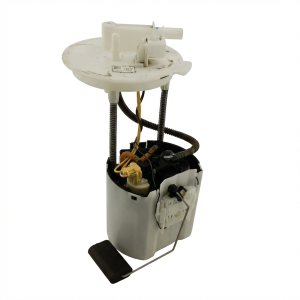


New Aftermarket Parts Available


The information in this article is provided for general reference and educational purposes only. Vehicle specifications, procedures, and part compatibility can vary by production date, trim level, and region. Always consult your vehicle's factory service manual and verify part numbers before purchasing or performing repairs. Safety-critical components such as airbags, seat belts, and braking systems should be installed by a qualified professional.
- GMC Canyon:
- 🎬 Helpful Videos
- 🛍️ Shop This Part
- What's Unique About the 2015-2016 GMC Canyon
- Symptoms You May Notice
- Most Likely Causes
- Rare But Worth Checking
- Diagnosis Steps
- Parts You'll Likely Need
- Related Codes That Often Appear With This One
- Technical Service Bulletins (TSBs) & Recalls
- Platform-Specific Known Issues
- Mechanic-Grade Diagnostic Values
- Scan Tool Commands That Help
- Wiring & Ground Locations
- Real Owner Repair Stories
- "I Checked Everything" — The Actual Cause
- OEM Part Supersession History
- Model Year Variations Within This Range
- Diagnostic Flowchart
- Other Known Issues on This Vehicle
- Used vs. New Parts: Buying Guide for This Vehicle
- Real Owner Stories
- 2015 GMC Canyon 3.6L V6
- 2016 GMC Canyon 3.6L V6
- 2015-2016 GMC Canyon 3.6L V6 — ~90000 miles
- Related OBD-II Codes
- Frequently Asked Questions
- 🎟️ Get 5% Off