

P0088 on 2007-2013 Mini Cooper S: Fuel Pressure Too High Causes and Fixes
On a 2007-2013 Mini Cooper S, code P0088 almost always points to a failing High-Pressure Fuel Pump (HPFP). This is a very common issue, especially on the N14 engine. The internal pressure regulator fails, causing fuel pressure to exceed the commanded value. Expect to pay between $500 and $1,200 for a quality replacement part, with DIY replacement taking 2-3 hours. Verifying low-pressure fuel supply (~5 bar) is a key first step before condemning the expensive HPFP.
- P0088 on a 2007-2013 Cooper S is most likely caused by a failed High-Pressure Fuel Pump (HPFP).
- Symptoms include rough cold starts, stalling, and the engine going into a low-power 'limp mode'.
- Before replacing the expensive HPFP, use a scan tool to confirm that actual fuel rail pressure is significantly higher than desired pressure.
- The N14 engine (2007-2010) is more prone to this failure than the N18 (2011-2013), and they use different part numbers for the HPFP.
- This repair is possible for an advanced DIYer, but involves working with a high-pressure fuel system, so caution is essential.
What's Unique About the 2007-2013 Mini Cooper S

The second-generation Mini Cooper S, particularly models with the N14 engine (2007-2010), is notorious for High-Pressure Fuel Pump (HPFP) failures. This pump is a mechanical unit driven by a lobe on the intake camshaft that boosts fuel pressure from the in-tank pump's ~72.5 psi up to ~1740 psi (120 bar) under load. The internal fuel volume regulator on the pump is a common failure point, causing it to default to maximum pressure and trigger code P0088. While the later N18 engine also experiences this, the problem is a hallmark issue for the N14. The failure was so widespread that MINI issued an extended warranty for the pump on many N14 and N18 vehicles.
Generation note: The 2007-2013 period covers the R56 generation of the Mini Cooper S but includes two different engines. The N14 engine was used from 2007-2010 (and in John Cooper Works models until 2012), while the updated N18 engine was used from 2011-2013. While both can experience P0088, the HPFP failure is more frequent and well-documented on the N14. The replacement part numbers for the HPFP are different for each engine, and it's critical to order the correct one for your specific vehicle.
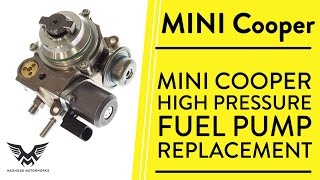
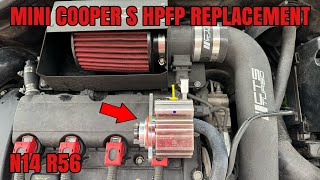
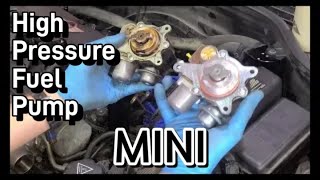
🎬 See this walkthrough on how to replace a Mini HPFP.Symptoms You May Notice
- Check Engine Light is on
- Engine enters 'limp mode' (reduced power)
- Rough running, especially on cold starts
- Engine sputtering, hesitating, or surging
- Hard starting or long crank times, sometimes followed by stalling
- Engine stalls, sometimes right after starting
- Reduced fuel economy
- Black smoke from the exhaust, indicating a rich condition
- Noticeable smell of gasoline
- Replacing the in-tank low-pressure fuel pump. While this pump can fail, it typically causes low-pressure codes (like P0087), not a high-pressure code like P0088. Always test the low-pressure pump's output (should be stable at ~5 bar / 72.5 psi) before condemning the HPFP.
Most Likely Causes

- Failing High-Pressure Fuel Pump (HPFP) 🔴 High Probability The HPFP is a known weak point on the N14 and N18 direct-injection engines. The internal fuel control valve can wear and fail, causing it to get stuck and over-pressurize the fuel rail. It is considered a common wear item, with failures reported as early as 40,000 miles.
How to confirm: Use a diagnostic scan tool to monitor 'Fuel Rail Pressure, Actual' vs. 'Fuel Rail Pressure, Setpoint (or Desired)'. At idle, desired pressure is around 50 bar (725 psi). If the actual pressure is significantly higher (e.g., stuck at 120 bar or more) and does not follow the desired value as you rev the engine, the HPFP is the confirmed culprit. A difference of more than 10 bar is a strong indicator of a fault.
Typical fix: Replace the High-Pressure Fuel Pump. 🎬 Watch: Step-by-step N14 high pressure fuel pump replacement guide. It is also highly recommended to replace the one-time-use high-pressure fuel line that connects the pump to the rail, as it uses soft iron seals that only seal once.
Est. part cost: $500-$1200 - Faulty Fuel Rail Pressure Sensor ⚪ Low Probability
How to confirm: If the scan tool shows an illogical or fixed pressure reading (e.g., a maxed-out value that doesn't change at all, even with the engine off), the sensor may be at fault. You can test the sensor's wiring for a short to power, which would send a false high-voltage (and thus high-pressure) signal to the ECM. A reading of 5 volts or more from the sensor signal wire often indicates a short or a bad ground.
Typical fix: Replace the fuel rail pressure sensor.
Est. part cost: $70-$150 - Kinked or Restricted Fuel Line ⚪ Low Probability This is not a common issue, but the high-pressure line from the pump to the rail can be damaged during other engine work. A kink or restriction in the return line (less common on this system) could also theoretically cause pressure to build.
How to confirm: Visually inspect the hard fuel line running from the HPFP to the fuel rail for any signs of kinks, sharp bends, or damage. This is often checked after a new HPFP is installed and the code persists.
Typical fix: Replace the damaged fuel line.
Est. part cost: $50-$90
Rare But Worth Checking
- Wiring Harness Issue: A short circuit in the wiring to the fuel rail pressure sensor can cause a false high-pressure reading. Inspect the harness for any signs of damage, especially around the engine cover where it can rub or where rodents might chew on wires.
- Engine Control Module (ECM) Fault: In very rare cases, the ECM itself can fail and misinterpret the data from the fuel pressure sensor. This should only be considered after all other possibilities have been exhaustively ruled out and confirmed with professional diagnostic tools. Sometimes a software update or re-flash can resolve the issue.
Diagnosis Steps
- Connect a MINI-compatible OBD-II scanner and check for any other stored codes.
- Access the live data stream on the scanner. Monitor 'Fuel Rail Pressure, Actual' and 'Fuel Rail Pressure, Desired'.
- At idle, the desired and actual pressures should be close, around 50 bar (725 psi). If the actual pressure is significantly higher (e.g., >60 bar) or pegged at the system maximum (~120-140 bar), the HPFP is the primary suspect.
- To rule out the low-pressure side, use a fuel pressure gauge to test the pressure from the in-tank pump at the inlet to the HPFP. It should be stable at approximately 5 bar (72.5 psi). If low-side pressure is good, the problem is in the high-pressure system.
- If the pressure reading is erratic, stuck at a maximum value, or doesn't change when the engine is off, perform a visual inspection of the fuel rail pressure sensor and its wiring harness for damage or corrosion.
- If the low-pressure system is healthy and the high-pressure readings are confirmed to be excessive and not tracking with the desired value, the HPFP has most likely failed and requires replacement. 🎬 Watch: A helpful mechanic's guide to replacing the high pressure fuel pump.
Parts You'll Likely Need

- High-Pressure Fuel Pump (HPFP) for N14 Engine
(OEM #13517588879)— This is the most common failure part for P0088 on 2007-2010 models. The internal regulator fails, causing over-pressurization. Superseded from 13517573436.
Trusted brands: Genuine MINI/PSA, Bosch
OEM price range: $800-$1250
Aftermarket price range: $450-$700 - High-Pressure Fuel Pump (HPFP) for N18 Engine
(OEM #13517592429)— This is the corresponding failure part for P0088 on 2011-2013 models. Note that post-03/2012 models may use a different pump (13518605102) and require a wiring adapter.
Trusted brands: Genuine MINI/PSA, Bosch
OEM price range: $600-$1100
Aftermarket price range: $400-$650 - High-Pressure Fuel Line (Pump to Rail)
(OEM #13537528348)— This is a one-time use line that connects the HPFP to the fuel rail. It is highly recommended to replace it anytime it is removed to prevent dangerous high-pressure fuel leaks.
Trusted brands: Genuine MINI
OEM price range: $50-$90
Aftermarket price range: $30-$60 - Fuel Rail Pressure Sensor
(OEM #13537537319)— If diagnosis points to a sensor or wiring fault rather than a mechanical pump failure, this part is needed. It fits both N14 and N18 engines.
Trusted brands: Genuine MINI, Bosch
OEM price range: $100-$180
Aftermarket price range: $60-$120
Related Codes That Often Appear With This One
- P2880 — This is a MINI-specific code for 'High Pressure System Plausibility', which often appears alongside HPFP failure symptoms.
- P030x (e.g., P0300, P0301) — Misfire codes are common because the incorrect fuel pressure disrupts the air/fuel mixture, leading to incomplete combustion in one or more cylinders.
- P0193 — This code for 'Fuel Rail Pressure Sensor Circuit High Input' can appear if the sensor itself or its wiring is the root cause, sending an abnormally high voltage signal to the ECM.
Technical Service Bulletins (TSBs) & Recalls
- SI M01 01 16: Details the extended limited warranty for the High-Pressure Fuel Pump (HDP) on N18 engines to 10 years/120,000 miles.
- SI M01 04 19: Relates to the class action settlement extending the HPFP warranty for specific N14 engine models to 10 years/120,000 miles.
- SI M12 02 10: A TSB regarding misfire fault diagnosis that instructs technicians to check the fuel pressure recorded during the fault. If pressure is below 4.0 MPa (40 bar), it suggests replacing the HPFP, indicating a link between pressure faults and misfires.
Platform-Specific Known Issues
- MINI USA previously offered an extended warranty on the HPFP for some model years (up to 10 years / 120,000 miles). This was the result of a class-action lawsuit (Boehm v. BMW of North America, LLC) and was formalized in TSBs like SI M01 01 16 (for N18) and SI M01 04 19 (for N14). While this warranty has likely expired for all affected vehicles by now, it highlights how widespread the issue was.
- Failure is most common on the N14 engine, but the N18 is not immune. Always verify your engine type and the correct part number before ordering.
- When replacing the HPFP, specific
Mechanic-Grade Diagnostic Values

- Low-Pressure Fuel Pump (In-tank) Output Pressure — expected: Stable 5 bar (72.5 psi). Failure: Pressure is significantly lower than 5 bar or unstable.
- High-Pressure Fuel Rail at Idle (Actual vs. Desired) — expected: ~50 bar (725 psi). Failure: Actual pressure is stuck at a high value (e.g., 120+ bar) and does not track the desired pressure.
- Fuel Rail Pressure Sensor Signal Wire Voltage (Key-On, Engine-Off) — expected: ~0.5V - 0.6V. Failure: Voltage is stuck at 5V, indicating a short to power or a bad ground in the sensor circuit.
- Fuel Rail Pressure Sensor Connector Pins (Key-On, Engine-Off) — expected: One pin at 5V (reference), one at 0V (ground), one at ~0.5V (signal).. Failure: Finding 5V on both the reference and signal pins suggests a short between them.
Hidden / Shadow Codes Worth Checking
- 0x2880: High Pressure System Plausibility. This is a manufacturer-specific code that frequently accompanies P0088 and points directly to a problem with the HPFP system. (see via MINI/BMW-specific scan tools like ISTA+ or advanced OBD-II scanners (Foxwell, etc.).)
- 0x2C03: High pressure fuel, plausibility: Pressure too low. While this indicates low pressure, it can be stored during the diagnostic process if the HPFP fails intermittently or if other related faults exist. (see via MINI/BMW-specific scan tools.)
- 0x2BF5: Rail pressure sensor, plausibility: Pressure too low before engine start. This points towards an issue with the sensor's reading before the HPFP is even fully active. (see via MINI/BMW-specific scan tools.)
Scan Tool Commands That Help
- ISTA+: Diagnosis Scan / Call up ECU functions — This is the primary function to view live data, including 'Rail pressure, setpoint' and 'Rail pressure, actual value', which is the definitive test for a failing HPFP.
- ISTA+: Component Triggering — After confirming a pressure issue, this function can be used to test related components controlled by the DME, such as individual fuel injectors, to rule them out as contributing factors.
- ISTA+: Service Functions / Reset Adaptations — After replacing a major component like the HPFP or fuel rail pressure sensor, it is best practice to reset the engine's fuel trim and other learned adaptations to ensure the system operates correctly with the new part.
Wiring & Ground Locations
- JBE (Junction Box Electronics) Module — In the passenger footwell, behind the kick panel.. The JBE contains the K96 relay for the low-pressure fuel pump, which is soldered directly to the circuit board. A cracked solder joint on this relay can cause intermittent low-pressure fuel supply, which can complicate diagnosis even though P0088 is a high-pressure code.
- DME Pins A22 & A24 — At the main Engine Control Module (DME) connector.. These are the pins corresponding to the fuel rail pressure sensor's signal and reference lines. Testing for voltage here can confirm if a suspected sensor short is happening at the sensor or within the harness/DME itself.
- Low-Pressure Fuel Pump Connector — Under the rear seat, at the access panel for the in-tank fuel pump.. The white/blue wire is positive and the brown wire is negative. This is critical for manually testing the low-pressure pump to confirm it's operational before focusing on the high-pressure system.
Real Owner Repair Stories
- Reddit user on r/MINI (2011 Cooper S, 80k miles) — Car would go into limp mode and stall after 10-15 minutes of driving. Would restart after a few minutes, then die again sooner. Eventually would not start at all. Codes were for low pressure HPFP and low fuel during crank.
❌ Tried (didn't work) Initial diagnosis pointed towards a failing HPFP or LPFP based on symptoms and codes.
✅ What actually fixed it The root cause was a cracked solder joint for the low-pressure fuel pump relay (K96) inside the Junction Box Electronics (JBE) module. The owner disassembled the JBE, separated the circuit boards, and re-soldered the cracked pin, which completely resolved the issue.
OEM Part Supersession History
13517592429 (For N18 engines, typically pre-03/2012)→13518605102— Updated 'tappet style' pump design.
Heads up: When replacing the older style pump with the new 13518605102 pump, a wiring adapter harness (PN 12518638006) is required to connect it to the vehicle's harness.13517573436 (For N14 engines)→13517588879— Internal design revisions to improve reliability.
Heads up: The Genuine PSA (Peugeot/Citroën) branded version of this pump is identical to the Genuine MINI part and can be used as a direct, often cheaper, replacement.
Model Year Variations Within This Range
- 2011-2013 (N18 Engine): A change in the HPFP design occurred around March 2012. Vehicles produced after this date may have the newer pump (13518605102) from the factory. When servicing an earlier N18, upgrading to the newer pump requires a specific wiring adapter harness.
- 2007-2010 (N14) vs 2011-2013 (N18): The N14 and N18 engines use physically different High-Pressure Fuel Pumps with unique part numbers. They are not interchangeable. The failure is significantly more common on the N14 engine.
Diagnostic Flowchart
Used vs. New Parts: Buying Guide for This Vehicle
When a used part is the smart pick: For the primary cause of P0088, the High-Pressure Fuel Pump (HPFP), a used part is NEVER a smart choice. The failure rate of this component is exceptionally high, and a used part from a salvage yard has an unknown history and a high probability of premature failure.
What to inspect on the donor part:
- Not applicable, as used HPFPs are not recommended for this repair.
OEM-only on this vehicle (don't cheap out):
- High-Pressure Fuel Pump (HPFP)
- High-Pressure Fuel Line (Pump to Rail)
Aftermarket brands forum-validated for this vehicle:
- Bosch (OEM supplier for the HPFP)
- Genuine PSA (Peugeot/Citroën) - The N14 pump is an identical part to the MINI one and often cheaper.
Brands owners have reported issues with on this vehicle:
- Unbranded, low-cost HPFPs from eBay or other online marketplaces. Forum members explicitly report these failing within a short period.
Real Owner Stories
Aggregated from forums and TSBs cited above. Mileages and costs reflect what owners reported in those sources.
2008 Mini Cooper Clubman S R55
Symptoms: Fuel rail pressure would intermittently spike from a normal 700 PSI to over 1500 PSI, triggering the reduced power 'limp mode'. Restarting the car would temporarily resolve the issue. The owner also noted pressure spiking to 1800 PSI while coasting downhill.
What fixed it: The owner had not found a definitive fix at the time of posting, but the car had stopped going into reduced power mode on its own.
Source hint: North American Motoring
Mini Cooper S R56
Symptoms: The car would only run if the fuel rail pressure sensor was unplugged.
What fixed it: The root cause was determined to be a faulty sensor or wiring, which was triggering a P0193 (sensor circuit high) code, not a failed fuel pump.
Source hint: Mini Cooper Forums
Mini Cooper Clubman S R55
Symptoms: The P0088 code returned even after replacing the High-Pressure Fuel Pump (HPFP).
What fixed it: The forum discussion suggested the next diagnostic steps were to check the fuel pressure sensor and inspect the high-pressure line for kinks. A definitive fix was not stated.
Source hint: NorthAmericanMotoring.com - 'R55 P0088 Fuel Rail/System Pressure-Too High'
Mini Cooper S — ~40000 miles
Symptoms: Symptoms of a failing HPFP returned just one week after a new pump was installed.
What fixed it: The source suggests that either the new replacement part was faulty or an underlying issue, like a failing low-pressure fuel pump, was causing the problem. No final resolution was provided.
Source hint: NorthAmericanMotoring.com - 'HPFP replaced, ran fine for one week, now has problems again'
Related OBD-II Codes
Frequently Asked Questions
Is the High-Pressure Fuel Pump (HPFP) failure on my 2007-2013 Mini Cooper S covered by a warranty?
My scan tool shows the fuel rail pressure is stuck at 120 bar. Is it definitely the HPFP?
I'm replacing the HPFP myself. Is there anything else I must replace at the same time?
I replaced the HPFP but I'm still getting a P0088 code. What else could it be?
Is the HPFP failure more common on the N14 or N18 engine?
What are the normal fuel pressure readings I should see on a scan tool?
Helpful Videos
We Have This Part in Stock


The information in this article is provided for general reference and educational purposes only. Vehicle specifications, procedures, and part compatibility can vary by production date, trim level, and region. Always consult your vehicle's factory service manual and verify part numbers before purchasing or performing repairs. Safety-critical components such as airbags, seat belts, and braking systems should be installed by a qualified professional.
- Mini Cooper S:
- 🎬 Helpful Videos
- 🛍️ Shop This Part
- What's Unique About the 2007-2013 Mini Cooper S
- Symptoms You May Notice
- Most Likely Causes
- Rare But Worth Checking
- Diagnosis Steps
- Parts You'll Likely Need
- Related Codes That Often Appear With This One
- Technical Service Bulletins (TSBs) & Recalls
- Platform-Specific Known Issues
- Mechanic-Grade Diagnostic Values
- Hidden / Shadow Codes Worth Checking
- Scan Tool Commands That Help
- Wiring & Ground Locations
- Real Owner Repair Stories
- OEM Part Supersession History
- Model Year Variations Within This Range
- Diagnostic Flowchart
- Used vs. New Parts: Buying Guide for This Vehicle
- Real Owner Stories
- 2008 Mini Cooper Clubman S R55
- Mini Cooper S R56
- Mini Cooper Clubman S R55
- Mini Cooper S — ~40000 miles
- Related OBD-II Codes
- Frequently Asked Questions
- 🎟️ Get 5% Off