

P0088 on 2018-2023 Ford Mustang 5.0L: Causes for Fuel Rail Pressure Too High
On a 2018-2023 Mustang GT, code P0088 usually points to a faulty Fuel Rail Pressure Sensor (FRPS) or a failing High-Pressure Fuel Pump (HPFP). Start by checking the sensor's readings, as it's a cheaper fix than the pump, which can cost over $400 for the part alone. If service was recently performed, check for an incorrectly installed fuel jumper line per Ford SSM 50089.
- P0088 on your Mustang GT means the high-pressure fuel system is reading pressure above its safe limit.
- The most likely causes are a bad Fuel Rail Pressure Sensor or a failing High-Pressure Fuel Pump (HPFP).
- Always diagnose the sensor first, as it is a much cheaper and easier repair than the pump.
- If you recently had fuel system or engine work done, check for the incorrectly installed fuel line mentioned in Ford's SSM 50089.
- Due to extreme pressures and fire risk, this repair is best left to a professional unless you are highly experienced.
What's Unique About the 2018-2023 Ford Mustang
The 2018 model year introduced the 'Gen 3' 5.0L Coyote V8, which features a dual-fuel system combining port injection with a new high-pressure direct injection (DI) system. This code specifically relates to the DI system's high-pressure side. While sensor or pump failures are common causes, Ford also issued a Special Service Message (SSM 50089) for these vehicles, noting that P0088 (or its counterpart, P0087 for low pressure) can be triggered if a fuel jumper line was installed incorrectly during a previous repair, creating a restriction.
🎬 Watch: How to identify and fix the backward jumper line.Symptoms You May Notice
- Check Engine Light is on
- Reduced engine power or entering 'limp mode'
- Engine hesitation or stumbling during acceleration
- Rough or unstable idle
- Difficulty starting the engine
- Black smoke from the exhaust
- Strong smell of raw gasoline
- Replacing the in-tank low-pressure fuel pump. This code is specific to the high-pressure side of the system, and a failing low-pressure pump would cause low pressure (P0087), not high pressure.
- Replacing fuel injectors. While high pressure can damage injectors, they are not the cause of the P0088 code itself.
Most Likely Causes
- Faulty Fuel Rail Pressure Sensor (FRPS) 🔴 High Probability The sensor provides the pressure reading to the PCM. A common failure mode is the sensor sending an erroneously high voltage signal (a 'Circuit High' condition, often with code P0193), tricking the computer into thinking the pressure is dangerously high even when it's normal.
How to confirm: Use an OBD-II scan tool to monitor live fuel rail pressure data. If the scan tool shows a fixed, impossibly high reading (e.g., over 4000 PSI) even with the engine off, the sensor is almost certainly bad. Compare the scan tool reading to a mechanical fuel pressure gauge if possible; a large discrepancy points to the sensor.
Typical fix: Replace the fuel rail pressure sensor. 🎬 See this quick DIY guide for replacing the pressure sensor.
Est. part cost: $50-$150 - Failing High-Pressure Fuel Pump (HPFP) 🟡 Medium Probability The HPFP is a mechanical pump driven by the camshaft that can fail internally. Its internal pressure regulator can stick, causing it to generate excessive pressure instead of bypassing it. This is a documented failure on direct-injection platforms. Manufacturer TSB Bulletin #20B41 notes that if a fuel orifice becomes dislodged, it can damage the pressure control valve pintle, resulting in DTC P0088.
How to confirm: If the Fuel Rail Pressure Sensor is confirmed to be working correctly, and both scan tool data and a mechanical gauge show genuinely high pressure that doesn't respond to engine RPM changes as expected, the HPFP is the likely culprit.
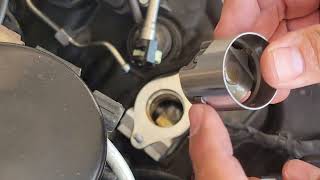
Typical fix: Replace the high-pressure fuel pump. This requires depressurizing the fuel system first. 🎬 Watch: Step-by-step walkthrough for replacing the high-pressure fuel pump.
Est. part cost: $400-$700 - Incorrectly Installed Fuel Jumper Line ⚪ Low Probability Ford Special Service Message (SSM) 50089 states that if fuel system work was recently performed, an incorrectly oriented fuel jumper line can cause a restriction. While this SSM primarily discusses low pressure codes (P0087/P008A), a restriction could potentially cause pressure spikes under certain conditions. This line has an internal one-way check valve.
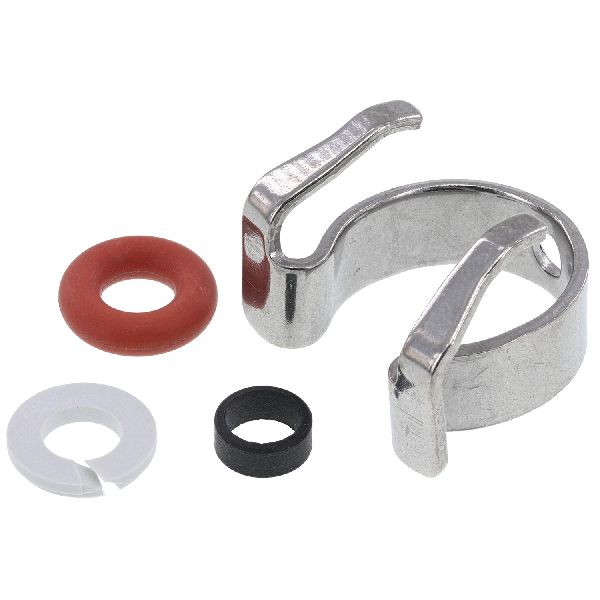
How to confirm: This is a visual inspection to be performed if the code appears shortly after engine or fuel system repairs. The Oetiker clamp on the black fuel line must be located closest to the end connected to the port injection rail. If it's on the other end, the line is backward.
Typical fix: Correctly orient and install the fuel jumper line and clamp per Ford's service procedure.
Est. part cost: $0-$20 (if only labor or a new clamp is needed) - Wiring Issue in the FRPS Circuit ⚪ Low Probability Damage to the wiring harness for the fuel rail pressure sensor (e.g., from rodents, chafing, or improper routing near hot exhaust components) can cause a short to voltage, sending a constant high signal to the PCM.
How to confirm: Visually inspect the wiring harness leading to the FRPS for any signs of damage. Use a multimeter to check for a short to power on the signal wire. A reading of 5 volts often indicates a short.
Typical fix: Repair or replace the damaged section of the wiring harness.
Est. part cost: $10-$100 (for wiring repair supplies)
Rare But Worth Checking
- Blocked Fuel Return Line: While less common on modern returnless systems, a restriction in any part of the fuel line that is supposed to relieve pressure could theoretically cause this code.
- Faulty Powertrain Control Module (PCM): This is extremely rare. The PCM should only be considered after all other possibilities, including sensors, pumps, and wiring, have been exhaustively ruled out.
Diagnosis Steps
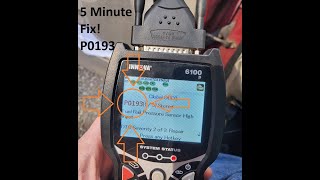
- Connect an OBD-II scanner and confirm P0088 is the active code. Note any other codes present, especially P0193.
- Using the scanner's live data function, monitor the 'Fuel Rail Pressure' (FRP) PID. Note the pressure reading with the key on/engine off, at idle, and under light load. An immediate, fixed high reading (e.g., >4000 PSI) points to a bad sensor.
- Visually inspect the wiring and connector for the Fuel Rail Pressure Sensor (FRPS) for any signs of damage, corrosion, or looseness.
- If the code appeared after recent engine or fuel system repairs, inspect the fuel jumper line and its clamp orientation, referencing Ford SSM 50089. The clamp should be on the port injection rail side.
- If the sensor readings seem plausible but are consistently high, the next step is to suspect a mechanical issue. If safe and possible, connect a mechanical fuel pressure gauge to the high-pressure rail to verify the scanner data. A match confirms the pressure is genuinely high.
- If both the mechanical gauge and scanner confirm that fuel pressure is genuinely too high, the issue is most likely a mechanical fault in the High-Pressure Fuel Pump (HPFP), such as a failed internal regulator.
- Before replacing the HPFP, ensure the low-pressure fuel system is supplying the correct volume and pressure to the HPFP, as an issue there could potentially cause the HPFP to malfunction, although this is less likely to cause a high-pressure code.
- If all components test good, investigate the possibility of a restricted fuel line or, in very rare cases, a PCM fault.
Parts You'll Likely Need
- High-Pressure Fuel Pump
(OEM #JR3Z-9350-C)— This is the mechanical pump responsible for creating high pressure for the direct injection system. Internal failure can cause it to over-pressurize the fuel rail.
Trusted brands: Motorcraft
OEM price range: $450-$650
Aftermarket price range: $300-$500 - Fuel Rail Pressure Sensor
(OEM #FR3Z-9F972-A)— This sensor reports pressure to the PCM. A common failure mode is sending a false high reading, which is a frequent cause of P0088.
Trusted brands: Motorcraft, Bosch, Standard Motor Products
OEM price range: $100-$180
Aftermarket price range: $50-$120
Related Codes That Often Appear With This One
- P0193: Fuel Rail Pressure Sensor Circuit High (often indicates the sensor itself has failed)
- P0087: Fuel Rail/System Pressure - Too Low (can appear alongside P0088 in cases of erratic sensor behavior or after track use)
- P0171: System Too Lean Bank 1 / P2195: O2 Sensor Signal Stuck Lean Bank 1 (can appear as a pending code if the high pressure is causing injector issues)
Technical Service Bulletins (TSBs) & Recalls
- SSM 50089 - Special Service Message regarding incorrect installation of the fuel jumper line causing fuel pressure codes on 2017-2021 models with 3.3L, 3.5L, and 5.0L engines.
- SSM 48807 - An earlier Special Service Message related to the same backward fuel jumper line issue on 2017-2020 F-150s and other models, which was later superseded by SSM 50089.
- Bulletin #20B41 - Manufacturer TSB noting that a dislodged fuel orifice can damage the pressure control valve pintle, resulting in DTC P0088.
- Bulletin #SSM 49185 - Manufacturer TSB stating that an illuminated MIL with DTC P0088 may be due to the pressure control valve in the fuel rail, requiring replacement of the rail and valve.
Platform-Specific Known Issues
- SSM 50089: An internal Ford message indicates that P0087/P008A can be set after service if the fuel jumper line's Oetiker clamp is installed in the wrong orientation, causing a flow restriction. While this TSB focuses on low pressure, it's a critical check for any fuel pressure code after a recent repair.
Mechanic-Grade Diagnostic Values
- High-Pressure Fuel Rail Pressure Sensor (FRPS) Signal Voltage — expected: 0.5V to 4.5V. The voltage increases as pressure increases.. Failure: A reading stuck near 4.8V or 5.0V indicates a short to voltage or an internally failed sensor. A reading below 0.27V can trigger a P0192 (Circuit Low) fault.
- High-Pressure Fuel Rail Pressure (FRP) - Live Data — expected: Direct injection high-pressure rails can operate from 200 to 350 bar (3000–5000 psi) under load.. Failure: The PCM flags P0088 if the actual pressure exceeds the desired pressure by more than 2.7 MPa (390 PSI) for over 5 seconds. A reading that is fixed and does not change with engine RPM is a strong indicator of a sensor fault.
- Low-Pressure Fuel System Pressure (supplying the HPFP) — expected: Nominal pressure is around 55-58 PSI.. Failure: While not a direct cause of P0088, verifying the low-pressure side is providing adequate pressure is a necessary step before condemning the HPFP.
- FRPS Circuit Resistance (harness side to PCM) — expected: Less than 5.0 ohms on the signal and reference voltage wires between the sensor connector and the PCM connector.. Failure: Resistance higher than 5.0 ohms indicates a wiring problem (corrosion, break) that could cause incorrect readings.
Scan Tool Commands That Help
- Ford IDS (Integrated Diagnostic System): Datalogger - Fuel System PIDs — Use this to monitor desired vs. actual fuel rail pressure, fuel pump command, and sensor voltage in real-time to determine if the pressure is actually high or if the sensor is reporting incorrectly.
- Ford IDS (Integrated Diagnostic System): Power Balance Test — After observing a high-pressure condition, this test can help identify if specific injectors are malfunctioning or being affected by the pressure issue, which can help isolate the problem to a specific bank, although P0088 is a general system code.
- Ford IDS (Integrated Diagnostic System): Clear Fuel Injector & HP Pump Adaptive Tables — This function should be used after replacing a High-Pressure Fuel Pump or injectors to reset the learned fuel trim and pressure adaptations in the PCM. Failure to do so may cause the code to return even with new parts.
Wiring & Ground Locations
- G104 — Located on the driver's side, next to the battery.. This ground is shared by multiple components, including the Data Link Connector (DLC). A poor ground here can cause communication issues with scan tools and potentially affect sensor readings that share common ground circuits.
- G106 (5.0L) — Located on the right side (passenger side) of the engine block.. This is a primary engine block ground. A loose or corroded connection here can cause a variety of sensor and actuator issues, including erratic signals from the FRPS or improper operation of the HPFP's control solenoid.
- G400 — Located in the trunk area on the driver's side.. This ground point is used by the Fuel Pump Driver Module (FPDM). While the FPDM primarily controls the low-pressure pump, an issue with its ground could potentially cause erratic low-pressure supply to the HPFP, although this is an unlikely cause for a high-pressure code.
- FRPS Connector — On the high-pressure fuel rail, typically accessible on the top of the engine.. This is the direct connection to the sensor. Inspecting for corrosion, pin fitment, and damage is a primary diagnostic step. A short to voltage in this harness is a common cause of P0088 and P0193.
OEM Part Supersession History
JR3Z-9350-A, JR3Z-9350-B→JR3Z-9350-C— Standard part revision and improvement process by the manufacturer.
Model Year Variations Within This Range
- 2018-2023: The Gen 3 Coyote (2018-2023) is distinct from the Gen 2 (2015-2017) due to the addition of the high-pressure direct injection system alongside port injection. This dual-fuel system is the primary reason P0088 is relevant to these model years. There are no major documented changes to the core high-pressure fuel system components within the 2018-2023 range that would significantly alter diagnosis for this code.
Diagnostic Flowchart
Other Known Issues on This Vehicle
Issues unrelated to this code that are worth knowing about as an owner of this generation:
- Engine 'Typewriter Tick' or 'BBQ Tick' 🟡 Low — Common across all Gen 3 Coyotes (2018+). The light, intermittent ticking noise is often heard at idle when the engine is warm. (Ref: Ford Service Bulletin 7718 states this is a normal operating characteristic and no repairs should be attempted.)
- 10R80 Automatic Transmission Harsh Shifting/Shudder 🟠 Medium — Common complaint on 2018+ models with the 10-speed automatic. Issues include harsh/clunky downshifts (especially 3-2-1), delayed engagement, and shuddering. (Ref: Multiple software updates and TSBs have been released. A key issue was the CDF clutch drum, addressed by TSB 24-2254 for some vehicles. Valve body issues are also common.)
- MT82 Manual Transmission Issues 🟠 Medium — Affects manual transmission models. Complaints include notchy shifting, high-RPM lockout, and premature wear of shift forks and clutches, sometimes leading to transmission failure. (Ref: No single recall, but it has been the subject of class-action lawsuits. Owners often resort to aftermarket shifters, clutches, and support bushings to mitigate the issues.)
- Piston Slap / Oil Consumption 🔴 High — Less common than the tick, but a serious concern for some early Gen 3 engines (2018-2019). Caused by issues with the plasma-coated cylinder liners and piston clearance, leading to scoring and high oil consumption. (Ref: No specific TSB, but has led to dealer engine replacements under warranty in documented cases.)
- Faulty Digital Instrument Cluster or Center Screen 🟡 Low — Reported on some 2018+ models. The 8-inch center SYNC screen or the entire digital dash can go blank or become unresponsive, often requiring a dealer visit to replace the unit.
Used vs. New Parts: Buying Guide for This Vehicle
When a used part is the smart pick: For this specific repair, sourcing used parts is generally not recommended for the core fuel system components. The High-Pressure Fuel Pump (HPFP) and Fuel Rail Pressure Sensor (FRPS) are wear items and critical for safety and performance. A used electronic component like the Fuel Pump Driver Module (FPDM) could be a viable option if sourced from a low-mileage, known-good donor vehicle.
Donor-vehicle mileage cap: roughly under 50000 miles for the part to have meaningful remaining life.
What to inspect on the donor part:
- For an FPDM, ensure the part number matches exactly.
- Check the donor vehicle's VIN for any history of accidents, floods, or fires.
- Inspect the electrical connector on the part for any signs of corrosion, melting, or bent pins.
OEM-only on this vehicle (don't cheap out):
- High-Pressure Fuel Pump (HPFP)
- Fuel Rail Pressure Sensor (FRPS)
Aftermarket brands forum-validated for this vehicle:
- Bosch (often the OEM supplier for sensors)
Brands owners have reported issues with on this vehicle:
- Unknown, no-name brands found on online marketplaces, especially for critical sensors and pumps.
Real Owner Stories
Aggregated from forums and TSBs cited above. Mileages and costs reflect what owners reported in those sources.
2018 Mustang GT 5.0L
Symptoms: Engine stall and die; Check Engine Light on with a pending P0088 code, a confirmed P0171 (System Too Lean), and a pending P2195 (O2 Sensor Stuck Lean).
What fixed it: The fuel pressure issue was causing cascading faults including lean conditions and O2 sensor errors.
Source hint: Mustang6G.com - Thread: 'Engine stall and die'
Documented NHTSA Reports
An owner reported in NHTSA ODI #11515513 that while driving approximately 50-55 MPH, a winding sound was detected and code P0088 was displayed. Another report, NHTSA ODI #10721001, describes a vehicle that lacked power with a P0088 code, which the owner noted was related to a known manufacturer defect regarding high fuel rail pressure.
Related OBD-II Codes
Frequently Asked Questions
Does Ford SSM 50089 apply to my 2018-2023 Mustang 5.0L?
My Mustang has a 'typewriter tick' at idle; is this related to the P0088 high-pressure code?
Can a bad Fuel Rail Pressure Sensor (FRPS) cause a P0088 code on my Coyote V8?
How can I tell if my High-Pressure Fuel Pump (HPFP) is causing the P0088 code?
I just had engine work done and now have P0088. What should I check first?
Is the P0088 code related to the harsh shifting I'm experiencing in my 10R80 transmission?
Helpful Videos


Used OEM Parts in Stock


New Aftermarket Parts Available


The information in this article is provided for general reference and educational purposes only. Vehicle specifications, procedures, and part compatibility can vary by production date, trim level, and region. Always consult your vehicle's factory service manual and verify part numbers before purchasing or performing repairs. Safety-critical components such as airbags, seat belts, and braking systems should be installed by a qualified professional.
- Ford Mustang:
- 🎬 Helpful Videos
- 🛍️ Shop This Part
- What's Unique About the 2018-2023 Ford Mustang
- Symptoms You May Notice
- Most Likely Causes
- Rare But Worth Checking
- Diagnosis Steps
- Parts You'll Likely Need
- Related Codes That Often Appear With This One
- Technical Service Bulletins (TSBs) & Recalls
- Platform-Specific Known Issues
- Mechanic-Grade Diagnostic Values
- Scan Tool Commands That Help
- Wiring & Ground Locations
- OEM Part Supersession History
- Model Year Variations Within This Range
- Diagnostic Flowchart
- Other Known Issues on This Vehicle
- Used vs. New Parts: Buying Guide for This Vehicle
- Real Owner Stories
- 2018 Mustang GT 5.0L
- Documented NHTSA Reports
- Related OBD-II Codes
- Frequently Asked Questions
- 🎟️ Get 5% Off