

P0087 on 2011-2021 Jeep Grand Cherokee 3.0L Diesel: Low Fuel Pressure Causes and Fixes
For the 3.0L EcoDiesel, P0087 is a critical code that almost always points to a failing high-pressure fuel pump (HPFP). This is a known issue with a safety recall (Z46 / NHTSA 22V-406). Stop driving immediately and have the vehicle towed to a dealer to check for HPFP failure and metal contamination in the fuel system, which can lead to a repair costing over $10,000 if not covered.
- P0087 on a 3.0L EcoDiesel is a critical warning. Do not drive the vehicle; have it towed.
- Your first action should be to check if your VIN is part of the FCA Z46 safety recall for the high-pressure fuel pump.
- The most likely cause is a catastrophic failure of the HPFP, which can contaminate the entire fuel system with metal shavings.
- As a first, inexpensive diagnostic step, replace both fuel filters and check the old ones for any signs of metal debris.
- This is not a DIY repair. The high pressures and complexity of a contaminated system require professional service, preferably at a Jeep dealership familiar with the Z46 recall.
What's Unique About the 2011-2021 Jeep Grand Cherokee
On the Grand Cherokee with the 3.0L EcoDiesel engine (model years 2014-2020), code P0087 is exceptionally serious. It is most frequently linked to the catastrophic failure of the original Bosch CP4.2 high-pressure fuel pump (HPFP). This specific pump is notorious for disintegrating internally, sending metallic debris throughout the entire fuel system. This widespread contamination can destroy the fuel injectors, fuel rails, all high-pressure lines, and sensors, turning a single pump failure into a complete fuel system replacement. A major safety recall, FCA #Z46 (NHTSA #22V-406), was issued to replace this pump with a more durable design, often a CP3-style pump.
Generation note: The 2011-2021 year range covers the WK2 generation of the Grand Cherokee. The 3.0L CRD V6 EcoDiesel engine was available in North America from the 2014 to 2020 model years. The information regarding the P0087 code and its link to HPFP failure is consistent across all years this engine was offered in the WK2 platform.
Symptoms You May Notice
- Check Engine Light illuminated
- Vehicle enters reduced power or 'limp mode'
- Engine stalling, sometimes suddenly and without warning while driving
- Hesitation or stumbling during acceleration
- Rough or uneven idle
- Hard starting or extended cranking time
- Abnormal engine noise, such as a whining or grinding from the pump area
- Service Electronic Throttle Control warning light may illuminate
- Replacing only the fuel rail pressure sensor without confirming the actual pressure is stable with a mechanical gauge where applicable.
- Replacing the high-pressure fuel pump without first checking for clogged filters or a weak low-pressure lift pump.
- Replacing just the HPFP on a system that is already contaminated with metal debris. The new pump will quickly fail, and the problem will return, requiring the full, expensive repair.
Most Likely Causes
- Failing High-Pressure Fuel Pump (HPFP) 🔴 High Probability The original Bosch CP4.2 pump is a known weak point, prone to catastrophic internal failure. FCA issued a safety recall (Z46 / NHTSA 22V-406) to replace it with a more robust CP3 pump. The failure can happen without warning and cause an immediate stall.
How to confirm: A technician will check the fuel filter housing and the fuel metering unit/solenoid on top of the HPFP for metallic shavings ('glitter'), a definitive sign of HPFP failure. They will also use a scan tool to monitor desired vs. actual fuel rail pressure; if actual pressure cannot meet desired pressure under load (e.g., only making 800 PSI when 3,500+ is commanded during cranking), the pump has likely failed.
Typical fix: If no metal contamination is found, only the HPFP is replaced (ideally under the Z46 recall, Service Procedure A). If metal debris is present (Service Procedure B), the entire fuel system must be replaced, including the pump, both fuel rails, all high-pressure lines, fuel injectors, and the in-tank lift pump module.
Est. part cost: $800-$1500 for a pump kit, $5000-$8000+ for a full contaminated system kit. 🎬 Watch: See the damage caused by a catastrophic CP4 pump failure.
- Clogged or Restricted Fuel Filters 🟡 Medium Probability Diesel fuel systems are sensitive to contamination. The vehicle has two fuel filters that must be changed at regular intervals (typically every 20,000 miles). Neglecting this service can easily lead to fuel starvation and trigger P0087.
How to confirm: Replace both fuel filters as the first diagnostic step. Cut open the old filters and inspect the media for dirt, water, and especially metal flakes. If the code disappears and performance returns, the filters were the cause.
Typical fix: Replace both fuel filters. This is a standard maintenance item and the cheapest and easiest first step in diagnosis. The Mopar kit part number is 68436631AA. 🎬 Watch: Step-by-step guide to changing your diesel fuel filters.
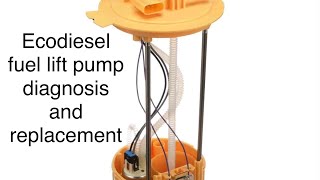
Est. part cost: $60-$120 for a set of two quality filters. - Failing Low-Pressure In-Tank Fuel Pump (Lift Pump) ⚪ Low Probability The lift pump supplies fuel from the tank to the HPFP. If it becomes weak, it cannot provide enough volume for the HPFP to pressurize, triggering P0087. This can be caused by internal wear or contamination from the fuel tank.
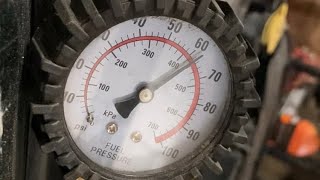
How to confirm: A technician must test the low-side fuel pressure with a mechanical gauge, 🎬 See how to properly test fuel pressure with a gauge. as scan tool readings can be misleading. Pressure should be a steady 54-64 PSI. If it drops into the 40-46 PSI range while cranking, the lift pump is weak and cannot keep up with demand.
Typical fix: Replace the in-tank fuel pump module. If this was caused by contamination, the fuel tank should be dropped and cleaned.
Est. part cost: $250-$600
Rare But Worth Checking
- Leaking Fuel Injector(s): An injector can leak internally, bleeding off rail pressure. This can be diagnosed with an injector return flow test. This is a less common cause than pump or filter issues on this platform.
- Faulty Fuel Rail Pressure Sensor or Regulator: The sensor that reads the pressure or the regulator that controls it can fail, leading to an incorrect reading or loss of pressure control. This is less common than pump or filter issues.
- Air in the Fuel System: Air can enter the system during a fuel filter change or from a leak on the suction side of the fuel lines, causing pressure to be unstable. Proper priming after a filter change is critical.
Diagnosis Steps
- IMMEDIATELY check if your vehicle's VIN is covered by Safety Recall Z46 / NHTSA 22V-406. If it is, have the vehicle towed to a Jeep dealership for the recall procedure, which is free of charge.
- If the recall status is unknown or completed, start by replacing both fuel filters (Mopar P/N 68436631AA). This is the simplest and most common maintenance-related fix.
- Carefully inspect the old fuel filter media and the filter housing for any signs of metallic glitter or shavings. If metal is found, the HPFP has failed, and the system is contaminated. Stop diagnosis and prepare for a full fuel system replacement.
- If filters are clean and the problem persists, have a professional test the low-pressure fuel pump (lift pump). Pressure must be tested with a mechanical gauge and should hold a steady 54-64 PSI, even while cranking.
- Using a diagnostic scan tool, monitor 'Desired Fuel Rail Pressure' vs. 'Actual Fuel Rail Pressure' while cranking and under load. If the actual pressure cannot keep up with the desired pressure, it points to a high-pressure side failure (HPFP).
- As a final confirmation of HPFP failure, a technician can remove the fuel metering solenoid from the top of the pump (held by two Torx screws) and inspect the inlet screen for metal debris.
- If the HPFP is suspected but no metal is found, a technician should perform a fuel injector return flow test to rule out a leaking injector before condemning the expensive pump.
Parts You'll Likely Need
- High-Pressure Fuel Pump (HPFP) Kit
(OEM #CSSMZ461AA (Recall Kit), 68631088AA (Service Part))— This is the recall kit that replaces the failure-prone Bosch CP4.2 with the more robust CP3 pump. It is the most common cause of P0087 on this engine.
Trusted brands: Mopar
OEM price range: $1000-$1500
Aftermarket price range: $800-$1200 - Fuel Filter Kit
(OEM #68436631AA)— Clogged fuel filters are a common and inexpensive cause of low fuel pressure. This should always be the first part replaced when diagnosing P0087.
Trusted brands: Mopar, Bosch, Mahle, Wix
OEM price range: $80-$120
Aftermarket price range: $60-$90 - Low-Pressure In-Tank Fuel Pump
(OEM #68102700AB)— If the lift pump in the tank is weak, it cannot supply the HPFP with enough fuel volume, leading to starvation and low-pressure codes. This is a common failure point after filters are ruled out.
Related Codes That Often Appear With This One
- P016F — Stands for 'Closed Loop Fuel Pressure Control At Limit - Pressure Too Low', which is a direct companion code to P0087 indicating the system is trying to compensate for the low pressure but cannot.
- P0093 — Indicates a 'Large Fuel System Leak Detected'. This can be triggered when the pressure drop is severe and sudden, as happens with a failing HPFP.
- P1292 — A manufacturer-specific code for 'CNG Pressure Sensor High' that has been reported by owners in conjunction with P0087, possibly indicating a sensor or wiring issue that can confuse the diagnosis.
Technical Service Bulletins (TSBs) & Recalls
- Safety Recall Z46 / NHTSA 22V-406: High Pressure Fuel Pump Failure. This is the most critical document for this issue, detailing the defect, risks, and repair procedure for the failure-prone Bosch CP4.2 HPFP.
- TSB Bulletin #18-012-16: Notes that P0087-00 (Fuel Rail Pressure Too Low) may be set in conjunction with other performance codes like P208B-00 (Reductant Pump 1 Control Performance).
- TSB Bulletin #18-094-15: Lists P0087-00 as a potential fault code requiring a PCM software update to improve diagnostic accuracy and system performance.
- TSB Bulletin #18-023-15 REV.C: Identifies P0087-00 as a code that may be stored alongside EGR and SCR efficiency codes, requiring specific diagnostic routines.
- TSB Bulletin #18-023-15 REVA: Mentions P0087-00 as a possible stored code that can appear with "System Too Lean" or "Forced Engine Shutdown" conditions.
- TSB Bulletin #18-023-15: An earlier manufacturer bulletin documenting P0087-00 occurring alongside reductant system performance faults.
Platform-Specific Known Issues
- Safety Recall Z46 (NHTSA 22V-406): This recall was issued for 2014-2020 Grand Cherokees with the 3.0L diesel due to the high rate of HPFP failures that can cause stalling and a crash. The fix involves replacing the pump and potentially other fuel system components if debris is found.
- Improper Recall Service: Some owners have reported poor fuel economy after the Z46 recall was performed. This can be due to the new HPFP being installed without being correctly timed to the engine, requiring a return visit to the dealer to correct the installation.
Mechanic-Grade Diagnostic Values
- Low-Pressure Fuel System (Lift Pump) — expected: 54-64 PSI, measured with a mechanical gauge.. Failure: Pressure drops into the 40-46 PSI range or below 53 PSI while cranking.
- High-Pressure Fuel System (Cranking) — expected: Must exceed 3,500 - 4,000 PSI for the engine to start.. Failure: Scan tool shows actual pressure is significantly below desired pressure (e.g., only 800-1500 PSI).
- Injector Return Flow (Leak-off) Test — expected: Little to no fuel return during a 10-second crank cycle.. Failure: Any single injector returning more than 2.5 ml of fuel in 10 seconds of cranking is leaking internally.
- Fuel Rail Pressure Sensor Voltage — expected: Approximately 1.0V at idle, rising with pressure.. Failure: Voltage is static (e.g., stuck at 0.5V or 4.8V) and does not change with engine RPM.
- Fuel Injector Solenoid Resistance — expected: 185k ohms +/- 10%.. Failure: Resistance is significantly outside of the specified range.
Hidden / Shadow Codes Worth Checking
- P016D: Excessive time to enter closed loop pressure control. This indicates the system is failing to build pressure in the expected timeframe upon startup. (see via Advanced scan tools like the dealer's wiTECH or high-end aftermarket scanners.)
- P1EDC: A manufacturer-specific code that can translate to 'Empty Fuel Tank', which may be set erroneously during a severe low-pressure event, confusing the diagnosis. (see via Visible on advanced diagnostic scan tools during a full system scan.)
Scan Tool Commands That Help
- wiTECH (Dealer Tool): Fuel System Test — To perform guided diagnostics, activate specific components like the lift pump independently, and view proprietary data PIDs not available on generic scanners.
- wiTECH (or equivalent advanced tool): Injector Quantity Adjustment (IQA) / Zero Delivery Calibration — This is a mandatory step after replacing fuel injectors. Each new injector has a specific calibration code that must be programmed into the PCM for proper fuel delivery and engine balance.
- wiTECH (or equivalent advanced tool): Actuate In-Tank Fuel Lift Pump Module — To test the low-pressure pump's function without starting the engine, verifying it runs and primes the system.
Wiring & Ground Locations
- G104 / G105 — Left inner fender area, near the headlamp and dash harness connection.. These are primary ground points for the engine control systems. Corrosion or a loose connection here can cause erratic sensor readings and module behavior, potentially mimicking fuel pressure issues.
- Engine Dipstick Tube Stud — The stud that secures the engine oil dipstick tube to the engine block.. This serves as a critical engine block ground point. If it's loose, corroded, or missing, it can cause a host of electrical issues, including problems with sensors mounted to the engine like the fuel rail pressure sensor.
- PCM Connector C1/C2 — The Powertrain Control Module (PCM) is located in the engine bay. The fuel rail pressure sensor and fuel quantity solenoid wiring run to these main connectors.. When diagnosing sensor faults, checking for voltage and continuity requires probing specific pins at these connectors to rule out wiring breaks between the sensor and the PCM.
Real Owner Repair Stories
- EcoDieselRam.com forum user (2015 Ram 1500 EcoDiesel (same engine/fuel system)) — Complete power loss on the highway when attempting to pass, followed by the P0087 check engine light. The truck would recover power after letting off the gas.
❌ Tried (didn't work) Changing the fuel filters twice a year as preventative maintenance did not prevent the issue.
✅ What actually fixed it The user was advised by another member to test the low-pressure lift pump with a mechanical gauge. Their pressure dropped from a key-on 60 PSI to 40-46 PSI while cranking. The final fix was replacing the weak in-tank low-pressure fuel pump. - JeepGarage.org forum user (similar story) (2014 Jeep Grand Cherokee EcoDiesel) — P0087 and P1292 codes, stalling issues.
❌ Tried (didn't work) Replaced both fuel filters.
✅ What actually fixed it The dealership replaced the low-pressure fuel pump after the filters didn't solve the problem. The user reported the truck ran fine after the lift pump replacement. - YouTube repair video (Just Rolled In) (2018 Ram 3.0L EcoDiesel) — Rough running, stalling, P0087 code.
❌ Tried (didn't work) Initial diagnosis was difficult as symptoms were intermittent.
✅ What actually fixed it After stalling during a test drive, the technician replaced the fuel filters. Upon further inspection, the in-tank low-pressure pump housing was found to be full of dirt and contamination, which had clogged the pump itself. Replacing the contaminated in-tank lift pump assembly resolved the issue.
OEM Part Supersession History
68501449AA (HPFP)→68631088AA (HPFP)— Part number update for the same failure-prone CP4.2 pump.
Heads up: Both are the problematic CP4.2 pump. The official fix is the recall kit CSSMZ461AA, which contains a more robust CP3-style pump. Some dealers may use the recall kit as a service replacement even for non-recall repairs.68235275AA (Fuel Filter)→68235275AB— Standard part revision.
Model Year Variations Within This Range
- 2014-2019: These model years were subject to a recall for a cracking EGR cooler (NHTSA 20V-699), which is a separate issue from the HPFP but affects the same engine. While not directly causing P0087, it's a significant known problem for this engine family.
- 2020+: Later model year 3.0L EcoDiesel engines (Gen 3) used in Ram and other Jeep models have different power levels and potentially different accessory components, though the core high-pressure fuel system design principles remain similar. Tuning modules and some parts may not be interchangeable.
Diagnostic Flowchart
Other Known Issues on This Vehicle
Issues unrelated to this code that are worth knowing about as an owner of this generation:
- EGR Cooler Failure 🔴 High — Common enough to warrant a recall (NHTSA 20V-701) for 2014-2019 models. The cooler can crack internally, leaking coolant into the intake manifold, which can cause a fire. (Ref: NHTSA 20V-701)
- Engine Oil Cooler Failure 🔴 High — A frequent issue where the oil cooler, which is integrated with the oil filter housing, fails internally. This pumps engine oil into the cooling system, contaminating it completely and requiring replacement of the cooler, coolant reservoir, and potentially many coolant hoses that swell and degrade from oil exposure. Often occurs around 80,000-100,000 miles.
- Crankshaft Position Sensor Tone Wheel Delamination 🔴 High — The reluctor wheel on the crankshaft can separate or delaminate, causing a loss of signal for crankshaft position. This results in an immediate engine stall with no warning and the inability to restart the engine. A recall was issued for this problem. (Ref: NHTSA 18V-280 (Chrysler U44))
- Main/Rod Bearing Failure 🔴 High — Some earlier (2014-2016) engines experienced premature main and/or connecting rod bearing failure, leading to a bottom-end knock and catastrophic engine failure. This is sometimes attributed to quality control issues or oil starvation from other problems like oil cooler leaks.
Used vs. New Parts: Buying Guide for This Vehicle
When a used part is the smart pick: For this specific P0087 failure on the EcoDiesel, sourcing used parts is extremely high-risk and generally not recommended. The only potential exception might be a purely cosmetic or ancillary component like a mounting bracket if it were damaged during repair. A used in-tank lift pump could be considered ONLY if its history is known and the vehicle it came from did NOT suffer an HPFP failure.
Donor-vehicle mileage cap: roughly under 50000 miles for the part to have meaningful remaining life.
What to inspect on the donor part:
- For a lift pump: verify the donor vehicle did not have P0087 or any fuel system codes.
- Inspect the donor vehicle's fuel tank for any signs of debris or contamination before pulling the part.
- Absolutely no signs of metal 'glitter' anywhere in the donor's fuel system.
OEM-only on this vehicle (don't cheap out):
- High-Pressure Fuel Pump (HPFP): Must be a new Mopar part, preferably the recall kit (CSSMZ461AA) containing the CP3 conversion.
- Fuel Injectors: Must be new. Used injectors can be contaminated with metal from the old pump and will cause the new pump to fail.
- Fuel Rails and Lines: Must be new. It is nearly impossible to clean microscopic metal fragments from used rails and lines. Attempting to reuse them will contaminate the entire new system.
Aftermarket brands forum-validated for this vehicle:
- Mopar (for all critical fuel system components)
- Bosch, Mahle, Wix (for fuel filters)
Brands owners have reported issues with on this vehicle:
- Unknown or unbranded 'rebuilt' HPFPs or injectors from online marketplaces. The risk of contamination or premature failure is too high for the cost of the repair.
Real Owner Stories
Aggregated from forums and TSBs cited above. Mileages and costs reflect what owners reported in those sources.
2014 Jeep Grand Cherokee 3.0L EcoDiesel
Symptoms: The vehicle triggered a Check Engine Light with code P0087 and P1292.
What fixed it: The owner resolved the issue by replacing the two fuel filters.
Source hint: https://www.ecodieselram.com/forum/threads/check-engine-code-p0087.1639/
2015 Jeep Grand Cherokee 3.0L EcoDiesel
Symptoms: The owner reported various engine codes and electronic faults accompanying the engine issues.
What fixed it: The discussion points toward checking for HPFP failure and potential recall eligibility.
Source hint: https://www.reddit.com/r/EcoDiesel/comments/z85g30/2015_grand_cherokee_a_list_of_problems_help/
Related OBD-II Codes
Frequently Asked Questions
Is there a recall for the high-pressure fuel pump on my 2014-2020 Jeep Grand Cherokee 3.0L Diesel?
How can I tell if my HPFP has failed and contaminated the rest of the fuel system?
My Jeep is stalling and showing P0087; what is the cheapest first step to fix it?
I just had the Z46 recall performed, but now my fuel economy is poor. What happened?
What should the low-pressure fuel pump (lift pump) reading be on a 3.0L CRD?
Are there other major engine issues I should watch for on my EcoDiesel Grand Cherokee?
Helpful Videos

We Have This Part in Stock


The information in this article is provided for general reference and educational purposes only. Vehicle specifications, procedures, and part compatibility can vary by production date, trim level, and region. Always consult your vehicle's factory service manual and verify part numbers before purchasing or performing repairs. Safety-critical components such as airbags, seat belts, and braking systems should be installed by a qualified professional.
- Jeep Grand Cherokee:
- 🎬 Helpful Videos
- 🛍️ Shop This Part
- What's Unique About the 2011-2021 Jeep Grand Cherokee
- Symptoms You May Notice
- Most Likely Causes
- Rare But Worth Checking
- Diagnosis Steps
- Parts You'll Likely Need
- Related Codes That Often Appear With This One
- Technical Service Bulletins (TSBs) & Recalls
- Platform-Specific Known Issues
- Mechanic-Grade Diagnostic Values
- Hidden / Shadow Codes Worth Checking
- Scan Tool Commands That Help
- Wiring & Ground Locations
- Real Owner Repair Stories
- OEM Part Supersession History
- Model Year Variations Within This Range
- Diagnostic Flowchart
- Other Known Issues on This Vehicle
- Used vs. New Parts: Buying Guide for This Vehicle
- Real Owner Stories
- 2014 Jeep Grand Cherokee 3.0L EcoDiesel
- 2015 Jeep Grand Cherokee 3.0L EcoDiesel
- Related OBD-II Codes
- Frequently Asked Questions
- 🎟️ Get 5% Off