

OBD-II Code P1292: A Comprehensive Guide to Fuel & Cooling System Faults
What P1292 means for your Ford, VW, Audi, or Dodge, and how to fix it right the first time
- Code P1292 is manufacturer-specific: it indicates a Bank 2 fuel injector electrical short on Ford/Hyundai vehicles, or an open circuit in the map-controlled thermostat on VW/Audi models.
- For 2011-2019 Ford 6.7L diesels, inspect the engine wiring harness for chafing against the EGR cooler or PCM bracket before spending $500+ replacing fuel injectors.
- On VW and Audi 2.0T engines, a P1292 code requires testing the thermostat's internal heating element for a resistance of 14-16 Ohms to confirm failure before authorizing a $600+ replacement.
- Never drive with an active P1292 code, as a shorted Ford injector will destroy a $2,000 catalytic converter, and a stuck VW thermostat will warp the cylinder head.
What Does P1292 Mean?

P1292 is a manufacturer-specific code. For Ford and Hyundai/Kia, it signals an electrical short in the fuel injector system for Bank 2 (the driver's side on Ford V8s). For Volkswagen and Audi, it points to an open circuit in the electronically controlled thermostat. For Dodge and Ram CNG vehicles, it indicates high voltage from the natural gas pressure sensor.
Technical definition: P1292 is a manufacturer-specific code. Common definitions include: Ford/Hyundai/Kia: Injector High Side Short To Ground or VBATT Bank 2; Volkswagen/Audi: Map Controlled Engine Cooling Thermostat (F265): Open Circuit; Dodge/Chrysler: CNG Pressure Sensor Voltage Too High.
Can I Drive With P1292?
No — Do Not Drive. Driving is strongly discouraged. For Ford and Hyundai, a shorted injector dumps raw fuel, destroying the catalytic converter (a $1,000-$2,500+ repair) or hydro-locking the engine. For VW and Audi, a stuck-closed thermostat causes severe overheating, warping cylinder heads or blowing a head gasket (a $2,000-$4,000+ repair). The risk of causing thousands in additional damage is high.
Common Causes

- Chafed or Damaged Wiring Harness (Ford/Hyundai) (Very Common) — Wires for the fuel injectors rub against hot or sharp engine parts, like the EGR cooler, valve covers, or PCM bracket. This wears away the insulation and causes a direct short circuit to ground.
- Failed Map-Controlled Thermostat (VW/Audi) (Common) — The electronically controlled thermostat (F265) fails internally, creating an open circuit in its heating element that triggers the code.
- Internally Shorted Fuel Injector (Ford/Hyundai) (Common) — A fuel injector fails electrically, creating an internal short. On Ford Powerstroke diesels, Diesel Exhaust Fluid (DEF) or water contamination in the fuel system frequently causes this.
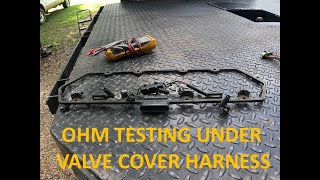
- Damaged UVCH or 42-Pin Connector (Ford 7.3L) (Common) — On older Ford 7.3L Powerstrokes, the Under-Valve-Cover Harness (UVCH) becomes brittle and shorts out. Additionally, the main 42-pin engine harness connector suffers from burnt or loose pins, interrupting the injector signal.
- Failed CNG Pressure Sensor or Regulator (Dodge/Ram) (Less Common) — The CNG pressure sensor fails and sends a falsely high 5V signal, or the pressure regulator fails and causes a true over-pressure condition that the sensor accurately reports.
- Faulty Powertrain Control Module (PCM) (Rare) — The driver circuit inside the main engine computer that controls the injectors or thermostat fails. Consider this only after exhaustively ruling out all wiring and component faults.
Symptoms

- Check Engine Light is On — The Malfunction Indicator Lamp (MIL) illuminates immediately upon detecting the fault.
- Rough Idle or Engine Misfire — The engine shakes, stumbles, or runs poorly. On Ford V8s, this is highly noticeable as an entire bank of 4 cylinders shuts down.
- Engine Overheating or Slow to Warm Up — For VW/Audi vehicles, a faulty thermostat causes the engine temperature to spike into the red zone (stuck closed) or prevents it from reaching normal operating temperature (stuck open).
- Reduced Engine Power or No-Start — The vehicle enters 'limp mode' with severely limited power. With a dead injector bank, the engine cranks but refuses to start.
- Raw Fuel Smell — A shorted, stuck-open injector dumps unburnt fuel into the exhaust, creating a strong fuel odor.
Diagnostic Flowchart

Tap your situation to follow the diagnostic path that matches what you're seeing on this code.
Common Fixes & Costs

- Repairing Chafed Injector Wiring Harness — Parts: $10-$50, Labor: $200-$400, ~2.5 hr book time (Intermediate)
- Replacing Map-Controlled Thermostat (VW/Audi 2.0T)
— Parts: $150-$300, Labor: $450-$800, ~4.5 hr book time
(Professional)
VW Jetta/GTI/Passat (2008-2014, CCTA/CBFA): OEM 06H121026DD (Alt: Mahle TM41105, Behr TM15105)
Audi A4/A6 (2009-2016, 2.0T): OEM 06L121111H (Alt: Continental, Graf) - Replacing Under-Valve-Cover Harness (Ford 7.3L)
— Parts: $50-$150, Labor: $250-$500, ~3.5 hr book time
(Intermediate)
Ford F-250/F-350 (1999-2003, 7.3L): OEM F81Z-9D930-AB (Alt: Dorman 615-201, Alliant Power AP0014) - Replacing a Single Diesel Fuel Injector (Ford 6.7L)
— Parts: $220-$525, Labor: $264-$387, ~2.8 hr book time
(Professional)
Ford F-250/F-350 (2011-2014): OEM BC3Z-9H529-C (Alt: Bosch 0445117024)
Ford F-250/F-350 (2015-2019): OEM FC3Z-9H529-A (Alt: Bosch 0445117083) - Replacing CNG Fuel Pressure Sensor (Ram 2500)
— Parts: $50-$150, Labor: $100-$200, ~1.2 hr book time
(Intermediate)
Ram 2500 CNG (2013-2018): OEM 68210175AA (Alt: Standard Motor Products FPS57) - Replacing Entire Fuel System due to DEF Contamination (Ford 6.7L)
— Parts: $3,800-$5,500, Labor: $2,000-$4,500, ~20.0 hr book time
(Professional)
Ford 6.7L (2015-2019): OEM DEF-CONTAMINATION-KIT-15-19 (Alt: Bosch OE New Kit)
Used vs. New Parts: Buying Guide
When a used part is worth it: Never buy used fuel injectors or electronic thermostats. Their remaining lifespan is unknown, and the labor to replace them is too high to risk a second failure. Used wiring harnesses are acceptable if they show zero signs of brittleness or corrosion.
Donor-vehicle mileage cap: roughly under 60000 miles for the part to have meaningful remaining life.
Donor quality checklist:
- For wiring, ensure the donor vehicle shows no signs of engine bay fire, flood damage, or front-end collision.
- Match part numbers exactly; aftermarket electronic parts often have compatibility issues.
- Verify the seller offers at least a 90-day warranty.
Decision logic:
- If The failed part is a fuel injector or electronic thermostat. → Buy new OEM or high-quality aftermarket. The risk of a used part failing quickly is too high.
- If The failed part is a wiring harness and the vehicle is over 10 years old. → A used harness from a low-mileage, non-corrosion-belt donor is acceptable if a new one is unavailable.
Warranty tradeoff: Used parts typically come with a 30-90 day warranty covering the part only. New OEM parts carry a 1-2 year warranty.
Worst-case if a used part fails: $1000, representing the repeated labor costs to diagnose and replace a faulty used part.
What Happens If You Wait — Timeline
- 0-1 month: Code P1292 appears. Ford owners notice intermittent rough idle. VW/Audi owners see the temperature gauge fluctuate. The fault is often intermittent. (MPG impact: 0-5%% · Added cost: $0-$50 in wasted fuel)
- 1-3 months: The Ford injector short becomes consistent, causing a persistent misfire and raw fuel smell. The VW/Audi thermostat fails completely open or closed. (MPG impact: 10-25%% · Added cost: $50-$150 in wasted fuel. Overheating risk becomes critical for VW/Audi.)
- 3-6 months: Ford catalytic converters melt from raw fuel saturation. Oil dilution accelerates engine wear. A single VW/Audi overheating event warps the cylinder head. (MPG impact: 25-40%% · Added cost: $1,500-$4,500 (Catalytic converter or cylinder head repair))
- 6+ months: The Ford catalytic converter plugs completely, or oil dilution spins an engine bearing. Severe VW/Audi overheating cracks the engine block. (MPG impact: N/A (Vehicle undriveable)% · Added cost: $8,000-$15,000+ (Complete engine replacement))
Cost of Not Fixing It
- Immediate (0-1 month): For Ford/Hyundai, a shorted injector washes cylinder walls with fuel, diluting engine oil and causing a loss of compression. For VW/Audi, a stuck-closed thermostat causes immediate overheating, leading to warped heads. (Added cost: $2000-$4000)
- Short Term (1-3 months): Continued driving with a rich condition from a faulty injector destroys the catalytic converter and oxygen sensors due to raw fuel saturation. (Added cost: $1500-$3500)
- Long Term (6+ months): Long-term oil dilution causes catastrophic wear on bearings, camshafts, and piston rings, requiring a complete engine replacement. (Added cost: $8000-$15000)
Diagnosis Steps
- Identify Your Vehicle's P1292 Definition
Determine exactly what P1292 means for your specific vehicle make. The diagnostic path for a Ford injector short is entirely different from a VW thermostat open circuit.
Tools: OBD-II Scanner, Internet Access (Beginner) - Visual Inspection of Wiring Harnesses
For Ford 6.7L, inspect wiring rubbing against the EGR cooler or PCM bracket (TSB 19-2231). For Ford 7.3L, check the 42-pin connector over the driver's side valve cover. For VW/Audi, inspect the wiring at the thermostat housing. Look for melted insulation or exposed copper.
Tools: Flashlight (Beginner) - Check Cooling System Fuses (VW/Audi)
A blown fuse for the engine cooling system triggers this code. Check the engine bay fuse box for blown fuses related to the thermostat or cooling fans.
Tools: Fuse Puller, Multimeter (Beginner) - Test Map-Controlled Thermostat Resistance (VW/Audi)
Disconnect the electrical connector from the thermostat. Measure the resistance across the two pins on the thermostat. A healthy heating element reads 14 to 16 Ohms. A reading of infinite resistance (OL) confirms an internal open circuit, requiring thermostat replacement.
Tools: Multimeter (Intermediate) - Perform an Injector Buzz Test (Ford 7.3L)
Use a bidirectional scan tool to command the Injector Driver Module (IDM) to fire each injector. Listen for a sharp, distinct 'buzz'. A weak or silent buzz on Bank 2 cylinders points directly to a wiring or injector problem on that circuit.
Tools: Advanced OBD-II Scanner (with bidirectional controls) (Intermediate) - Test Injector Resistance and Short-to-Ground (Ford/Hyundai)
Disconnect the Bank 2 injector harness. Measure the resistance of each injector (7.3L should be 2.0-5.0 ohms; 6.7L over 180 kOhms). Next, test the harness power wire for continuity to a chassis ground. A beep indicates a shorted wire.
Tools: Multimeter, Basic Hand Tools (Intermediate) - Test CNG Sensor Voltage (Dodge)
Back-probe the signal wire on the CNG pressure sensor. With key on/engine off, voltage must be 0.5V to 4.5V. If stuck near 5V, verify the 5V reference and ground are intact. If they are, the sensor has failed.
Tools: Multimeter, Back-probe Kit (Advanced) - Analyze Injector Waveform (Ford/Hyundai)
Use an oscilloscope to view the injector voltage pattern. A healthy pattern shows a sharp drop to ground and a 60V+ inductive spike when closing. A shorted injector pulls the entire bank voltage down, confirming an electrical short over a mechanical failure.
Tools: Automotive Oscilloscope, Back-probe Kit (Advanced)
When This Code Triggers (Freeze-Frame Conditions)
- Engine Coolant Temp: 170-210°F (77-99°C) (Engine is fully warmed up and running for several minutes.)
- Engine RPM: 1500-3000 RPM (Sets under light to moderate load, such as steady-state cruising.)
- Vehicle Speed: 40-65 mph (Occurs during highway driving when the system runs its self-tests.)
- System Voltage: 13.0-14.5V (Normal operating voltage; the code stems from an isolated electrical short or open circuit, not a dying battery.)
Related Codes
- P1291 — On Ford and Hyundai, P1291 indicates an injector short on Bank 1. If P1291 and P1292 appear together, it strongly suggests systemic failure like widespread DEF contamination shorting out all injectors, rather than two independent wiring faults.
- P0128 — On VW and Audi, P0128 (Coolant Temperature Below Regulating Temperature) appears with P1292. P1292 indicates the electrical failure of the thermostat's heater, while P0128 indicates the mechanical result (the engine isn't warming up).
- P0201-P0208 — These are generic codes for 'Injector Circuit/Open' for specific cylinders. P1292 identifies the bank with the short, while the P020X code pinpoints which specific injector circuit triggered the fault.
- P1293 — On Dodge CNG vehicles, P1293 indicates 'CNG Pressure Sensor Voltage Too Low,' the exact opposite of P1292. Both point to a fault in the same sensor or circuit.
Climate & Environmental Factors
- High Engine Bay Heat: Prolonged exposure to high heat breaks down wiring insulation. This heat cycling makes harnesses for injectors (Ford) and under-valve-cover components (7.3L) brittle and prone to shorting out.
- Humidity and Water Intrusion: Moisture causes corrosion, a key failure point for external connectors like the Ford 7.3L 42-pin engine harness connector. Water entering microscopic cracks in a wiring harness creates a path to ground.
- Extreme Cold: Old wiring harnesses become brittle in the cold and crack easily if disturbed during maintenance.
How to Talk to a Mechanic About This Code
Say this: "I have a P1292 code. For my Ford, I suspect a wiring chafe on Bank 2; please start with a visual inspection of the harness and an injector buzz test. For my Audi/VW, I believe it's the map-controlled thermostat; please check fuses and test the thermostat's resistance before quoting a replacement."
This directs the technician to perform targeted diagnostic steps first, preventing them from immediately quoting an expensive, unnecessary part replacement like a PCM or all new injectors.
Avoid saying:
- 'Just fix whatever's wrong'
- 'My check engine light is on, can you look at it?'
- 'Whatever you recommend'
Questions to ask before authorizing the repair:
- For Ford: Did you find the specific point of failure in the wiring? Can you show me the damaged section?
- For VW/Audi: What was the resistance measurement on the thermostat?
- Will you provide a written estimate with a clear breakdown of parts and labor costs?
- What is the warranty on this specific repair, covering both parts and labor?
Where to Take It: Dealer vs Independent vs Chain
- Dealer:
Best for: Vehicles under warranty, Complex manufacturer-specific systems (e.g., Dodge CNG), When TSBs are the primary diagnostic path
Downsides: Highest labor rates, typically 25-50% more than independent shops., May recommend replacing a large assembly when a smaller component repair is possible. (Typical cost: +50% vs. baseline) - Independent Shop:
Best fit, provided it is a specialist. An independent shop focused on Ford diesels or European cars has the expertise at a lower cost than a dealer. Avoid general-purpose mechanics.
Best for: Out-of-warranty vehicles where cost is a major factor., Shops that specialize in your vehicle type (Powerstroke diesel expert or German auto specialist).
Downsides: Quality varies widely; vetting is crucial., A general mechanic lacks the specific knowledge for this code. (Typical cost: +0% vs. baseline) - Chain Shop:
AVOID. The complexity of P1292 is a poor match for the chain shop model. The risk of misdiagnosis is very high.
Best for: Simple, routine maintenance like oil changes or tires.
Downsides: Technicians lack the specialized training for complex codes like P1292., High pressure to upsell leads to misdiagnosis. (Typical cost: -10% vs. baseline)
When to Walk Away From the Repair
If the estimated repair cost exceeds 40-50% of the car's private-party value, consider selling or trading it in.
- Car worth $8000, fix is $750: Fix it. A $750 repair for a wiring harness or UVCH on an $8,000 truck is a sound investment.
- Car worth $12000, fix is $1600: Borderline. A $1,600 thermostat job on a $12,000 Audi is significant. Get a second quote from an independent specialist.
- Car worth $20000, fix is $12000: Walk away. A $12,000 repair for DEF contamination on a $20,000 truck is not financially viable.
What Scan Tool You Need for This Code
Minimum: A scanner that reads manufacturer-specific codes and live data. For Ford Powerstroke, bidirectional control is mandatory.
A basic $20 reader only shows 'P1292' but won't allow necessary diagnostic tests like an injector buzz test on a Ford 7.3L, leading to guesswork.
Budget: FORScan Lite with OBDLink Adapter (~$120) — FORScan is incredibly powerful for Fords and performs the critical 'Injector Buzz Test' to diagnose 7.3L issues.
Mid-range: Foxwell NT530 or Autel MaxiCheck MX808S (~$180) — Offers bidirectional controls. Performs deep diagnostics like actuating components and coding injectors for Ford 6.7L.
Professional: Autel MaxiCOM MK906BT or XTOOL D7 (~$500-1200) — Provides full dealer-level bidirectional functions, extensive live data graphing, and advanced coding for all makes.
Rent vs buy: For a one-time code read, a free loaner tool from AutoZone confirms the code. However, if you plan to DIY the repair, buying a mid-range bidirectional scanner is a mandatory investment.
How to Clear the Code After You Fix It
- Ensure the repair is complete and all connectors are secure.
- Use an OBD-II scan tool to clear the P1292 fault code from the PCM.
- Perform a complete drive cycle to allow the vehicle's readiness monitors to run and set.
Drive cycle (~20 minutes): Start the engine cold (off for 8+ hours) and idle for 3 minutes. Drive for 15 minutes with a mix of stop-and-go city traffic and steady highway speeds (55-60 mph for 5 minutes). Include several smooth accelerations and decelerations.
Readiness monitors affected: Catalyst Monitor, Oxygen Sensor Monitor, Evaporative System (EVAP) Monitor, Misfire Monitor
Before emissions retest: drive at least 50 miles to fully set monitors.
Watch out for:
- Disconnecting the battery clears the code but resets all readiness monitors to 'Not Ready', guaranteeing an emissions test failure.
- The code returns immediately upon startup if the underlying electrical short or open circuit was not repaired.
Will This Fail Emissions / State Inspection?
Yes — this code typically fails an OBD-II emissions inspection.
- California: An illuminated Check Engine Light is an automatic failure. After repair, all readiness monitors must be 'Ready' before a retest.
- New York: An illuminated MIL is an automatic failure. For model year 2001 and newer, only one readiness monitor is allowed to be 'Not Ready'.
- Texas: An illuminated Check Engine Light is an automatic failure. You can have at most one monitor 'Not Ready' to pass the test.
Most Commonly Affected Vehicles
- Ford F-250/F-350 Super Duty (6.7L Powerstroke) (2011-2019) — Highly prone to injector wiring harness chafing. Check TSB 11-10-10 for 2011-12 models (chafe near EGR cooler) and TSB 19-2231 for 2017-19 models (chafe on PCM bracket).
- Ford F-250/F-350 Super Duty (7.3L Powerstroke) (1999-2003) — Commonly experiences issues with the under-valve-cover harness (UVCH) and the main 42-pin connector. Check for burnt pins at the connector first.
- Audi A4, A6 (1.8T, 2.0T engines) (2004-2016) — Frequently uses a map-controlled thermostat (F265) that fails electrically, causing an open circuit.
- Volkswagen Jetta, Golf, Passat (1.8T, 2.0T engines) (2006-2016) — Shares the same map-controlled thermostat technology as Audi. Always check fuses before replacing the thermostat.
- Ram 2500 CNG (2013-2018) — Sets P1292 for a high voltage reading from the Compressed Natural Gas (CNG) fuel pressure sensor.
- Hyundai Santa Fe (V6 engines) (2007-2012) — Uses P1292 for 'Injector High Side Short - Bank 2', identical to Ford. Check for wiring chafing near the rear of the intake manifold.
Manufacturer-Specific Notes
- Ford: The code almost always points to an electrical short in the fuel injector circuit for Bank 2. The root cause is frequently a wiring harness rubbed through on the EGR cooler or PCM bracket. Damage from DEF contamination is explicitly NOT covered by Ford's warranty.
- Volkswagen / Audi: The code indicates an 'Open Circuit' for the map-controlled thermostat (F265). This means the thermostat's internal heating element has failed and the entire housing assembly requires replacement.
- Dodge / Ram: On CNG-equipped trucks, it means the CNG pressure sensor's voltage is too high. Verify the specific definition for your exact year and engine, as older gasoline models use it for fuel pressure sensor faults.
Real Owner Stories
2017 Ford F-250 6.7L at 10,000 miles
Check engine light came on with intermittent loss of power during acceleration. Code P1292 was present.
What they tried:
- Initial diagnosis pointed to a short on Bank 2 injectors.
- A visual inspection found the engine wiring harness rubbing directly on the EGR cooler, melting through the cylinder #5 injector wire.
Outcome: The technician repaired the single damaged wire and wrapped the harness in protective tubing. The code was cleared and did not return, saving the owner from an expensive injector replacement.
Lesson: On a Ford Powerstroke, always perform a meticulous visual inspection of the wiring harnesses near hot components before assuming an injector has failed.
2002 Ford F-250 7.3L with a no-start condition
After replacing the driver's side glow plugs, the truck started briefly, ran rough, then died, setting code P1292.
What they tried:
- An injector buzz test passed with a known-good IDM, but the code returned with the original IDM.
- Forum advice pointed towards checking the main 42-pin connector and the harness over the driver's side valve cover.
Outcome: The issue was traced to the wiring harness running to the 42-pin connector, which was disturbed during the initial repair. Securing the harness resolved the short.
Lesson: On the 7.3L Powerstroke, a P1292 code immediately following a repair points to a disturbed wiring harness or unseated connector, not a newly failed component.
2013 Audi TT 2.0T with overheating symptoms
The temperature gauge acted erratically, and a dealership quoted $1,600 to replace the map-controlled thermostat.
What they tried:
- The owner sought a second opinion from an independent VW/Audi specialist.
- The specialist confirmed the thermostat failed but quoted a significantly lower price.
Outcome: The owner proceeded with the independent shop, saving hundreds of dollars on the labor-intensive repair.
Lesson: For VW/Audi thermostat replacement, labor is the most expensive factor. Always get a quote from a trusted independent European auto specialist.
2011 Ford F-Super Duty 6.7L with P1291 and P1292
Truck was a crank-no-start with codes for high-side injector shorts on both Bank 1 and Bank 2.
What they tried:
- Technician followed Ford TSB 11-10-10, checking for DEF contamination.
- The fuel conditioning module filter was removed and dried. White crystalline deposits formed, confirming DEF contamination.
Outcome: The entire high-pressure fuel system, injectors, and control module required replacement at a cost exceeding $10,000.
Lesson: If you see both P1291 and P1292 on a Ford 6.7L, immediately suspect DEF contamination. A simple filter check confirms the diagnosis before wasting time on electrical testing.
How to Prevent This Code From Triggering
- Protect Wiring Harnesses in Chafe-Prone Areas (During any engine service or once every 50,000 miles) — Wiring insulation wears down from vibration. Proactively inspect known chafe points (EGR cooler, PCM bracket) and apply protective wire loom to prevent shorts.
- Practice Strict DEF Handling Procedures (Every time filling the DEF tank) — DEF contamination is catastrophic. Use dedicated, clean funnels, wipe the area around the blue cap, and never put anything other than DEF in the tank to prevent crystallization.
- Perform Regular Cooling System Flushes (VW/Audi) (Every 40,000-60,000 miles) — Degraded coolant becomes corrosive and leads to premature failure of the map-controlled thermostat. Flushing maintains chemical stability.
Frequently Asked Questions
What does 'Bank 2' mean on a Ford 6.7L Powerstroke?
Bank 2 refers to the driver's side of the engine and includes cylinders 2, 3, 5, and 8. Uniquely, Bank 1 (passenger side) consists of cylinders 1, 4, 6, and 7.
How can I tell if my Ford P1292 is from a wiring chafe or DEF contamination?
First, visually inspect the injector wiring harness near the EGR cooler and PCM bracket. If no damage is found, remove the fuel conditioning module filter and let it dry for two hours. White, crystalline deposits confirm DEF contamination.
I replaced my 7.3L Powerstroke injectors but still have P1292. What did I miss?
The fault lies upstream of the injectors. The Under-Valve-Cover Harness (UVCH) becomes brittle and fails, or the main 42-pin harness connector suffers from burnt pins. Test the UVCH for continuity before condemning the IDM.
What is a map-controlled thermostat?
It is a 'smart' thermostat used by VW and Audi. The engine computer electrically heats it to open sooner, allowing the engine to run hotter under light loads for efficiency and cooler under heavy loads for performance.
Why is the repair cost for a VW/Audi thermostat so high?
The electronic part is expensive, and its location is buried deep in the engine bay. The repair often requires removing the intake manifold, driving up labor costs.
My Ford truck has codes P1291 and P1292. What does that mean?
The computer detects a high-side electrical short on BOTH banks of injectors. This almost always indicates systemic fuel contamination (like Diesel Exhaust Fluid) which crystallizes and shorts out all injectors simultaneously.
What does 'injector high side short' actually mean?
The 'high side' is the power supply wire providing battery voltage to a bank of injectors. A 'short' means this wire is making unintended contact with a ground source, disrupting power and forcing the PCM to shut down the bank.
Can I just clear code P1292 and keep driving?
No. P1292 indicates a hard electrical fault, not a random glitch. Ignoring it destroys expensive components like the catalytic converter or warps the cylinder head.
I have P1292 but the truck seems to run fine. What's going on?
You have an intermittent short. The wiring only makes contact under specific conditions, like hitting a bump or reaching a certain temperature. Consider this a serious warning that a permanent failure is imminent.
Key Takeaways
- Code P1292 is manufacturer-specific: it indicates a Bank 2 fuel injector electrical short on Ford/Hyundai vehicles, or an open circuit in the map-controlled thermostat on VW/Audi models.
- For 2011-2019 Ford 6.7L diesels, inspect the engine wiring harness for chafing against the EGR cooler or PCM bracket before spending $500+ replacing fuel injectors.
- On VW and Audi 2.0T engines, a P1292 code requires testing the thermostat's internal heating element for a resistance of 14-16 Ohms to confirm failure before authorizing a $600+ replacement.
- Never drive with an active P1292 code, as a shorted Ford injector will destroy a $2,000 catalytic converter, and a stuck VW thermostat will warp the cylinder head.
Helpful Videos



The information in this article is provided for general reference and educational purposes only. Vehicle specifications, procedures, and part compatibility can vary by production date, trim level, and region. Always consult your vehicle's factory service manual and verify part numbers before purchasing or performing repairs. Safety-critical components such as airbags, seat belts, and braking systems should be installed by a qualified professional.
- 🎬 Helpful Videos
- What Does P1292 Mean?
- Can I Drive With P1292?
- Common Causes
- Symptoms
- Diagnostic Flowchart
- Common Fixes & Costs
- Used vs. New Parts: Buying Guide
- What Happens If You Wait — Timeline
- Cost of Not Fixing It
- Diagnosis Steps
- When This Code Triggers (Freeze-Frame Conditions)
- Related Codes
- Climate & Environmental Factors
- How to Talk to a Mechanic About This Code
- Where to Take It: Dealer vs Independent vs Chain
- When to Walk Away From the Repair
- What Scan Tool You Need for This Code
- How to Clear the Code After You Fix It
- Will This Fail Emissions / State Inspection?
- Most Commonly Affected Vehicles
- Manufacturer-Specific Notes
- Real Owner Stories
- 2017 Ford F-250 6.7L at 10,000 miles
- 2002 Ford F-250 7.3L with a no-start condition
- 2013 Audi TT 2.0T with overheating symptoms
- 2011 Ford F-Super Duty 6.7L with P1291 and P1292
- How to Prevent This Code From Triggering
- Frequently Asked Questions
- What does 'Bank 2' mean on a Ford 6.7L Powerstroke?
- How can I tell if my Ford P1292 is from a wiring chafe or DEF contamination?
- I replaced my 7.3L Powerstroke injectors but still have P1292. What did I miss?
- What is a map-controlled thermostat?
- Why is the repair cost for a VW/Audi thermostat so high?
- My Ford truck has codes P1291 and P1292. What does that mean?
- What does 'injector high side short' actually mean?
- Can I just clear code P1292 and keep driving?
- I have P1292 but the truck seems to run fine. What's going on?
- Key Takeaways
- 🎟️ Get 5% Off