

P0030 on 2009-2016 Chevrolet Cruze: HO2S Heater Circuit Causes and Fixes
P0030 on a Chevy Cruze almost always means the upstream oxygen sensor (Bank 1, Sensor 1) has failed and needs to be replaced. This is a common failure item, and the fix is typically a new sensor, costing between $40 for an aftermarket part and $100 for an OEM ACDelco part. Before replacing, check the fuse and inspect the wiring for damage, especially for oil contamination from the valve cover on 1.4L models.
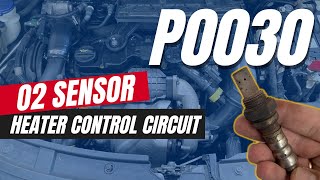
- P0030 points directly to a fault in the heater circuit of the upstream oxygen sensor, located before the catalytic converter.
- The most probable cause is the oxygen sensor itself has failed. This is a common repair for the 2009-2016 Cruze.
- On 1.4L Turbo models, a very common cause of this code is an oil leak from the valve cover dripping onto the sensor's wiring connector. Inspect for oil contamination.
- Before buying a new sensor, perform a quick visual inspection of the wiring and connector for obvious damage and check the associated fuse in the underhood fuse box.
- The 1.4L Turbo and 1.8L engines use different upstream oxygen sensors. Verify the correct part number for your specific engine.
- Replacing the sensor is a DIY-friendly job for most, requiring an O2 sensor socket and basic hand tools. Let the exhaust cool down completely before starting.
- This code will cause an automatic failure on an emissions test.
What's Unique About the 2009-2016 Chevrolet Cruze

The first-generation Chevrolet Cruze (including the 2016 'Cruze Limited') uses this code consistently for a failed upstream O2 sensor heater. While the issue is not unique to the Cruze, it is a frequent failure point. On the 1.4L Turbo engine, this failure is often indirectly caused by another extremely common issue: oil leaks from the valve cover gasket or a failed internal PCV diaphragm. This leaking oil can saturate the O2 sensor's wiring connector, causing a short or open circuit and triggering P0030. Owners often report this code appearing alongside others related to sensor performance, like P015B, as the failed heater prevents the sensor from responding correctly. Both the 1.4L Turbo and 1.8L engines position this sensor in the exhaust manifold, making access relatively straightforward.
Generation note: The 2009-2016 model years primarily cover the first generation of the Chevrolet Cruze. However, in 2016, Chevrolet sold both the new second-generation Cruze and the first-generation model, which was rebranded as the 'Cruze Limited'. The information here applies to the first generation, including the 2016 Cruze Limited.
Symptoms You May Notice
- Check Engine Light is on.
- Decreased fuel economy.
- Rough idle, especially when the engine is cold.
- Hesitation or loss of power.
- Failing an emissions test.
- Noticeable fuel smell from exhaust when cold.
- Replacing the downstream (post-catalyst) oxygen sensor. P0030 specifically refers to Sensor 1, which is always the upstream (pre-catalyst) sensor.
- Replacing the oxygen sensor without fixing an underlying oil leak on a 1.4L engine, leading to repeat failure of the new sensor's connector.
Most Likely Causes

- Failed Oxygen Sensor Heater Element 🔴 High Probability The internal heating element of the O2 sensor is a common failure point due to age and constant heat cycles. It is the most frequent cause for this code.
How to confirm: Using a multimeter, test the resistance between the two heater circuit pins on the sensor's connector. A reading of infinite resistance (open circuit) or a value far outside specification (typically 4-15 Ohms) confirms a failed heater element. Some sources cite a specific range of 4.5-6.2Ω for the 1.4L engine.
Typical fix: Replace the upstream oxygen sensor (Bank 1, Sensor 1).
Est. part cost: $40-$120 - Damaged Wiring or Connector 🟡 Medium Probability On 1.4L Turbo models, the valve cover gasket is a known failure point. Leaking oil often drips directly onto the O2 sensor wiring harness and connector, degrading the insulation and causing shorts or open circuits. The harness can also become brittle from heat.
How to confirm: Visually inspect the wiring harness and connector leading to the O2 sensor for any signs of melting, chafing, or corrosion. Specifically check for oil saturation on and inside the connector. Check for 12V power and a good ground at the harness-side connector with the ignition on.
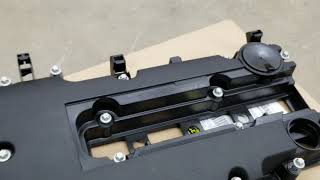
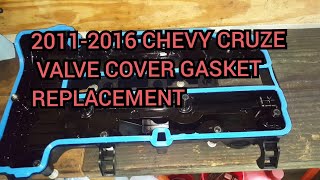
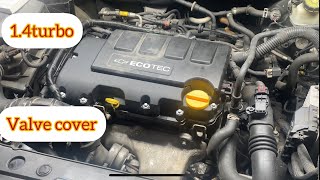
Typical fix: Repair the damaged section of the wiring harness or clean/replace the connector. If oil contamination is the cause, the source of the oil leak (e.g., the valve cover gasket) 🎬 Watch: Step-by-step guide to replacing a leaking valve cover. must also be repaired.
Est. part cost: $5-$150 - Blown Fuse ⚪ Low Probability
How to confirm: Check the underhood fuse box for a blown fuse. It may be labeled 'EMISSIONS', 'O2 HTR', or similar. If the fuse is blown, replace it. If it blows again, a short circuit exists in the wiring or the sensor itself, which is a common reason for the fuse to blow.
Typical fix: Replace the blown fuse after diagnosing the underlying short circuit.
Est. part cost: $1-$5
Rare But Worth Checking
- Faulty Engine Control Module (ECM): This is very rare. The ECM's internal driver for the heater circuit can fail, but all other possibilities should be exhausted before condemning the ECM.
Diagnosis Steps

- Scan the vehicle for any other stored trouble codes. Address those first if they are present, especially P0171 on a 1.4L engine, as it may point to a related root cause.
- Visually inspect the Bank 1, Sensor 1 (upstream) oxygen sensor's wiring harness and connector. On 1.4L engines, pay close attention to signs of oil saturation from a leaking valve cover. Check for melting, chafing, or corrosion.
- Check the vehicle's underhood fuse box for a blown fuse related to the emissions system or O2 sensors (often labeled 'O2 HTR' or similar).
- Disconnect the oxygen sensor. With the ignition on (engine off), use a multimeter to verify that the harness-side connector is receiving ~12V power and has a solid ground connection for the heater circuit.
- With the sensor still disconnected, measure the resistance across the two heater pins on the sensor itself. A reading of infinite resistance (open circuit) or a value outside the typical 4-15 Ohm range indicates the heater has failed and the sensor must be replaced.
- If wiring, fuses, and the sensor's heater element all test good, the issue may be an intermittent connection or, in very rare cases, a faulty ECM driver.
Parts You'll Likely Need
- Upstream Oxygen Sensor (1.4L Turbo)
(OEM #ACDelco 213-4764 (GM 55566649))— The internal heater element failing is the most common cause. This is the correct OEM part for the 1.4L LUJ/LUV engine.
Trusted brands: ACDelco, Denso (234-4528), Bosch, NGK
OEM price range: $80-$120
Aftermarket price range: $40-$80 - Upstream Oxygen Sensor (1.8L)
(OEM #ACDelco 213-4698 (GM 55572216))— The internal heater element failing is the most common cause. This is the correct OEM part for the 1.8L LUW/LWE engine. Note that it is a different part from the 1.4L sensor.
Trusted brands: ACDelco, Bosch (16737), Denso, NGK
OEM price range: $70-$110
Aftermarket price range: $40-$70
Related Codes That Often Appear With This One
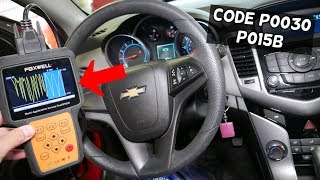
- P015B — Stands for 'O2 Sensor Delayed Response'. This code often appears with P0030 because if the heater isn't working, the sensor takes too long to warm up and provide a signal to the ECM.
- P0132 — Stands for 'O2 Sensor Circuit High Voltage'. A short in the heater circuit or sensor can sometimes cause this related code to appear.
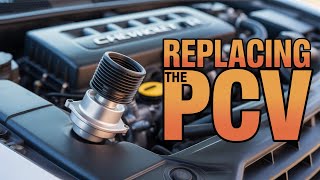
- P0171 — Stands for 'System Too Lean'. While not directly related, a common cause for P0171 on the 1.4L Cruze is a failed PCV system in the valve cover, which also causes oil leaks that can damage the O2 sensor wiring, linking the two codes.
Technical Service Bulletins (TSBs) & Recalls
- Bulletin #PIT5336: This manufacturer bulletin provides information for technicians regarding vehicles with a Service Engine Soon lamp and notes that P0030 may be found alongside a wide range of other O2 sensor heater and circuit codes.
- 17-NA-155: While this TSB is for a newer generation Cruze and code P015B, it highlights that GM sometimes resolves sensor sensitivity issues with an ECM software update. It explicitly states, 'Do Not replace the O2 sensor until the latest ECM calibration has been validated.' It is worth checking if any updates are available for your vehicle, though P0030 is more often a hardware fault.
Platform-Specific Known Issues
- cause: Valve Cover Oil Leak Contaminating Sensor Connector (1.4L Engine) | note: The 1.4L Turbo engine is well-known for developing oil leaks from a failed valve cover gasket or a ruptured PCV diaphragm integrated into the cover. The location of the leak is directly above the O2 sensor and its wiring. Many owners have reported that their P0030 code was caused by oil wicking into the sensor's electrical connector, causing a short. Simply replacing the sensor without fixing the oil leak will likely lead to a repeat failure.
Mechanic-Grade Diagnostic Values

- HO2S Heater Element Resistance — expected: 5-15 Ohms, with some sources citing 5-6 Ohms for a cold sensor.. Failure: Infinite resistance (OL - Open Loop) indicates a burned-out heater element.
- Voltage at Harness Connector (Heater Power Pin) — expected: ~12V (Battery Voltage) with Key On, Engine Off (KOEO).. Failure: 0V indicates a blown fuse or an open in the power supply wire.
- Heater Control Circuit Voltage (at ECM) — expected: The ECM provides a pulse-width modulated (PWM) ground. Voltage will vary, but a scan tool is the best way to monitor the commanded state.. Failure: The ECM will set P0030 if the detected voltage on the control circuit is out of the expected range for more than 6 seconds.
- Live Data - O2 Sensor Voltage (B1S1) — expected: Should fluctuate rapidly between approximately 0.1V and 0.9V once in closed loop.. Failure: A flatlined voltage (e.g., stuck at 1.275V or 451mV) indicates a non-responsive sensor, often due to a failed heater.
Scan Tool Commands That Help
- GDS2 (GM Techline Connect): HO2S Heater ON/OFF Command — This bidirectional control allows a technician to manually command the heater circuit on and off to verify the ECM driver, wiring, and sensor functionality without waiting for the engine to meet specific conditions. It's used to confirm if the ECM can control the ground-side of the circuit.
- GDS2 (GM Techline Connect): HO2S Heater Control Circuit High Voltage Test Status — This parameter is used during a specific diagnostic procedure where a fused jumper is applied. It helps determine if a short to voltage or open/high resistance exists in the control circuit by observing if the status changes to 'Malfunction' as expected.
Wiring & Ground Locations
- HO2S Connector (Harness Side) - 1.4L/1.8L — Connected to the upstream O2 sensor, located on the front of the engine in the exhaust manifold.. This is where all voltage and resistance tests are performed. Pin 1: Heater Control (ground side, from ECM). Pin 2: Heater Power (12V from fuse). Pin 3: Signal Low. Pin 4: Signal High. The heater circuit uses pins 1 and 2.
- G103 — On the left front shock tower in the engine compartment.. This is a major engine compartment ground point. While not the primary engine block ground, poor connections here can cause various electrical issues. A wiring diagram shows it's a key grounding point for the underhood fuse block which supplies power to the heater.
- G100 / G101 — Located on the lower left front of the engine block, sometimes as part of the main negative battery cable harness.. This is a primary ground for the Engine Control Module (ECM). A faulty ECM ground can cause erratic behavior and incorrect diagnostic trouble codes, although it would likely cause more issues than just P0030.
- Underhood Fuse Block — Left side of the engine compartment.. Contains the fuse that provides 12V power to the O2 sensor heater circuit. This fuse is often labeled F15, 'EMISSIONS', or 'O2 HTR'.
Documented NHTSA Reports
- NHTSA ODI #11632222 describes a vehicle with a "Reduced Propulsion" message and P0030 where technicians found a blown 15-amp fuse for the EGR valve, which can share circuits with other emissions components.
- NHTSA ODI #11560268 notes a case where a computer registered multiple faults including P0030 and P0135, and a 15-amp fuse was found to be blown.
- NHTSA ODI #11681144 reports P0030 appearing as part of a large list of codes resulting from an EGR failure to circulate coolant properly.
- NHTSA ODI #11448862 describes a vehicle that would eventually stop with an "engine offline" message and multiple error codes including P0030, P0031, and P0135.
Real Owner Repair Stories
- Reddit r/cruze user (2011 Chevrolet Cruze LTZ, 1.4L Turbo, 132k miles) — Initially had a P0420 code (Catalyst System Efficiency Below Threshold).
❌ Tried (didn't work) Replaced the upstream O2 sensor with a new Denso aftermarket sensor to address the P0420 code.
✅ What actually fixed it After replacing the sensor, the car immediately set a P0030 code. The user questioned if the new Denso sensor was bad out of the box or incompatible. Another user suggested that some aftermarket sensors can be problematic and that the connector could be plugged in backward, highlighting the importance of using a quality OEM part or ensuring correct installation. The final fix was implied to be using a compatible sensor or correcting the installation.
OEM Part Supersession History
GM 55566649→ACDelco 213-4764 is the current service part number.— Standard part lifecycle updates.
Heads up: While many aftermarket sensors are available, some owners report immediate issues or premature failures with non-OEM brands. A Reddit user reported getting a P0030 immediately after installing a Denso sensor, questioning its compatibility. It is often recommended to use the ACDelco GM OE part to avoid compatibility problems.
Model Year Variations Within This Range
- 2011-2016: The 1.4L Turbo engine was updated from the LUJ to the LUV design around 2011-2012. While they are very similar, there were internal changes to pistons and other components. However, for the purpose of P0030, the upstream oxygen sensor part number (ACDelco 213-4764) and diagnostic procedure remain the same for both LUJ and LUV engines in the Cruze.
Diagnostic Flowchart
Real Owner Stories
Aggregated from forums and TSBs cited above. Mileages and costs reflect what owners reported in those sources.
2011 Chevrolet Cruze LTZ — 132000 miles
Symptoms: Check engine light is back on for a p0030, permanent code, after replacing upstream O2 sensor to fix a P0420 code.
What fixed it: Ended up doing the whole pcv fix with the intake manifold and valve cover.
Source hint: r/cruze (P0030 after changing upstream oxygen sensor : r/cruze)
2015 Chevrolet Cruze 1.8L
Symptoms: Engine light on, scanner shows P0030 oxygen sensor heater circuit bank one sensor one.
What fixed it: Replaced the upstream oxygen sensor.
Source hint: Electrical Car Repair LIVE (YouTube)
Chevrolet Cruze 1.4L
Symptoms: Oil leak from the valve cover dripping onto the O2 sensor, causing electrical issues and triggering the code.
What fixed it: Addressed the oil leak and replaced the contaminated O2 sensor.
Source hint: cruzetalk.com/threads/oil-leak-onto-o2-sensor.203418/
Chevrolet Sonic (Platform Mate)
Symptoms: Check engine light on with codes P0030 and P0132 present simultaneously.
What fixed it: Replaced the upstream O2 sensor.
Source hint: reddit.com/r/ChevySonic/comments/z8k79c/ho2s_help/
Related OBD-II Codes
Frequently Asked Questions
Is the P0030 code related to the common valve cover oil leak on my 1.4L Cruze?
I have a 1.4L Cruze. What should the resistance reading be for the O2 sensor heater element?
Does TSB 17-NA-155 apply to the P0030 code on my Cruze?
I replaced the O2 sensor on my Cruze but the P0030 code came back. What else could it be?
Are there other GM vehicles that share this exact P0030 issue?
Helpful Videos
We Have This Part in Stock

The information in this article is provided for general reference and educational purposes only. Vehicle specifications, procedures, and part compatibility can vary by production date, trim level, and region. Always consult your vehicle's factory service manual and verify part numbers before purchasing or performing repairs. Safety-critical components such as airbags, seat belts, and braking systems should be installed by a qualified professional.
- Chevrolet Cruze:
- 🎬 Helpful Videos
- 🛍️ Shop This Part
- What's Unique About the 2009-2016 Chevrolet Cruze
- Symptoms You May Notice
- Most Likely Causes
- Rare But Worth Checking
- Diagnosis Steps
- Parts You'll Likely Need
- Related Codes That Often Appear With This One
- Technical Service Bulletins (TSBs) & Recalls
- Platform-Specific Known Issues
- Mechanic-Grade Diagnostic Values
- Scan Tool Commands That Help
- Wiring & Ground Locations
- Documented NHTSA Reports
- Real Owner Repair Stories
- OEM Part Supersession History
- Model Year Variations Within This Range
- Diagnostic Flowchart
- Real Owner Stories
- 2011 Chevrolet Cruze LTZ — 132000 miles
- 2015 Chevrolet Cruze 1.8L
- Chevrolet Cruze 1.4L
- Chevrolet Sonic (Platform Mate)
- Related OBD-II Codes
- Frequently Asked Questions
- 🎟️ Get 5% Off