

P0022 on 2008-2017 Honda Accord 3.5L V6: Intake Cam Timing Over-Retarded (Bank 2) Causes and Fixes
On the Honda Accord V6, P0022 is almost always caused by either low/dirty engine oil or a faulty Bank 2 VVT (spool valve) solenoid. A common underlying issue is excessive oil consumption from the VCM system, which leads to low oil levels. Start by checking your oil. If the oil is fine, the likely fix is replacing the front VVT solenoid (OEM Part #15810-R70-A04), which costs about $70-$150 for an aftermarket part or $200-$300 for OEM.
- P0022 on a Honda Accord V6 points to a timing issue on the front-side (Bank 2) intake camshaft.
- Before buying any parts, check your engine oil level and condition. Due to known VCM issues, these engines often consume oil, and low oil is a primary cause of P0022.
- The most likely failed part is the Bank 2 (front) VVT solenoid, which Honda calls a 'spool valve' (OEM #15810-R70-A04).
- A simple 'swap test' (swapping the front and rear solenoids) can definitively diagnose a bad solenoid at home with basic tools.
- Ignoring this code can lead to stalling and poor performance, and may cause expensive damage to other components like the catalytic converter over time.
What's Unique About the 2008-2017 Honda Accord
The Honda J35 V6 is a very reliable engine, but its VVT system is highly sensitive to oil pressure and cleanliness. A significant factor for this generation is the Variable Cylinder Management (VCM) system, which can cause excessive oil consumption. This oil burning leads to low oil levels, which is a primary trigger for P0022. While the code sounds serious, it's rarely due to a major mechanical failure like a timing belt. The most frequent culprit is a clogged or failed VVT solenoid, which Honda calls a 'spool valve,' often contaminated by dirty or low oil. Owners often find that simple oil maintenance or replacing this specific solenoid resolves the code without needing more extensive engine work.
Generation note: This guide covers the 8th generation (2008-2012) and 9th generation (2013-2017) Honda Accord. The J35 3.5L V6 engine (J35Z2 in 8th gen, J35Y1 in 9th gen) was available in both, and the causes, symptoms, and fixes for code P0022 are consistent across these years. The VVT system in the J35Z2 (automatic transmission) does not have a VTEC high-lift mode like the manual transmission's J35Z3, but it does use the VVT mechanism for its Variable Cylinder Management (VCM) system. Both generations can suffer from oil consumption issues related to the VCM system, which is a frequent underlying cause.
Symptoms You May Notice
- Check Engine Light is on
- Rough or unstable engine idle
- Engine stalling, especially when coming to a stop or at low RPM
- Noticeable loss of power and sluggish acceleration
- Reduced fuel economy
- Engine may feel 'heavy' or unresponsive when accelerating
- Replacing the camshaft position sensor. While possible, the sensor is less likely to fail than the VVT solenoid. Swapping the sensors between banks is a good way to rule it out before spending money.
Most Likely Causes
- Low, Old, or Dirty Engine Oil 🔴 High Probability The VVT system is hydraulic and uses engine oil pressure to adjust timing. Sludge or low oil levels prevent the system from working correctly. J35 engines with VCM are known for excessive oil consumption, which can lead to dangerously low oil levels between changes, triggering this code. A class-action lawsuit was settled regarding this issue.
How to confirm: Check the oil level on the dipstick and inspect its color and consistency. If the level is low or the oil is dark, thick, or gritty, this is the likely cause. Check oil levels regularly (e.g., every 1,000 miles) to monitor for consumption.
Typical fix: Perform a complete engine oil and filter change using the manufacturer-recommended oil weight (e.g., 0W-20 or 5W-20). Consider replacing the PCV valve (Part #17130-5A2-A01) as a preventative measure to help reduce oil consumption.
Est. part cost: $40-$80 - Faulty Bank 2 (Front) VVT Solenoid / Spool Valve 🔴 High Probability This solenoid controls oil flow to the camshaft phaser. It contains small passages and a filter screen that can become clogged with oil sludge, or the solenoid can fail electrically. Oil leaks from the spool valve gasket onto the alternator below are also a common failure point.
How to confirm: After verifying the oil is clean and full, the best method is the 'swap test.' Swap the front (Bank 2) solenoid with the rear (Bank 1) solenoid. If the trouble code changes to P0012 (the code for Bank 1), the solenoid is bad. The solenoid is located on the front valve cover, near the oil dipstick.
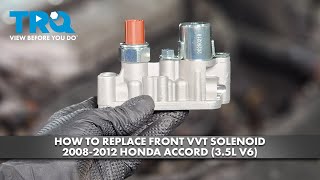
Typical fix: Replace the Bank 2 (front) VVT spool valve assembly. 🎬 Watch this step-by-step guide to replacing the front VVT solenoid. It is highly recommended to use an OEM part (Honda or Hitachi) as some aftermarket versions have high failure rates.
Est. part cost: $70-$300
Rare But Worth Checking
- Stretched or Jumped Timing Belt: This is very uncommon on a well-maintained J35 engine but can happen if the belt is past its service interval (typically around 100,000 miles). It would typically be accompanied by more severe running issues, rattling noises, and potentially other timing codes. This is a last resort to check if all other diagnostics fail.
- Failed Camshaft Phaser: The mechanical phaser (VTC actuator) that the solenoid acts upon can get stuck. This is a much more involved and expensive repair that should only be considered after ruling out oil and solenoid issues. A rattling noise on cold starts can be a symptom of a failing VTC actuator.
Diagnosis Steps
- Check Engine Oil: Pull the dipstick. Is the oil level correct? Is the oil clean or is it dark and sludgy? If low or dirty, perform an oil and filter change, clear the code, and drive to see if it returns. This is the most critical first step.
- Scan for Other Codes: Use an OBD-II scanner to confirm P0022 is the only code present. Note any VCM-related codes like P3400 or P3497.
- Inspect the Solenoid: Locate the Bank 2 (front) VVT spool valve. Check the electrical connector and wiring for any obvious damage or corrosion. Look for oil leaking from the spool valve assembly down onto the alternator. 🎬 See how to identify and fix a leaking front spool valve.
- Perform the 'Swap Test': Unplug and unbolt the front (Bank 2) and rear (Bank 1) VVT spool valves. They are identical parts. Swap their positions. Clear the codes and drive the vehicle. If the code returns as P0012 (Bank 1 over-retarded), you have confirmed the solenoid you moved to the rear is faulty.
- Test the Solenoid (Optional): If you have a multimeter, you can check the resistance of the solenoid. A video for Honda vehicles suggests a reading between 6.9 and 7.9 ohms is expected. You can also briefly apply 12V power to see if the solenoid makes an audible click.
- Inspect for Sludge: When the solenoid is removed, look into the port in the cylinder head for signs of heavy sludge buildup that could be blocking oil passages. If sludge is present, more extensive engine cleaning may be necessary.
- Seek Professional Help: If a new OEM solenoid and clean oil do not fix the issue, the problem may be mechanical (timing belt, phaser) and requires professional diagnosis.
Parts You'll Likely Need
- Front VVT Solenoid / Spool Valve Assembly (Bank 2)
(OEM #15810-R70-A04)— This is the most common part to fail for code P0022. It gets clogged with oil debris or fails electrically, preventing correct camshaft timing adjustment. This part number supersedes the older 15810-R70-A03.
Trusted brands: Honda (OEM), Dorman, Hitachi (Often the OEM supplier)
OEM price range: $200-$300
Aftermarket price range: $70-$150 - Engine Oil and Filter — The VVT system is entirely dependent on clean oil at the correct pressure. Due to the J35's tendency to consume oil, this should always be the first step in addressing this code.
Trusted brands: Mobil 1, Castrol, Valvoline
OEM price range: $60-$90
Aftermarket price range: $40-$70 - PCV Valve
(OEM #17130-5A2-A01)— As a low-cost maintenance item, replacing a clogged PCV valve may help reduce the excessive oil consumption that often leads to the low oil condition triggering P0022.
Trusted brands: Honda (OEM)
OEM price range: $25-$40
Aftermarket price range: $10-$20
Related Codes That Often Appear With This One
- P3400 / P3497: These codes relate to the VCM system (Bank 1 and Bank 2 respectively) and often appear alongside oil consumption issues that can lead to P0022. Honda TSB 11-033 addresses a software update for these codes.
Technical Service Bulletins (TSBs) & Recalls
- TSB 11-033: Addresses excessive oil consumption and related VCM codes (P3400, P3497) by updating the PGM-FI software to change how the VCM system engages. While not directly for P0022, it addresses the root cause of oil loss that often triggers it.
Platform-Specific Known Issues
- VCM-Related Oil Consumption: The Variable Cylinder Management (VCM) system in the J35 engine is designed to improve fuel economy by shutting down cylinders during light load. However, it is widely documented to cause increased oil consumption due to oil seeping past piston rings on the deactivated cylinders. This leads to low oil levels, which directly causes P0022. A class-action lawsuit was settled over this issue, and Honda released TSB 11-033 with a software update that 'may' reduce consumption by altering VCM behavior.
Mechanic-Grade Diagnostic Values
- VVT Solenoid (Spool Valve) Coil Resistance — expected: 6.9 to 7.9 ohms at 68°F (20°C). Failure: A reading of 'OL' (open circuit) or a value significantly outside the expected range indicates a failed solenoid coil.
- VVT Solenoid (Spool Valve) Bolt Torque — expected: 8.7 ft-lbs (104 in-lbs). Failure: Over-tightening can damage the new gasket and cause leaks; under-tightening can also cause leaks.
- VVT Solenoid Harness Voltage — expected: Approximately battery voltage (e.g., 8.6V - 12V+) with key on, engine off.. Failure: No voltage or very low voltage suggests a wiring issue, blown fuse, or problem with the PCM driver circuit.
Scan Tool Commands That Help
- Honda HDS (Honda Diagnostic System): VTC System Test — This is a bidirectional test available on the dealer-level scan tool. It allows a technician to command the VVT solenoid on and off while monitoring the camshaft angle to see if the system responds correctly. This can definitively confirm if the solenoid is working and if the phaser is able to move, helping to distinguish between an electrical and a mechanical fault.
Wiring & Ground Locations
- G101 — On the intake manifold plenum, on the driver's side of the engine bay. On some J-series engines, it is located on or near the thermostat housing.. G101 is a primary ground point for the engine harness and ECU. A poor connection at this ground can cause a wide range of erratic sensor readings and actuator problems, including incorrect operation of the VVT solenoids, potentially triggering timing codes like P0022.
- VVT Solenoid Connector — The connector plugs directly into the top of the VVT spool valve assembly on the front valve cover.. The two pins in this connector provide power and ground (or signal) to the solenoid. Testing for voltage at this connector is a key diagnostic step to rule out a wiring problem before replacing the solenoid itself.
Real Owner Repair Stories
- Reddit user in r/HondaElement (Honda Element (with K-series engine, but VVT solenoid principle is identical)) — Classic symptoms of a bad VVT solenoid.
❌ Tried (didn't work) The user initially tried to clean the original, heavily sludged OEM solenoid but it was too far gone.
✅ What actually fixed it A Dorman aftermarket solenoid was installed and it failed after 6 months. The user's advice was to use an OEM (Honda) or OEM-supplier (Keihin/Hitachi) part for reliability and to maintain clean oil, as the root cause was severe neglect of oil changes. - Reddit user in r/HondaOdyssey (2011 Honda Odyssey (with J35 engine)) — Leaking spool valve.
❌ Tried (didn't work) Replacing just the gasket with a Mahle aftermarket gasket resulted in the leak returning after 5,000 miles., Another user reported that a non-OEM assembly continued to leak.
✅ What actually fixed it Replacing the leaking part with a genuine Honda OEM part (15810-R70-A04) resolved the leak. Multiple users in the thread strongly recommended using only the OEM part to avoid repeat failures.
OEM Part Supersession History
15810-R70-A03→15810-R70-A04— Standard part revision by Honda. The new part is a direct replacement.
Heads up: The parts are fully cross-compatible. 15810-R70-A04 is the correct and current part to order.
Model Year Variations Within This Range
- 2008-2012 (8th Gen with Automatic Transmission): The J35Z2 engine in automatic Accords does not have a true high-lift VTEC system on the intake cam like the manual transmission's J35Z3 engine. Instead, it uses a single intake cam lobe profile and utilizes the VVT/VCM hardware to deactivate cylinders for fuel economy. The P0022 code is still relevant as the base cam timing is controlled by the same oil-pressure-actuated phaser and spool valve.
- 2013-2017 (9th Gen): The 9th generation uses the J35Y1 engine. While it is an evolution of the J35Z series, the VVT system and the causes for P0022 (oil level, spool valve failure) remain fundamentally the same. The VCM system and its related oil consumption issues are also present on this generation.
Diagnostic Flowchart
Other Known Issues on This Vehicle
Issues unrelated to this code that are worth knowing about as an owner of this generation:
- Excessive Oil Consumption (VCM) 🔴 High — Very common across all V6 models with VCM, often starting after 60,000 miles. Led to a class-action lawsuit. (Ref: TSB 11-033)
- Automatic Transmission Judder/Shudder 🟠 Medium — Common issue, especially on 9th gen (2013-2017) models, typically felt between 20-60 mph. Caused by deteriorated transmission fluid. (Ref: TSB 17-017, TSB 17-018)
- Premature Starter Motor Failure 🟠 Medium — A well-documented problem on both 8th and 9th generation models, where the starter may grind or fail to engage. (Ref: TSB 16-002 (for 2013-2015 V6))
- Premature Brake Wear 🟡 Low — Owners frequently report replacing pads and rotors sooner than expected, particularly on 8th generation models.
- Failing LED Daytime Running Lights 🟡 Low — Affects 2016-2017 models, where the LED strip in the headlight assembly partially or completely fails. (Ref: Honda extended the warranty for this specific issue.)
- Power Steering Hose Leak 🟡 Low — Common on higher-mileage 8th generation models, leading to whining noises and stiff steering if fluid becomes low.
Used vs. New Parts: Buying Guide for This Vehicle
When a used part is the smart pick: A used OEM spool valve from a low-mileage, rear-ended donor vehicle can be a cost-effective alternative to a new aftermarket part. Given the high failure rate of some aftermarket brands, a used genuine Honda/Hitachi part is often a safer bet.
Donor-vehicle mileage cap: roughly under 80000 miles for the part to have meaningful remaining life.
What to inspect on the donor part:
- Ask for the VIN of the donor car to verify mileage and check for a history of regular maintenance if possible.
- Inspect the filter screen on the solenoid. It should be perfectly clean and free of any metallic debris or sludge.
- Check the electrical connector for any corrosion, cracks, or damage.
- Avoid parts from engines that show visible signs of heavy oil sludge or poor maintenance.
OEM-only on this vehicle (don't cheap out):
- VVT Solenoid / Spool Valve Assembly
Aftermarket brands forum-validated for this vehicle:
- Hitachi (often the original OEM supplier to Honda)
Brands owners have reported issues with on this vehicle:
- Unbranded parts from Amazon/eBay have a high reported failure rate.
- Dorman is sometimes cited as having a shorter lifespan than OEM, with some owners reporting failures within a year.
Real Owner Stories
Aggregated from forums and TSBs cited above. Mileages and costs reflect what owners reported in those sources.
2010 Honda Accord V6
Symptoms: Owner reported being a quart low on oil between changes and discussed the need for a software update to address VCM behavior.
What fixed it: Software update (PGM-FI) as per TSB 11-033 to change how the VCM system engages and reduce oil consumption.
Source hint: driveaccord.net - '2010 Accord V6 AT SB 11-033'
2010 Honda Accord V6 — ~65000 miles
Symptoms: Excessive oil consumption issues common across V6 models with VCM, often starting after 60,000 miles.
What fixed it: Implementation of TSB 11-033 which includes a software update to the PGM-FI system.
Source hint: driveaccord.net - '2010 V6 Service bulletin 11-033'
2008-2013 Honda Accord J35 V6
Symptoms: High oil consumption in VCM engines leading to low oil levels; issue was part of a class-action settlement.
What fixed it: Extended warranty offered as part of the class-action settlement and TSB software updates.
Source hint: BobIsTheOilGuy.com - 'High oil consumption VCM engines'
Related OBD-II Codes
Frequently Asked Questions
Does TSB 11-033 apply to my 2010 Accord V6 with P0022?
Can I use an aftermarket VVT spool valve to fix the P0022 code?
Is there a specific part number for the PCV valve to help with the oil consumption causing this code?
How can I tell if my P0022 code is caused by a bad solenoid or just low oil?
Was there a legal settlement regarding the oil issues on the 2008-2017 Honda Accord?
What should the resistance be if I test the VVT solenoid with a multimeter?
Helpful Videos
We Have This Part in Stock


The information in this article is provided for general reference and educational purposes only. Vehicle specifications, procedures, and part compatibility can vary by production date, trim level, and region. Always consult your vehicle's factory service manual and verify part numbers before purchasing or performing repairs. Safety-critical components such as airbags, seat belts, and braking systems should be installed by a qualified professional.
- Honda Accord:
- 🎬 Helpful Videos
- 🛍️ Shop This Part
- What's Unique About the 2008-2017 Honda Accord
- Symptoms You May Notice
- Most Likely Causes
- Rare But Worth Checking
- Diagnosis Steps
- Parts You'll Likely Need
- Related Codes That Often Appear With This One
- Technical Service Bulletins (TSBs) & Recalls
- Platform-Specific Known Issues
- Mechanic-Grade Diagnostic Values
- Scan Tool Commands That Help
- Wiring & Ground Locations
- Real Owner Repair Stories
- OEM Part Supersession History
- Model Year Variations Within This Range
- Diagnostic Flowchart
- Other Known Issues on This Vehicle
- Used vs. New Parts: Buying Guide for This Vehicle
- Real Owner Stories
- 2010 Honda Accord V6
- 2010 Honda Accord V6 — ~65000 miles
- 2008-2013 Honda Accord J35 V6
- Related OBD-II Codes
- Frequently Asked Questions
- 🎟️ Get 5% Off