

P0019 on 2015-2017 GMC Acadia: Crank/Cam Correlation, Causes, and Fixes
P0019 on a 2015-2017 GMC Acadia almost always indicates stretched timing chains, a known issue with the 3.6L V6 engine. This is a serious, urgent repair. Expect a shop cost of $2,800-$3,700 due to high labor. The issue is often linked to extended oil change intervals, sometimes encouraged by the factory Oil Life Monitor (OLM).
- P0019 on a 2015-2017 Acadia is a serious code that should be addressed immediately to prevent severe engine damage.
- The overwhelming cause is stretched timing chains, a known issue with the 3.6L V6 engine.
- Do not waste money replacing sensors first; the problem is almost certainly mechanical.
- This is not a DIY-friendly repair. Budget for a significant professional repair bill, as labor can exceed 12-15 hours.
- Always use the correct specification engine oil and change it on schedule to maximize the life of the timing components.
What's Unique About the 2015-2017 Gmc ACADIA
The 3.6L V6 engine (RPO code LFX) used in this generation of GMC Acadia is widely known for premature timing chain stretching, though it is considered more reliable than the earlier LLT version. The problem is often attributed to the original Oil Life Monitor (OLM) calibration, which could suggest oil change intervals of 10,000 miles or more. Such long intervals can lead to oil degradation and viscosity breakdown, causing insufficient lubrication and accelerated wear on the three timing chains, their tensioners, and guides. GM acknowledged this issue across the engine family with multiple TSBs (like #PIP3423P and #12-06-01-009D) and even Special Coverage Adjustments for earlier model years, highlighting the prevalence of the problem.
Diagnostic Flowchart
Tap your situation to follow the diagnostic path that matches what you're seeing on this vehicle.
Generation note: The 2015-2016 models are part of the first generation. The 2017 model year was a split: GM sold both the first-generation model as the 'Acadia Limited' and the all-new, smaller second-generation Acadia. Both generations used a 3.6L V6, but the first generation (and the 'Limited') used the LFX engine, which is most commonly associated with this timing chain problem. The second-generation 2017 Acadia also used a 3.6L V6 (LGX), which is an evolution of the LFX and can still be susceptible to timing issues, though less commonly.
Symptoms You May Notice
- Check Engine Light is on
- Rough or unstable idle
- Engine hesitation or stumbling during acceleration
- Reduced engine power
- Poor fuel economy
- Rattling or whining noise from the engine, especially on cold startup, that may last for a few seconds.
- Engine shaking or vibrating.
- Replacing only the camshaft position sensor.
- Replacing only the crankshaft position sensor.
- Replacing only the VVT solenoid without checking the timing chain slack or swapping solenoids to confirm the failure.
Most Likely Causes
- Stretched Timing Chains 🔴 High Probability The 3.6L V6 engine family has a well-documented history of premature timing chain wear. The chains stretch over time, causing the cam/crank correlation to fall out of the acceptable range. This is often linked to oil degradation from extended oil change intervals suggested by the Oil Life Monitor. This issue is confirmed by manufacturer TSBs like #PIP3423P and #12-06-01-009D.
How to confirm: A technician can use a professional scan tool to observe camshaft position deviation data. A deviation of more than 4-5 degrees at idle is a strong indicator of a mechanical timing issue. Definitive diagnosis requires physically inspecting the chains for slack by removing the front timing cover, which is a labor-intensive process. A loose chain will be visibly slack when inspected.
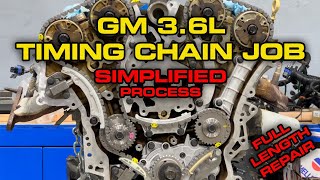
Typical fix: Replace all three timing chains, all hydraulic tensioners, and all plastic guides. It is also highly recommended to replace the water pump and camshaft phasers during the job.
Est. part cost: $400-$800 - Failed Timing Chain Tensioners 🔴 High Probability The hydraulic tensioners, which use oil pressure to keep the chains tight, can weaken or fail. This is especially common if oil changes are neglected or the oil level is low, leading to chain slack. They are considered a wear item and are always replaced as part of a complete timing chain job.
How to confirm: Diagnosed during a physical inspection of the timing system. A rattling noise on cold startups is a classic symptom of a tensioner failing 🎬 Watch: Hear what a failing timing chain rattle sounds like. to pump up with oil pressure immediately.
Typical fix: Replace tensioners along with the timing chains and guides. Using an updated, complete timing kit is essential.
Est. part cost: $100-$200 (part of kit) - Low or Dirty Engine Oil 🟡 Medium Probability The camshaft phasers (VVT actuators) and timing chain tensioners are operated by oil pressure. Low oil level, incorrect oil viscosity (not using 5W-30 Dexos-spec oil), or dirty/sludgy oil can prevent them from working correctly, leading to timing correlation codes. Many owners report that the issue is exacerbated by not checking the oil level frequently, as low oil levels reduce lubrication to the upper parts of the chain system.
How to confirm: Check the oil level on the dipstick and inspect its condition. If it's low or very dirty, this is a likely contributing factor. An oil change may be a temporary fix, but if the chains are already stretched, the code will return.
Typical fix: Perform an oil and filter change using the correct specification oil (5W-30 full synthetic meeting GM's Dexos specification). Clear codes and see if the problem returns. Many experts recommend a 5,000-mile oil change interval, regardless of the OLM reading, to prevent recurrence.
Est. part cost: $50-$100 - Faulty Camshaft Position Actuator Solenoid (VVT Solenoid) ⚪ Low Probability This solenoid controls oil flow to the cam phaser. It can become clogged with sludge or fail electronically. While possible, it's a much less common cause for P0019 on this engine than the chains themselves and is often replaced as a misdiagnosis.
How to confirm: Can be tested with a scan tool by commanding it on and off. A common DIY method is to swap the Bank 2 exhaust solenoid with the Bank 2 intake solenoid. If the code changes to P0018 (Intake correlation error), the solenoid is confirmed to be faulty. If P0019 returns, the issue is mechanical.
Typical fix: Replace the Bank 2 exhaust VVT solenoid. The OEM part number is 12633613, which may have been superseded by newer numbers like 12679100.
Est. part cost: $30-$70
Rare But Worth Checking
- Faulty Camshaft or Crankshaft Position Sensor: While these sensors provide the data, they rarely fail in a way that causes a correlation code without also setting a sensor-specific circuit code (e.g., P034x, P033x). It's an unlikely cause but possible. Swapping sensors is a common but usually fruitless diagnostic step.
- Failed Camshaft Phaser: The phaser itself, which is the gear on the end of the camshaft, can get stuck or fail internally. In some cases, the teeth can show significant wear from a loose chain. It is best practice to replace the phasers during a full timing chain job to prevent future issues.
- Slipped Crankshaft Reluctor Ring: There are some reports, particularly on the related 3.6L LLT engine, of the reluctor ring (tone ring) on the crankshaft moving from its original position. This causes the crankshaft position sensor to send incorrect data, leading to correlation codes even with new timing chains. This is a rare but difficult-to-diagnose cause.
Diagnosis Steps
- Verify the engine oil level and condition. Correct if low or dirty, as this is a major contributing factor.
- Use an OBD-II scanner to check for any other stored trouble codes. The presence of P0008, P0016, P0017, or P0018 strongly points to a timing chain issue.
- Use a professional scan tool to monitor live data for Camshaft Position Variance for Bank 2. Deviations beyond 4-5 degrees at idle strongly suggest a mechanical timing issue.
- Listen for a rattling or scraping noise from the front (passenger side) of the engine on a cold start, which indicates a loose chain and failing tensioners.
- As a low-cost diagnostic step, swap the Bank 2 exhaust VVT solenoid with the Bank 2 intake VVT solenoid. Clear codes. If the code changes to P0018, the solenoid is bad. If P0019 returns, the problem is mechanical. 🎬 See how to diagnose P0018 and P0019 codes on an Acadia.
- If the above steps confirm a mechanical fault, a physical inspection of the timing chains is required. This involves significant labor to remove the engine front cover and check for chain slack and guide/tensioner wear.
Parts You'll Likely Need
- Engine Timing Chain Kit
(OEM #12651450 (This is a common kit number, verify for specific VIN. May also see 12700436 or 12700437).)— This is the most common failure. A complete k
Related Codes That Often Appear With This One
- P0008 — Indicates a general engine position system performance error for Bank 1. It is often the first code to appear in a timing chain failure and points to a stretched primary chain affecting both banks.
- P0018 — Indicates a cam/crank correlation issue on Bank 2, but for the intake camshaft ('Sensor A'). Often appears with P0019, strongly suggesting the Bank 2 secondary timing chain is loose.
- P0016 — Indicates a cam/crank correlation issue on Bank 1 (firewall side), intake camshaft. Suggests all chains are stretched or the primary chain has a problem.
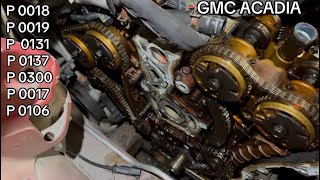
- P0017 — Indicates a cam/crank correlation issue on Bank 1 (firewall side), exhaust camshaft. Seeing multiple codes (P0016, P0017, P0018, P0019) is a definitive sign of a major timing system failure.
Technical Service Bulletins (TSBs) & Recalls
- Bulletin #PIP3423P: Notes that DTCs P0016, P0017, P0018, P0019, P0008 or P0009 may be set and advises technicians to inspect for loose timing chains or tensioners.
- Bulletin #12-06-01-009D: Announces comprehensive timing chain service kits and advises against unnecessarily replacing guides, idler sprockets, or phasers unless they show clear signs of wear.
Platform-Specific Known Issues
- The primary issue is the premature stretching of the timing chains in the 3.6L V6 engine, as documented in GM TSB #PIP3423P.
- The factory Oil Life Monitor (OLM) calibration often encouraged excessively long oil change intervals, which is widely believed to be a primary contributor to accelerated chain wear due to oil degradation.
- For earlier models, GM issued Special Coverage Adjustment #11340C, extending the warranty on timing chains to 10 years/120,000 miles, demonstrating the widespread nature of the problem. While this does not apply to 2015-2017 models, it establishes the engine's history.
Mechanic-Grade Diagnostic Values
- Camshaft Position Actuator Solenoid (VVT Solenoid) Resistance — expected: 8 to 13 Ohms. Failure: A reading in the kilo-ohms (KΩ) or mega-ohms (MΩ) indicates an open circuit, while a reading outside the spec (e.g., 7 Ohms or 15 Ohms) also indicates failure.
- Camshaft Position Sensor (3-wire Hall-effect) Signal Voltage — expected: The signal wire should read approximately 5 volts with Key On, Engine Off. When a metal object passes in front of the sensor, the voltage should drop to near 0 volts.. Failure: Voltage does not switch, is always 0V, or is always 5V, indicating a faulty sensor or wiring issue.
- Camshaft Position Sensor Mounting Bolt Torque — expected: 89 lb-in (10 Nm). Failure: N/A - This is an installation specification.
Scan Tool Commands That Help
- GDS2 / Professional Scan Tool: VVT Solenoid (OCV) Actuator Test — Use this bidirectional control to command the Bank 2 exhaust solenoid on and off while the engine is idling. A functional solenoid and clear oil passages will cause the engine to hesitate or stall. If there is no change in engine operation, the solenoid may be faulty or its oil passages may be blocked.
- GDS2 / Professional Scan Tool: Crankshaft Position System Variation Learn — This procedure must be performed after replacing the ECM, the crankshaft position sensor, or the crankshaft itself. Failure to perform the relearn can result in misfire detection issues or other running problems, though it will not typically cause a P0019 code on its own.
Wiring & Ground Locations
- Camshaft Position Sensor Connector — On the Bank 2 (front/radiator side) valve cover, connecting to the exhaust camshaft position sensor.. This is a 3-wire connector. GM TSB PI0090D (superseding earlier versions) notes that intermittent hesitation or codes can be caused by poor connections or backed-out terminals in the camshaft sensor harness connectors. A visual inspection for corrosion, damage, or loose pins is a critical early step.
- Main Engine/Chassis Ground — The main ground cable runs from the battery's negative terminal to a grounding point on the engine block and a smaller wire to the vehicle's chassis/frame. On the Acadia, a designated ground lug for jumping is located on the passenger side strut tower.. While not a direct cause of P0019, a poor ground connection can cause a host of bizarre electrical issues, including intermittent sensor readings and no-start conditions that can complicate diagnosis. Ensuring the main grounds are clean and tight is a foundational step in any electrical diagnosis.
Real Owner Repair Stories
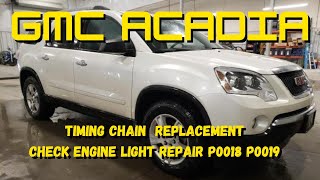
- YouTube channel 'UnpopularMechanic' (2012 GMC Acadia with P0018 and P0019) — Check engine light on, rough running, and rattling noise from engine.
❌ Tried (didn't work) The owner purchased the vehicle at auction with the codes present, so prior attempts are unknown.
✅ What actually fixed it A complete timing job was performed. The video shows extreme slack in the Bank 2 timing chain upon removing the valve cover. The fix involved replacing all timing chains, guides, tensioners, and sprockets. The mechanic also noted indentations on the cam phasers from the loose chain hitting them. - 2CarPros Forum user 'YOSSRY EISA' (2007 GMC Acadia with P0019) — Check Engine Light on, factory remote start not working.
❌ Tried (didn't work) Replaced two camshaft sensors on Bank 2., Replaced two VVT solenoids on Bank 2., Replaced the crankshaft position sensor., Cleared the code with a scanner, but it returned.
✅ What actually fixed it The story is a classic example of misdiagnosis. The user replaced all the common electrical components associated with the code without success. An ASE certified mechanic on the forum advised that the problem is almost certainly mechanical (timing chains) or a severe oil sludge issue, and that replacing sensors was a waste of money. The final fix from the user was not posted, but the expert diagnosis points directly to the timing chains as the unresolved root cause.
OEM Part Supersession History
12628348, 12646784, 12655421→12679100— Part has been updated by GM over time for improved reliability or manufacturing changes. This is a common VVT solenoid part number for many GM engines.
Heads up: While the Pass 2 article mentioned 12633613, 12679100 is a widely cited replacement for VVT solenoids on this engine family, superseding multiple older numbers. Always verify the correct part number with the vehicle's VIN.
Model Year Variations Within This Range
- 2017: The 2017 model year was a split. The first-generation style was sold as the 'Acadia Limited' and retained the 3.6L LFX engine, which is highly susceptible to the timing chain issues that cause P0019. The all-new second-generation 2017 Acadia introduced the redesigned 3.6L LGX engine. The LGX was a 'clean-sheet design' intended to fix the LFX's flaws, featuring a more robust timing drive system, improved cooling, and a variable displacement oil pump. While an LGX can still theoretically set a P0019, it is far less common, and the root cause is less likely to be premature chain stretch compared to the LFX.
Helpful Videos
Used OEM Parts in Stock


New Aftermarket Parts Available


The information in this article is provided for general reference and educational purposes only. Vehicle specifications, procedures, and part compatibility can vary by production date, trim level, and region. Always consult your vehicle's factory service manual and verify part numbers before purchasing or performing repairs. Safety-critical components such as airbags, seat belts, and braking systems should be installed by a qualified professional.
- Gmc ACADIA:
- 🎬 Helpful Videos
- 🛍️ Shop This Part
- What's Unique About the 2015-2017 Gmc ACADIA
- Diagnostic Flowchart
- Symptoms You May Notice
- Most Likely Causes
- Rare But Worth Checking
- Diagnosis Steps
- Parts You'll Likely Need
- Related Codes That Often Appear With This One
- Technical Service Bulletins (TSBs) & Recalls
- Platform-Specific Known Issues
- Mechanic-Grade Diagnostic Values
- Scan Tool Commands That Help
- Wiring & Ground Locations
- Real Owner Repair Stories
- OEM Part Supersession History
- Model Year Variations Within This Range
- 🎟️ Get 5% Off