

P0017 on 2015-2020 Lincoln MKZ: Crank-Cam Correlation Causes and Fixes
P0017 on a 2015-2020 Lincoln MKZ most often points to a sticking exhaust VCT solenoid on Bank 1, often due to dirty or low engine oil. Start by checking your oil; if the level and quality are good, the VCT solenoid is the next likely culprit. Replacing the solenoid costs around $200-$436 at a shop. If the engine has a rattling noise, it could indicate a more serious timing chain issue.
- P0017 is a serious code that should be addressed promptly to avoid poor performance and potential engine damage.
- The most likely cause on your Lincoln MKZ is a faulty Bank 1 exhaust VCT solenoid, a known issue referenced in manufacturer TSBs.
- Always check your engine oil level and condition first, as low or dirty oil is a primary trigger for VCT system faults.
- Do not immediately replace the camshaft sensor; it is more likely to be reporting a real problem than to be the problem itself.
- If a VCT solenoid replacement and oil change do not fix the issue, the problem is likely a more complex mechanical timing issue requiring professional diagnosis.
What's Unique About the 2015-2020 Lincoln MKZ
For this generation of Lincoln MKZ, Ford has issued multiple Technical Service Bulletins (TSBs) acknowledging that VCT solenoids can stick due to small debris in the engine oil, directly causing codes like P0017. This makes a faulty VCT solenoid a higher-than-average probability compared to other potential causes. The TSBs even advise technicians to attempt to clear the debris by cycling the solenoid with a scan tool before replacing it. While sensor or timing chain issues can occur, the manufacturer has specifically highlighted the solenoids as a known trouble spot across the 2.0L, 3.7L, and 3.0L engines used in this vehicle.
Diagnostic Flowchart
Tap your situation to follow the diagnostic path that matches what you're seeing on this vehicle.
Generation note: The 2015-2020 period covers the second generation of the MKZ, but a major facelift occurred in 2017. This update included replacing the 3.7L V6 engine with a new 3.0L twin-turbo V6. While the code's meaning is the same, specific parts like VCT solenoids differ between the 2.0L, 3.7L, and 3.0L engines, requiring careful part selection.
Symptoms You May Notice
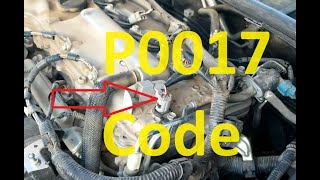
- Check Engine Light is on 🎬 Watch: A breakdown of common P0017 causes and fixes.
- Rough or unstable idle
- Noticeable loss of engine power and poor acceleration
- Engine may hesitate or stall
- Decreased fuel economy
- Rattling noise from the engine, especially on startup
- Replacing the camshaft position sensor when the root cause is a sticking VCT solenoid or a mechanical timing issue. The sensor is often accurately reporting a problem, it is not the cause of the problem.
- Replacing the timing chain when the issue is only a clogged/failed VCT solenoid. Due to the high cost of a timing chain job, the much cheaper solenoid should always be diagnosed and/or replaced first.
Most Likely Causes
- Sticking or Failed VCT Solenoid 🔴 High Probability This is a known issue documented by Ford/Lincoln in TSBs SSM 47170, SSM 48423, and SSM 54366. Small debris in the oil can clog the solenoid's internal screens and passages, causing it to stick.
How to confirm: Use a scan tool to command the solenoid on/off (per TSBs, cycle it 10 times) and listen for a click or watch for a change in engine idle. You can also swap the exhaust solenoid with the intake solenoid (if identical) and see if the code changes to P0016.
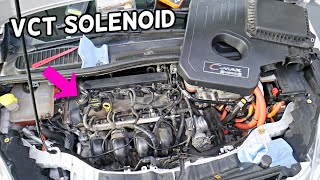
Typical fix: Replace the Bank 1 exhaust VCT (Variable Camshaft Timing) solenoid. The causal part number referenced in Ford's TSBs is the base number 6M280. 🎬 See this walkthrough on locating and replacing the VCT solenoid.
Est. part cost: $40-$85 - Low or Dirty Engine Oil 🔴 High Probability The VCT system is entirely dependent on hydraulic pressure from clean engine oil. Delayed oil changes, as reported by owners, lead to sludge and debris that directly clog and disable VCT components, triggering P0017.
How to confirm: Check the oil level on the dipstick and inspect its color and consistency. If it's low or appears dark and sludgy, it needs to be changed.
Typical fix: Perform an engine oil and filter change using the manufacturer-specified grade of oil (e.g., Motorcraft Synthetic Blend).
Est. part cost: $50-$100 - Stretched Timing Chain or Worn Timing Components 🟡 Medium Probability Over time, especially on higher mileage engines (over 100k miles), the timing chain can stretch, or the plastic guides and tensioners can wear out. This creates slack, altering the mechanical timing between the crank and cams and triggering a correlation code.
How to confirm: This is a mechanical issue that requires removing the timing cover for a physical inspection of the chain, guides, tensioner, and phaser sprockets. A rattling noise from the front of the engine is a strong indicator. This is an advanced diagnostic step.
Typical fix: Replace the timing chain, tensioners, guides, and often the camshaft phasers as a complete kit.
Est. part cost: $300-$700 - Failed Camshaft Position Sensor ⚪ Low Probability
How to confirm: After confirming the VCT solenoid is working and the base timing is correct, test the sensor's signal with a multimeter or oscilloscope. A lack of signal or an erratic signal points to a bad sensor. However, this is rare; the sensor is usually correctly reporting the timing error.
Typical fix: Replace the Bank 1 exhaust camshaft position sensor.
Est. part cost: $25-$60
Rare But Worth Checking
- Damaged Camshaft Phaser (Actuator): The gear at the end of the camshaft can fail internally or get stuck, preventing it from adjusting timing correctly. This is often replaced during a full timing chain service.
- Clogged Oil Passages: Severe engine sludge can block the small oil passages in the cylinder head that feed the VCT solenoid and phaser, starving them of the oil pressure needed to operate.
- Damaged Wiring or Connectors: Frayed wires or corroded pins at the VCT solenoid or camshaft sensor connector can cause an intermittent signal and trigger the code. A visual inspection is the first step.
- Internal Water Pump Failure (3.7L V6): On the 3.7L Duratec V6, the water pump is driven by the timing chain. A failure of the pump's bearing can cause coolant to leak into the engine oil, compromising lubrication and potentially causing the timing chain to fail, leading to P0017 and other timing codes.
Diagnosis Steps
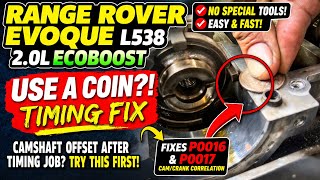
- Check Engine Oil: Verify the oil level is correct and the oil is clean. If low or dirty, perform an oil and filter change, clear the code, and re-test. This is the simplest 🎬 Watch: A clever trick to try before replacing the timing chain. and often most effective first step.
- Scan Tool Analysis: Use a capable OBD-II scanner to monitor the desired vs. actual camshaft position for Bank 1 Exhaust. A large discrepancy indicates a real-time fault.
- Test the VCT Solenoid: Following Ford's TSB procedure, use the scanner's bidirectional controls to command the Bank 1 exhaust VCT solenoid on and off 10 times to dislodge debris. A healthy solenoid will produce an audible click and a noticeable change in engine idle. No change suggests a stuck or failed solenoid.
- Swap Solenoids (if applicable): If the intake and exhaust solenoids are identical, swap them. Clear the codes and drive the vehicle. If the code changes to P0016 (Intake Cam), the solenoid you moved is faulty.
- Inspect Wiring: Check the connector and wiring going to the VCT solenoid and the camshaft position sensor for any signs of damage, corrosion, or loose connections.
- Test Camshaft Position Sensor: If other tests pass, test the sensor's output signal to ensure it is functioning correctly. This is an unlikely failure point.
- Inspect Mechanical Timing: If all electrical components and sensors check out, the final step is to perform a mechanical inspection. This involves removing the engine's timing cover to check for a stretched timing chain, worn guides, or a failed phaser. This is a labor-intensive step best left to professionals.
Parts You'll Likely Need
- Engine Variable Valve Timing (VVT) Solenoid
(OEM #2.0L EcoBoost: 8L3Z-6M280-B (or BL3Z-6M280-B); 3.7L Duratec V6: 7T4Z-6M280-C; 3.0L EcoBoost V6: FT4Z-6M280-B)— This is the most common point of failure according to manufacturer TSBs for this specific code and vehicle.
Trusted brands: Motorcraft, Dorman, Standard Motor Products (SMP), NGK
OEM price range: $60-$100
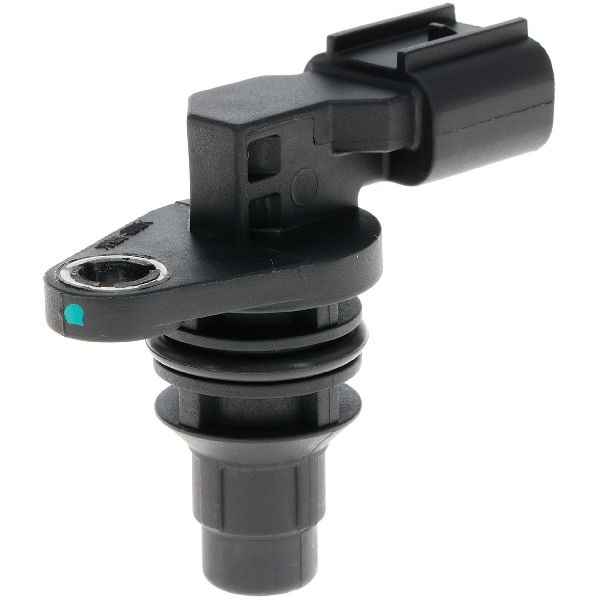
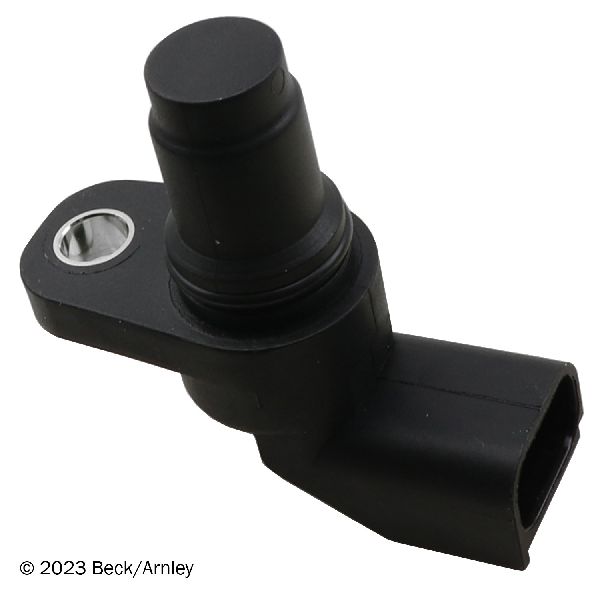
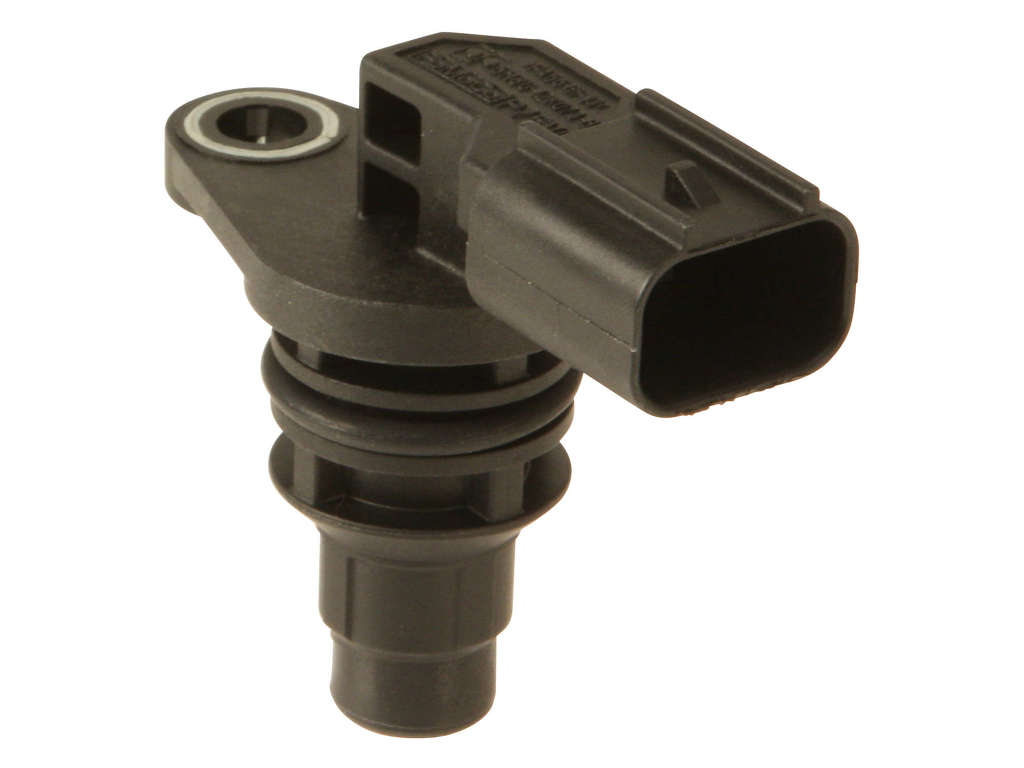
Aftermarket price range: $40-$85 - Camshaft Position Sensor — A less common but possible cause. It may fail and send incorrect data to the PCM.
Trusted brands: Motorcraft, Bosch, Delphi
OEM price range: $40-$70
Aftermarket price range: $25-$60 - Timing Chain Kit — Required if diagnosis points to a stretched chain, worn guides, or failed tensioner. This is a major repair, often needed on higher mileage vehicles.
Trusted brands: Motorcraft, Cloyes
OEM price range: $400-$800
Aftermarket price range: $300-$700
Related Codes That Often Appear With This One
- P0016 — Crank/Cam correlation error for Bank 1 Intake. If seen with P0017, it strongly suggests a base timing issue (e.g., stretched chain) affecting the entire bank, rather than a single component failure.
- P0011, P0012, P0014, P0015 — These are other VCT-related codes for over-advanced or over-retarded timing. Their presence alongside P0017 points to a widespread VCT system problem, often related to oil pressure or quality, as noted in the TSBs.
- P0301, P0302, P0303 — Misfire codes for cylinders on Bank 1. A severe timing correlation issue on Bank 1 can disrupt combustion enough to cause misfires on that entire bank, as seen in owner reports.
Technical Service Bulletins (TSBs) & Recalls
- SSM 47170: Notes that VCT codes including P0017 may be due to small debris causing the VCT solenoid to stick. Advises technicians to cycle the solenoid 10 times with a scan tool to try and clear it before replacement.
- SSM 48423: Re-issues the same guidance as SSM 47170 for a broader range of model years, confirming the persistent nature of the VCT solenoid issue. Causal part is listed as 6M280.
- SSM 54366: Updates the diagnostic procedure, pointing technicians to updated pinpoint tests in the official workshop manual for a group of VCT codes that includes P0017.
Platform-Specific Known Issues
- Per NHTSA Technical Service Bulletins SSM 47170, SSM 48423, and SSM 54366, these vehicles are known to exhibit P0017 and other related VCT codes due to small debris causing the VCT solenoid to stick. The TSBs specifically recommend using a scan tool to cycle the solenoid 10 times to attempt to dislodge the debris before component replacement.
Mechanic-Grade Diagnostic Values
- VCT Solenoid Resistance — expected: 5 to 14 Ohms. Failure: A reading outside this range, or an open/short circuit, indicates a failed solenoid coil.
- Camshaft Position Sensor (CMP) Signal Voltage Test — expected: Approximately 5V on the signal wire with key on, engine off. Should drop to near 0V when a ferrous metal object is passed in front of the sensor tip.. Failure: No voltage change during the test indicates a faulty sensor.
- Camshaft Position Sensor (CMP) Connector Voltage — expected: With key on, engine off: ~5V on the reference wire, ~12V (battery voltage) between the ground pin and the positive battery terminal.. Failure: Incorrect or missing voltage points to a wiring or PCM issue, not a faulty sensor.
Scan Tool Commands That Help
- Ford IDS (or equivalent high-level scanner): VCT Solenoid On/Off Command (Bidirectional Control) — As per TSBs SSM 47170, SSM 48423, and SSM 54366, this command should be used to cycle the suspect VCT solenoid multiple times to attempt to dislodge small debris causing it to stick. This can potentially fix the issue without replacing the part.
- Ford IDS (or equivalent high-level scanner): Monitor PIDs: VCTADV (VCT Advance), VCTADVERR (VCT Advance Error) — Monitor these Parameter IDs while running the engine to see the desired versus actual camshaft angle. A large, persistent value in VCTADVERR for the Bank 1 exhaust cam confirms a correlation error in real-time.
Wiring & Ground Locations
- G100 / G102 — Located on or near the left front strut tower in the engine compartment.. This is a primary engine and PCM ground point. A corroded or loose connection here can cause erratic voltage and signal issues for various engine sensors, including the camshaft and crankshaft sensors, leading to false correlation codes.
- G104 / G106 — Located on the right side of the engine compartment, often near the strut tower or inner fender.. Serves as another critical ground for engine electronics. Poor contact at this ground can introduce electrical noise and unstable sensor readings, contributing to timing correlation faults.
- VCT Solenoid Connector — Connected directly to the VCT solenoid, located on the valve cover (2.0L) or under the valve cover (3.7L, 3.0L).. This 2-pin connector and its wiring are exposed to heat and vibration. Check for oil contamination, brittle wires, or loose pins which can interrupt the signal from the PCM to the solenoid, preventing it from actuating correctly.
Real Owner Repair Stories
- Diesel Technician Society forum member Keith Browning (2015 Ford Transit with 3.7L Ti-VCT (engine shared with MKZ)) — Lack of power, Malfunction Indicator Lamp (MIL) on with code P0017.
❌ Tried (didn't work) Scan tool data showed the Bank 1 exhaust cam phaser was stuck at -18 degrees, suggesting a phaser issue.
✅ What actually fixed it Upon disassembly, the actual cause was a failed bearing in the timing chain idler gear. The bearing had disintegrated, likely causing enough timing deviation to trigger the P0017 code. The fix required a full timing component replacement.
OEM Part Supersession History
3L3Z-6M280-EA→8L3Z-6M280-A, then 8L3Z-6M280-B— Part has been revised and updated by Ford over the years for improved durability and performance.
Heads up: The latest part number, 8L3Z-6M280-B (or the compatible BL3Z-6M280-B), is the recommended replacement for the 2.0L EcoBoost and other Ford applications. Using older stock is not advised.
Model Year Variations Within This Range
- 2015-2016: These models used the 3.7L Duratec V6 as the optional engine. On this engine, the VCT solenoids are located under the valve covers, making replacement more labor-intensive, especially for the rear bank which requires intake manifold removal.
- 2017-2020: The 3.7L V6 was replaced by the 3.0L EcoBoost V6. While the VCT system functions similarly, the specific part numbers for solenoids (FT4Z-6M280-B) and other timing components are different from the 3.7L and 2.0L engines.
Helpful Videos

Used OEM Parts in Stock

New Aftermarket Parts Available


The information in this article is provided for general reference and educational purposes only. Vehicle specifications, procedures, and part compatibility can vary by production date, trim level, and region. Always consult your vehicle's factory service manual and verify part numbers before purchasing or performing repairs. Safety-critical components such as airbags, seat belts, and braking systems should be installed by a qualified professional.
- Lincoln MKZ:
- 🎬 Helpful Videos
- 🛍️ Shop This Part
- What's Unique About the 2015-2020 Lincoln MKZ
- Diagnostic Flowchart
- Symptoms You May Notice
- Most Likely Causes
- Rare But Worth Checking
- Diagnosis Steps
- Parts You'll Likely Need
- Related Codes That Often Appear With This One
- Technical Service Bulletins (TSBs) & Recalls
- Platform-Specific Known Issues
- Mechanic-Grade Diagnostic Values
- Scan Tool Commands That Help
- Wiring & Ground Locations
- Real Owner Repair Stories
- OEM Part Supersession History
- Model Year Variations Within This Range
- 🎟️ Get 5% Off