

P0017 on 2012-2018 Cadillac CTS: Stretched Timing Chain Causes and Fixes
P0017 on a 2012-2018 Cadillac CTS, especially with the 3.6L V6, almost always indicates a stretched timing chain. This is a serious issue requiring immediate attention. Expect a repair cost of $1,500-$2,500, as it is a labor-intensive job. While other causes like faulty sensors or solenoids are possible, they are far less common for this specific engine family.
- P0017 on a 2012-2018 CTS is a serious code that should be addressed immediately to prevent catastrophic engine failure.
- The overwhelming cause is a stretched timing chain, a known issue with the 3.6L V6 engine.
- Do not waste money replacing only the cam or crank sensors; the problem is almost certainly mechanical.
- The repair is expensive and complex, requiring the replacement of the full timing chain kit (chains, guides, tensioners).
- Using the correct engine oil (GM Dexos) and maintaining regular oil change intervals is critical for the longevity of the timing system.
What's Unique About the 2012-2018 Cadillac CTS
The Cadillac CTS from this era, particularly models equipped with the 3.6L V6 engine (LFX), is notoriously prone to premature timing chain stretching. This isn't a random part failure; it's a well-documented pattern for this engine family, as confirmed by multiple GM Technical Service Bulletins (TSBs). While other causes are possible, the high probability of a stretched timing chain is the key issue owners and technicians face. Many owners and technicians believe that extended oil change intervals, often promoted by the vehicle's own Oil Life Monitor (OLM) system, contribute to oil breakdown and sludging, which accelerates wear on the timing chains and tensioners.
🎬 Watch: Why these GM 3.6L timing chains fail so often.Diagnostic Flowchart
Tap your situation to follow the diagnostic path that matches what you're seeing on this vehicle.
Generation note: This range covers the end of the second generation (2012-2014) and the beginning of the third generation (2014-2018). Both generations used versions of the 3.6L V6 engine (LFX and later LGX) which are known for this timing chain issue. The problem is not isolated to one generation, though some sources suggest the timing chain design was updated in 2012, making earlier models more susceptible.
Symptoms You May Notice
- Check Engine Light is on
- Rattling noise from the engine, especially on a cold start
- Rough or unstable idle, with RPMs fluctuating
- Reduced engine power and sluggish acceleration
- Difficulty starting the engine or extended cranking time
- Poor fuel economy
- Engine stalling
- Replacing only the camshaft position sensor. While easy to access, this rarely fixes the P0017 code on a CTS because the underlying problem is almost always the mechanical timing chain system.
- Replacing only the crankshaft position sensor. Similar to the camshaft sensor, this is an unlikely fix for a correlation code on this specific vehicle.
- Performing an oil change and assuming the problem is fixed. While an oil change can sometimes temporarily clear the code by improving hydraulic pressure, it often returns quickly if significant mechanical wear is present.
Most Likely Causes
- Stretched Timing Chain 🔴 High Probability The GM High Feature V6 engines (especially the 3.6L LFX) have a documented history of premature timing chain wear. Manufacturer TSBs #PIP3423P and #12-06-01-009F directly cite this as the cause for P0017 and other related codes. The issue is so common that it's often referred to as a 'death code' for these engines in forum discussions.
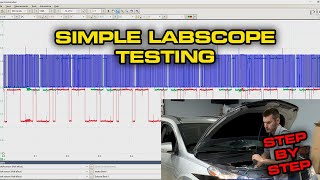
How to confirm: A technician can use a scan tool to view camshaft/crankshaft correlation data; a variance of more than a few degrees that doesn't correct itself points to a mechanical timing issue. An oscilloscope can also be used to compare the crank and cam sensor patterns for a definitive electronic diagnosis. 🎬 See how to use a labscope to confirm timing issues. Physical inspection is the ultimate confirmation but requires significant labor.
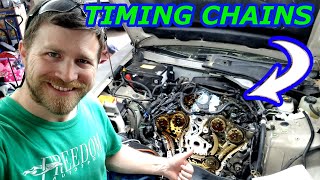
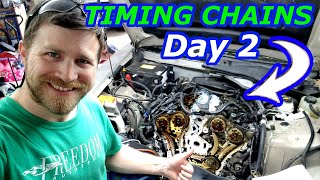
Typical fix: Replace all three timing chains, the tensioners, and the guides. This is typically done as a complete kit (e.g., Cloyes 9-0753S). It is also wise to replace the water pump and front crankshaft seal at the same time.
Est. part cost: $250-$500 - Worn Timing Chain Tensioners or Guides 🔴 High Probability The tensioners and guides are made of plastic and wear along with the chain. A failing hydraulic tensioner can lose pressure and create slack, causing the correlation code even if the chain itself isn't severely stretched. TSB #PIP3423P mentions inspecting for loose tensioners.
How to confirm: Diagnosed during the physical inspection for a stretched timing chain. A rattling noise is a strong indicator of guide or tensioner failure. A visual comparison of tensioner extension can reveal chain stretch.
Typical fix: Always replaced as part of a complete timing chain service. It is not recommended to replace only the tensioners or guides.
Est. part cost: $100-$200 (if bought separately) - Low or Dirty Engine Oil 🟡 Medium Probability The camshaft phasers and timing chain tensioners are hydraulically operated by engine oil pressure. Low oil levels or oil that is dirty/sludgy can impede their function, leading to timing correlation errors. Some owners have reported temporarily fixing the code with an engine flush and oil change.
How to confirm: Check the oil level on the dipstick and inspect its condition. If the level is low or the oil is sludgy, this is a likely contributing factor.
Typical fix: Perform an oil and filter change using the correct viscosity oil specified by GM (typically 5W-30). Consider using an engine flush product beforehand. Clear codes and see if P0017 returns. If it does, the underlying mechanical wear is too significant to be overcome by fresh oil.
Est. part cost: $50-$100 - Faulty Camshaft Position Actuator Solenoid (VVT Solenoid) ⚪ Low Probability These solenoids control oil flow to the cam phasers. They can get clogged with sludge or fail electrically, causing timing to be incorrect. While less common than chain stretch, it's a possible and much cheaper fix.
How to confirm: Can be tested by checking resistance with a multimeter. A common diagnostic technique is to swap the Bank 1 exhaust solenoid with the Bank 1 intake solenoid. If the code changes from P0017 to P0016, the solenoid is confirmed to be faulty.
Typical fix: Replace the faulty solenoid. They are relatively accessible on top of the valve covers.
Est. part cost: $30-$80 - Faulty Camshaft or Crankshaft Position Sensor ⚪ Low Probability While a sensor can fail, it is much less common than the timing chain issue on this engine. The code indicates a *correlation* problem, which is more often mechanical than a single failed sensor. Many owners have replaced these sensors only to have the code return, indicating the root cause was elsewhere.
How to confirm: Can be tested with an oscilloscope to view the sensor's signal pattern or a multimeter to check for voltage signals.
Typical fix: Replace the specific sensor that is determined to be faulty.
Est. part cost: $40-$100
Rare But Worth Checking
- Worn Camshaft Phaser (Actuator): The gear on the end of the camshaft that adjusts timing can fail internally or get stuck, but this is less frequent than chain stretch.
- Damaged/Slipped Crankshaft Reluctor Ring: TSB #PIP3423P notes that the toothed wheel that the crank sensor reads can slip on the crankshaft, causing a timing correlation error even if the chains are good. This requires crankshaft replacement.
Diagnosis Steps
- Verify engine oil level and condition. If low or dirty, perform an engine flush and oil change using GM-specified oil, clear the code, and test drive for 15-20 minutes.
- Scan for other DTCs. The presence of codes like P0008, P0016, P0018, or P0019 reinforces the diagnosis of a timing chain issue.
- Using a professional scan tool, monitor the camshaft vs. crankshaft angle variance data. On GM vehicles, this data can directly show how many degrees the timing is off, confirming a mechanical fault if the variance is large and static.
- Test the Bank 1 exhaust VVT solenoid. Swap it with the intake solenoid on the same bank. Clear codes and re-scan. If the code changes to P0016, the solenoid is bad.
- If the above steps do not resolve the issue, proceed with a physical inspection of the timing chains, guides, and tensioners. This requires removing the engine's front cover and is a labor-intensive process.
- While the cover is off, carefully inspect the chains for slack, and check the tensioners and plastic guides for wear, cracking, or damage.
- As a final, less common check, inspect the crankshaft reluctor ring for any signs of movement, which can be done through the crankshaft position sensor hole with a borescope per TSB PIP3423P.
Parts You'll Likely Need
- Engine Timing Chain Kit
(OEM #12650230 (per TSB 12-06-01-009F for early models, check VIN))— This is the definitive fix for the most common cause. A complete kit ensures all wearable components (chains, tensioners, guides, sprockets) are replaced simultaneously.
Trusted brands: ACDelco, Cloyes, Melling
OEM price range: $350-$500
Aftermarket price range: $200-$400 - Camshaft Position Actuator Solenoid
(OEM #12679099)— A potential, though less likely, cause of the code. It's a common maintenance item and sometimes replaced during a timing chain job as a preventative measure.
Trusted brands: ACDelco, Dorman, Standard Motor Products
OEM price range: $40-$70
Aftermarket price range: $25-$50 - Engine Oil and Filter — Crucial for the hydraulic VVT system and tensioners. Always the first step in diagnosis and required after a timing chain replacement.
Trusted brands: ACDelco Gold (formerly Professional), Mobil 1, Pennzoil Platinum
OEM price range: $50-$100
Aftermarket price range: $40-$80
Related Codes That Often Appear With This One
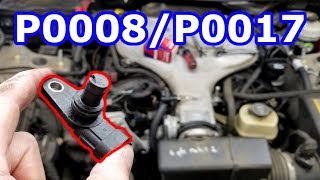
- P0008 — This code indicates a general engine position system performance error for Bank 1. It is a very common companion code to P0017 and strongly points to a stretched primary timing chain.
- P0016 — This code is for the Intake camshaft correlation on Bank 1. Seeing P0016 and P0017 together confirms the timing issue is on Bank 1 and is not isolated to a single camshaft, pointing towards a chain issue rather than a single phaser or solenoid.
- P0018 — This is the correlation code for the Intake camshaft on Bank 2. If seen with P0017, it suggests a widespread timing issue affecting both banks, likely originating from the primary chain.
- P0019 — This is the correlation code for the Exhaust camshaft on Bank 2. Seeing multiple correlation codes (P0016, P0017, P0018, P0019) almost guarantees a major timing system failure affecting all chains.
Technical Service Bulletins (TSBs) & Recalls
- TSB #12-06-01-009F: Announces availability of updated timing chain service kits for repairing stretched chains causing codes P0008, P0009, P0016, P0017, P0018, and/or P0019.
- TSB #PIP3423P: Instructs technicians to check for loose timing chains or a slipped crankshaft reluctor ring when multiple timing correlation codes are present.
Platform-Specific Known Issues
- The 3.6L V6 (LFX) engine used in these CTS models is widely known for premature timing chain stretching. GM issued special coverage programs for earlier model years (pre-2012) for this exact issue, highlighting the prevalence of the problem.
- Failure to follow strict oil change intervals with GM-specified oil (Dexos) is believed to accelerate timing chain wear.
Mechanic-Grade Diagnostic Values
- Crankshaft Reluctor Wheel Position — expected: 25 to 26 mm from the end of the machined surface of the crankshaft throw to the edge of the open space in the reluctor.. Failure: Any measurement outside of the 25-26mm range indicates the reluctor has slipped on the crankshaft.
- Camshaft to Crankshaft Correlation (Scan Tool) — expected: Near 0 degrees at idle.. Failure: A value greater than 16.31 degrees indicates a correlation fault sufficient to set DTC P0017.
- Camshaft Position (CMP) Actuator Solenoid Resistance — expected: Approximately 6.9-7.9 ohms (value from Pass 2, re-verified as a common range).. Failure: A reading significantly outside this range, or an open/short circuit, indicates a failed solenoid.
Scan Tool Commands That Help
- GDS2 / Professional Scan Tool: Camshaft Position Actuator Solenoid Test — This bidirectional control allows the technician to command the VVT solenoid on and off while the engine is running to verify its mechanical operation. If commanding the solenoid causes a change in engine idle, it confirms the solenoid and phaser are responding to commands.
- GDS2 / Professional Scan Tool: View Camshaft/Crankshaft Correlation Data — To monitor the live data for desired vs. actual camshaft position and the calculated variance. A large, static variance that does not change with RPM points directly to a mechanical timing issue (stretched chain or slipped reluctor) rather than a solenoid or sensor issue.
Wiring & Ground Locations
- G103 / G104 — On 2014+ models, located on the right front of the engine compartment. On other GM platforms, these are often found at the back of the cylinder heads.. These are critical ground points for the Engine Control Module (ECM) and other control modules. A loose or corroded ground here can cause a wide range of erratic electrical issues and fault codes, including sensor correlation problems.
- ECM Connector Pin (Bank 1 Exhaust VVT Solenoid) — On a 2006 CTS ECM, this is Pin 13 (Light Green wire, circuit 5282) on one of the main connectors.. This is the specific control wire from the ECM to the Bank 1 Exhaust VVT solenoid. It is essential for testing continuity and checking for shorts or open circuits between the ECM and the solenoid if a solenoid fault is suspected.
Real Owner Repair Stories
- Reddit user Shrute142 (2010 Cadillac CTS 3.0L) — Persistent P0017 check engine light.
❌ Tried (didn't work) Cleaned original camshaft and crankshaft sensors., Replaced both camshaft and crankshaft sensors with new parts.
✅ What actually fixed it The user did not post a final fix, but a technician in the thread stated the definitive cause was a stretched timing chain, a super common issue requiring a ~$4,500 repair, reinforcing that sensor replacement is not the fix. - YouTube channel Kevin Nadeau (2007 Cadillac CTS 3.6L with 88,000 miles) — P0008 and P0017 codes.
❌ Tried (didn't work) Replaced the Bank 1 Camshaft Position Sensor.
✅ What actually fixed it The sensor replacement did NOT fix the issue and the check engine light returned after a short drive. The ultimate required repair, shown in a later video, was a full timing chain replacement. - Cadillac Forums user 'sshaikh19' (2010 Cadillac CTS 3.0L with 182,000 miles) — P0017 code, but car runs perfectly.
❌ Tried (didn't work) Replaced intake, exhaust, and crank sensors on Bank 1., Replaced intake and exhaust VVT solenoids.
✅ What actually fixed it The dealer inspected the timing chain and found it to be good. Their final diagnosis was a worn/slipped crankshaft reluctor wheel, requiring crankshaft replacement at a quoted cost of $7,500. This is a documented edge-case failure.
When the Usual Fixes Don't Work
- While a stretched timing chain is the cause for P0017 in the vast majority of cases, it is not the only possibility. In one documented case, a vehicle owner had the timing chains inspected by a dealer and they were found to be in good condition. The code persisted, and the final diagnosis was a slipped crankshaft reluctor wheel, an issue that requires complete crankshaft replacement. This serves as a critical counterpoint for situations where a timing chain replacement does not resolve the code.
Model Year Variations Within This Range
- 2012-2015 (LFX) vs. 2016-2018 (LGX): The 3.6L V6 was significantly redesigned for the 2016 model year, changing from the LFX to the LGX. The LGX engine is a 'clean-sheet' design intended to improve reliability. Key changes include moving the timing chains to the rear of the engine, a variable displacement oil pump, and integrated exhaust manifolds. The LGX is considered less prone to the timing chain stretching issues that were common on the LFX.
Helpful Videos
Used OEM Parts in Stock


New Aftermarket Parts Available


The information in this article is provided for general reference and educational purposes only. Vehicle specifications, procedures, and part compatibility can vary by production date, trim level, and region. Always consult your vehicle's factory service manual and verify part numbers before purchasing or performing repairs. Safety-critical components such as airbags, seat belts, and braking systems should be installed by a qualified professional.
- Cadillac CTS:
- 🎬 Helpful Videos
- 🛍️ Shop This Part
- What's Unique About the 2012-2018 Cadillac CTS
- Diagnostic Flowchart
- Symptoms You May Notice
- Most Likely Causes
- Rare But Worth Checking
- Diagnosis Steps
- Parts You'll Likely Need
- Related Codes That Often Appear With This One
- Technical Service Bulletins (TSBs) & Recalls
- Platform-Specific Known Issues
- Mechanic-Grade Diagnostic Values
- Scan Tool Commands That Help
- Wiring & Ground Locations
- Real Owner Repair Stories
- When the Usual Fixes Don't Work
- Model Year Variations Within This Range
- 🎟️ Get 5% Off