

P0016 on 2010-2016 Hyundai Genesis Coupe 3.8L: Timing Chain and Sensor Guide
P0016 on a Genesis Coupe 3.8L almost always points to a mechanical timing issue, not a bad sensor. The most likely cause is a stretched timing chain and/or worn tensioners, especially if you hear a rattling noise on cold starts. Expect a repair cost of $1,500-$3,000 at a shop.
- P0016 on your Genesis Coupe 3.8L is a serious code that points to a mechanical timing problem, not just a bad sensor.
- A rattling noise from the engine on a cold start is a strong indicator of a failing timing chain tensioner, which is the most likely cause.
- Do not ignore this code. Continued driving can lead to the timing chain breaking, causing severe and expensive engine damage.
- The first, easiest diagnostic step is to check your engine oil. Low or dirty oil can cause this code by affecting the oil-dependent CVVT system.
- Repair involves replacing the entire timing kit (chains, guides, tensioners) and is a job best left to a professional mechanic.
What's Unique About the 2010-2016 Hyundai Genesis Coupe
The 3.8L Lambda V6 in the Genesis Coupe is generally robust, but it is known for timing chain issues, particularly with the tensioners and CVVT phasers. This makes P0016 a more serious code on this platform compared to others where it might just be a simple sensor fault. The 2013-2016 GDI models (BK2) are also susceptible to carbon buildup and have different timing chain components than the earlier 2010-2012 MPI models (BK1), as noted in Hyundai TSB 19-EM-001H. Neglecting oil changes can accelerate wear on the timing components and clog the oil control valves (OCVs) that are critical for the engine's continuously variable valve timing (CVVT) system.
Generation note: This range covers the BK1 (2010-2012) and BK2 (2013-2016) generations. The BK1 uses a Multi-Point Injection (MPI) 3.8L V6, while the BK2 uses a Gasoline Direct Injection (GDI) 3.8L V6. The GDI engines are more prone to timing chain tensioner rattle and have different timing chain part numbers per Hyundai TSB 19-EM-001H. It is critical not to mix old and new part designs during a repair.
Symptoms You May Notice
- Check Engine Light is on
- Engine rattles, especially a brief grinding or chain noise on cold startup
- Rough or unstable idle
- Sluggish acceleration and poor engine performance
- Engine may be hard to start or cranks without starting
- Stalling at low speeds or when coming to a stop
- Noticeable loss of power, feeling 'sluggish'
- Replacing the camshaft position sensor or crankshaft position sensor without first verifying the mechanical timing. The code points to a correlation fault, which is most often mechanical (stretched chain) rather than electrical (bad sensor).
- Replacing just one component, like an OCV, when the root cause is a stretched chain or failing tensioner. This may temporarily fix the issue, but the code will likely return.
Most Likely Causes
- Stretched Timing Chain and/or Failed Tensioners/Guides 🔴 High Probability The Lambda V6 is known to develop timing chain rattle from worn tensioners and guides, typically after 80,000 miles, which leads to chain slack and incorrect timing readings. This is the most common cause of P0016 on this platform.
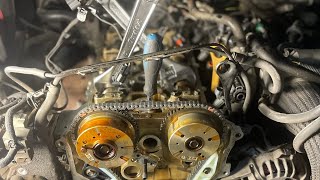
How to confirm: Listen for a distinct rattle from the front of the engine on a cold start that may last for a few seconds. The definitive check is to remove the valve covers and front timing cover to physically inspect the chain for slack, check the condition of the plastic guides, and confirm the timing marks on the sprockets align perfectly.
Typical fix: Replace the timing chains (there are two main chains), tensioners, guides, and often the water pump and CVVT phasers as a complete kit. This is a significant labor-intensive job.
Est. part cost: $400-$800 - Low or Dirty Engine Oil 🟡 Medium Probability The CVVT system relies on clean oil at the correct pressure to function. Sludge from infrequent oil changes can clog the Oil Control Valves (OCVs) or their passages, preventing the cam phasers from adjusting timing correctly.
How to confirm: Check the oil level and condition on the dipstick. If the oil is very dark, thick, or below the minimum level, this is a likely contributor. This should be the very first check.
Typical fix: Perform an engine oil and filter change using a quality full synthetic oil of the correct viscosity (check owner's manual). An engine flush may be considered if sludge is suspected, but proceed with caution on high-mileage engines.
Est. part cost: $60-$120 - Faulty Oil Control Valve (OCV) / VVT Solenoid 🟡 Medium Probability These solenoids can become clogged with debris from dirty oil or fail electrically, preventing proper adjustment of the cam timing. They are a common failure point and a logical diagnostic step before condemning the timing chain.
How to confirm: Remove the OCV for Bank 1 intake and inspect its screen for sludge. Test its resistance with a multimeter (typically 6.9-7.9 ohms for Denso parts or 6.7-7.7 ohms for Delphi parts) or apply 12V to see if the internal plunger actuates.
Typical fix: Clean or replace the faulty Oil Control Valve for Bank 1 (intake side). It's often recommended to replace them in pairs (intake/exhaust).
Est. part cost: $70-$150
Rare But Worth Checking
- Faulty Camshaft or Crankshaft Position Sensor: While these sensors can fail, it's uncommon for them to cause a correlation code without also setting a sensor-specific code (e.g., circuit low/high). P0016 indicates the signals don't match, not that a signal is missing. This is often misdiagnosed, and sensors are replaced unnecessarily.
- Incorrect Timing After a Previous Repair: If the timing chain was recently replaced, it's possible it was misaligned by one tooth, which is enough to set this code and cause performance issues. It is also critical that old and new design parts specified in TSB 19-EM-001H are not mixed on GDI engines.
- Failed CVVT Cam Phaser/Sprocket: The cam phaser itself, which is hydraulically adjusted by the OCV, can fail internally. It can get stuck in one position or develop play, causing a correlation fault. This is often the source of the cold-start rattle and is typically replaced during a full timing job.
Diagnosis Steps
- Check Engine Oil: Immediately verify the oil level is correct and the oil is clean. Low or dirty oil is a primary cause of CVVT system issues and can trigger this code.
- Scan for Codes: Confirm P0016 is the primary code. Note any other codes like P0017, or OCV/sensor circuit codes, as they can guide diagnosis.
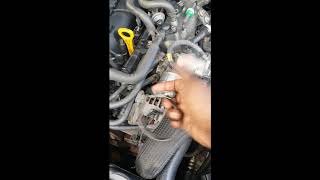
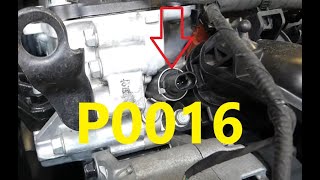
- Inspect OCV: Locate and remove the Bank 1 intake Oil Control Valve (OCV). Check the screen for sludge or debris. Test its function with a multimeter (resistance check) and a 12V source to confirm the plunger moves.
- Listen for Cold Start Rattle: Let the car sit for several hours. Start the engine and listen carefully for a brief (1-3 second) metallic rattle or chain noise from the front of the engine. This is a strong indicator of failing tensioners or CVVT phasers.
- Inspect Sensor Wiring: Check the wiring harnesses and connectors for the camshaft and crankshaft position sensors for any damage, oil contamination, or loose connections.
- Verify Mechanical Timing: This is the most crucial and labor-intensive step. If other checks pass, the timing cover must be removed to physically inspect the timing chain for slack, check the condition of the plastic guides for wear or breakage, and confirm the timing marks on all sprockets align perfectly per the service manual.
Parts You'll Likely Need
- Timing Chain Kit
(OEM #BK1 (2010-12 MPI): 24100-3CGA1 (Kit Example). BK2 (2013-16 GDI): Use parts from TSB 19-EM-001H, e.g., Chain 24312-3L100 (x2), Sprockets 23121-3L100 (LH) & 23122-3L100 (RH).)— This is the most common root cause of P0016 on the 3.8L engine due to chain stretch and tensioner wear. A full kit ensures all related wear items are replaced.
Trusted brands: Hyundai Genuine
OEM price range: $400-$600
Aftermarket price range: $250-$450 - Oil Control Valve (VVT Solenoid)
(OEM #24375-3C102 (Intake, Bank 1 & 2 are often the same part))— Can get clogged by oil sludge or fail electrically, preventing the cam phaser from adjusting timing correctly. It's a common failure point and much easier to replace than the timing chain.
Trusted brands: Hyundai Genuine, Delphi, Dorman
OEM price range: $120-$180
Aftermarket price range: $60-$110
Related Codes That Often Appear With This One
- P0017 — This code is for 'Crankshaft Position - Camshaft Position Correlation (Bank 1, Sensor B)', which is the exhaust camshaft on the same bank. If the timing chain has stretched or jumped, it's common for both the intake and exhaust cams on that bank to be out of time.
- P0018 / P0019 — These are the equivalent correlation codes for Bank 2 (driver's side). Seeing them along with P0016 is rare but would indicate a severe timing issue affecting both sides of the engine, or a problem with the primary timing chain from the crankshaft.
Technical Service Bulletins (TSBs) & Recalls
- 19-EM-001H: Details critical changes in timing chain and crankshaft sprocket parts for 2013-2016 Lambda 3.8L GDI engines. It explicitly warns against intermixing old parts (e.g., Chain 24312-3CGA2) with new parts (e.g., Chain 24312-3L100) due to different sprocket tooth diameters.
Platform-Specific Known Issues
- Timing chain tensioners are a known weak point, often causing a rattling noise on cold starts before the P0016 code appears.
- Hyundai TSB 19-EM-001H was issued for GDI models, indicating a change in timing chain and crankshaft sprocket designs. Old and new parts must not be mixed during a repair. The new chain is 24312-3L100 and new sprockets are 23121-3L100 (LH) and 23122-3L100 (RH).
- Owner experiences on forums like Gencoupe.com and Reddit consistently point to the timing chain as the primary culprit for P0016, with many sharing DIY guides and dealer repair quotes.
Mechanic-Grade Diagnostic Values
- Oil Control Valve (OCV) Coil Resistance — expected: Denso supplied: 6.9 - 7.9 Ω at 68°F (20°C). Delphi supplied: 6.7 - 7.7 Ω at 68°F (20°C).. Failure: Resistance outside of this range indicates a faulty solenoid coil.
- Camshaft Position Sensor (CMP) Signal Voltage — expected: The sensor is a 3-wire Hall effect type. With the key on, engine off, you should find a power wire (5V or 12V), a ground wire, and a signal wire reading around 5V.. Failure: When a piece of metal is passed in front of the sensor tip, the signal voltage should drop to near 0V (e.g., 0.7V). If the voltage does not change, the sensor is likely faulty.
- Engine Oil Pressure (at operating temperature) — expected: At least 25 PSI at idle.. Failure: Pressure significantly below 25 PSI at idle can starve timing components of oil, leading to noise and correlation faults.
- Fuel Pressure (BK2 GDI vs BK1 MPI) — expected: BK2 GDI Engine: 290 - 3,626 PSI. BK1 MPI Engine: 42 - 64 PSI.. Failure: While not a direct cause of P0016, incorrect fuel pressure can cause performance issues that may occur alongside timing codes.
Scan Tool Commands That Help
- Hyundai GDS (or equivalent advanced scanner): CVVT Actuator Test — Use this bidirectional control to command the Bank 1 Intake OCV on and off while monitoring cam angle PIDs. This directly tests if the solenoid and phaser are responding to commands from the ECM, helping to isolate a stuck OCV or phaser from a wiring or sensor issue.
- Hyundai GDS (or equivalent advanced scanner): Reset CVVT Values — After replacing timing components or OCVs, this function can be used to clear the learned adaptive values for the CVVT system. This forces the ECM to relearn the new components' positions and response times.
- Hyundai GDS (or equivalent advanced scanner): Live Data Monitoring — Monitor the 'CVVT' parameters to see desired vs. actual cam timing angles at idle and under load. A large, persistent discrepancy on Bank 1 Intake points towards a mechanical or hydraulic issue.
Wiring & Ground Locations
- ECM Ground — On the passenger side strut tower in the engine bay. This is a critical ground point for the Engine Control Module.. A poor ECU ground can cause erratic sensor readings and misinterpretation of the cam/crank signals, potentially leading to false correlation codes.
- Engine Block Ground — A ground strap is located on the engine mount, and another important ground is on one of the starter bell housing bolts.. Ensures the engine block and its attached sensors have a solid ground path back to the chassis and battery. A weak ground here can affect the crank sensor signal quality.
- ECM Location — Located in the left rear of the engine compartment (passenger side against the firewall).. Knowing the physical location is necessary for inspecting the main connectors for corrosion or damage if wiring issues are suspected.
- Ground GLG01 — Located at the left rear of the engine compartment (passenger side).. This is a designated ground point in the vicinity of the ECM and engine sensors, making it a key point to check for tightness and corrosion.
Real Owner Repair Stories
- Hyundai Forum user (2012 Genesis Coupe 2.0T (different engine, but same code and platform)) — P0016 and P0017 codes, sluggish performance, stalling, rough idle.
❌ Tried (didn't work) The initial repair was a timing chain replacement after the original broke and bent a valve.
✅ What actually fixed it The codes returned after the repair. The final diagnosis was that the timing was set incorrectly by one tooth during the reassembly, requiring the timing job to be redone correctly. - Reddit user u/LogicOverAll in r/genesiscoupe (Hyundai Genesis Coupe 3.8L (year not specified)) — P0016 and P0018, severe rough idle, stalling, car slowly died over a few days until it would not start.
❌ Tried (didn't work) Not specified, user immediately suspected timing.
✅ What actually fixed it The user's car required a timing chain replacement and inspection for valve damage. A leak-down test showed 80% leakage on intake valves, confirming bent valves from the timing failure. The fix is a complete timing job and cylinder head repair/replacement.
OEM Part Supersession History
Various older timing chain and sprocket part numbers for GDI engines.→Chain: 24312-3L100, Crank Sprocket (LH): 23121-3L100, Crank Sprocket (RH): 23122-3L100.— An updated design to improve durability and reduce noise/stretch issues on the GDI engines.
Heads up: Per Hyundai TSB 19-EM-001H, old and new design parts must not be mixed. Using an old design chain with new sprockets (or vice-versa) can lead to immediate timing issues or premature failure.
Model Year Variations Within This Range
- 2010-2012 (BK1): Uses a Multi-Point Injection (MPI) 3.8L V6 with a 10.4:1 compression ratio. Has different intake manifold gaskets (rubber) and a smaller throttle body compared to the BK2. Fuel pressure is low, around 42-64 PSI.
- 2013-2016 (BK2): Uses a Gasoline Direct Injection (GDI) 3.8L V6 with a higher 11.5:1 compression ratio. Features a high-pressure fuel pump and different cylinder heads. The intake manifold flows better and uses MLS gaskets. This engine is the subject of TSB 19-EM-001H regarding updated timing chain components.
Diagnostic Flowchart
Other Known Issues on This Vehicle
Issues unrelated to this code that are worth knowing about as an owner of this generation:
- Manual Transmission 2nd/5th/6th Gear Grind/Lockout 🟠 Medium — Common issue, especially on earlier BK1 models and during aggressive shifting. Often addressed with better transmission fluid (e.g., Motul, Red Line) and upgraded transmission/engine mounts.
- Taillight Gasket Failure / Trunk Water Leak 🟡 Low — Very common if taillights are ever removed and reinstalled without a new gasket or sealant. Leads to water pooling in the spare tire well.
- Interior Rattles and Peeling Chrome Finishes 🟡 Low — Widespread complaint. Rattles often come from the dash and door panels. The chrome finish on the steering wheel, door handles, and center console is known to peel over time.
- GDI Engine Intake Valve Carbon Buildup (BK2) 🟠 Medium — Inherent to all GDI engines. Becomes noticeable after 60,000-80,000 miles, causing rough idle and power loss. Requires periodic walnut blasting service.
- Differential Bushing Wear 🟠 Medium — The factory rear differential bushing is prone to wear, causing a 'thunk' or 'clunk' noise from the rear on acceleration or during shifts. Aftermarket polyurethane bushings are a common upgrade.
Used vs. New Parts: Buying Guide for This Vehicle
When a used part is the smart pick: Used parts are generally not recommended for this repair due to the critical nature of timing components. Only consider used for non-wear, external parts like brackets, engine covers, or specific bolts if they are in excellent condition.
Donor-vehicle mileage cap: roughly under 50000 miles for the part to have meaningful remaining life.
What to inspect on the donor part:
- For any electronic part (harness, sensor), check for brittle plastic, corroded pins, or oil contamination.
- For any mechanical part, check for cracks, warping, or signs of extreme heat.
- Never buy used timing chains, tensioners, or guides.
OEM-only on this vehicle (don't cheap out):
- Timing Chain Kit (Chains, Guides, Tensioners)
- CVVT Cam Phasers
- Crankshaft Position Sensor
- Camshaft Position Sensor
Aftermarket brands forum-validated for this vehicle:
- Delphi (For Oil Control Valves)
Brands owners have reported issues with on this vehicle:
- Unbranded, low-cost timing kits and sensors from online marketplaces are a significant risk and often fail prematurely, leading to catastrophic engine damage.
Real Owner Stories
Aggregated from forums and TSBs cited above. Mileages and costs reflect what owners reported in those sources.
2010-2012 Hyundai Genesis Coupe 3.8L (BK1) — 244000 miles
Symptoms: Owner performed a full timing system component replacement including chains, tensioners, and guides.
What fixed it: Full timing system replacement using a factory service manual guide, including new chains and guides.
Source hint: Gencoupe.com - 3.8 BK1 Timing System Components Replacement Guide
2013-2016 Hyundai Genesis Coupe 3.8L (BK2)
Symptoms: Cold-start rattle and P0016 code.
What fixed it: Full timing job including chains and tensioners.
Cost: $3,600-$3,600
Source hint: ThreePiece.us - Genesis Coupe 3.8 Buying Guide-BK2
2010-2016 Hyundai Genesis Coupe 3.8L
Symptoms: Vehicle displayed P0016 and P0018 error codes simultaneously; owner was advised to stop driving immediately to check the timing chain.
What fixed it: Immediate inspection of the timing chain system to prevent engine damage.
Source hint: Reddit - P0016 and p0018 3.8 error code help
Related OBD-II Codes
Frequently Asked Questions
Does TSB 19-EM-001H apply to my 2013-2016 Genesis Coupe 3.8L GDI?
I hear a brief grinding noise when I start my 3.8L V6 in the morning; is this related to P0016?
Can I just replace the timing chain, or do I need other parts for my Genesis Coupe?
What is the specific resistance for the Oil Control Valve on the 3.8L engine?
Is the P0016 code common on the 3.8L Lambda V6 after a certain mileage?
Should I check my oil before assuming the timing chain is stretched?
Helpful Videos
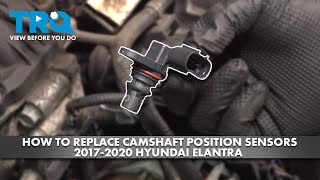
We Have This Part in Stock

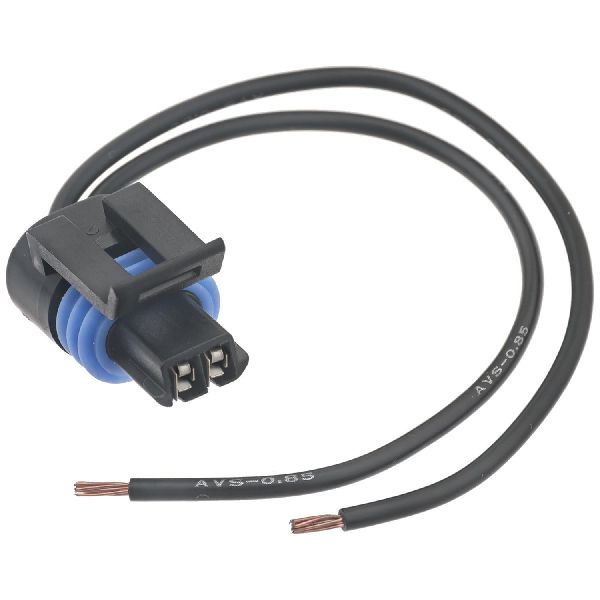

The information in this article is provided for general reference and educational purposes only. Vehicle specifications, procedures, and part compatibility can vary by production date, trim level, and region. Always consult your vehicle's factory service manual and verify part numbers before purchasing or performing repairs. Safety-critical components such as airbags, seat belts, and braking systems should be installed by a qualified professional.
- Hyundai Genesis Coupe:
- 🎬 Helpful Videos
- 🛍️ Shop This Part
- What's Unique About the 2010-2016 Hyundai Genesis Coupe
- Symptoms You May Notice
- Most Likely Causes
- Rare But Worth Checking
- Diagnosis Steps
- Parts You'll Likely Need
- Related Codes That Often Appear With This One
- Technical Service Bulletins (TSBs) & Recalls
- Platform-Specific Known Issues
- Mechanic-Grade Diagnostic Values
- Scan Tool Commands That Help
- Wiring & Ground Locations
- Real Owner Repair Stories
- OEM Part Supersession History
- Model Year Variations Within This Range
- Diagnostic Flowchart
- Other Known Issues on This Vehicle
- Used vs. New Parts: Buying Guide for This Vehicle
- Real Owner Stories
- 2010-2012 Hyundai Genesis Coupe 3.8L (BK1) — 244000 miles
- 2013-2016 Hyundai Genesis Coupe 3.8L (BK2)
- 2010-2016 Hyundai Genesis Coupe 3.8L
- Related OBD-II Codes
- Frequently Asked Questions
- 🎟️ Get 5% Off