

P0016 on 2012-2019 GMC Yukon XL: Crank/Cam Timing Correlation Causes and Fixes
P0016 on a GMC Yukon XL almost always indicates a serious mechanical timing issue, such as a stretched timing chain or a slipped crankshaft reluctor wheel. This is not a simple sensor fault. Immediate diagnosis is required to prevent severe engine damage, and the repair is complex and costly.
- P0016 on a 2012-2019 Yukon XL is a serious code indicating a mechanical timing failure, not just a bad sensor.
- Do not drive the vehicle. Continued operation risks catastrophic engine damage.
- The most likely causes are a stretched timing chain or a slipped crankshaft reluctor wheel.
- Diagnosis requires professional tools and knowledge; this is not a simple DIY fix.
- If the code appeared right after a major engine repair, the timing was likely set incorrectly.
What's Unique About the 2012-2019 Gmc YUKON XL
On the V8 engines found in the 2012-2019 GMC Yukon XL, code P0016 is particularly serious. Unlike on some other vehicles where it might be a faulty sensor, on these trucks it frequently points to deeper mechanical failures. Two issues are prominent: a stretched timing chain, which becomes more likely with age and mileage, or a crankshaft reluctor wheel that has physically moved on the crankshaft, a known issue documented in GM Technical Service Bulletin #PIP5102. 🎬 Watch: A breakdown of common P0016 causes on GM trucks. Both are labor-intensive repairs that go far beyond a simple part swap. A user on Tahoe Yukon Forum experienced this firsthand when their 2008 Yukon with 208,000 miles suddenly lost power on the freeway, setting the P0016 code, which pointed to a timing chain issue rather than a simple sensor.
Diagnostic Flowchart
Tap your situation to follow the diagnostic path that matches what you're seeing on this vehicle.
Generation note: This range covers two generations of the Yukon XL: the GMT900 (2012-2014) and the K2XX (2015-2019). While the fundamental cause of P0016 (mechanical timing) is the same, the specific V8 engines (Gen IV Vortec vs. Gen V EcoTec3) have different timing chain components and procedures. The Gen IV engines (e.g., 5.3L LC9) were used through 2014. The Gen V EcoTec3 engines (e.g., 5.3L L83, 6.2L L86) were introduced in 2014/2015 and feature direct injection and different VVT systems. TSB PIP5554A specifically addresses timing issues on these newer Gen V engines after internal repairs, noting the difficulty of seeing the timing marks correctly.
Symptoms You May Notice
- Check Engine Light is on
- Engine is hard to start or will not start
- Rough idling
- Reduced engine power or 'limp mode'
- Engine rattling or loud noise, especially from the front (timing cover area)
- Engine stalling unexpectedly
- Sudden loss of power while driving
- Decreased fuel economy
- Replacing the Camshaft Position Sensor
- Replacing the Crankshaft Position Sensor
Most Likely Causes
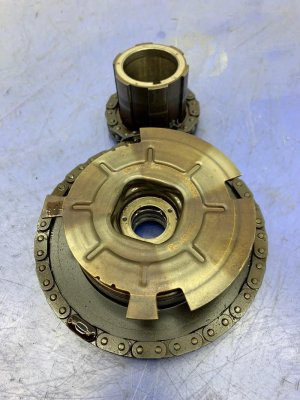
- Stretched Timing Chain or Worn Tensioner/Guides 🔴 High Probability Timing chains naturally wear and stretch over high mileage (typically over 100k miles). Lack of oil pressure from low or dirty oil can accelerate wear on the hydraulic tensioners and plastic guides, allowing slack in the chain which can cause it to jump a tooth. A broken tensioner was the confirmed cause for a P0016 code in a 2007 Sierra, causing the timing to jump one tooth.
How to confirm: A technician can use a scan tool to observe camshaft angle variance at idle; a value consistently off from zero degrees suggests a timing issue. Physical inspection is definitive but requires removing the engine front cover to check for chain slack, broken guide pieces in the oil pan, and a failed tensioner.
Typical fix: Replace the timing chain, tensioners, guides, and sprockets as a complete kit. This is a labor-intensive job often requiring removal of the oil pan and front differential on 4WD models.
Est. part cost: $150-$400 - Slipped Crankshaft Reluctor Wheel 🟡 Medium Probability GM has issued TSB #PIP5102 for this specific problem on 2012-2013 models. The reluctor wheel, a toothed ring that the crankshaft position sensor reads, is press-fit onto the crankshaft and can rotate from its original position. This causes a mismatch with the cam signal even if the chain is perfectly timed. This is a known, though less common, failure point on LS-based engines.
How to confirm: This is difficult to diagnose. TSB #PIP5102 suggests inspecting the reluctor on the crankshaft. This may be possible with a borescope through the crank sensor hole, but often requires removing the oil pan or transmission for a clear view. An oscilloscope comparing the crank and cam sensor patterns to a known-good waveform is the most reliable non-invasive method to spot the deviation.
Typical fix: If the reluctor wheel has moved, the official GM procedure is to replace the entire crankshaft, as the wheel is not serviced separately. This is a very extensive and expensive repair.
Est. part cost: $500-$1200 - Incorrect Timing After a Recent Repair ⚪ Low Probability TSB #PIP5554A specifically notes that P0016 can set after internal engine work on Gen V V8s (2015+) because the timing marks are difficult to align perfectly without a straight-on view. 🎬 See how timing issues occur after cam and lifter replacement. A forum user with a 2008 model confirmed this, finding their P0016 was caused by being 2-3 teeth off after a self-done timing chain replacement.
How to confirm: Review recent service history. If the code appeared immediately after a camshaft replacement, AFM/DOD delete, or other major engine work, this is the most likely cause. The timing must be re-checked by disassembling the front of the engine.
Typical fix: Re-time the engine correctly by disassembling and properly aligning the camshaft and crankshaft sprockets according to the factory service manual. 🎬 Watch: How to properly align V8 engine timing marks.
Est. part cost: $0 (labor only)
Rare But Worth Checking
- Faulty Camshaft Phaser / VVT Actuator: The variable valve timing (VVT) actuator (phaser) can get stuck due to sludge from poor oil maintenance or internal failure. This can cause a correlation code, but it's less common than a stretched chain and often accompanied by other VVT-specific codes (like P0011 or P0014). A user on GMTNation ultimately traced their recurring P0016 to a failed cam phaser after replacing sensors.
- Low Oil Pressure or Incorrect Oil Viscosity: The timing chain tensioners and cam phasers are hydraulically operated by engine oil pressure. Severely low oil pressure (below 25 PSI at idle) or using the wrong oil can prevent these components from working correctly, leading to timing correlation issues. This is usually a symptom of another problem (like a failing oil pump or severe oil consumption) rather than the root cause itself.
Diagnosis Steps
- Verify engine oil level and condition. Low or dirty oil, or incorrect viscosity, can cause VVT and tensioner issues.
- Use a professional scan tool to check for other DTCs and view live data. Monitor the Camshaft Angle Variance parameter at idle. It should be close to 0 degrees.
- If other sensor-circuit codes (like P0335, P0340) are present, diagnose those first.
- If the code appeared immediately after an engine repair, suspect improper timing alignment as per TSB #PIP5554A.
- If no other codes are present and the cam variance is off, the next step is mechanical inspection. This involves removing the engine front cover to inspect the timing chain for slack, and checking the tensioner and guides for wear or damage.
- If the timing chain and components appear correct, the next suspect is the crankshaft reluctor wheel, as per TSB #PIP5102. This may require a borescope or removal of the oil pan to inspect.
- Using an oscilloscope to compare the crankshaft and camshaft sensor waveforms against a known-good pattern is an advanced, but effective, way to confirm a timing or reluctor wheel issue without major disassembly.
Parts You'll Likely Need
- Engine Timing Chain Kit — This is the most common fix for a high-mileage vehicle with P0016. A kit ensures all wearable components (chain, guides, tensioner, sprockets) are replaced at once.
Trusted brands: ACDelco, Cloyes
OEM price range: $250-$400
Aftermarket price range: $150-$250 - Crankshaft
(OEM #12685650 (For 2015+ 5.3L L83 / 6.2L L86))— Required if the crankshaft reluctor wheel has slipped, as per GM TSB #PIP5102. The wheel is not serviced separately from the crankshaft. Part number 12685650 is specified for the Gen V engines.
Trusted brands: ACDelco (GM Genuine)
OEM price range: $500-$1200
Aftermarket price range: $400-$800 - Camshaft Position Actuator Solenoid
(OEM #12655420)— Can become clogged with sludge and cause timing control issues. It's sometimes replaced as a preventative measure during a larger timing job, but is rarely the sole cause of P0016. A forum member noted that using only an AC Delco OEM part was critical to resolving their issue.
Trusted brands: ACDelco, Delphi
Related Codes That Often Appear With This One
- P0017 — This code is for the Exhaust Camshaft Position Correlation (Bank 1, Sensor B). If the timing chain has stretched or the crank reluctor has slipped, it will affect the timing relationship of both the intake (P0016) and exhaust (P0017) camshafts.
- P0335 — This code indicates a fault in the Crankshaft Position Sensor circuit. While P0016 is a correlation *error*, a failing sensor can sometimes cause erratic signals that lead to the P0016 code before the sensor fails completely.
- P0340 — This code indicates a fault in the Camshaft Position Sensor circuit. Similar to P0335, a failing cam sensor can cause the correlation code P0016 to appear.
Technical Service Bulletins (TSBs) & Recalls
- TSB #PIP5102: Advises technicians that for a P0016 code, they need to inspect the crankshaft reluctor wheel for movement. If it has moved, the official repair is to replace the entire crankshaft.
- TSB #PIP5554A: Notes that code P0016 can appear on Gen V V8 engines (2015+) after internal engine repairs because the timing marks are difficult to see and align correctly, leading to incorrect base timing.
Platform-Specific Known Issues
- TSB #PIP5102 documents that the crankshaft reluctor wheel can move, causing P0016. The fix is to replace the entire crankshaft.
- TSB #PIP5554A warns that P0016 can be set on 2015 and newer models if the base engine timing is not set correctly during an internal engine repair due to the difficulty of visually aligning the timing marks.
Mechanic-Grade Diagnostic Values
- Camshaft Position Sensor (CMP) Signal Voltage (Hall Effect Sensor) — expected: The signal wire should toggle between approximately 0V and 5V (or 4.8V) as a metal object is passed in front of the sensor.. Failure: A constant voltage (e.g., stuck at 0V or 5V) or no change when metal is passed by indicates a faulty sensor.
- Scan Tool - CMP Variance Angle at Idle — expected: Less than 1 degree at stable, warm idle.. Failure: A consistent reading of more than +/- 1-2 degrees, or a value that is erratic, points to a timing correlation problem. The code may set when the variance exceeds 11-14 degrees.
- Engine Oil Pressure (Mechanical Gauge) — expected: At least 25 PSI at idle.. Failure: Pressure below 25 PSI at idle can starve the VVT system and timing chain tensioners of oil, leading to timing codes.
Scan Tool Commands That Help
- GDS2 / Tech 2 (or equivalent professional scan tool): CMP Actuator Output Control — After verifying base timing, this command allows a technician to command the camshaft phaser to a specific angle (e.g., 25 degrees) and observe if the 'Desired CMP Angle' and 'CMP Angle' parameters match. If they don't, it points to a problem with the VVT actuator (phaser) or the oil control solenoid.
Wiring & Ground Locations
- G102 — Located at the left rear of the engine.. This ground is for the 8 ignition coils. While not a direct cause of P0016, a poor ground here can cause misfires and erratic engine behavior that could complicate diagnosis.
- G103 — Located on the rear of the driver's side cylinder head (GMT900) or on the cowl above the brake booster (older models).. This is a critical ground point for the Engine Control Module (ECM) and Body Control Module (BCM). A corroded or loose G103 can cause a wide range of phantom electrical issues, including incorrect sensor readings that could potentially contribute to or be confused with a P0016 fault.
- Camshaft Position Sensor Connector — On Gen IV (2012-2014) engines, it's at the back of the engine block near the oil pressure sensor, often requiring intake manifold removal for access. On Gen V (2015-2019) engines, it is on the front of the engine.. This is the primary connection for the sensor providing half of the data for the correlation code. The 3-wire connector provides power (12V), ground, and a signal (0-5V) wire. Testing voltages here is a key diagnostic step.
Real Owner Repair Stories
- Tahoe Yukon Forum user (2007 GMC Yukon Denali 6.2L with 168,000 miles) — Check Engine Light with code P0016, stalling, and no-start condition.
❌ Tried (didn't work) Initial diagnosis was difficult as the vehicle would sometimes start and run.
✅ What actually fixed it The confirmed fix was replacing a stretched timing chain. The chain had enough slack to cause the correlation error, leading to the intermittent stalling and starting issues.
Model Year Variations Within This Range
- 2012-2013: TSB #PIP5102 specifically calls out vehicles built between Feb 1, 2012, and Feb 12, 2013, for the potential of a slipped crankshaft reluctor wheel. While it can happen on other years, this specific production window was highlighted by GM.
- 2012-2014 vs 2015-2019: The camshaft position sensor is in a different location. On the earlier Gen IV engines (through 2014), the sensor is at the top rear of the engine block, behind the intake manifold. On the later Gen V engines (2015+), the sensor is located on the front of the engine, making it much more accessible.
Helpful Videos

We Have This Part in Stock

The information in this article is provided for general reference and educational purposes only. Vehicle specifications, procedures, and part compatibility can vary by production date, trim level, and region. Always consult your vehicle's factory service manual and verify part numbers before purchasing or performing repairs. Safety-critical components such as airbags, seat belts, and braking systems should be installed by a qualified professional.
- Gmc YUKON XL:
- 🎬 Helpful Videos
- 🛍️ Shop This Part
- What's Unique About the 2012-2019 Gmc YUKON XL
- Diagnostic Flowchart
- Symptoms You May Notice
- Most Likely Causes
- Rare But Worth Checking
- Diagnosis Steps
- Parts You'll Likely Need
- Related Codes That Often Appear With This One
- Technical Service Bulletins (TSBs) & Recalls
- Platform-Specific Known Issues
- Mechanic-Grade Diagnostic Values
- Scan Tool Commands That Help
- Wiring & Ground Locations
- Real Owner Repair Stories
- Model Year Variations Within This Range
- 🎟️ Get 5% Off