

C1016 on 2017-2019 Lincoln Continental: Not a Code, But a Connector Location
If you are searching for 'C1016' for a 2017-2019 Lincoln Continental, you should know it is not a standard OBD-II trouble code. It is a connector name used in Ford/Lincoln technical service bulletins, specifically related to wiring for the Engine Coolant Temperature (ECT) sensor.
- C1016 is not a trouble code for a Lincoln; it is the name of an electrical connector.
- If you encounter 'C1016', it's likely in the context of TSB SSM 47791, which points to a wiring problem.
- The actual trouble codes will be powertrain codes like P0116, P0117, or P0118 related to the Engine Coolant Temperature (ECT) sensor.
- Do not replace the ECT sensor without first thoroughly inspecting the wiring harness between connectors C1016 and C1168 for damage, as this is the most likely cause.
- Repairing the damaged wire is the most common fix and is much cheaper than replacing parts unnecessarily.
What's Unique About the 2017-2019 Lincoln CONTINENTAL
On the Lincoln Continental and related Ford platforms (like the Edge, Fusion, and MKX), the term C1016 appears in a specific TSB regarding engine cooling issues. This is confusing because 'C' codes typically relate to chassis systems like ABS, but in this context, it's simply a part of a wiring diagram location name. The issue highlighted in the TSB is critical because it can lead to misdiagnosis, where the ECT sensor is replaced when the actual fault is in the wiring harness near connector C1016.
Diagnostic Flowchart
Tap your situation to follow the diagnostic path that matches what you're seeing on this vehicle.
Symptoms You May Notice
- Check Engine Light (Malfunction Indicator Lamp) is on
- Engine temperature gauge reading is inaccurate, erratic, or stuck on cold/hot
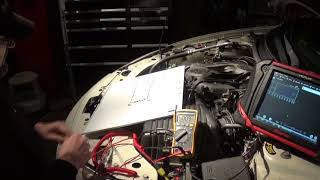
- Cooling fans run constantly, even when the engine is cold 🎬 See how to diagnose a cooling fan that runs constantly.
- Cooling fans do not turn on, leading to potential overheating
- Reduced engine performance or poor fuel economy
- Engine may be hard to start or may start and then die.
- Replacing the Engine Coolant Temperature (ECT) Sensor. The TSB SSM 47791 explicitly warns technicians: 'ECT sensors should not be replaced if damaged wiring is found at or near these connectors...'
- Replacing the thermostat. While a faulty thermostat can cause temperature-related codes like P0128, it is less likely to cause the specific circuit-low/high codes (P0117/P0118) associated with this wiring issue.
Most Likely Causes
- Damaged Wiring Between Connectors C1016 and C1168 🔴 High Probability A manufacturer TSB (SSM 47791) specifically calls out this wiring section as a point of failure, suggesting a potential issue with harness routing, securing, or vulnerability to heat and vibration. The wiring harness may rub against other components, causing chafing and eventual wire failure.
How to confirm: Visually inspect the wiring harness between the firewall and the engine, specifically locating the harness that includes the ECT sensor wiring. Look for any signs of chafing, rubbing, melting, or broken wires, paying close attention to the areas near connectors C1016 and C1168. A multimeter can be used to check for continuity or shorts to ground in the affected wires if visual inspection is inconclusive.
Typical fix: Repair the damaged section of the wire. This involves cutting out the bad section, splicing in a new piece of wire with appropriate connectors (butt connectors or solder), and protecting the repair with heat shrink tubing. The TSB also recommends wrapping the harness with high-quality wiring harness tape to prevent future damage. In some cases, a connector pigtail may need to be replaced if the damage is at the connector itself.
Est. part cost: $5-$30
Rare But Worth Checking
- Faulty Engine Coolant Temperature (ECT) Sensor: While the TSB points to wiring as the primary issue, the sensor itself can still fail. However, it should only be replaced after the wiring has been thoroughly inspected and confirmed to be in good condition.
- Poor Connection at ECT Sensor or PCM: The pins within the connectors themselves can become corroded or loose. Unplugging the connectors, inspecting for green or white corrosion, and ensuring a snug fit can sometimes resolve the issue.
- Air Pocket in the Cooling System: An air pocket trapped near the ECT sensor can cause erratic readings, leading to codes like P0116 or P0117. This can happen after a coolant service if the system is not properly bled.
Diagnosis Steps
- Scan the vehicle for Diagnostic Trouble Codes (DTCs) to confirm if codes like P0116, P0117, or P0118 are present.
- Note that a search for 'C1016' will not yield a DTC but may have led you here via TSB research.
- Obtain a vehicle-specific wiring diagram to identify the locations of the ECT sensor, connector C1016, and connector C1168. C1016 is a major inline connector, often located near the firewall or on the engine itself, joining body and engine harnesses.
- Perform a thorough visual inspection of the wiring harness between these points as recommended by TSB SSM 47791.
- Look for any signs of physical damage, such as chafing, melting, or breaks in the wiring loom and wires. Pay close attention to areas where the harness may rub against brackets, engine components, or the firewall.
- If damage is found, repair the specific wires. Do not replace the sensor.
- If no wiring damage is visible, test the circuit's integrity. Disconnect the ECT sensor and the PCM. Use a multimeter set to continuity to check for an open circuit between the sensor connector and the PCM connector. Check for a short to ground by testing continuity between each wire and a known good ground.
- A 'quick test' for a P0117 (low input) is to disconnect the ECT sensor. If the code changes to a P0118 (high input), it strongly suggests the wiring up to the sensor is intact and the sensor itself may be shorted internally. 🎬 Watch: A professional guide to diagnosing P0117 and P0118 codes.
- If the wiring and connections are confirmed to be good, then consider testing the ECT sensor itself by measuring its resistance at different temperatures and comparing it to the manufacturer's specifications.
Parts You'll Likely Need
- Wiring Repair Supplies — The most common cause identified by the manufacturer is damaged wiring, which requires splicing and protection.
Trusted brands: 3M, Coroplast (for tape), Motorcraft (for pigtail connectors)
OEM price range: $10-$30
Aftermarket price range: $5-$20 - Engine Coolant Temperature (ECT) Sensor
(OEM #FT4Z-12A648-B (Motorcraft DY-1309))— This is a common misdiagnosis but could be the actual cause if wiring is confirmed to be intact. This part number fits the 2.7L and 3.0L engines.
Trusted brands: Motorcraft, Bosch, Delphi, Walker Products
OEM price range: $40-$70
Aftermarket price range: $20-$45
Related Codes That Often Appear With This One
- P0117 — Indicates 'Engine Coolant Temperature Sensor Circuit Low Input', which occurs if the signal wire is shorted to ground.
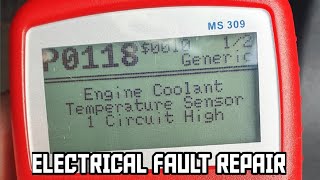
- P0118 — Indicates 'Engine Coolant Temperature Sensor Circuit High Input', which occurs if the signal wire is broken or the connector is unplugged. 🎬 Watch: An easy walkthrough for repairing a P0118 circuit high fault.
- P0116 — Indicates 'Engine Coolant Temperature Sensor Circuit Range/Performance', which can be set if the sensor readings are erratic due to an intermittent wiring connection.
- P0128 — Indicates 'Coolant Thermostat (Coolant Temperature Below Thermostat Regulating Temperature)'. This can sometimes be triggered if the faulty ECT signal makes the PCM believe the engine is not warming up correctly.
Technical Service Bulletins (TSBs) & Recalls
- SSM 47791: Addresses issues related to the engine coolant temperature (ECT) sensor connector being not fully seated or having damaged wiring between connectors C1016 and C1168. It explicitly warns against replacing the ECT sensor if wiring damage is found.
Platform-Specific Known Issues
- TSB SSM 47791 documents a known issue with damaged wiring between connectors C1016 and C1168 causing ECT sensor circuit faults on 2017-2019 Lincoln Continental, Edge, Fusion, MKX, and Nautilus vehicles. The TSB is the primary source identifying C1016 as a connector name in this context.
Mechanic-Grade Diagnostic Values
- ECT Sensor Resistance — expected: Approx. 3520 Ω at 68°F (20°C), dropping to approx. 973 Ω at 122°F (50°C). Resistance should decrease smoothly as temperature increases.. Failure: Infinite resistance (open circuit) or very low resistance when cold. Reading does not change with temperature.
- ECT Sensor Signal Voltage (at PCM) — expected: Approx. 0.5V (hot) to 4.5V (cold). Varies with temperature.. Failure: Voltage below 0.14V indicates a short to ground (P0117). Voltage near 5.0V indicates an open circuit (P0118).
- Scan Tool Live Data (ECT) — expected: With a cold engine, the ECT reading should be very close to the Ambient Air Temperature (AAT) reading. Should climb steadily to ~190-215°F on a warm engine.. Failure: A reading of -40°F indicates an open circuit (P0118). A reading of 250°F+ indicates a short circuit (P0117).
- Harness Connector Jumper Test (for P0118) — expected: With the sensor unplugged and a jumper wire connecting the two pins on the harness-side connector, the scan tool reading should jump to a very high temperature (250°F+).. Failure: If the temperature reading does not jump to maximum, it confirms an open circuit in the wiring between the connector and the PCM.
Wiring & Ground Locations
- C1016 — This is the electrical connector on the Engine Coolant Temperature (ECT) sensor itself. On the 2.7L and 3.0L engines, the sensor is located under the intake manifold, making it difficult to access.. This is the starting point of the circuit mentioned in TSB SSM 47791. The TSB indicates it may not be fully seated, or the wiring directly attached to it could be damaged.
- C1168 — A harness-to-harness inline connector located in the engine bay, between the ECT sensor (C1016) and the Powertrain Control Module (PCM).. TSB SSM 47791 specifically identifies the wiring between C1016 and C1168 as the location prone to chafing and damage. A visual inspection of the harness loom in this area is critical.
- C1016 Pinout (2.7L/3.0L) — At the ECT sensor connector.. Pin 1 (YE-GY wire) is Signal Return/Ground. Pin 2 (GY-VT wire) is the ECT Sensor Signal to the PCM. Knowing these pins is essential for performing continuity and voltage tests directly at the source.
- G104 — A major chassis ground point located on the left front of the engine compartment.. While not specific to the ECT circuit, a loose or corroded main ground can cause widespread, intermittent electrical issues and erratic sensor readings. It is good practice to check and clean major grounds when diagnosing any electrical fault.
Real Owner Repair Stories
- Ford Edge Forum user report (aggregated) (2016 Ford Edge Sport 2.7L) — Engine Coolant Over Temperature warning light appeared, temperature gauge was behaving erratically, and the engine cooling fans were running constantly.
❌ Tried (didn't work) Initial thought was a bad thermostat or ECT sensor.
✅ What actually fixed it The owner was provided with vehicle-specific wiring diagrams showing the ECT sensor circuit, including the locations of connectors C1016 and C1168. The final fix was inspecting the wiring harness between these two connectors as highlighted by TSB SSM 47791 and repairing the damaged section.
Helpful Videos

We Have This Part in Stock


The information in this article is provided for general reference and educational purposes only. Vehicle specifications, procedures, and part compatibility can vary by production date, trim level, and region. Always consult your vehicle's factory service manual and verify part numbers before purchasing or performing repairs. Safety-critical components such as airbags, seat belts, and braking systems should be installed by a qualified professional.
- Lincoln CONTINENTAL:
- 🎬 Helpful Videos
- 🛍️ Shop This Part
- What's Unique About the 2017-2019 Lincoln CONTINENTAL
- Diagnostic Flowchart
- Symptoms You May Notice
- Most Likely Causes
- Rare But Worth Checking
- Diagnosis Steps
- Parts You'll Likely Need
- Related Codes That Often Appear With This One
- Technical Service Bulletins (TSBs) & Recalls
- Platform-Specific Known Issues
- Mechanic-Grade Diagnostic Values
- Wiring & Ground Locations
- Real Owner Repair Stories
- 🎟️ Get 5% Off