

2020-2024 Ford Explorer & Police Interceptor 3.3L V6: Problems, Identification, and Used Replacement
Identify the naturally aspirated 3.3L Cyclone V6, understand its catastrophic block failure risks, and learn when to swap in a used OEM replacement.
- Before buying a replacement, verify your engine is the correct 3.3L non-hybrid by checking for the 8th VIN digit 'B' and noting if your vehicle is RWD or AWD for parts transfer.
- For 2020-2022 models, investigate any engine knock with a Ford dealer immediately, as it may be the connecting rod bearing failure covered by recall 24S52 and CSP 24N10, potentially entitling you to a free engine.
- Engine replacement is an expert-level job that requires mandatory computer programming (CKP relearn, PATS) and the replacement of single-use TTY bolts and high-pressure fuel lines to prevent fire hazards.
- Do not use engines from the 3.3L Hybrid Explorer (VIN 'W') or the 3.3L Ford F-150, as they are not compatible due to differences in block castings, wiring, and mounting points.
Engine Identification: Is This Your Engine?

The engine at the heart of many 2020-2024 Ford Explorers and Police Interceptor Utility vehicles is a 3.3-liter, naturally aspirated V6 from Ford's Cyclone (also known as Duratec) engine family. This engine uses direct injection for fuel delivery and features dual overhead camshafts (DOHC) with 4 valves per cylinder. In the Police Interceptor Utility, the non-hybrid 3.3L V6 produces 285 horsepower and 260 lb-ft of torque. It is paired with a 10R80 10-speed automatic transmission.
How to Verify Your Vehicle's Engine
Correctly identifying your engine is the most important step before ordering a replacement. Use these two methods to confirm you have the standard 3.3L V6:
- Check the VIN: The Vehicle Identification Number (VIN) is a 17-digit code found on your driver's side dashboard (visible through the windshield) or on the door jamb sticker. The 8th digit of the VIN must be 'B' to match this engine.
- Visual Inspection: This engine has an external, belt-driven water pump located on the front of the engine. 🎬 Watch this video on replacing the 3.3L water pump.
Critical Interchange Mismatches to Avoid
Not all engines from similar Ford models will fit or function correctly. Buyers must avoid these common interchange mistakes:
- Hybrid vs. Standard Gas: The 3.3L Hybrid engine, identified by VIN 'W', is not interchangeable with the standard gasoline 3.3L (VIN 'B'). The hybrid models feature completely different engine block castings, wiring, and electrical integrations.
- AWD vs. RWD Drivetrain: The core engine block is identical, but All-Wheel Drive (AWD) and Rear-Wheel Drive (RWD) models use different oil pans, oil pickup tubes, and front differential mounting brackets. If you are installing a used engine into an AWD vehicle, your mechanic must transfer the original oil pan, pickup tube, and differential brackets to the replacement engine.
- Ford F-150 Engines: While the Ford F-150 also uses a 3.3L V6, it has different engine mounting points, wiring, and software calibrations. It cannot be used in an Explorer or Police Interceptor Utility.
Pro Tip: Before purchasing, always confirm your vehicle's 8th VIN digit is 'B' and note whether you have RWD or AWD to prepare for the necessary parts transfer during installation.
Common Problems and Failure Symptoms

Key indicators of a serious engine problem include a persistent knocking sound from the engine, loss of power, visible metal shavings in the engine oil during an oil change, or smoke from the engine compartment. In severe cases, a connecting rod can break and puncture the engine block, causing a catastrophic oil leak and a risk of fire.
Major Recalls and Service Bulletins
Several official service campaigns apply to this engine. Always provide a dealer with your VIN to check for applicability.
Engine Block Failure (NHTSA 24V598 / Ford 24S52)
Warning: A severe issue affects some 2020-2022 models, primarily in Police Interceptor Utility vehicles subjected to frequent high-RPM use.
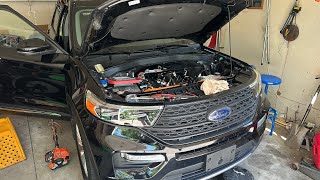
A connecting rod bearing can fail, leading to engine failure and potentially a hole in the engine block. This can release oil and fuel vapor, creating a significant fire risk. As of July 2024, 13 under-hood fires were reported on Police Interceptor vehicles with 3.3L engines built before June 2, 2022. In response, Ford issued recall 24S52 (NHTSA 24V598) for 85,238 vehicles. 🎬 Watch this news report on the police vehicle recall. The remedy involves a powertrain control module (PCM) software update and, if necessary, a free replacement of the engine long block. Ford also created Customer Satisfaction Program 24N10, extending the warranty for this specific failure to 10 years or 150,000 miles.
Catalytic Converter & Wiring Issues (CSP 24M01)
For 2020 models, Ford issued Customer Satisfaction Program 24M01. This addresses front catalytic converters that may crack or fail, triggering trouble codes like P0420 or P0430 and possibly an exhaust odor. The program also includes an inspection of the engine wiring harness, which can chafe and cause misfires or rough running. This program covers repairs for 15 years or 150,000 miles.
Exhaust Rattle (TSB SSM 51881)
Owners of 2020-2023 non-hybrid models may notice an exhaust rattle. Technical Service Bulletin SSM 51881 identifies the cause as the design of the exhaust flexible pipe. The fix involves replacing the original pipe with an updated design.
Harsh Shifting or Hesitation (TSB 22-2046 & 20-2249)
Some 2020-2021 vehicles may experience hesitation or a buck/jerk feeling at low speeds. This is often a software issue, not a mechanical engine fault. TSB 22-2046 and 20-2249 instruct dealers to reprogram the Powertrain Control Module (PCM) to correct the condition.
🎬 Watch this guide on resolving harsh shifting TSBs.Diagnostic Flowchart
What Fails at Every Mileage Band
Pro Tip: The mileage bands below describe used replacement units of that mileage. The checklists provided are things to do WHILE INSTALLING the purchased engine, not maintenance for your current engine.
Under 60,000 Miles
Engines in this band are generally fresh, but 2020-2022 models are at high risk for the connecting rod bearing failure outlined in NHTSA Recall 24V598. Other early issues include cracked front catalytic converters (CSP 24M01), chafed wiring harnesses, and premature fuel injector problems leading to rough idling and poor economy. Minor cooling system leaks or thermostat failures can also occur.
- ✓Do during install (required): Verify if the engine falls under the 24S52 recall. If so, ensure the connecting rod bearings have been inspected or the long block replaced per the recall before installation.
- ✓Do during install (required): Inspect front catalytic converters for cracks (common on 2020 models).
- ✓Do during install (required): Inspect the engine wiring harness for any signs of chafing or improper routing.
- ✓Do during install (required): Perform all required PCM software updates after installation to address potential shifting and hesitation issues.
60,000 - 100,000 Miles
As mileage increases, the timing chain may begin to rattle, indicating stretch or tensioner wear. Oil leaks from the valve cover gaskets and oil pan become more apparent. Variable Valve Timing (VVT) solenoids can fail due to oil sludge, causing rough idling and decreased performance.
- ✓Do during install (required): Replace all six OE-spec spark plugs (pre-gapped to 0.049-0.053 inches), as they are due at 100,000 miles.
- ✓Do during install (recommended): Replace the serpentine belt and inspect all tensioners and idler pulleys.
- ✓Cheap insurance while the engine is out: Carefully inspect the timing chain cover and valve covers for any signs of oil leakage. Replace gaskets as needed.
- ✓Cheap insurance while the engine is out: Consider replacing VVT solenoids as a preventative measure if the engine's maintenance history is unknown.
100,000 - 150,000 Miles
Ticking noises from the cam phasers become much more common in this range, which can affect valve timing and lead to a loss of power. The external water pump is a wear item that often fails around this time. On hybrid models (VIN W, noted for platform context), the battery coolant system requires service.
- ✓Do during install (required): If not already done, this is the ideal time to perform a complete timing service, including the timing chain, guides, tensioners, and cam phasers.
- ✓Do during install (recommended): Replace the external water pump and thermostat. The cost is minimal while the engine is out of the vehicle.
- ✓Cheap insurance while the engine is out: Replace all accessible seals and gaskets, such as the rear main seal and oil pan gasket, as they are prone to leaking with age.
- ✓Cheap insurance while the engine is out: Service the fuel injectors or consider replacement if history is unknown, as they can be sensitive to contaminants.
Over 150,000 Miles
At this stage, failures are related to cumulative wear. The 3.3L Cyclone is generally reliable and can reach 200,000 to 300,000 miles with strict 5,000-7,500 mile synthetic oil changes. However, the paired 10R80 transmission often shows reliability concerns before the engine itself fails.
- ✓Do during install (required): Assume all recommendations from the 100-150k mileage band are mandatory.
- ✓Do during install (required): A compression and leak-down test is essential to verify the internal health of a high-mileage unit before purchase and installation.
- ✓Do during install (recommended): Thoroughly inspect all sensors and consider replacing key ones like the crankshaft and camshaft position sensors.
Real Owner Experiences
| Source | Mileage | What Happened | Cost |
|---|---|---|---|
| Verified Injected Data | 2020-2022 models | Connecting rod bearing failure leading to potential engine block breach and fire risk. | Covered under Ford Recall 24S52 and Customer Satisfaction Program 24N10 for a long-block replacement. |
| Online Forums / TSBs | Under 60,000 | Harsh shifting or hesitation from the 10-speed automatic transmission. | Reprogramming the Powertrain Control Module (PCM) under TSB 22-2046 or 20-2249. |
| Online Forums | ~70,000+ | A ticking or rattling noise on startup that goes away, or persists, indicating timing chain or cam phaser wear. | Repair can be expensive as it is labor-intensive. It is often recommended to replace the phasers along with the timing chain kit. |
| YouTube Mechanic Analysis | 120,000-150,000 miles | Ticking noise from Ti-VCT phasers becomes more prevalent. Replacement is recommended along with the timing chain. | Varies, but it is a significant labor cost. |
| Ford Service Schedule | 150,000 miles | Scheduled replacement of automatic transmission fluid and serpentine belt. | Varies by shop, part of major scheduled maintenance. |
| Reddit Forum User | 225,000 miles | A 2018 F-150 with the same 3.3L engine reported running strong with only routine maintenance (plugs at 200k, tires, pads, and synthetic oil changes every 7,500 miles). | Routine maintenance costs. |
| Ford Truck Enthusiasts Forums | 77,000 | Dealer quoted a full long block replacement due to a failed timing chain tensioner causing the engine to be out of time. | $8,867.21 |
| Explorer ST Forum | 95,000 | Engine seized due to oil loss. Dealer quoted for a replacement. | $15,000 |
| Explorer ST Forum | 62,000 | Engine locked up despite regular dealer oil changes. | $13,043.60 (Paid by Ford under warranty) |
Repair or Replace?

Deciding whether to repair your current engine or replace it depends heavily on the type of failure.
- When Repair Makes Sense: Minor issues like an exhaust rattle (TSB SSM 51881) typically cost $300 - $700 to fix. Harsh shifting (TSB 22-2046) is a software update costing $100 - $250. Even a cracked catalytic converter (CSP 24M01) at $1,500 - $2,500 per converter is worth repairing if the core engine is healthy.
- When Replacement is Smarter: Replacement is the only viable option in cases of catastrophic connecting rod bearing failure leading to a block breach (NHTSA Recall 24V598). Any internal engine failure involving significant metal contamination, a spun bearing, or loss of oil pressure that damages the crankshaft or block makes repair economically unfeasible. For 2020-2022 models, any sign of a bottom-end knock should be investigated under Ford's Customer Satisfaction Program 24N10, which provides for a one-time long-block replacement.
If you must pay out of pocket, used OEM units typically run $1,800 - $5,000. Remanufactured engines range from $4,000 - $6,500, while new OEM crate engines cost $8,500 - $9,700. Installation labor will add $1,800 - $4,000 (15-20 hours) to the total bill.
Used Engine Replacement Guide
What's Included in a Used Engine Assembly?
A used engine is typically sold as a "long block" assembly. Based on standards from the Automotive Recyclers Association (ARA), you should expect the following parts to be included, but always verify with your supplier.
- Included Core Components: Cylinder block and heads, crankshaft, pistons, camshafts, valves, oil pan, valve covers, timing covers, timing chain assembly, and harmonic balancer.
- Included Bolt-On Parts: Intake manifold, throttle body, fuel injectors, and fuel rails.
- Generally Not Included: Alternator, starter motor, A/C compressor, power steering pump, exhaust manifolds, and the engine wiring harness. Plan to reuse these parts from your original engine.
Installation: Key Steps and Gotchas
This is an expert-level job requiring 15-20 shop labor hours. It is not recommended for DIY mechanics. Key considerations include:
Required Programming
The vehicle will not start or run correctly without programming. A Ford-compatible diagnostic scan tool (such as FDRS, IDS, or FORScan with an extended license) is required to perform a Crankshaft Position (CKP) Sensor Relearn, program the vehicle's VIN into the Powertrain Control Module (PCM), and re-marry the PATS anti-theft system. The transmission's adaptive learning strategy must also be reset.
Critical Part Swaps & Consumables
Always replace certain items during an engine swap to ensure reliability and safety. This includes:
- 6.0 quarts of SAE 5W-20 synthetic blend or full synthetic oil and a new premium oil filter (e.g., Motorcraft FL-500S).
- Fresh Motorcraft Yellow Prediluted Antifreeze/Coolant (meeting Ford specification WSS-M97B57-A1 or WSS-M97B44-D2).
- Upper and lower intake manifold gaskets, exhaust manifold gaskets, and water pump gasket and O-rings (if transferring the external pump).
- Torque-to-Yield (TTY) bolts for the crankshaft pulley and flexplate-to-crankshaft, which are single-use and must be replaced. A torque angle gauge is required for installation.
Warning: The direct injection fuel system operates at extremely high pressure (over 2,900 psi). The high-pressure fuel lines and direct injector Teflon seals are also Torque-to-Yield (TTY) and are designed for one-time use. Reusing them creates a severe fire hazard and is strongly discouraged. High-pressure fuel line disconnect tools are required.
Installation Traps to Avoid
- Internal Water Pump Delete Idler Gear: This engine uses a belt-driven external water pump, but an internal idler sprocket remains inside the timing cover, with seals blocking old coolant passages. If these seals fail, coolant leaks directly into the engine oil, causing major damage. Inspect these seals if the timing cover is removed.
- AWD Front Differential Clearance: On AWD models, the front axle shafts and differential mount directly adjacent to the oil pan, requiring careful alignment during engine drop-in to avoid damage.
- Tight Manifold Bolt: One lower intake manifold bolt is too long to be fully removed while the engine is in the vehicle; the manifold must be lifted out with the bolt captured in its bore.
- Harness Compatibility: Plan to reuse your vehicle's original engine wiring harness, as the used harness on the donor engine may be cut, damaged, or missing.
Questions to Ask Your Installer
Before handing over your vehicle, ask your mechanic these specific questions:
- Have you performed this specific engine swap on a 2020+ Explorer/PIU before?
- Are you prepared to swap my original oil pan, pickup tube, and differential brackets if the donor engine is from a RWD model and my vehicle is AWD?
- Do you have the necessary Ford-compatible scan tool (like FDRS, IDS, or FORScan) to perform the mandatory Crankshaft Position (CKP) sensor relearn and PATS security programming?
- Does your quote include all required one-time-use Torque-to-Yield (TTY) bolts for the flexplate and harmonic balancer?
- Does your quote include replacing the high-pressure fuel lines and injector seals, as required by the service manual?
- Will you be using my vehicle's original engine wiring harness, or the one from the donor engine? (The original is strongly preferred).
- Does the quoted price include the necessary 6.0 quarts of 5W-20 synthetic blend oil and Motorcraft Yellow coolant?
Freight & Delivery Reality

A complete 3.3L V6 engine assembly is a massive piece of machinery. Verified shipping data shows this unit weighs approximately 525 lbs and measures roughly 40" x 36" x 40" before crating. Because of its size and weight, it ships as LTL (Less Than Truckload) freight on a wooden pallet—it will never arrive as a standard parcel.
Delivery requires a freight truck equipped with a liftgate or a facility with a forklift. It is an industry best practice to conduct a pre-purchase verification interview with your supplier to confirm your 8th VIN digit is 'B', your drivetrain (RWD vs AWD), and the presence of the external water pump. When the engine arrives, you must thoroughly inspect the pallet and the engine for any transit damage before signing the delivery receipt.
Before the First Start: Priming and Fluids
Before you start your used replacement engine, you must add the correct new fluids and prime the oil system. Priming means pumping oil through the engine before it actually runs. Used engines sit on warehouse shelves for months, causing the oil to drain away from moving parts.
Mandatory New Fluids
You must install a new oil filter and fill the engine with fresh fluids that meet Ford's exact rules (specifications):
- Engine Oil: Use SAE 5W-20 motor oil that meets Ford specification WSS-M2C960-A1.
- Engine Coolant: Use Motorcraft Yellow antifreeze that meets Ford specification WSS-M97B57-A1. Do not mix this with older orange or green coolants.
How to Prime the Oil System
Ford vehicles have a built-in safety feature called "Clear Flood Mode." This stops the fuel injectors from spraying gas. It allows the engine to spin (crank) and pump oil without actually starting.
- Press the gas pedal all the way to the floor and hold it there. Do not let up.
- Turn the key to the "Start" position, or press the push-button start. The engine will crank but will not start.
- Keep cranking for 10 to 15 seconds to pump oil through the engine block.
- Stop cranking and wait 30 seconds to let the starter motor cool down.
- Repeat this process two or three times. Watch your dashboard. Stop when the low oil pressure light turns off or the oil pressure gauge moves up.
- Take your foot off the gas pedal. The engine is now primed and safe to start normally.
Frequently Asked Questions (FAQ)
Can I use a 3.3L engine from a Ford F-150?
No. The F-150 version of this engine has different mounting hardware, electrical connections, and PCM programming that make it incompatible with the Explorer and Police Interceptor Utility.
What is the actual difference between the RWD and AWD engines?
The core long block is identical. The only physical differences are the oil pan, oil pickup tube, and the mounting brackets for the front differential on AWD models. These parts must be transferred from your original engine if the donor engine comes from a vehicle with a different drivetrain configuration.
Do I have to program the computer after installation?
Yes, programming is mandatory. At a minimum, a Crankshaft Position (CKP) Sensor Relearn must be performed using a Ford-compatible scan tool. The vehicle's security system (PATS) must also be synchronized with the engine computer for the vehicle to start.
Is the 3.3L Hybrid engine (VIN W) a direct swap?
No, it is not a direct swap. The Hybrid engine has a different VIN code ('W') and features significant differences in its block casting, wiring harness, and control systems to integrate with the electric motor and battery.
How long does the 3.3L V6 engine typically last?
The naturally aspirated 3.3L Cyclone V6 is generally regarded as highly reliable. With strict adherence to 5,000-7,500 mile oil change intervals using full synthetic 5W-20 oil, many owners report service lives exceeding 200,000 to 250,000 miles. Often, the 10-speed automatic transmission will require major service before the engine itself fails.
What is the difference between the 3.3L and the 3.0L EcoBoost?
The 3.3L (VIN B) is a naturally aspirated engine that uses an external water pump. The 3.0L EcoBoost is a twin-turbocharged engine with completely different power outputs, plumbing, and computer controls. They are entirely different engine platforms and do not interchange.
Helpful Videos

Technical Specifications
Engine Family: Cyclone / Duratec; Displacement: 3.3 Liters; Configuration: V6; Aspiration: Naturally Aspirated; Valvetrain: DOHC, 4 valves per cylinder; Fuel System: Direct Injection; Horsepower (Police Interceptor): 285 hp; Torque (Police Interceptor): 260 lb-ft; Transmission Pairing: 10R80 10-speed automatic; VIN Identifier: 8th digit 'B'; Oil Type: SAE 5W-20 Synthetic Blend or Full Synthetic; Oil Capacity: 6.0 quarts; Coolant Type: Motorcraft Yellow (WSS-M97B57-A1 or WSS-M97B44-D2); Spark Plug Gap: 0.049-0.053 inches
We Have This Part in Stock


The information in this article is provided for general reference and educational purposes only. Vehicle specifications, procedures, and part compatibility can vary by production date, trim level, and region. Always consult your vehicle's factory service manual and verify part numbers before purchasing or performing repairs. Safety-critical components such as airbags, seat belts, and braking systems should be installed by a qualified professional.
- Ford Explorer:
- Ford Police Interceptor Utility:
- 🎬 Helpful Videos
- 🛍️ Shop This Part
- Engine Identification: Is This Your Engine?
- How to Verify Your Vehicle's Engine
- Critical Interchange Mismatches to Avoid
- Common Problems and Failure Symptoms
- Major Recalls and Service Bulletins
- Diagnostic Flowchart
- What Fails at Every Mileage Band
- Under 60,000 Miles
- 60,000 - 100,000 Miles
- 100,000 - 150,000 Miles
- Over 150,000 Miles
- Real Owner Experiences
- Repair or Replace?
- Used Engine Replacement Guide
- What's Included in a Used Engine Assembly?
- Installation: Key Steps and Gotchas
- Questions to Ask Your Installer
- Freight & Delivery Reality
- Before the First Start: Priming and Fluids
- Mandatory New Fluids
- How to Prime the Oil System
- Frequently Asked Questions (FAQ)
- 🎟️ Get 5% Off