

2020 Ford Escape 1.5L EcoBoost I3: Problems, Identification, and Used Replacement
Identify the 3-cylinder "Dragon" engine, understand wet belt failures, and know when to replace it with a used OEM unit.
- Before installing a used engine, always drop the oil pan to inspect the 'wet' oil pump belt and clean the oil pickup screen, as belt degradation is the primary cause of catastrophic failure.
- Verify all safety recalls are complete, especially NHTSA 22V859000 for cracked fuel injectors and 22V191000 for the oil separator, as both pose a fire risk.
- This 3-cylinder 'Dragon' engine is not interchangeable with the older 4-cylinder 1.5L or engines from 2021+ Escapes/Bronco Sports due to critical differences in mounts, wiring, and calibration.
- After installation, programming of the fuel injectors, crankshaft position sensor, and immobilizer with a Ford-specific tool is mandatory for the engine to start and run correctly.
- You must use engine oil meeting Ford's WSS-M2C960-A1 specification to prevent the premature failure of the 'wet' oil pump belt.
Identifying the Correct 1.5L EcoBoost Engine

The 2020 Ford Escape uses a specific 1.5L EcoBoost engine known as the "Dragon" engine. This is a turbocharged inline 3-cylinder (I3) engine featuring direct injection. It should not be confused with the older 1.5L 4-cylinder engine (Sigma family) used in Escapes from 2017-2019, which has a different design and known issues like coolant intrusion. The 2020 engine is part of a newer family with a redesigned block and has its own unique characteristics.
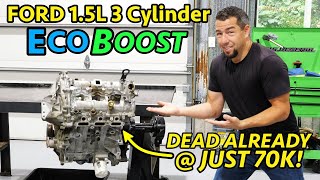
🎬 Watch this teardown of the 1.5L 3-cylinder engineTo ensure you are purchasing the correct engine for your 2020 Escape, use these identifiers:
- VIN Check: The 8th digit of your vehicle's Vehicle Identification Number (VIN) must be '6'.
- Visual Confirmation: Visually inspect the engine to confirm it is a 3-cylinder, not a 4-cylinder or a hybrid powertrain.
- Engine Codes: Look for identifying codes such as "996" or "Y1DA".
- Part Number: The original engine should have a barcoded sticker on the timing cover with an engineering part number that begins with LX6G (e.g., LX6G-6007-TA).
Interchange and Fitment Warnings
Warning: This specific unit is configured and calibrated to fit the 2020 Ford Escape only. Do not attempt to install it in a 2021 or newer Escape or a Ford Bronco Sport (2021+). These vehicles use a similar engine, but have critical differences in engine mounts, oil pans, wiring harness pinouts, accessory positioning, and computer (PCM) calibrations that make them incompatible.
Warning: If you are swapping an engine between an All-Wheel Drive (AWD) and a Front-Wheel Drive (FWD) model, you must transfer the original oil pan, oil pickup tube, and intermediate shaft brackets. This is because the AWD model's oil pan is shaped differently to provide clearance for the Power Transfer Unit (PTU), which directs power to the rear wheels.
What is Included in a Used Assembly

When purchasing a used, recycled engine assembly from a professional auto recycler, it typically follows Automotive Recyclers Association (ARA) standards. You can expect the following components to be included:
- Engine block and cylinder head
- Internally lubricated parts (crankshaft, pistons, rods, camshafts, valves)
- Oil pan and valve cover
- Timing covers and timing chain
- Intake manifold and throttle body
- Fuel injection system (fuel rail, high-pressure fuel pump, fuel injectors)
- Harmonic balancer
- Engine oil separator housing
Not Included: Accessories like the A/C compressor, starter motor, alternator, power steering pump, and exhaust manifold are generally removed and sold separately. You will need to transfer these from your old engine.
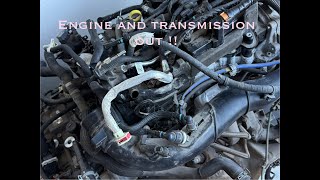
🎬 See a step-by-step engine removal walkthroughCommon Failure Symptoms and Diagnosis

A major engine failure can present several distinct symptoms. If you experience any of the following, it is critical to have your vehicle inspected by a qualified technician immediately:
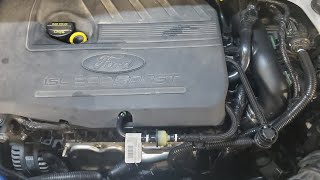
- Loud knocking or clanking noises from the engine. 🎬 Listen to normal vs abnormal engine noises
- Significant loss of engine power.
- Excessive white or blue smoke from the exhaust.
- A strong smell of fuel inside or outside the vehicle.
- Visible smoke or flames from the engine compartment.
- Engine misfires, sometimes accompanied by diagnostic codes like P0302 or P0316.
A mechanic will typically confirm internal engine failure through a series of tests, such as a compression test to check for loss of pressure in the cylinders, a leak-down test to pinpoint where the pressure is escaping, and an inspection of the engine oil and coolant for cross-contamination (e.g., a milky, frothy appearance).
Diagnostic Flowchart
Known Issues, Recalls, and Technical Service Bulletins (TSBs)
This engine has several documented issues that owners and buyers should be aware of. It is much easier to perform these checks and repairs while the engine is out of the vehicle.
Pro Tip: Before installing a used engine, check its VIN history for open recalls. If any recalls are pending, have the repairs performed by a Ford dealer before the engine is installed in your vehicle.
Cracked Fuel Injector (Potential Fire Risk)
Severity: Severe
A major safety issue involves the high-pressure fuel injectors, which can crack and leak fuel onto hot engine surfaces, creating a significant fire risk. This issue affects 2020-2022 Escapes.
- Recall Numbers: NHTSA Campaigns 22V859000 and 24V-187 (Ford Recall 22S73), and a late 2025 update 25V467.
- Remedy: The initial fix involved updating the engine control software (PCM) to detect a fuel pressure drop and installing a drain tube to divert fuel away from hot surfaces. A late 2025 update replaces all high-pressure fuel injectors with a revised design. Ford also implemented a customer satisfaction program (22N18) to cover injector replacement for 15 years or 150,000 miles.
Cracked Oil Separator (Potential Fire Risk)
Severity: Moderate
The engine oil separator housing can crack, leading to an oil leak. If the leaking oil contacts a hot surface, it can also pose a fire risk. This affects 2020-2022 models.
- Recall Number: NHTSA Campaign 22V191000 (Ford Recall 22S21).
- Remedy: Dealers will inspect the right-hand oil separator housing and replace it if necessary.
Check Engine Light with Code P04DB
Severity: Minor
Some 2020 Escapes built on or before July 21, 2020, may experience a persistent check engine light with diagnostic trouble code P04DB.
- TSB Number: TSB 21-2120.
- Remedy: The fix involves replacing the crankcase ventilation tube assembly and reprogramming the vehicle's main computer (PCM).
Engine Vibration at Idle
Severity: Minor
An issue causing excessive vibration at idle was identified on 2020 Escapes built on or before November 30, 2019.
- TSB Number: TSB 20-2215.
- Remedy: The procedure involves replacing the roll restrictor, engine mounts, and transmission mounts with updated parts designed to better absorb vibrations.
Harsh Shifting (FWD Models)
Severity: Minor
Some 2020 FWD Escapes built between June 9, 2020, and October 2, 2020, may exhibit harsh shifting, specifically harsh engagement into Drive or harsh downshifts.
- TSB Number: TSB 20-2366.
- Remedy: This issue is related to the transmission calibration and can be addressed by a dealer.
What Fails at Every Mileage Band
Pro Tip: The mileage bands below describe the typical condition of used replacement units at that mileage. The checklists provided are things to do WHILE INSTALLING the purchased engine, not maintenance for your current engine.
Under 60,000 Miles
Engines in this range are generally healthy, but they are squarely in the window for factory defects and recalls. The primary concerns are the cracked fuel injectors (NHTSA 22V859000) and the cracked oil separator (NHTSA 22V191000), both of which pose fire risks. Early build models may also suffer from a faulty crankcase ventilation tube (TSB 21-2120) or excessive idle vibration (TSB 20-2215).
- ✓Do during install (required): Verify all recall work is complete, especially for the fuel injectors and oil separator. It is much easier to perform these repairs with the engine out of the vehicle.
- ✓Do during install (required): Change engine oil and filter using only 5.6 quarts of 5W-20 synthetic oil meeting Ford's WSS-M2C960-A1 specification to protect the wet belt system.
- ✓Do during install (recommended): Replace spark plugs (Motorcraft SP-588 or equivalent, gapped to 0.028-0.031 inches).
- ✓Cheap insurance while the engine is out: Inspect and consider replacing the crankcase ventilation tube if the engine build date is prior to July 21, 2020. If the donor vehicle was built before November 30, 2019, consider installing the updated engine and transmission mounts.
60,000 - 100,000 Miles
As the engine approaches 100,000 miles, the "wet" oil pump belt becomes a major concern. This belt runs immersed in engine oil. If incorrect oil was used or oil changes were neglected, the belt degrades. Debris from the belt clogs the oil pickup screen, leading to oil starvation and catastrophic engine failure. Additionally, as a direct-injection engine, carbon buildup on the intake valves can cause hesitation and power loss.
- ✓Do during install (required): Drop the oil pan, inspect the wet oil pump belt for cracking or delamination, and clean the oil pickup tube screen.
- ✓Do during install (required): Replace all one-time-use Torque-to-Yield (TTY) bolts (crankshaft pulley, flywheel/flexplate, engine mounts).
- ✓Do during install (recommended): Perform an intake valve cleaning (walnut blasting) to remove carbon deposits.
- ✓Cheap insurance while the engine is out: Proactive replacement of the wet oil pump belt (Ford Part J7BZ-6B651-A) is strongly recommended. Thoroughly inspect the turbocharger for shaft play and signs of oil contamination, especially if the previous engine failed due to oiling issues.
100,000 - 150,000+ Miles
At this high mileage, wet oil pump belt failure is the primary mechanical threat. While Ford's recommended service interval is 150,000 miles, owner reports show failures happening much earlier (e.g., 128,000 miles). Normal wear-and-tear items like the cylinder head temperature (CHT) sensor and EVAP purge valves also begin to fail.
- ✓Do during install (required): Assume the wet oil pump belt and tensioner are at the end of their life. Replacement is not optional at this mileage; it is critical preventative maintenance.
- ✓Do during install (required): Replace all gaskets, seals, and one-time-use bolts as a rule.
- ✓Do during install (recommended): Replace the timing belt. While some claim it is a "lifetime" belt, mechanics recommend replacing it around 100,000 miles to prevent catastrophic failure.
- ✓Cheap insurance while the engine is out: Strongly consider replacing the water pump, thermostat, and all coolant hoses while access is easy. Clean the intake valves, throttle body, and mass air flow sensor.
Real Owner Experiences
The following table highlights real-world failures and repair costs reported by owners of vehicles equipped with this 1.5L EcoBoost engine.
| Source | Mileage | What Happened | Cost |
|---|---|---|---|
| CarComplaints.com | 21,895 (average) | The NHTSA has logged 70 engine-related complaints for the 2020 Escape, with failures occurring at a low average mileage. | N/A |
| 45,000 | An owner reported spending nearly $1,000 for a faulty software issue. | ~$1,000 | |
| YouTube Teardown (I Do Cars) | ~70,000 | A teardown of an engine from a 2021 Escape revealed a terribly degraded oil pump belt, though it had not yet failed. The analyst suggested the engine was likely replaced due to sludge and timing-related codes caused by the belt material contaminating the oil. | Engine Replacement |
| CarComplaints.com | ~80,000 | A failure was reported at approximately 80,000 miles. | N/A |
| YouTube / WCVB | 80,000 | Replaced the engine at a local mechanic due to coolant intrusion, a known issue with the older 1.5L 4-cylinder, not the 3-cylinder 'Dragon' engine. Ford denied assistance as the vehicle was out of warranty. | $7,000+ |
| 110,000 | A 2021 Bronco Sport owner with the 1.5L reported no engine issues, but noted it was time for a spark plug job. | Standard Maintenance | |
| 120,000 | Owner reported minor issues: a burnt-out cylinder head temp sensor ($70 in parts) and a replaced purge valve. The engine itself was still running well. | ~$70 + parts for purge valve | |
| 128,000 | Owner replaced the engine due to metal shavings in the oil and top-end wear. Upon inspection, the oil pump belt was found to be severely cracked, despite the service interval being 150,000 miles. | Engine Replacement | |
| BobIsTheOilGuy Forums | 260,000 | Owner was quoted $6,300 to replace the wet oil pump belt. Instead, they had a used engine with 10,000 miles installed. | Not specified, but stated as 'way cheaper than the belt' |
Replacement Cost Comparison
The cost to replace a failed 1.5L EcoBoost engine can vary widely based on the type of replacement unit you choose. Labor costs are also significant due to the complexity of the job.
| Part / Service | Estimated Cost (USD) | Notes |
|---|---|---|
| New OEM | $4,000+ | Brand new from a Ford dealer. Highest cost, may have limited availability. |
| Remanufactured | $2,500 - $4,000 | Rebuilt to OEM specifications, often with updates to correct original flaws. Comes with a warranty. |
| Used (Recycled) | $385 - $1,800 | A functional engine from a salvage vehicle. Price depends heavily on mileage and condition. |
| Installation Labor | $1,600 - $2,500 | Represents an estimated 12-15 hours of professional shop time. |
Repair or Replace?
Deciding whether to repair your current engine or replace it entirely depends on the nature of the failure.
When Repair Makes Sense
- Cracked Fuel Injector: This should always be repaired under the NHTSA recall (22V859000 / 24V-187) or Customer Satisfaction Program 22N18 at a Ford dealer for free. If paying out of pocket, a single injector replacement is estimated between $458 and $614, but the recall covers all three.
- Cracked Oil Separator: This should be repaired for free under NHTSA Campaign 22V191000 (Ford Recall 22S21).
- Preventative "Wet" Oil Pump Belt Replacement: If the engine is already removed for another major service, or if the vehicle has over 80,000 miles and you plan to keep it long-term, replacing the belt makes sense. A specialist estimates the job at around $1,500 to $2,000 (approx. £1500). A failure of this belt will cause catastrophic engine damage, making preventative replacement a wise investment.
When Replacement is Smarter
Replacement is the smarter option when the engine has suffered catastrophic internal failure, most commonly due to a snapped "wet" oil pump belt causing oil starvation. One owner was quoted $6,300 just to replace the belt, and opted for a low-mileage used engine instead because it was cheaper. Given that used engines for this model typically run $385 to $1,800, any repair approaching or exceeding $2,500 to $4,000 should be weighed carefully against the cost of a complete used unit.
Questions to Ask Your Installer
Before handing over your vehicle, ask your mechanic these questions to ensure they are prepared for this specific engine:
- Have you worked on the Ford 1.5L 3-cylinder "Dragon" engine before, and are you aware it's different from the older 4-cylinder?
- Will you be dropping the front subframe for the installation?
- Will you inspect the "wet" oil pump belt and oil pickup screen before installing the engine? What is the condition?
- Do you have the Ford-specific tools for timing (303-1635) and programming (IDS/FDRS)?
- How will you handle the programming for the fuel injector codes, CKP relearn, and PATS immobilizer?
- Will you be replacing all one-time-use Torque-to-Yield (TTY) bolts for the crank pulley, flexplate, and engine mounts?
- Can you confirm you are using engine oil that meets the Ford WSS-M2C960-A1 specification to protect the wet belt?
- While the engine is out, can you inspect the oil separator housing (Recall 22S21) and confirm the fuel injector recall (22S73) status or perform the update?
- If my vehicle is AWD, are you prepared to transfer the original oil pan and associated parts from the old engine?
- What is your plan for reusing my vehicle's original wiring harness to ensure compatibility?
Installation: Key Considerations and Required Parts

Professional Installation Recommended
Replacing this engine is an expert-level task. The standard procedure requires the technician to drop the entire front subframe with the engine and transmission attached. It requires an engine hoist and an engine support fixture. It is not recommended for DIY mechanics without significant experience and access to specialized equipment.
Special Tools and Programming
Warning: The engine will not start or run correctly without proper programming. After installation, a Ford-specific diagnostic tool (like IDS/FDRS, a high-end aftermarket scan tool, or FORScan with a compatible OBDLink adapter) is required to program several components to the vehicle's main computer (PCM).
- Fuel Injector Codes: Each high-pressure fuel injector has a unique 10-digit calibration code that must be programmed into the PCM.
- Crankshaft Position (CKP) Sensor Relearn: This procedure synchronizes the sensor with the PCM to prevent false misfire codes.
- Immobilizer (PATS) Relearn: This security procedure allows the newly installed engine to communicate with your vehicle's keys.
Mechanics will also need specific physical tools, including a Camshaft Alignment/Timing Tool Kit (Ford OEM 303-1635), a Crankshaft Vibration Damper Remover/Installer (Ford OEM 303-1636), and a Fuel Injector Remover/Installer (Ford OEM 303-1567).
Mandatory Replacement Parts
To ensure a reliable installation, a number of parts are considered one-time-use or are critical to replace any time the engine is removed. Always replace the following:
- Engine Oil and Filter: Use 5.6 quarts of 5W-20 oil meeting Ford specification WSS-M2C960-A1. Using the wrong oil can destroy the wet belt. Use a Motorcraft FL-910S filter or equivalent.
- Engine Coolant: Use Motorcraft Yellow Prediluted Coolant meeting Ford specification WSS-M97B57-A1.
- Oil Pump Drive Belt (Wet Belt): This belt (Ford Part J7BZ-6B651-A) runs inside the engine in the oil. It is a critical wear item and should always be inspected and likely replaced.
- Torque-to-Yield (TTY) Bolts: The crankshaft pulley bolt, flywheel/flexplate bolts, and engine mount bolts are designed to stretch and are one-time-use only. They must be replaced. Reusing the crankshaft pulley bolt causes the pulley to wobble, ruining the crankshaft snout and throwing off timing.
- Gaskets and Seals: Always install new intake and exhaust manifold gaskets, thermostat housing seals, and fuel injector O-rings and Teflon seals. Reusing old Teflon seals or O-rings causes high-pressure fuel leaks and fire hazards.
Critical "Gotchas" During Installation
Warning: The 'Wet' Oil Pump Belt. This engine uses an oil pump belt that runs directly in engine oil. It is known to degrade if incorrect oil is used or oil changes are neglected. Belt debris can clog the oil pickup screen, starving the engine of oil and causing catastrophic failure. Before installing a used engine, drop the oil pan, inspect the belt's condition, and thoroughly clean the oil pickup screen.
- Turbocharger Inspection: If the original engine failed due to oil contamination, the turbocharger is likely compromised. Installing a contaminated turbo on a new engine can cause immediate failure. Inspect it for shaft play and signs of oil starvation.
- Wiring Harness: You must reuse your vehicle's original engine wiring harness. The replacement engine's harness may not match your car's specific options, sensor pinouts, and PCM configurations.
- EVAP Lines: Plastic EVAP lines can become brittle; aftermarket purge valves may have different fittings requiring modification.
Freight, Delivery, and Pre-Purchase Verification

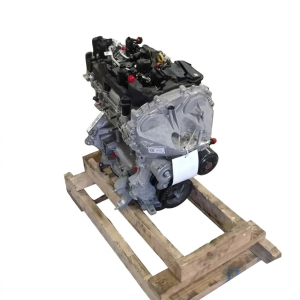
Because an engine assembly is a massive industrial part, it does not ship like a normal parcel. A used 1.5L EcoBoost engine weighs approximately 375 lbs and measures roughly 36" x 34" x 40" before crating. It will ship via Less-Than-Truckload (LTL) freight on a wooden pallet.
When receiving the freight shipment, you must request a liftgate service if you do not have a loading dock or a forklift. Most importantly, you must inspect the engine for physical damage (like cracked plastic manifolds or broken sensors) before signing the driver's delivery receipt. Signing without inspecting waives your right to claim shipping damage later.
Before you even order the engine, a reputable auto recycler will conduct a pre-purchase verification interview. They will ask you to:
- Verify the 8th digit of your VIN is '6'.
- Confirm the vehicle is a 2020 model.
- Verify if the vehicle is FWD or AWD to prepare for potential oil pan transfer.
- Visually confirm the engine is a 3-cylinder and not a 4-cylinder or hybrid variant.
Frequently Asked Questions (FAQ)
Is this the same 1.5L EcoBoost engine that had coolant intrusion problems?
No. The coolant intrusion and block cracking issues are widely associated with the older 1.5L 4-cylinder EcoBoost engine (Sigma family) used in 2017-2019 Escapes and other Ford models. This article covers the newer 1.5L 3-cylinder "Dragon" engine, which has a redesigned block.
Can I use standard 5W-20 engine oil?
No. You must use an oil that specifically meets Ford's WSS-M2C960-A1 specification. Standard oils lack the additives required to protect the 'wet' oil pump belt. Using the wrong oil will cause the belt to break down, clog the oil system, and lead to complete engine failure.
Do I have to get the engine programmed by a dealer?
Yes, programming is mandatory. The fuel injectors, crankshaft position sensor, and vehicle immobilizer (PATS) must be programmed to the car's computer using a Ford-specific scan tool (IDS/FDRS) or a high-end professional aftermarket tool. Without this step, the engine will not start or will run very poorly.
Can I reuse the fuel injectors or turbo from my old engine?
It is strongly discouraged. The high-pressure fuel injectors are a known failure point and subject to a safety recall; they should be replaced with new, updated parts. If your old engine failed due to an internal issue like oil contamination, reusing the old turbocharger is a huge risk, as it can send damaging debris into your replacement engine.
What exactly is the "wet belt" everyone talks about?
The "wet belt" refers to the oil pump drive belt (Ford Part J7BZ-6B651-A). Unlike traditional belts that run dry on the outside of the engine, this belt runs inside the engine block, completely submerged in engine oil. It is highly sensitive to oil quality and maintenance intervals.
Will this 2020 engine fit my 2021 Ford Bronco Sport?
No. Even though the 2021+ Bronco Sport and 2021+ Escape use a 1.5L 3-cylinder engine, the 2020 Escape engine has differences in engine mounts, oil pans, wiring harness pinouts, accessory positioning, and PCM calibrations that make it incompatible.
Helpful Videos
Technical Specifications
OEM Part Numbers: LX6G-6007-TA J7BZ-6B651-A
Engine Family: Dragon; Cylinders: 3; Displacement: 1.5L; Aspiration: Turbocharged; Fuel System: Direct Injection; VIN (8th Digit): 6; Engine Codes: 996, Y1DA; Oil Type: 5W-20 Synthetic; Oil Specification: WSS-M2C960-A1; Oil Capacity: 5.6 quarts; Coolant Specification: WSS-M97B57-A1; Spark Plug Gap: 0.028-0.031 inches
We Have This Part in Stock

The information in this article is provided for general reference and educational purposes only. Vehicle specifications, procedures, and part compatibility can vary by production date, trim level, and region. Always consult your vehicle's factory service manual and verify part numbers before purchasing or performing repairs. Safety-critical components such as airbags, seat belts, and braking systems should be installed by a qualified professional.
- Ford Escape:
- 🎬 Helpful Videos
- 🛍️ Shop This Part
- Identifying the Correct 1.5L EcoBoost Engine
- Interchange and Fitment Warnings
- What is Included in a Used Assembly
- Common Failure Symptoms and Diagnosis
- Diagnostic Flowchart
- Known Issues, Recalls, and Technical Service Bulletins (TSBs)
- Cracked Fuel Injector (Potential Fire Risk)
- Cracked Oil Separator (Potential Fire Risk)
- Check Engine Light with Code P04DB
- Engine Vibration at Idle
- Harsh Shifting (FWD Models)
- What Fails at Every Mileage Band
- Under 60,000 Miles
- 60,000 - 100,000 Miles
- 100,000 - 150,000+ Miles
- Real Owner Experiences
- Replacement Cost Comparison
- Repair or Replace?
- When Repair Makes Sense
- When Replacement is Smarter
- Questions to Ask Your Installer
- Installation: Key Considerations and Required Parts
- Professional Installation Recommended
- Special Tools and Programming
- Mandatory Replacement Parts
- Critical "Gotchas" During Installation
- Freight, Delivery, and Pre-Purchase Verification
- Frequently Asked Questions (FAQ)
- 🎟️ Get 5% Off