

2017-2020 Nissan Rogue 2.5L QR25DE: Problems, Identification, and Used Replacement
Identify the correct QR25DE engine, understand what causes catastrophic failure, and learn what to look for when buying a used OEM replacement.
- The most critical failure is caused by the pre-catalytic converter degrading and sending debris into the engine; you MUST inspect the original exhaust manifold before installing a replacement engine.
- Verify the correct engine using the VIN (1st digit '5', 4th digit 'A') and confirm you have a Rogue, not a Rogue Sport, as their engines are not interchangeable.
- When installing a FWD-sourced engine into an AWD Rogue, it is mandatory to transfer the oil pan, intermediate shaft bracket, and transfer case mounting bracket from the original engine.
- To ensure compatibility and avoid electrical issues, always transfer the complete wiring harness, all sensors, and external brackets from your original engine to the replacement unit.
Is This the Right Engine for Your Rogue?


The 2017-2020 Nissan Rogue uses a 2.5-liter, naturally aspirated (non-turbo) inline four-cylinder engine known as the QR25DE. This engine family has been in production since the early 2000s and is known for its straightforward, non-direct-injection design. Before purchasing a replacement, it's critical to confirm it is the correct version for your specific vehicle.
VIN Verification
The easiest way to identify your engine is by checking your vehicle's 17-digit Vehicle Identification Number (VIN). For this specific engine, two digits are crucial:
| 1st VIN Digit | Must be '5', indicating the vehicle was built in the USA (Smyrna, Tennessee). |
| 4th VIN Digit | Must be 'A', which designates the 2.5L QR25DE engine for this model. |
You can find the VIN on the driver's side of the dashboard (visible through the windshield) or on the driver's side door jamb sticker.
Pro Tip: Do not confuse the standard Rogue with the Rogue Sport. The Rogue Sport is a different vehicle that uses a completely different 2.0L MR20DD engine, which is not interchangeable with the 2.5L QR25DE.
Critical Interchange Notes
Even with the correct engine, you must be aware of a few key variations:
- FWD vs. AWD: This engine is typically sold in a Front-Wheel Drive (FWD) configuration. If your Rogue is All-Wheel Drive (AWD), you must transfer the oil pan, intermediate shaft bracket, and transfer case mounting bracket from your original engine. The FWD oil pan lacks the necessary clearance and mounting provisions for the AWD transfer case.
- Build Location: If your Rogue was built in Japan (VIN starts with 'J') or Korea (VIN starts with 'K'), the core engine (long block) is physically identical. However, you must transfer all external brackets, sensors, and the complete wiring harness from your original engine to the replacement unit to ensure compatibility. Minor pinout or connector differences exist between these build locations.
Common Failure Symptoms

The most catastrophic failure for this engine often stems from a problem with a separate component: the pre-catalytic converter, which is part of the exhaust manifold. When it fails, it can send debris back into the engine, causing severe damage.
- Sluggish Performance and Power Loss: If the engine feels weak, struggles to accelerate, or even stalls, it can be a sign of a clogged catalytic converter creating excessive backpressure.
- Rattling Noises from Under the Car: A metallic rattle, especially on startup, can indicate that the honeycomb structure inside the catalytic converter has broken apart.
- High Oil Consumption: If the catalytic converter debris has been ingested by the engine, it can score the cylinder walls. This damage allows oil to bypass the piston rings and burn in the combustion chamber, leading to rapid oil loss and blue-tinted exhaust smoke.
- Engine Rattle on Startup: A brief rattling noise that disappears after a few seconds can be a sign of worn timing chain guides or a failing tensioner, which is more common on higher-mileage units (typically over 150,000 miles).
Diagnostic Flowchart
Known Issues, Recalls, and Technical Service Bulletins (TSBs)
Pre-Catalytic Converter Failure and Engine Damage
Warning: The most severe issue for the QR25DE is not the engine itself, but the exhaust manifold's integrated pre-catalytic converter. Over time, the ceramic honeycomb material can degrade and get sucked back into the engine's cylinders. This abrasive debris scores the cylinder walls, leading to catastrophic engine failure. You MUST inspect your original exhaust manifold before bolting it to a replacement engine. If it shows any signs of damage or degradation, do not reuse it.
Symptoms of a failing catalytic converter include a check engine light with code P0420, a rotten-egg smell from the exhaust, and reduced engine power.
NHTSA Recall 22V875000: Dash Harness Connector Corrosion
This safety recall, also known as Nissan campaign PC934, applies specifically to 2017 model year Rogues. A water leak in the driver's side footwell can cause moisture to enter a dash harness connector. This can lead to corrosion, causing electrical shorts, inoperative power windows/seats, an illuminated AWD warning light, a dead battery, or even a fire in rare cases. The fix involves inspecting the connector, replacing it if corroded, and applying lithium grease to prevent future moisture intrusion. Ensure this is addressed before installing a replacement engine.
TSB NTB18-050A: ECM Reprogram for Hot Climates
This voluntary service campaign (also known as PC633 / P8325) applies to 2014-2017 Rogues. It addresses issues where the engine may hesitate or turn off when accelerating from a stop in very hot weather. The remedy is a simple software reprogram of the Engine Control Module (ECM) to optimize performance.
TSB NTB18-066: Radiator Coolant Mixture Degradation
Also known as Voluntary Service Campaign PC652, this applies to 2017 models. The radiator coolant mixture can degrade prematurely. The remedy is to drain and refill the radiator to ensure the proper coolant mixture is present.
Valve Cover & Spark Plug Tube Seal Leaks
The QR25DE uses a plastic valve cover with integrated, non-serviceable spark plug tube seals. These seals prevent oil from leaking into the spark plug wells. Over time, they can harden and fail. Because the seals are not sold separately, a leak requires replacing the entire valve cover assembly.
Throttle Body Carbon Buildup
Like many modern engines, the QR25DE can suffer from carbon deposits in the throttle body. This can disrupt airflow and cause a rough or unstable idle. The fix is to clean the throttle body and perform a strict electronic idle relearn procedure.
What Fails at Every Mileage Band
Pro Tip: The mileage bands below describe used replacement units of that mileage. The checklists provided are things to do WHILE INSTALLING the purchased engine, not maintenance for your current engine.
Under 60,000 Miles
Engines in this range are generally very healthy. However, some owner reports mention early A/C compressor failure around 47,000 miles, as well as various electrical issues. While not an engine failure, the associated CVT transmission is a major concern, and many engine problems are actually secondary to a failing CVT.
- ✓Do during install (required): ALWAYS inspect the pre-catalytic converter for degradation before installation to prevent catastrophic engine failure.
- ✓Do during install (recommended): Perform a full cooling system flush and fill with Nissan Blue Long Life Antifreeze (approx. 7.1 US quarts). Install a new thermostat and gasket. Replace the serpentine belt.
- ✓Cheap insurance while the engine is out: Inspect and replace the A/C compressor if there are any signs of leakage or unusual noise. Replace spark plugs with double-fine-tipped platinum or iridium plugs (OEM NGK Laser Iridium), as intervals can be as low as every 25,000-30,000 miles.
60,000 - 100,000 Miles
Oil consumption may begin or increase in this range, with some sources considering one quart per 1,000 miles as within Nissan's acceptable limits. CVT transmission issues are a significant concern between 60,000 and 120,000 miles, often mistaken for engine problems due to symptoms like shaking and loss of power. Valve adjustments may be needed every 60,000-80,000 miles if the engine is vibrating or has lost performance. Alternator failures are also reported.
- ✓Do during install (required): All required items from the previous band. Replace the valve cover gasket and the entire valve cover if the spark plug tube seals are leaking.
- ✓Do during install (recommended): Replace the PCV valve. Replace all motor mounts, especially the torque mount which is known to wear out and cause vibrations.
- ✓Cheap insurance while the engine is out: Strongly consider replacing the timing chain, tensioner, and guides as a preventative measure, as they can start to rattle after 100,000 miles.
100,000 - 150,000 Miles
The timing chain may stretch and begin to rattle, typically requiring replacement between 120,000-130,000 miles. Catalytic converter failure becomes more common, often due to unburnt fuel from worn spark plugs destroying the internal honeycomb structure. Stuck PCV valves and alternator failures are also frequent. Lower control arm bushings can wear out, causing clunking noises.
- ✓Do during install (required): Mandatory replacement of the timing chain, guides, and tensioner. Clean the throttle body and intake manifold thoroughly.
- ✓Do during install (recommended): Replace ignition coils along with spark plugs.
- ✓Cheap insurance while the engine is out: Replace both camshaft position sensors and the crankshaft position sensor as they are known failure points and inexpensive to replace while the engine is out.
Over 150,000 Miles
The QR25DE engine itself is considered durable and is frequently reported to last between 200,000 and 250,000 miles with proper maintenance. The primary limiting factor is often the CVT transmission, which may fail multiple times within the engine's lifespan. General wear and tear on all components is expected, and catalytic converter failure remains a high risk.
- ✓Do during install (required): Perform all maintenance from the previous bands, with an emphasis on replacing the timing components, all sensors (cam/crank), and the entire valve cover assembly.
- ✓Do during install (recommended): Assume all rubber hoses, gaskets, and seals are brittle and should be replaced.
- ✓Cheap insurance while the engine is out: A complete cooling system overhaul (radiator, hoses, thermostat, water pump) is cheap insurance at this mileage.
Real Owner Experiences
Below is a collection of real-world owner experiences detailing failures, symptoms, and quoted repair costs for the 2017-2020 Nissan Rogue.
| Source | Mileage | What Happened | Cost |
|---|---|---|---|
| under 50,000 | Dealer quoted for a full engine replacement after the engine developed a knock and was found to be 'bone dry' of oil shortly after an oil change. | $16,500 | |
| 48,243 | Dealer quoted for a new engine due to a blown head gasket. Nissan denied goodwill assistance despite being under the mileage portion of the powertrain warranty. | $10,500 | |
| 28,000 | Dealer quoted for a new engine after a 'catastrophic heating event' where all coolant was lost. CPO warranty would not cover it. (Note: Rogue Sport model) | $17,500 | |
| Cars.com | 47,000 | A/C compressor went bad. | ~$1,500 |
| CarComplaints.com | 45,000 | Unspecified engine issue reported. | N/A |
| Cars.com | 60,000 | Multiple issues including electrical problems (batteries, touchpad, door locks) and unspecified engine problems. | N/A |
| CarComplaints.com | 71,256 | Vehicle began shuttering, stalling, and jerking, suspected to be a failing CVT transmission. | N/A |
| 86,500 | Car shakes while driving and dies at stop lights, occurred after a CVT fluid change at 60k miles. | N/A | |
| CarComplaints.com | 96,000 | RPMs fluctuated but the vehicle failed to respond, diagnosed as a faulty ADAS control module and AEB system, not directly an engine issue but affects driveability. | N/A |
| 110,000 | Owner was quoted for a tune-up including spark plugs and a PCV valve, indicating these are common service items at this mileage. | $627 (quoted for tune-up) | |
| 113,000 | Alternator belt snapped, causing the car to overheat and stall. Required replacement of the cooling system and alternator. | N/A | |
| 120,000 | A stuck open PCV valve required a significant repair. | ~$2,000 | |
| 129,000 | No immediate failure, but new owner was advised to immediately service the CVT fluid. | N/A | |
| 156,000 | Besides a PCV valve and A/C hose replacement around 120k, the car still runs great with regular maintenance. | N/A | |
| YouTube | 213,000 | Owner reports no problems at all, just kept up with required maintenance. | N/A |
| 300,000 | Owner of a 2017 model reached this high mileage, though they consider it the 'worst car' they've owned, implying numerous issues along the way. | N/A |
Replacement Cost Comparison
The cost of replacing a Nissan Rogue engine can vary widely based on the type of engine and labor rates. Below are typical cost estimates.
| Part or Service | Estimated Cost (USD) |
|---|---|
| New OEM | $4,000 - $10,000+ (Part only) |
| Remanufactured | $3,400 - $4,300 (Part only) |
| Used OEM (Recycled) | $425 - $1,700 (Part only, depending on mileage) |
| Installation Labor | $1,200 - $2,500 (10 to 14 hours) |
Repair or Replace?
Not every engine issue requires a full replacement. Knowing when to repair versus when to replace can save you thousands of dollars.
When Repair Makes Sense
- Timing Chain Stretch / Rattle: If caught early before catastrophic failure, replacing the timing chain, guides, and tensioners typically costs $800 - $1,500. This is a common high-mileage wear item.
- Valve Cover Gasket & Spark Plug Tube Seal Leaks: This is a routine maintenance repair. Since the spark plug tube seals are integrated, the entire valve cover must be replaced, but at $250 - $500, it is far more economical than engine replacement.
- Throttle Body Carbon Buildup: If you are experiencing an unstable idle, cleaning the throttle body and performing an idle relearn procedure is a simple repair costing $150 - $300.
When Replacement is Smarter
Replacement is the recommended course of action when the engine has suffered catastrophic failure from the ingestion of pre-catalytic converter debris. This leads to severe cylinder scoring, massive oil consumption, and low compression. It is also the best option for severe overheating causing a cracked block or blown head gasket, or any internal failure resulting in metal shavings in the oil. In these cases, the cost and complexity of a rebuild often exceed the price of a lower-mileage used engine.
Questions to Ask Your Installer
- Have you inspected my original exhaust manifold/pre-catalytic converter for degradation? Will you show it to me before reinstalling it?
- Are you familiar with the required oil pan and bracket swap for my AWD vehicle?
- Will you be swapping my original wiring harness and all sensors onto the replacement engine?
- Do you have a bidirectional scan tool to perform the Idle Air Volume Learning (IAVL) procedure after installation?
- What is the source and mileage of the used engine you are providing?
- Does your quoted price include all necessary new consumables like gaskets, seals, oil, and coolant?
- What warranty do you provide on the replacement engine and your labor?
Freight & Delivery Reality

A used 2.5L QR25DE engine assembly is not a parcel. Verified shipping data shows this unit weighs approximately 271 lbs and measures roughly 21" x 26" x 28" before crating. It ships via Less-Than-Truckload (LTL) freight on a pallet.
Because of its size and weight, it will arrive on a large freight truck. If you are having it delivered to a residential address or a shop without a loading dock or forklift, you must request a truck with a liftgate to lower the pallet to the ground. Always inspect the engine thoroughly for any physical damage (such as a cracked plastic valve cover or broken sensors) before signing the driver's delivery receipt. Once you sign, you are acknowledging it arrived in good condition.
Installation Best Practices & Common Mistakes

Proper installation is key to the longevity of a replacement engine. This job is rated as Advanced to Expert and requires special tools like an engine hoist/crane with a load leveler, an engine support bar, and a bidirectional OBD2 scan tool (such as Autel, Launch, or Nissan CONSULT-III Plus). Here are some critical steps and common errors to avoid:
Warning: The most common and costly installation mistake is failing to swap the oil pan for AWD models. If you are installing a FWD-sourced engine into an AWD Rogue, you must use your original AWD oil pan. Attempting to bolt an AWD transfer case onto the FWD engine without swapping the oil pan will not work and can cause significant delays and damage.
Warning: Before mating the engine to the CVT transmission, ensure the torque converter is fully seated in the transmission's front pump. Forcing the engine and CVT together using bellhousing bolts when the torque converter isn't fully seated will crush and destroy the CVT's front pump, leading to a catastrophic transmission failure.
- Use Your Original Harness: Always transfer the wiring harness and all sensors from your old engine to the replacement. Leaving the donor engine's wiring harness on can lead to pinout variations or mismatched sensor plugs.
- Torque the Valve Cover Carefully: The plastic valve cover is highly fragile. Follow the factory torque sequence and tighten bolts to exactly 7-8 ft-lbs (84-96 in-lbs) to avoid cracking.
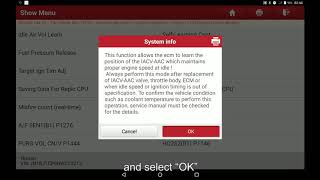
- Perform Idle Relearn Procedures: After installation, the engine will likely have a very high or surging idle. You must perform the Idle Air Volume Learning (IAVL), Throttle Valve Closed Position Learning, Accelerator Pedal Released Position Learning, and Crankshaft Position Sensor (CKP) Relearn. The IAVL requires specific conditions: coolant temp between 65°C and 100°C, battery voltage above 12.9V, and all accessories off, or the ECM will reject the command.
- Check Ground Wires: Ensure all engine ground straps are clean, free of corrosion, and bolted tightly to prevent phantom misfires.
- Use Proper Consumables: Fill the engine with 4.9 US quarts (4.6 liters) of SAE 0W-20 full synthetic oil and a new OEM-spec oil filter (e.g., Nissan 15208-65F0E). Use High-temp RTV Silicone (ThreeBond 1217H or equivalent) where required, and install new intake, exhaust, and thermostat gaskets.
Warning: Never reuse torque-to-yield (TTY) bolts, such as those for the flexplate (flywheel) or harmonic balancer. Always install new bolts to prevent them from stretching, backing out, or breaking.
Arrival Inspection: Compression and Leak-Down
When your used engine arrives, test the cylinders before installing it. A compression test measures the pressure your engine makes while cranking. A healthy QR25DE engine should show between 150 and 180 PSI (pounds per square inch) in each cylinder. The most important rule is consistency. The lowest cylinder must be within 10 to 15 percent of the highest cylinder.
You should also perform a leak-down test. This test pumps compressed air into the cylinder to see how much air escapes. A good used engine should have less than 15 percent air loss per cylinder. If you hear air hissing from the exhaust or intake, the valves are not sealing properly.
Before the First Start: Fluids and Priming
Never start a used engine dry. Used engines sit on shelves for months, and all the oil drains away from the moving parts. You must prime the oil system first.
Follow these steps to safely start your replacement engine:
- Add Fresh Fluids: Install a new, high-quality oil filter. Fill the engine with fresh 0W-20 full synthetic motor oil. Fill the cooling system with Nissan Blue Long Life Antifreeze/Coolant (or an exact equivalent). Never reuse old oil or coolant.
- Disable Fuel and Spark: Remove the fuel pump fuse and disconnect the ignition coils. This stops the engine from actually starting while you prime it.
- Crank the Engine: Turn the key and crank the engine for 10 to 15 seconds. Wait one minute to let the starter motor cool down. Repeat this process three or four times. This pumps fresh oil through the entire engine.
- Check for Pressure: Watch your dashboard oil pressure light. Once the light turns off during cranking, the engine has safe oil pressure.
- Start the Engine: Reinstall the fuel pump fuse and plug the ignition coils back in. Start the engine and let it idle. Do not rev the engine. Check underneath for any oil or coolant leaks.
Frequently Asked Questions (FAQ)
Do I need to reprogram the computer (ECU) after installing a used engine?
You do not need to reprogram the main computer for NATS Immobilizer security purposes if you reuse your original ECU/ECM. However, you absolutely MUST perform the Idle Air Volume Learning and other calibration procedures with a bidirectional scan tool to ensure the engine idles correctly.
What is the difference between a Rogue and a Rogue Sport engine?
The standard Rogue from 2017-2020 uses the 2.5L QR25DE engine. The Rogue Sport uses a completely different 2.0L MR20DD engine. They are not interchangeable.
Can I use an engine from an AWD Rogue in my FWD Rogue?
Yes. This is a direct swap with no modifications needed. However, going the other way (installing a FWD engine into an AWD vehicle) requires you to swap over your original oil pan, intermediate shaft bracket, and transfer case mounting bracket.
What parts come with a typical used engine assembly?
A standard used engine assembly, often called a "long block," includes the engine block, cylinder head, oil pan, valve cover, timing cover, intake manifold, fuel injectors, fuel rail, throttle body, harmonic balancer, and internally lubricated components.
What parts are NOT included with a used engine?
Accessories like the A/C compressor, starter, power steering pump, alternator, exhaust manifold, ignition coils, engine control module (ECU), and engine mounts are typically not included and should be transferred from your original engine.
Helpful Videos
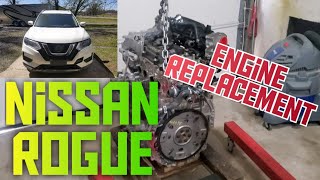


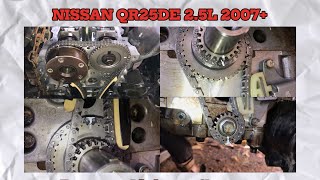
Technical Specifications
Engine Code: QR25DE; Displacement: 2.5 Liters; Cylinders: Inline 4-Cylinder; Aspiration: Naturally Aspirated; Injection: Non-Direct-Injection; Oil Type: SAE 0W-20 Full Synthetic; Oil Capacity: 4.9 US quarts (4.6 liters); Coolant Capacity: approx. 7.1 US quarts; Coolant Type: Nissan Blue Long Life Antifreeze; Valve Cover Torque: 7-8 ft-lbs (84-96 in-lbs); Shipping Weight: approx. 271 lbs; Shipping Dimensions: approx. 21" x 26" x 28"
We Have This Part in Stock


The information in this article is provided for general reference and educational purposes only. Vehicle specifications, procedures, and part compatibility can vary by production date, trim level, and region. Always consult your vehicle's factory service manual and verify part numbers before purchasing or performing repairs. Safety-critical components such as airbags, seat belts, and braking systems should be installed by a qualified professional.
- Nissan Rogue:
- 🎬 Helpful Videos
- 🛍️ Shop This Part
- Is This the Right Engine for Your Rogue?
- VIN Verification
- Critical Interchange Notes
- Common Failure Symptoms
- Diagnostic Flowchart
- Known Issues, Recalls, and Technical Service Bulletins (TSBs)
- Pre-Catalytic Converter Failure and Engine Damage
- NHTSA Recall 22V875000: Dash Harness Connector Corrosion
- TSB NTB18-050A: ECM Reprogram for Hot Climates
- TSB NTB18-066: Radiator Coolant Mixture Degradation
- Valve Cover & Spark Plug Tube Seal Leaks
- Throttle Body Carbon Buildup
- What Fails at Every Mileage Band
- Under 60,000 Miles
- 60,000 - 100,000 Miles
- 100,000 - 150,000 Miles
- Over 150,000 Miles
- Real Owner Experiences
- Replacement Cost Comparison
- Repair or Replace?
- When Repair Makes Sense
- When Replacement is Smarter
- Questions to Ask Your Installer
- Freight & Delivery Reality
- Installation Best Practices & Common Mistakes
- Arrival Inspection: Compression and Leak-Down
- Before the First Start: Fluids and Priming
- Frequently Asked Questions (FAQ)
- 🎟️ Get 5% Off