

2014-2017 Ram 1500 3.6L Pentastar V6: Problems, Identification, and Used Replacement
Identify the VIN G ERB engine, understand what causes the infamous Pentastar tick, and learn when to swap in a used OEM replacement.
- Verify the 8th digit of the VIN is 'G' and, for 2014-2016 models, confirm the truck does not have the Engine Start-Stop (ESS) system to ensure you purchase a compatible replacement engine.
- Proactively replace the failure-prone plastic oil filter housing with an all-aluminum aftermarket unit (e.g., Dorman 926-876) during any engine work to prevent catastrophic oil or coolant leaks.
- Address the common "Pentastar Tick" immediately by replacing all rocker arms and lifters to prevent the failure from causing expensive damage to the camshafts.
- After installation, a Crankshaft Position (CKP) Sensor Relearn procedure using a bi-directional scan tool is mandatory to prevent misfire codes and no-start conditions.
Is Your Ram 1500 Engine Failing?

When the 3.6L Pentastar V6 in a Ram 1500 has a major internal problem, it will give you clear warning signs. A complete engine replacement is often necessary when you experience symptoms pointing to significant mechanical damage, not just a single bad part.
- Engine Ticking or Knocking: A distinct ticking noise from the top of the engine, often called the "Pentastar Tick," is a classic sign of valvetrain failure. This can be caused by bad rocker arms or lifters. A deeper, heavier knocking sound from the bottom of the engine could mean worn bearings, a much more serious issue.
- Misfire Codes (P0300-P0306): While many things can cause a misfire, if you've already replaced spark plugs and coils and the problem persists, it may be due to internal issues like a failed lifter or camshaft damage. A flashing Check Engine Light indicates a severe misfire that can damage other components.
- Low Oil Pressure Warning: This light indicates a dangerous drop in oil pressure. It could be a simple sensor failure, but it could also mean a worn-out oil pump or excessive internal clearances from bearing wear, starving the engine of lubrication.
- Excessive Oil Consumption or Smoke: If your truck is burning a significant amount of oil between changes or you see blue-gray smoke from the exhaust, it can point to worn piston rings or bad valve seals, which are costly internal repairs.
Identifying the Correct 3.6L Pentastar Engine

Not all 3.6L Pentastar engines are the same. Ordering the correct used engine for your 2014-2017 Ram 1500 requires checking a few key details to ensure it will fit and function correctly. This specific engine family is known as the First-Generation or "Classic" ERB, featuring a 60-Degree V6, Dual Overhead Camshaft (DOHC), 24-Valve configuration.
Check Your VIN
The most important step is to check your truck's Vehicle Identification Number (VIN). The 8th digit of your VIN must be a 'G'. This code identifies your truck as having the correct 3.6L Pentastar ERB engine for this year range. You can find the VIN on the driver's side of the dashboard (viewable through the windshield) or on the sticker in the driver's door jamb.
Key Compatibility Checks
- Engine Start-Stop (ESS) System: For model years 2014, 2015, and 2016, this specific engine assembly is strictly for trucks without the automatic engine stop-and-start (ESS) feature. Engines from trucks with ESS have different components and are not directly compatible.
- Drivetrain (2WD vs. 4WD): The core engine (long block) is the same for both 2-wheel drive and 4-wheel drive models. However, you may need to swap the oil pan and oil pickup tube from your original engine onto the replacement unit, as these parts are different between the two drivetrain configurations.
Warning: Engines from other Chrysler, Dodge, Jeep, and Ram vehicles—even with a 3.6L Pentastar—will not interchange correctly. Vehicles like the Jeep Grand Cherokee, Dodge Durango, Chrysler 300, and Ram ProMaster use different engine mounts, intake manifolds, and accessory layouts that make them incompatible with the Ram 1500 pickup.
Common Problems, Recalls, and Technical Service Bulletins (TSBs)

The first-generation 3.6L Pentastar has several well-documented issues. When buying a used engine, it's wise to address these potential problems during the installation.
Valvetrain Ticking / Rocker Arm Failure
A widespread issue across the Pentastar family is a ticking noise caused by the failure of needle bearings inside the rocker arms. This can lead to a seized rocker arm, which then damages the camshaft lobe, causing a persistent misfire. FCA has issued revised parts and multiple service bulletins over the years, including TSB 09-009-23. A class-action lawsuit was also filed regarding this issue. If you hear this tick, the rocker arms and potentially the camshafts need replacement.
Cracked Oil Filter Housing & Cooler
The original oil filter and cooler assembly, mounted in the valley of the engine, is made of plastic and is prone to cracking from heat and vibration. This can cause severe oil or coolant leaks. TSB 09-012-22 and TSB 25-003-22 describe related issues where oil intrusion through the PCV system can cause spark knock, requiring extensive cleaning.
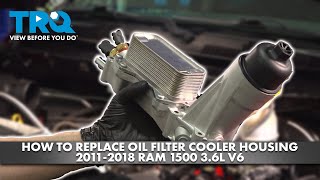
Pro Tip: It is highly recommended to replace the plastic factory oil filter housing with a more durable all-aluminum aftermarket version (like Dorman part 926-876 or 926-959) during the engine swap. 🎬 See this step-by-step oil filter housing replacement guide This is a preventative measure that can save you from a major failure down the road.
Fuel Rail Crossover Tube Leak (Recall)
Warning: Chrysler issued NHTSA Recall 16V-814 (manufacturer number S85) for a potential fuel leak. During engine assembly, the fuel rail crossover tube could have been damaged. This could lead to a fuel leak over time, increasing the risk of an engine fire. The recall affected certain 2016 and early 2017 models, and the fix involves a dealer inspection and, if necessary, replacement of the fuel rail crossover tube.
Cylinder Head Failure (Early Models)
The earliest Pentastar engines (primarily 2011-2013 models) suffered from a serious design flaw in the left-bank cylinder head, which could lead to overheating and valve seat failure. This issue was largely resolved by the 2014 model year, so it is less of a concern for the engines covered in this article. Chrysler extended the warranty on affected earlier models to 10 years or 150,000 miles to cover this repair.
Diagnostic Flowchart
What Fails at Every Mileage Band
Pro Tip: The mileage bands below describe used replacement units of that mileage. The checklists provided are things to do WHILE INSTALLING the purchased engine, not maintenance for your current engine.
Under 60K Miles
Even low-mileage engines can suffer from the cracked plastic oil filter housing/cooler assembly, leading to oil or coolant leaks. You may also see early signs of valvetrain ticking due to failing rocker arm bearings.
- ✓Do during install (required): Replace the original plastic oil filter housing with an upgraded all-aluminum aftermarket unit (e.g., Dorman). This is the most critical preventative measure.
- ✓Do during install (recommended): Replace spark plugs and the PCV valve. Replace all essential gaskets uncovered during the swap: intake manifold, exhaust manifold, and thermostat housing.
- ✓Cheap insurance while the engine is out: Install a new water pump and thermostat while access is easy.
60K - 100K Miles
In this range, there is an increased prevalence of oil filter housing/cooler assembly cracks and seal failures. The valvetrain "Pentastar Tick" becomes more common and pronounced, indicating rocker arm and/or lifter failure. Cooling system component failures, such as the water pump or radiator, also begin to appear.
- ✓Do during install (required): Proactively replace all 24 rocker arms and hydraulic lifters. Failure of these parts is common in this mileage range and can cause camshaft damage if neglected. Thoroughly inspect camshaft lobes for scoring or wear when replacing the rocker arms. Replace camshafts if any damage is found.
- ✓Do during install (recommended): Replace front and rear main crankshaft seals.
- ✓Cheap insurance while the engine is out: All items from the Under 60K band are still highly recommended.
100K - 150K Miles
Expect a significant increase in rocker arm and lifter failures, often leading to misfire codes and requiring camshaft inspection or replacement. There is a continued high rate of oil filter housing leaks, and occasional reports of oil pump issues or cylinder head problems.
- ✓Do during install (required): Replace the timing chain, guides, and tensioners. While the chain is durable, wear on the guides and tensioner is a concern at this mileage. Replace all 24 rocker arms, all 24 lifters, and inspect camshafts for wear, replacing if necessary.
- ✓Do during install (recommended): It is strongly advised to replace the oil pump as a precautionary measure.
- ✓Cheap insurance while the engine is out: Assume all items from the previous bands are considered mandatory at this mileage.
150K+ Miles
Engines in this range that have not had previous valvetrain work are at very high risk of rocker arm failure and subsequent camshaft damage. Seals and gaskets throughout the engine (intake, valve covers, main seals) are prone to drying out and leaking. Internal engine failure, like a loss of compression on a cylinder, becomes a possibility.
- ✓Do during install (required): Assume all items listed in the 100K-150K band are mandatory for a used engine in this mileage range to ensure reliability.
- ✓Do during install (recommended): A complete remanufactured long block is a strong consideration over a high-mileage used unit, as it will include new wear items and address factory defects.
- ✓Cheap insurance while the engine is out: Replace every accessible seal, gasket, and sensor before dropping the engine into the bay.
Real Owner Experiences
To understand what real owners face with the 3.6L Pentastar, here is a collection of reported failures and costs from various forums and communities.
| Source | Mileage | What Happened | Cost |
|---|---|---|---|
| ram_trucks Reddit | ~40,000 | Owner of a 2014 Wrangler with the 3.6L reported replacing the oil filter housing. It leaked again 3,000 miles later, requiring new seals. At 58,000 miles, two bad roller rockers were found, necessitating the replacement of all rockers and lifters. | Not specified |
| RamForum.com | 43,000-65,000 | Owner purchased a 2017 Ram 1500 at 43k miles and experienced a leaking oil filter housing/cooler. The owner opted to replace it with a Dorman aftermarket part. | Not specified |
| RamForum.com | 70,000 | A 2017 Ram 1500 owner reported no oil leaks but had to replace the A/C compressor and transfer case shift motor. | Not specified |
| 8020 Automotive | 70,000-120,000 | This range is cited as the common ballpark for oil cooler failures, which can be a costly repair at a shop. | $700 - $1,000+ |
| BobIsTheOilGuy Forums | ~80,000-86,000 | An owner reported their engine started ticking around 80k miles and they replaced the rocker arms at 86k miles. They noted that if caught early, the camshafts are usually fine. | Not specified |
| ScannerDanner Forum | 104,000 | A 2013 Ram 1500 owner experienced engine ticking and planned to replace all rocker arms and lifters, expecting potential camshaft damage as well. | Not specified |
| RamForum.com | ~112,400 | After experiencing overheating up to 235°F and a split radiator seam, a 2018 Ram 1500 owner was diagnosed with a cylinder #2 misfire due to coolant intrusion, potentially from a warped head or failed head gasket. | Dealer quoted $9,400 for a replacement engine. |
| RamForum.com | 118,000 | A 2018 Ram 1500 owner discovered a significant oil leak from the oil filter housing, requiring the addition of 2 quarts of oil. | Not specified |
| RamForum.com | 133,600 | An owner was exploring options for a rebuild or replacement. Another user mentioned a Jasper remanufactured engine cost about $5,000 for the unit, with a total installation cost of $9,000. | N/A (Inquiry) |
| 155,000 | An owner who had previously replaced the oil cooler twice (at 70k and 90k miles) experienced a total internal engine failure with zero compression in one cylinder. | Quoted $13,500 for replacement; owner declined. | |
| RamForum.com | 180,000 | A 2015 Ram 1500 developed a check engine light for cylinder #6. The owner found a failing rocker arm bearing upon inspection and replaced all 12 on that bank, noting no camshaft damage as it was caught early. | DIY parts cost |
| 199,000 | A 2017 Ram 1500 was diagnosed with a leaking oil cooler after the owner noticed oil on their driveway. | Quoted between $1,800-$2,300 at one shop; a dealer tech referred a side mechanic who would do it for $500 plus the part. | |
| RamForum.com | Not specified | The user was quoted by a dealership for a rebuilt engine replacement due to issues mentioned in a class-action lawsuit. They decided to hold off on the repair and lease a new truck pending the lawsuit's outcome. | $0 (declined repair) |
| BobIsTheOilGuy Forums | Not specified | A user reported their friend was charged $1,100 by a non-dealer shop to replace the leaking plastic oil filter/cooler housing. | $1,100 |
| Reddit r/ram_trucks | Not specified | A user was quoted over $7,200 by a dealer to replace camshafts and lifters. Another user commented they received a similar quote and opted to pay $9,000 for a different engine instead. | $9,000 (for a replacement engine) |
Repair or Replace?
Deciding whether to repair your current engine or replace it entirely depends on the severity of the failure and the cost of parts and labor.
When Repair Makes Sense
- Valvetrain Ticking / Rocker Arm Bearing Failure: This repair typically costs between $1,500 and $2,500 at a shop. It makes sense if caught early before the failed rocker arms cause damage to the camshafts. A full set of 24 rocker arms and lifters can be purchased for a few hundred dollars.
- Oil Filter Housing & Cooler Cracking: This is a very common issue and repair is always the correct path. The typical repair cost is $800 to $1,200. The part itself is relatively inexpensive, but labor is intensive as the intake manifold must be removed. Given the high probability of this part failing, it is a mandatory proactive replacement during any major engine work.
When Replacement is Smarter
Replacement becomes the smarter option when a valvetrain failure has been ignored, leading to damaged camshafts and metal debris circulating through the engine. A repair involving multiple new camshafts (at over $300 each) plus all rockers and lifters can quickly approach the cost of a complete used engine replacement. If a dealership quotes over $7,000 for a cam and lifter job, a $9,000 engine replacement can be a more sensible investment. Furthermore, if the engine has suffered from catastrophic failure like a thrown rod or severe overheating, replacement is the only option.
Questions to Ask Your Installer
- Does your quote include a new, upgraded aluminum oil filter housing assembly, or are you reusing the old plastic one?
- What is the mileage and warranty (parts and labor) on the used engine you are sourcing?
- Does the quoted price include all necessary fluids, new gaskets (intake, exhaust, etc.), and spark plugs?
- Will you be performing the mandatory Crankshaft Position (CKP) Sensor Relearn procedure after installation? Is this included in the price?
- Have you inspected my vehicle's wiring harness for any brittle connectors or damage?
- What is the source of the remanufactured engine (e.g., Jasper, Mopar, Powertrain Products), and what specific upgrades does it have over the OEM design?
- Is there a core charge for my old engine, and is that included or separate from the quote?
Engine Replacement Cost Comparison
The cost to replace a 3.6L Pentastar engine in a Ram 1500 varies based on the type of replacement engine you choose and local labor rates.
| Part Type | Estimated Cost (Part Only) | Notes |
|---|---|---|
| New OEM | $6,000 - $8,900+ | A brand new engine directly from Mopar. This is the most expensive option but comes with a factory warranty. |
| Remanufactured | $4,000 - $6,700 | Rebuilt by a specialized company to meet or exceed original specifications, often with updates to fix common flaws. Usually requires a refundable core deposit of around $600. |
| Used OEM | $2,400 - $4,800 | A tested, running engine pulled from a wrecked vehicle. Price depends heavily on mileage and condition. Often comes with a limited warranty. |
| Installation Labor | $1,800 - $4,300 | Professional installation can take between 12 and 24 hours. Costs vary by shop rate and the complexity of the job (e.g., 4WD vs. 2WD). |
Freight & Delivery Reality

When ordering a used engine assembly, it is critical to understand how it will arrive. An engine is not a parcel; it ships as LTL (Less Than Truckload) freight on a wooden pallet. The 3.6L Pentastar assembly weighs approximately 425 lbs and measures roughly 40" x 40" x 36" before crating.
- Delivery Requirements: If you are having the engine delivered to a residential address or a shop without a loading dock or forklift, you must request a truck with a liftgate.
- Inspection is Mandatory: Always inspect the engine thoroughly before signing the delivery receipt. Look for any damage to the oil pan, valve covers, or sensors that may have occurred during transit.
- Pre-Purchase Verification: A reputable supplier will conduct a pre-purchase verification interview. They will ask you to confirm the 8th digit of your VIN is 'G', verify your drivetrain configuration (2WD vs 4WD), and ensure your truck does not have the Engine Start-Stop (ESS) system.
Installation Essentials: What to Know Before You Start

Included vs. Excluded Parts
A used engine assembly is typically sold as a "long block." This means it includes the core internal components but requires you to transfer many parts from your old engine.
- Typically Included: Engine block, cylinder heads, oil pan, valve covers, timing covers, intake manifolds (upper and lower), fuel injectors, fuel rail, throttle body, harmonic balancer, and all internally lubricated components (crankshaft, pistons, connecting rods, camshafts, valves, lifters, and rocker arms).
- Typically Excluded (Must Transfer): Alternator, A/C compressor, starter motor, power steering pump, exhaust manifolds, engine control module (ECU/PCM), and the main wiring harness.
Required Parts and Fluids
Always install new gaskets, seals, and fluids to ensure a leak-free, reliable installation. Plan to purchase:
- Oil and Filter: 6 quarts of 5W-20 or 0W-20 synthetic oil and an OEM Mopar oil filter. Wait at least 5 to 10 minutes before checking the dipstick during the first oil fill to avoid overfilling due to slow oil drain-back.
- Coolant: Mopar OAT (Organic Additive Technology) coolant (MS.90032 / MS-12106). Mixing Mopar OAT with HOAT or green coolant gels the system.
- Gaskets and Seals: Upper and lower intake manifold gaskets (plenum gaskets), exhaust manifold gaskets, thermostat housing gasket, oil filter housing/cooler seals, and front and rear main crankshaft seals.
- Tune-Up Parts: Spark plugs (NGK Laser Iridium or Mopar OEM SP225755AB pre-gapped to 0.043") and a PCV Valve.
- Consider Replacing: It's highly advisable to also replace the thermostat and water pump while the engine is out and access is easy.
Special Tools and Programming
This is an advanced DIY job requiring specialized equipment.
- Tools: You will need an engine hoist and load leveler, a fuel line disconnect tool, a high-quality inch-pound torque wrench, and a torque angle gauge. If you are doing any valvetrain work, you must use camshaft phaser lock/holding tools (Miller Tool 10200A, 10202, or 10369A).
- Programming: After the engine is installed, the vehicle's computer requires a Crankshaft Position (CKP) Sensor Relearn and Immobilizer Synchronization. This procedure synchronizes the new engine's sensors with the computer and is necessary to prevent misfire codes or a no-start condition. This must be done with a high-end bi-directional scan tool or at a dealership. You must reuse your vehicle's original wiring harness and ECU/PCM to ensure proper sensor pinouts and computer calibration.
Warning: Fragile torque specifications are a major gotcha. Oil cooler bolts require a mere 106 in-lbs (12 Nm) of torque. Over-tightening will instantly crack the housing. The plastic oil filter cap only requires 18 ft-lbs (25 Nm). Camshaft cap bolts must be torqued precisely and in sequence to around 84 in-lbs.
Arrival Inspection: Compression and Leak-Down
When your used 3.6L Pentastar engine arrives, test the cylinders before you install it. A compression test measures the pressure your engine makes when it cranks. A healthy Pentastar V6 should show steady compression across all six cylinders, usually between 150 and 170 PSI (pounds per square inch). The most important rule is that the numbers should not vary by more than 10 to 15 percent between the highest and lowest cylinders.
You should also perform a leak-down test. This test pumps compressed air into each cylinder to see how much air escapes. A good used engine should have less than 10 to 15 percent air leakage. If you hear air escaping from the exhaust or intake, the engine has bad valves. If air escapes from the oil cap, the piston rings are worn.
Before the First Start: Fluids and Priming
Never start a used engine dry. The oil has likely drained away from the moving parts while sitting on a shelf. You must prime the engine, which means pumping oil through the system before the engine actually fires up.
- Add Fresh Fluids: Install a new oil filter and fill the engine with fresh oil. The 2014-2017 Ram 1500 3.6L requires 5W-20 motor oil that meets Chrysler's MS-6395 standard. Next, fill the cooling system with fresh OAT (Organic Additive Technology) coolant that meets the MS-12106 standard. Do not mix this with older coolant types, or it will turn into a thick gel.
- Disable the Fuel System: Remove the fuel pump relay from the fuse box. This stops fuel from reaching the engine so it will not start.
- Crank the Engine: Turn the key and let the starter crank the engine for 10 to 15 seconds. Watch the oil pressure gauge on your dashboard.
- Wait and Repeat: Let the starter rest for one minute so it does not overheat. Crank the engine again for another 10 to 15 seconds. Repeat this until the dashboard gauge shows normal oil pressure.
- Start the Engine: Reinstall the fuel pump relay. You can now safely start the engine. Listen closely for any strange noises and check for fluid leaks.
Frequently Asked Questions (FAQ)
Do I need to program the computer after installing the engine?
Yes. At a minimum, a Crankshaft Position (CKP) Sensor Relearn procedure and Immobilizer Synchronization are required. This ensures the engine computer gets an accurate signal from the new engine's sensors. Failure to do this often results in a check engine light with misfire codes or prevents the engine from starting. A high-end bi-directional scan tool or dealer tool is required.
Can I use a 3.6L engine from a Jeep Grand Cherokee or Dodge Charger?
No. While they are all part of the Pentastar family, the versions used in other vehicles are not directly compatible. The Ram 1500 engine has unique intake manifolds, oil pans, and accessory mounting points. You must use an engine from another 2014-2017 Ram 1500 with the correct specifications.
What is the "Pentastar Tick"?
The "Pentastar Tick" is the common term for a ticking or tapping noise coming from the engine's top end. It is most often caused by failing needle bearings in the valvetrain's rocker arms. If left unaddressed, it can lead to camshaft damage and engine misfires.
Should I replace the oil cooler housing during the swap?
Absolutely. The original plastic oil filter/cooler housing is a known failure point that can cause catastrophic oil or coolant leaks. It is strongly recommended to replace it with a more durable, all-aluminum aftermarket unit (like Dorman 926-876 or 926-959) as a preventative measure while the engine is accessible.
What fluids do I need for the new engine?
You will need 6 quarts of 5W-20 or 0W-20 synthetic oil and Mopar OAT (Organic Additive Technology) Coolant (MS.90032 / MS-12106). Never mix Mopar OAT with older HOAT or green coolants, as this will cause the coolant to gel and destroy the engine.
What is the fuel rail recall for this engine?
Chrysler issued NHTSA Recall 16V-814 (Chrysler Recall S85) for certain 2016 and early 2017 models. The fuel rail crossover tube could have been damaged during factory assembly, leading to a potential fuel leak and fire risk. The fix involves inspecting and replacing the fuel rail crossover tube.
Helpful Videos
Technical Specifications
Engine Family: First-Generation "Classic" ERB; Displacement: 3.6L; Configuration: 60-Degree V6; Valvetrain: Dual Overhead Camshaft (DOHC), 24-Valve; VIN Code (8th Digit): G; Weight: ~425 lbs; Shipping Dimensions: ~40" x 40" x 36"; Oil Type: 5W-20 or 0W-20 Synthetic; Oil Capacity: 6 quarts; Coolant Type: Mopar OAT (MS.90032 / MS-12106); Spark Plug Gap: 0.043"
We Have This Part in Stock



The information in this article is provided for general reference and educational purposes only. Vehicle specifications, procedures, and part compatibility can vary by production date, trim level, and region. Always consult your vehicle's factory service manual and verify part numbers before purchasing or performing repairs. Safety-critical components such as airbags, seat belts, and braking systems should be installed by a qualified professional.
- Ram 1500:
- 🎬 Helpful Videos
- 🛍️ Shop This Part
- Is Your Ram 1500 Engine Failing?
- Identifying the Correct 3.6L Pentastar Engine
- Check Your VIN
- Key Compatibility Checks
- Common Problems, Recalls, and Technical Service Bulletins (TSBs)
- Valvetrain Ticking / Rocker Arm Failure
- Cracked Oil Filter Housing & Cooler
- Fuel Rail Crossover Tube Leak (Recall)
- Cylinder Head Failure (Early Models)
- Diagnostic Flowchart
- What Fails at Every Mileage Band
- Under 60K Miles
- 60K - 100K Miles
- 100K - 150K Miles
- 150K+ Miles
- Real Owner Experiences
- Repair or Replace?
- When Repair Makes Sense
- When Replacement is Smarter
- Questions to Ask Your Installer
- Engine Replacement Cost Comparison
- Freight & Delivery Reality
- Installation Essentials: What to Know Before You Start
- Included vs. Excluded Parts
- Required Parts and Fluids
- Special Tools and Programming
- Arrival Inspection: Compression and Leak-Down
- Before the First Start: Fluids and Priming
- Frequently Asked Questions (FAQ)
- 🎟️ Get 5% Off