

2012-2018 Ford Focus Vapor Canister: Solving EVAP Codes and the PZEV vs. Federal Fitment Trap
This guide explains how to diagnose a failing EVAP canister, identify the correct PZEV or Federal version for your car, and understand the critical purge valve recall.
- A faulty Canister Purge Valve (CPV) prompted a major recall (18S32) that can cause engine stalling and fuel tank damage; check if your vehicle is affected before buying parts.
- You MUST verify if your Focus requires a PZEV or non-PZEV (Federal) canister by checking the emissions sticker under the hood; they are not interchangeable.
- Difficulty filling the gas tank (pump clicking off) is a classic sign of a saturated or clogged vapor canister.
- Common OBD-II codes for a failing EVAP system include P0455, P0456, and P0442, but these can also be caused by a bad gas cap or hoses.
Symptoms of a Failing Vapor Canister


A problem with the vapor canister or its related components can cause several distinct issues. While some are just annoyances, others can point to a more serious problem covered by a major recall.
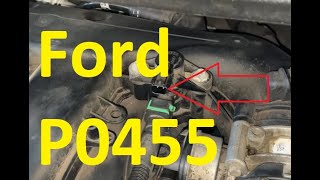
- Check Engine Light: This is the most common symptom. The car's computer will detect a leak in the EVAP system and trigger the light. Common codes include P0455 (gross leak), P0456 (small leak), and P0442 (very small leak). These codes confirm a leak but don't pinpoint the exact cause; it could be the canister, a loose gas cap, or a cracked hose.
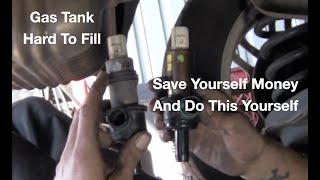
- Difficulty Fueling: If the gas pump nozzle constantly clicks off when you're trying to fill the tank, it's a classic sign of a bad vapor canister. The canister becomes saturated with liquid fuel or its vent is blocked, preventing air from escaping the tank as fuel goes in. 🎬 See why your Focus is hard to refill with gas.
- Fuel Smell: A noticeable gasoline smell around the rear of the car, especially when parked, can mean the canister is cracked or saturated and can no longer hold the fuel vapors.
- Poor Engine Performance or Rough Idle: While a bad canister can contribute, this symptom is more often caused by a faulty canister purge valve. If the valve sticks open, it creates a vacuum leak that can lead to a rough idle, hesitation, and even stalling, particularly after filling up with gas.
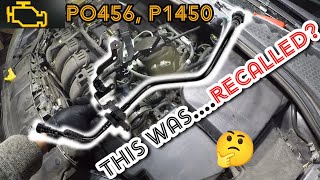
- Erratic or Inaccurate Fuel Gauge: If your fuel gauge fluctuates wildly or shows an incorrect level, it is a serious warning sign. This is not caused by the canister itself, but by the fuel tank being deformed from excessive vacuum—a problem directly addressed by a major Ford recall. 🎬 Watch: See how this recall causes fuel tank deformation.
CRITICAL RECALL INFORMATION: Ford issued a major safety recall (NHTSA 18V-735 / Ford 18S32) for approximately 1.3 million 2012-2018 Ford Focus models with 2.0L engines. The issue is a canister purge valve (CPV) that can stick open, creating an excessive vacuum in the fuel system. This vacuum can deform the plastic fuel tank, causing an inaccurate fuel gauge, engine stalling while driving, and an inability to restart the car. As part of the recall, dealers will reprogram the computer, and if fault codes are present, they will replace the purge valve, carbon canister, and even the fuel tank and fuel delivery module for free. Before buying any parts, contact a Ford dealer with your VIN to see if this recall is open for your vehicle.
The PZEV vs. Federal Emissions Trap: Choosing the Right Canister

For the 2012-2018 Focus with the 2.0L engine, Ford used two different vapor canisters depending on the vehicle's emissions certification. This is the single most important detail to get right when ordering a replacement.
- PZEV (Partial Zero Emission Vehicle): These vehicles have a more complex emissions system and require a specific canister. PZEV-certified cars were often sold in California and other states that follow its stricter emissions standards.
- Non-PZEV (Federal Emissions): These are the standard models sold in the rest of the country.
The two canister types are not interchangeable. Installing the wrong one will likely cause persistent Check Engine Lights and EVAP system problems.
How to Tell Which Version You Need
The only way to be certain is to check the Vehicle Emission Control Information (VECI) sticker located in your engine bay, usually on the underside of the hood or on the radiator support. This sticker will explicitly state whether the vehicle conforms to Federal (non-PZEV) or PZEV standards. Once you know your emissions type, you can match it to the correct part number.
| Emissions Type | Known Part Numbers |
|---|---|
| PZEV | BV6Z-9D653-A, BV6Z-9D653-B, BV6Z-9D653-C, BV6Z-9D653-D (latest) |
| Non-PZEV (Federal) | AS4Z-9D653-A, AS4Z-9D653-C, AS4Z-9D653-D, AS4Z-9D653-E, AS4Z-9D653-F (latest) |
Buying a Used Vapor Canister
A used OEM vapor canister is an excellent, cost-effective alternative to expensive new parts, especially since aftermarket quality can be inconsistent. Here’s what to look for when buying a recycled canister.
- Verify the Part Number: This is non-negotiable. Get the part number directly off your original canister and match it exactly. If you can't, use your VIN and emissions type (PZEV or Federal) to confirm the correct part number with a dealer or trusted parts source.
- Inspect for Cracks: Carefully check the entire plastic housing for cracks, especially around the mounting tabs and hose ports. A small crack can cause a persistent EVAP leak code.
- Check the Hose Ports: Ensure none of the ports are broken, chipped, or clogged with debris. The hose connections must be airtight.
- Smell for Raw Fuel: A strong, persistent smell of raw gasoline indicates the canister is saturated with liquid fuel, likely due to a bad purge valve or overfilling the tank. A saturated canister is ruined and cannot be repaired; do not buy it.
- Low Mileage is a Plus: While condition is more important than age, a canister from a lower-mileage vehicle (under 100,000 miles) is generally a safer bet.
Pro Tip: If you are replacing a canister that was saturated with fuel, it is highly recommended that you also replace the canister purge valve at the same time. A faulty purge valve is often the root cause of canister failure.
🎬 Watch: How to diagnose and replace the purge valve.Cost Comparison
Prices for a 2012-2018 Ford Focus vapor canister can vary significantly based on the source.
| Part Type | Estimated Cost |
|---|---|
| New OEM | $110 - $280 |
| New Aftermarket | $125 - $250 |
| Used OEM | $70 - $120 |
| Shop Labor | $197 - $289 |
Legal and Emissions Inspection Requirements
A functioning EVAP system is a federal requirement for all modern vehicles. Many states and metropolitan areas require an OBD-II emissions test as part of their annual or biennial vehicle inspection. A Check Engine Light caused by an EVAP code like P0455 or P0456 will result in an automatic test failure. Driving with a known emissions fault can also be illegal in some jurisdictions. There are no specific CARB compliance requirements for the canister itself, unlike a catalytic converter, but the part must be correct for the vehicle's emissions system (PZEV or Federal) to function properly and pass inspection.
Frequently Asked Questions (FAQ)
What's the difference between the vapor canister and the canister purge valve?
The vapor canister is the charcoal-filled box near the fuel tank that stores fuel vapors. The canister purge valve (or solenoid) is a separate part, usually located in the engine bay, that acts as a switch. It opens and closes to control when the stored vapors are drawn from the canister into the engine. A bad purge valve is a very common failure on the Focus and is the subject of recall 18S32.
Can I clean a fuel-saturated vapor canister?
No. The activated charcoal inside the canister is not serviceable. Once it becomes saturated with liquid fuel, its ability to absorb vapors is permanently compromised. The only solution is to replace the canister.
Will a bad vapor canister damage my engine?
A bad canister itself is unlikely to cause direct engine damage. However, the common related failure of a stuck-open purge valve can allow excess fuel vapor (or even raw fuel from a saturated canister) into the engine. This creates a rich fuel mixture that can lead to poor performance, rough idle, and over time, potentially foul spark plugs or damage the catalytic converter.
Why does my car stall or run rough after getting gas?
This is a classic symptom of a canister purge valve that is stuck open. When you refuel, the concentration of fuel vapor in the tank is very high. If the purge valve is stuck open, this overly rich vapor mixture is immediately drawn into the engine, overwhelming it and causing a rough idle or stall.
Helpful Videos


Technical Specifications
OEM Part Numbers: AS43-9E857-AG AS4Z-9D653-A AS4Z-9D653-C AS4Z-9D653-D AS4Z-9D653-E AS4Z-9D653-F AU5A-9D653-AE BV6Z-9D653-A BV6Z-9D653-B BV6Z-9D653-C BV6Z-9D653-D CX-2520
Fitment is dependent on vehicle emissions package (PZEV or non-PZEV/Federal). Location is typically near the fuel tank, under the rear of the vehicle.
We Have This Part in Stock




The information in this article is provided for general reference and educational purposes only. Vehicle specifications, procedures, and part compatibility can vary by production date, trim level, and region. Always consult your vehicle's factory service manual and verify part numbers before purchasing or performing repairs. Safety-critical components such as airbags, seat belts, and braking systems should be installed by a qualified professional.
- Ford Focus:
- 🎬 Helpful Videos
- 🛍️ Shop This Part
- Symptoms of a Failing Vapor Canister
- The PZEV vs. Federal Emissions Trap: Choosing the Right Canister
- How to Tell Which Version You Need
- Buying a Used Vapor Canister
- Cost Comparison
- Legal and Emissions Inspection Requirements
- Frequently Asked Questions (FAQ)
- 🎟️ Get 5% Off