

2003-2004 Toyota 4Runner 4.0L V6 Transmission: Problems, Identification, and Used Replacement
Identify whether your 4Runner has the A340F or A750F, learn what causes solenoid fatigue and torque converter shudder, and know when it is time to swap in a used OEM assembly.
- Verify if your 2003-2004 4Runner has the 4-speed A340F or 5-speed A750F transmission using the A/TM code on the driver's door jamb sticker, as they are not interchangeable.
- When installing a used or remanufactured transmission, always replace the torque converter, all external seals, the internal filter, and flush the cooler lines to prevent premature failure.
- Use only the specified fluid: Toyota Type T-IV for the A340F and Toyota WS for the A750F, as using the wrong fluid will cause severe damage.
- To prevent the catastrophic 'strawberry milkshake' failure, consider proactively replacing the radiator or installing an external transmission cooler on high-mileage vehicles.
Part Identification: Is it a 4-Speed A340F or 5-Speed A750F?

For the 2003-2004 Toyota 4Runner with the 4.0L V6 engine (1GR-FE) and 4x4, Toyota used two different automatic transmissions that are not interchangeable. The 2003 model year exclusively used the 4-speed Aisin A340F automatic (also known by the code 30-40LE). For the 2004 model year, some vehicles may have the 4-speed A340F while others came with the newer 5-speed Aisin A750F (often identified by part numbers starting with 35000 or 35010). Because these transmissions have different electronic controls, physical dimensions, and fluid requirements, you must confirm which model your specific vehicle has before purchasing a replacement.
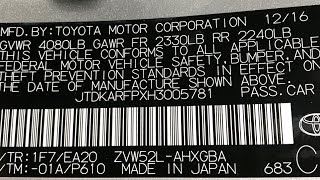
The most reliable way to identify your transmission is by checking the Manufacturer's Tag on the driver's side door jamb.
- Open the driver's door and locate the black and white sticker on the body pillar.
- Find the line that begins with A/TM, which stands for Axle/Transmission.
- The code following A/TM will identify your exact transmission. It will clearly state either A340F or A750F.
Warning: The A340F (4-speed) and A750F (5-speed) are NOT interchangeable. Ordering the wrong model will result in incompatible wiring, control module conflicts, and incorrect driveshaft fitment. Always verify your A/TM code before buying.
🎬 Watch: How to identify your Toyota transmission modelAs a secondary check, a metal identification plate is also located on the transmission case itself. Look on the passenger side for the A340F, or the driver's side for the A750F, just above the oil pan.
Common Failure Symptoms

A failing transmission in your 4Runner can manifest in several ways. If you experience any of the following, it may be time to have the transmission inspected by a professional.
- Delayed or Harsh Shifting: A noticeable pause or a hard clunk when the transmission shifts between gears, especially when cold. This can be caused by failing shift solenoids or issues within the valve body.
- Transmission Shudder or Vibration: A vibration or shuddering feeling, particularly during light acceleration or when the transmission shifts into overdrive. This often points to a worn torque converter lock-up clutch.
- "Strawberry Milkshake": Finding milky, pinkish fluid on the dipstick (A340F) or during a fluid check is a sign of catastrophic failure. This indicates the internal transmission cooler within the radiator has ruptured, mixing engine coolant with your transmission fluid and requiring immediate replacement 🎬 Watch: Step-by-step transmission fluid and filter replacement guide of both the radiator and transmission.
- Slipping Gears: The engine RPMs flare up, but the vehicle doesn't accelerate as it should, as if the transmission is in neutral for a moment.
- No Movement or Loss of a Gear: The vehicle won't move in Drive or Reverse, or it refuses to shift into a specific gear.
- Check Engine Light: A variety of diagnostic trouble codes can be triggered by transmission faults. A common code on the A750F is P2714, which often indicates a problem with the valve body, not just a single solenoid. Code P0771 is also frequently seen during failure.
Diagnostic Flowchart
Known Issues, Recalls, and Technical Service Bulletins (TSBs)
With regular maintenance, the A340F and A750F transmissions are known to be very robust, often lasting well over 200,000 to 250,000 miles. Some owners report reaching 300,000 or even 500,000 miles on the original unit with diligent fluid changes. However, service life is significantly shortened by towing, heavy off-road use, and neglecting fluid service. They have several well-documented issues, especially at higher mileage.
Solenoid and Valve Body Fatigue
Affected Models: A340F & A750F (high mileage)
Over time, the electronic solenoids that control shifting can wear out or their O-rings can fail, leading to pressure loss and poor shift quality. On the A750F, this can manifest as a P2714 trouble code, which often requires a full valve body service or replacement rather than just one solenoid. On the A340F, old and failing solenoids can cause harsh shifts or delayed engagement.
Torque Converter Shudder
Affected Models: A340F & A750F (high mileage)
A shudder felt around 40-50 MPH under light throttle is a classic symptom of a worn torque converter clutch. Sometimes, a complete fluid exchange with the correct fluid type (Toyota T-IV for A340F, Toyota WS for A750F) can resolve the issue. If not, the torque converter must be replaced.
Driveshaft "Clunk" or "Thump"
Affected Models: All 4x4 models
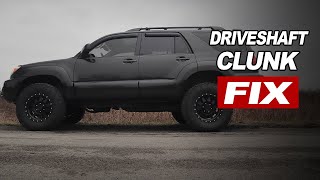
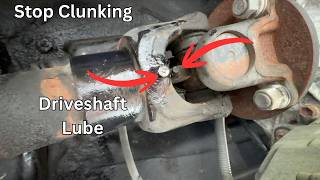
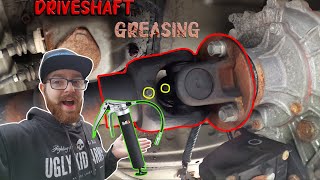
A common complaint is a "clunk" or a feeling of being bumped from behind when coming to a stop or accelerating from a stop. This is not a transmission issue, but rather the slip yoke on the rear driveshaft binding and releasing. The fix is to grease the driveshaft's slip yoke splines. While Toyota issued a TSB for this issue on later model Tacomas (TSB T-SB-0016-13), the same principle applies to the 4Runner.
Pronounced Reverse Engagement Delay (A340F)
Affected Models: A340 series
An older Technical Service Bulletin, TSB TC002-97, addressed a pronounced delay when shifting into Reverse on the A340 series. The prescribed remedy was to install an updated B3 brake return spring and piston rings inside the transmission.
What Fails at Every Mileage Band
Pro Tip: The mileage bands below describe used replacement units of that mileage. The checklists provided are things to do WHILE INSTALLING the purchased transmission, not maintenance for your current transmission.
Under 60,000 Miles
Failures are uncommon at this mileage and often linked to abuse, lack of use, or rare defects. Delayed engagement from Park to Drive can sometimes start at low mileage (under 85,000 miles). Torque converter shudder or slipping can occur, sometimes as early as 60,000 miles. Shift solenoid failure is possible, though not common.
- ✓Do during install (required): Replace the transmission filter/strainer and pan gasket. Replace front pump seal and rear output shaft seal.
- ✓Do during install (recommended): For A340F models, consider a transmission fluid drain-and-fill with Toyota Type T-IV fluid. For A750F models, perform a fluid drain-and-fill or full exchange with Toyota WS (World Standard) fluid.
- ✓Cheap insurance while the engine is out: Inspect and grease the propeller shaft (driveshaft) splines.
60,000 - 100,000 Miles
At this stage, shift solenoid fatigue or failure can lead to erratic shifting or loss of gears. Torque converter shudder (often described as driving over rumble strips) becomes more frequent. Delayed engagement when shifting between Park, Reverse, and Drive is common, as is Park/Neutral safety switch corrosion or failure.
- ✓Do during install (required): Complete fluid exchange with the correct fluid (T-IV for A340F, WS for A750F). Replace the internal transmission filter and pan gasket. Replace all external seals (front pump, output shaft, shifter shaft seal).
- ✓Do during install (recommended): Consider replacing shift solenoids as preventative maintenance, especially if the vehicle has a history of towing or heavy use.
- ✓Cheap insurance while the engine is out: Inspect and grease driveshaft slip yokes.
100,000 - 150,000 Miles
There is an increased likelihood of shift solenoid failure and torque converter failure (shuddering, slipping, or complete failure). Internal failures, such as a broken sun gear shell, can occur, though considered rare. Loss of reverse or forward gears due to internal seal or clutch pack wear is possible. The internal radiator transmission cooler may fail, causing the "strawberry milkshake" of death where coolant and ATF mix, destroying the transmission (primarily a risk for the A340F).
- ✓Do during install (required): Replace the torque converter with a new or quality remanufactured unit. Perform a full fluid exchange with the correct OEM-spec fluid. Replace the transmission filter and pan gasket. Replace all external seals (front pump, output shaft, etc.).
- ✓Do during install (recommended): Replace all shift solenoids and internal wiring harness O-rings.
- ✓Cheap insurance while the engine is out: Strongly consider replacing the radiator to prevent future internal cooler failure, or install an external transmission cooler.
Over 150,000 Miles
General wear and tear leads to slipping, delayed/harsh shifts, or complete failure. There is a high incidence of torque converter failure. Loss of specific gears (like Overdrive or Reverse) due to worn clutch packs or faulty solenoids is common. Internal hydraulic leaks leading to delayed engagement occur. Catastrophic failure from overheating or fluid contamination is much more likely.
- ✓Do during install (required): Assume the included used torque converter is at the end of its life; replace it with a new or remanufactured unit. Replace all shift solenoids, internal filter, and pan gasket. Replace all external seals.
- ✓Cheap insurance while the engine is out: If not done previously, replace the radiator or bypass the internal cooler with a dedicated external cooler as a critical reliability upgrade.
Real Owner Experiences
| Source | Mileage | What Happened | Cost |
|---|---|---|---|
| Car Forums at Edmunds.com | Just past 60,000 miles | Owner experienced a skipping/slipping feeling, diagnosed by the dealer as a failing torque converter. | Covered under warranty ($50 deductible). |
| 4Runner Forum | Under 85,000 miles | A 2006 V6 model developed a delayed engagement from Park to Drive. A neutral safety switch replacement did not fix it. | N/A |
| 4Runner Forum | 60k-100k range | Owner experienced a torque converter 'rumble strip' issue and hard downshifts. A full fluid exchange with an anti-shudder additive resolved the problem. | N/A |
| 4Runner Forum | 125,000 miles | Transmission was rebuilt due to a broken sun gear shell after experiencing delayed engagement for years. | Rebuild cost not specified. |
| IH8MUD Forum | 141,000 miles | After being stuck in snow and shifted between Drive and Reverse multiple times, the A750F transmission lost Reverse, 3rd, 4th, and 5th gears. The pan was clean with no debris. The owner replaced solenoids with no change; dealer recommended a full replacement. | Quoted for full replacement. |
| IH8MUD Forum | 165,000 miles | A750F transmission slipped on start from a stop and threw codes P0771 and P2714, entering limp mode. Dealer recommended replacement. | N/A |
| 4Runner Forum | 196,000 miles | A750F transmission began with difficulty engaging gears, progressing to high-RPM slipping on the highway, and finally a total failure to engage any forward gear. Reverse was the only gear that worked, and only at high RPMs. | Quoted $4,700 for a remanufactured transmission. |
| Toyota Tundra Forum | 225,000-250,000 miles | An A340F in a Sequoia (shared architecture) began to show a delayed, hard shift from 1st to 2nd around 225k miles and failed completely at 250k miles. | N/A |
| 4Runner Forum | 270,000 miles | Another user reported paying $1,300 for a performance rebuild on an A340 including a new torque converter and reprogram kit. | $1,300 (for the other user) |
| IH8MUD Forum | 165,000 miles | Owner decided to replace with a remanufactured unit with a longer warranty after diagnostics (~$250) revealed metal shavings in the pan. Another user on the same thread paid $5,000 total to have their A750F removed, sent for a rebuild, and reinstalled. | $5,000 (for the other user's rebuild and reinstall) |
| Reddit r/4Runner | Not Stated | Owner was quoted $5,000 for a rebuild or $1,500 for installation labor if they sourced their own used or rebuilt unit. | $5,000 rebuild / $1,500 labor |
| Reddit r/4Runner | Not Stated | Owner decided to proceed with the rebuild, viewing the cost as cheaper than a new car payment. | $2,800 |
| Reddit r/4Runner | Not Stated | One user reported having their 2005 transmission replaced with a used unit they bought for $700. The shop charged an additional $700 plus fluids for the installation. | ~$1,400 + fluids |
Repair or Replace?

Deciding whether to repair your existing transmission or replace it entirely depends on the severity of the failure. Shop labor to remove and replace the transmission typically ranges from $700 to $1,800 (representing 6.0 to 11.0 hours of labor).
| Repair Type | Part Cost | Labor Hours | Total Typical Cost |
|---|---|---|---|
| Solenoid Failure | $65 - $200 | 2 - 5 hours | $400 - $1,500 |
| Torque Converter Replacement | $200 - $400 | 4 - 10 hours | $600 - $1,500 |
When Replacement is Smarter: Replacement with a used or remanufactured unit is the smarter choice when there is evidence of catastrophic internal failure, such as large metal chunks in the transmission pan, or the "Strawberry Milkshake of Death" where coolant has mixed with the transmission fluid. It is also the preferred route when multiple issues are present (e.g., slipping, delayed engagement, and solenoid codes), as a full rebuild can cost as much or more than a quality remanufactured unit with a warranty.
Questions to Ask Your Installer
- Have you confirmed if my vehicle has the 4-speed A340F or the 5-speed A750F transmission?
- What brand and type of transmission fluid will you be using (Type T-IV for A340F, WS for A750F)?
- What is your process for completely flushing the transmission cooler and lines to remove old debris?
- Will you be installing a new torque converter, or reusing the old one?
- How do you ensure the torque converter is fully seated before mating the transmission to the engine?
- Will you inspect the engine flexplate for cracks while the transmission is out?
- Does your quote include new front and rear seals and a new transmission filter/pan gasket?
- For the A750F, what is your procedure for checking the fluid level at the correct temperature since there is no dipstick?
- What warranty do you provide on your labor and on the replacement transmission unit itself?
Replacement Cost Comparison
The cost to replace a 4Runner transmission varies based on the type of part you choose. New OEM units are generally not available or are prohibitively expensive (a dealer-sourced remanufactured unit was quoted online for $2,747 plus a $1,000 core charge).
| Part Type | Estimated Cost (Part Only) | Description |
|---|---|---|
| Used OEM | $500 - $2,200 | A salvaged unit from a compatible 4Runner. Mileage and condition vary. A short-term warranty is sometimes included. |
| Remanufactured OEM | $2,400 - $5,320 | A professionally rebuilt unit with new seals, gaskets, and updated internal components to correct factory weaknesses. Often comes with a longer warranty. |
| New OEM | $5,000+ | A brand new unit from Toyota. Rarely used for repairs due to very high cost and limited availability. |
Freight & Delivery Reality

If you are ordering a used replacement transmission online, be prepared for freight delivery. This assembly weighs approximately 255 lbs and measures roughly 42" x 26" x 28" before crating. It ships as LTL (Less Than Truckload) freight on a wooden pallet—it will NOT arrive via standard parcel services like UPS Ground or FedEx Home Delivery.
- Delivery Requirements: You will need a loading dock, a forklift, or a truck equipped with a liftgate to unload the pallet. Most residential deliveries require a liftgate service appointment.
- Inspect Before Signing: Always inspect the transmission for physical damage (such as cracked bellhousings, broken sensor connectors, or crushed oil pans) before signing the driver's delivery receipt.
Pre-Purchase Verification
Before pulling the trigger on a freight shipment, verify you are buying the exact right unit:
- Verify the A/TM code on the driver's side door jamb sticker (A340F vs A750F).
- Confirm the engine is a 4.0L V6 (1GR-FE).
- Confirm the vehicle is a 4x4 (four-wheel drive) model with a transfer case.
- Locate the transmission identification tag on the side of the case to verify the model and part number.
Installation Essentials & Common Mistakes

Required Parts & Fluids
When installing a replacement transmission, you must also replace several key items to ensure longevity and prevent immediate failure.
- Automatic Transmission Fluid (ATF): The correct fluid is critical. Use only Toyota Genuine ATF Type T-IV for the A340F and Toyota Genuine ATF WS (World Standard) for the A750F.
- Transmission Filter & Pan Gasket: Always install a new internal filter screen and pan gasket.
- Seals: Replace the front pump seal (where the torque converter inserts) and the rear output shaft seal (where the transfer case mounts).
- Cooler Flush Solvent: A dedicated chemical flush to clean the old, contaminated fluid out of the transmission cooler and lines.
Warning: Using the wrong type of automatic transmission fluid will cause severe damage. T-IV and WS fluids are not interchangeable. Confirm your transmission model (A340F or A750F) before purchasing fluid.
Special Tools Required
This is an Advanced to Expert level DIY job. You will need:
- Heavy-duty transmission jack
- High-quality jack stands
- Engine support bar
- Long socket extensions with swivel/u-joint
- Calibrated torque wrench
- OBD2 scan tool or SST/jumper wire for fluid temperature check
- Fluid pump
Installation Gotchas
Proper installation is just as important as the part itself. Avoid these common and costly mistakes:
- Improper Torque Converter Seating (The 'Three-Click' Rule): The torque converter must be fully seated into the transmission's front pump. You should feel it drop into place in three distinct steps or "clicks," recessing at least 1 to 1.25 inches. If it is not fully seated, using bellhousing bolts to pull the transmission flush to the engine block will crack the front pump gear, destroying the new transmission before it ever runs.
- Skipping the Cooler Flush: The transmission cooler in the radiator and its lines hold metal debris and contaminated fluid from the previous failure. This debris MUST be flushed out completely. Failure to do so will circulate contaminants through the replacement unit, causing it to fail quickly.
- Reusing the Old Torque Converter: Never reuse a torque converter from a failed transmission. It is full of contaminated fluid and debris that cannot be fully removed. A used or remanufactured transmission should always include a matching torque converter.
- A750F Sealed Transmission Procedure: The 5-speed A750F has no dipstick. The fluid level must be checked via an overflow tube in the pan while the vehicle is level and the transmission fluid is at a specific temperature (typically 115°F to 130°F). This requires a scan tool or a specific procedure to enter a temperature check mode.
- Bellhousing Alignment Dowels: Ensure alignment dowels are present in the engine block; missing dowels cause misalignment, vibrations, and front seal/pump failure.
- Flexplate Inspection: Check the engine flexplate for hairline cracks around crankshaft bolt holes before mating the transmission.
- Shift Linkage Adjustment: Ensure the gear selector in the cabin aligns perfectly with the physical detents on the transmission range switch.
Pro Tip: After installation is complete, disconnect the vehicle's battery for at least 30 minutes. This resets the Engine Control Unit's (ECU) memory, clearing the adaptive shift learning from the old, failing transmission and allowing it to learn the characteristics of the replacement unit.
What to Inspect When Your Used Transmission Arrives
Always inspect a used transmission before you spend hours installing it. Check these specific areas as soon as the part arrives.
- Fluid Color and Smell: Drain a small amount of fluid from the pan or cooling lines. Dark red or brown fluid is normal for a used part. Black fluid with a harsh, burnt smell means the internal clutches are destroyed.
- Pan and Magnet Inspection: Remove the bottom oil pan. Look at the small magnets resting inside. A light coating of fine, dark gray paste is normal metal wear. Large metal chunks, sharp steel splinters, or shiny brass flakes mean gears or bearings are broken inside.
- Converter Hub Condition: Look at the torque converter (the large, heavy metal bowl attached to the front). Check the smooth center tube (the hub) that slides into the transmission. If you feel deep grooves with your fingernail, it will tear the front seal and leak fluid.
- Input-Spline Condition: Check the input shaft splines (the grooved metal teeth inside the center of the transmission). The teeth must be straight and evenly spaced. Twisted teeth or edges worn flat mean the transmission suffered heavy abuse.
Frequently Asked Questions (FAQ)
Will a transmission from a V8 or 2WD 4Runner fit my V6 4x4?
No. The V8 models used a different transmission (A750F in all years), and the 2WD ('E' models like A340E/A750E) have a different tail housing and output shaft. You must use a 4x4 ('F' model) transmission from a 4.0L V6 application.
Do I need to reprogram the computer after installing a used transmission?
No. These transmissions do not require any VIN-specific programming or security relearning. However, it is highly recommended to perform an ECU memory reset by disconnecting the battery for 30 minutes to clear the old adaptive shift values.
What is included with a used transmission assembly?
A standard used assembly includes the transmission case, all internally lubricated parts, the valve body, oil pan, extension/tail housing, and the torque converter. It does NOT include the separate transfer case, external sensors, wiring harnesses, transmission control module (TCM), shifter assembly, shifter linkages, brackets, control cables, flexplate, or transmission cooler lines.
How long does it take a shop to install this transmission?
A professional shop will typically bill between 6.0 and 11.0 hours of labor to remove the old transmission, flush the cooler lines, and install the replacement unit. This translates to roughly $900 to $1,800 in labor costs alone, depending on the shop's hourly rate.
How do I prevent the "Strawberry Milkshake" failure?
The "Strawberry Milkshake" occurs when the internal transmission cooler inside the radiator ruptures, mixing engine coolant with transmission fluid. To prevent this catastrophic failure, proactively replace the vehicle's radiator every 10-12 years or around 150,000 miles. Alternatively, you can bypass the internal radiator cooler entirely by installing a dedicated external transmission cooler.
Helpful Videos

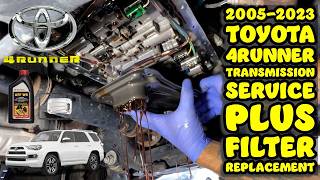
Technical Specifications
OEM Part Numbers: 35000-XXXXX 35010-XXXXX
Models: 2003-2004 Toyota 4Runner 4.0L V6 4x4; Engine: 4.0L V6 (1GR-FE); Transmission (2003): 4-Speed Aisin A340F (30-40LE); Transmission (2004): 4-Speed Aisin A340F or 5-Speed Aisin A750F; Fluid (A340F): Toyota Genuine ATF Type T-IV; Fluid (A750F): Toyota Genuine ATF WS (World Standard); Weight: ~255 lbs; Crated Dimensions: ~42" x 26" x 28"; A750F Fluid Check Temp: 115°F to 130°F; Torque Converter Seating Depth: 1 to 1.25 inches; TSBs: TC002-97, T-SB-0016-13
We Have This Part in Stock


The information in this article is provided for general reference and educational purposes only. Vehicle specifications, procedures, and part compatibility can vary by production date, trim level, and region. Always consult your vehicle's factory service manual and verify part numbers before purchasing or performing repairs. Safety-critical components such as airbags, seat belts, and braking systems should be installed by a qualified professional.
- Toyota 4Runner:
- 🎬 Helpful Videos
- 🛍️ Shop This Part
- Part Identification: Is it a 4-Speed A340F or 5-Speed A750F?
- Common Failure Symptoms
- Diagnostic Flowchart
- Known Issues, Recalls, and Technical Service Bulletins (TSBs)
- Solenoid and Valve Body Fatigue
- Torque Converter Shudder
- Driveshaft "Clunk" or "Thump"
- Pronounced Reverse Engagement Delay (A340F)
- What Fails at Every Mileage Band
- Under 60,000 Miles
- 60,000 - 100,000 Miles
- 100,000 - 150,000 Miles
- Over 150,000 Miles
- Real Owner Experiences
- Repair or Replace?
- Questions to Ask Your Installer
- Replacement Cost Comparison
- Freight & Delivery Reality
- Pre-Purchase Verification
- Installation Essentials & Common Mistakes
- Required Parts & Fluids
- Special Tools Required
- Installation Gotchas
- What to Inspect When Your Used Transmission Arrives
- Frequently Asked Questions (FAQ)
- 🎟️ Get 5% Off