

2019-2021 Subaru Forester TR580 CVT: Problems, Identification, and Used Replacement
Identify the TR580DHTAA transaxle, understand what causes chain slip and valve body failure, and learn what to look for when buying a used OEM replacement unit.
- Verify the exact transmission ID code (TR580DHTAA) before purchase, as units from other Subaru models are incompatible and will cause severe drivetrain damage.
- A mandatory TCM Adaptive Relearn procedure using a bi-directional scan tool is required after installation to prevent immediate failure of the replacement unit.
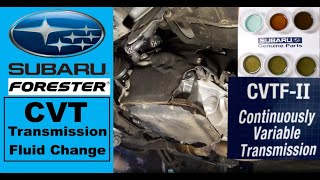
- Use two separate, specific fluids: Subaru CVTF-II for the main case and 75W-90 GL-5 gear oil for the front differential. Mixing them will destroy the transaxle.
- Before condemning the entire transmission, have a technician diagnose if the problem is a less expensive valve body, solenoid, or software issue that can be repaired independently.
Part Identification & Verification

The automatic transmission in the 2019-2021 Subaru Forester is a specific variant of the Lineartronic Continuously Variable Transmission (CVT) family, known as the TR580. A CVT doesn't have traditional fixed gears; instead, it uses a steel chain and two variable-width pulleys to create a nearly infinite number of gear ratios for smooth and efficient operation. This entire assembly, which includes the main case, torque converter, and integrated front differential and transfer case, is technically a longitudinal transaxle designed for Subaru's All-Wheel Drive (AWD) system.
How to Confirm This is Your Transmission
Before purchasing a replacement, you must verify that your Forester requires this exact unit. Mismatches can lead to catastrophic failure.
- Check the ID Plate: The most reliable method is to find the "Transmission Type" code on your vehicle's identification plate. This plate is typically a sticker located on the passenger-side B-pillar (in the door frame) or on the passenger-side suspension strut tower in the engine bay. The code should read TR580DHTAA.
- Confirm Engine and Drivetrain: This transmission is only for Forester models with the 2.5L naturally aspirated four-cylinder engine (engine code FB25D) and All-Wheel Drive (AWD). It does not fit turbocharged models.
- VIN Verification: Confirm the 8th digit of your Vehicle Identification Number (VIN) is 'A' or 'B'.
- Part Number Match: The OEM part number for this transmission assembly is 31000AK150.
Warning: Transmissions from other Subaru models like the Outback, Legacy, Impreza, or Crosstrek are NOT interchangeable. While they may also be TR580 units, they have different final drive ratios (e.g., 3.90 vs. the Forester's 3.70), different wiring harnesses, and unique software calibrations. Installing the wrong one will cause severe drivability problems and quickly destroy the vehicle's center differential.
Common Failure Symptoms & Diagnosis

A failing CVT can present several distinct symptoms. However, it's critical to get a professional diagnosis, as some issues can be resolved without replacing the entire transmission.
- Shuddering or Jerking: A noticeable shudder, vibration, or jerking during acceleration or deceleration is a common complaint. This can sometimes be caused by a faulty valve body or torque converter lock-up issues rather than a complete transmission failure.
- Loss of Power or Hesitation: The vehicle may feel like it's slipping or losing power, especially when trying to accelerate. This can be a sign of internal chain slip.
- Warning Lights: The illumination of the "AT OIL TEMP" light (often flashing), Check Engine light, or other warnings on the dashboard is a clear indicator of a transmission-related fault. Common trouble codes include P0700 (generic transmission fault), P2757 (Torque Converter Clutch Pressure Control Solenoid), P2762, and P2764.
- Abnormal Noise: Whining, droning, or grinding sounds that change with vehicle speed often point to failing internal bearings or chain damage.
Pro Tip: Before condemning the entire transmission, have a technician check if the issue is a known problem with the valve body or if a software update is available. A faulty valve body can often be replaced independently, saving thousands on a full replacement.
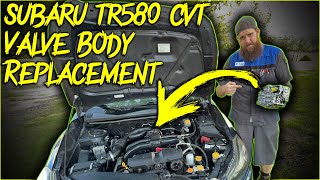
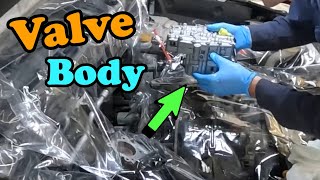
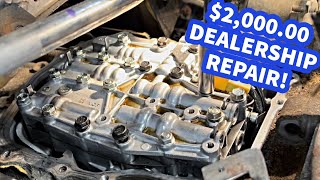
🎬 Watch: Step-by-step TR580 valve body replacement guideDiagnostic Flowchart
Known Problems, Recalls, and Warranty Extensions

Subaru has acknowledged several issues with these transmissions and has issued Technical Service Bulletins (TSBs) and a warranty extension to address them.
CVT Chain Slip / Loss of Power (Recall WRK-21)
- Issue: An improper program in the Transmission Control Module (TCM) can cause the internal drive chain to slip. Continued operation can cause the chain to break, leading to a complete loss of power.
- Affected Years: 2019-2020 Forester models are included in a broader campaign.
- Remedy: Recall WRK-21 (NHTSA ID: 21V-955) involves reprogramming the TCM. TSB 16-132-20R and TSB 16-139-22R also address this. If the inspection shows that chain slip has already occurred, the entire transmission assembly is replaced at no cost.
CVT Warranty Extension
- Issue: To provide customers with greater confidence, Subaru extended the powertrain warranty for the CVT.
- Affected Years: 2019-2020 Subaru Forester (among other models).
- Details: The original 5-year/60,000-mile warranty was extended to 10 years or 100,000 miles, whichever comes first. This extension specifically covers failures related to conditions like chain slip. Always have a dealer check your VIN for eligibility.
Valve Body / Solenoid Failure (TSB 16-156-25)
- Issue: A common failure point is the torque converter lock-up solenoid within the valve body, or premature sleeve wear. This can cause a severe shudder, hesitation, and the P2757 or P2762 trouble codes.
- Affected Years: 2019-2021.
- Remedy: TSB 16-156-25 addresses a design flaw causing this premature wear. In many cases, the valve body can be replaced without needing a new transmission.
What Fails at Every Mileage Band
Pro Tip: The mileage bands below describe what to expect from USED replacement units of that mileage. The checklists provided are things to do WHILE INSTALLING the purchased unit, not maintenance for your current transmission.
Under 60,000 Miles
Units in this range are generally healthy, but early failures are usually tied to factory defects or software issues. CVT chain slip caused by a programming error in the Transmission Control Unit (TCU) is the primary concern, addressed by recall WRK-21. Valve body or solenoid malfunctions can also appear early, causing shuddering or hesitation at low speeds. Torque converter shuddering is another known issue.
- ✓Do during install (required): Perform ALL required procedures including a mandatory cooler flush, TCM adaptive relearn, and using correct fluids. Verify the WRK-21 recall has been performed. If not, the TCU must be reprogrammed as part of the installation.
- ✓Do during install (recommended): Replace axle seals and the torque converter hub seal as cheap insurance.
- ✓Cheap insurance while the engine is out: Strongly consider replacing the engine's rear main seal while the transmission is removed.
60,000 - 100,000 Miles
This is a common failure window, especially if the fluid has never been changed. Valve body and solenoid failures are frequent, presenting as shuddering, hesitation, and dashboard warning lights. This repair alone can cost between $1,500 and $4,700. Vehicles that did not receive the WRK-21 update or have severely degraded fluid can experience catastrophic chain slip or failure. Many drivability issues in this band are directly linked to degraded CVT fluid that has lost its protective properties.
- ✓Do during install (required): If purchasing a used unit in this mileage band, assume the fluid is original unless proven otherwise. A complete drain and fill with Genuine Subaru CVTF-II or High-Torque fluid is mandatory.
- ✓Do during install (recommended): Given the increased likelihood of solenoid issues, consider having the valve body tested or preemptively replacing it if the budget allows, as it is much easier with the transmission out.
- ✓Cheap insurance while the engine is out: Replace the engine rear main seal.
100,000 - 150,000 Miles
Solenoid and valve body failures remain a primary issue, often presenting as a cluster of warning lights on the dashboard. The likelihood of a major internal failure, such as the chain breaking or bearings failing, increases significantly if maintenance was neglected. After this many heat cycles, external seals are also highly prone to leaking.
- ✓Do during install (required): A complete fluid service (both CVT and front differential chambers) is non-negotiable. At this mileage, it is highly advisable to replace the torque converter along with the used transmission. The original torque converter may contain debris from the previous failure or have significant internal wear.
- ✓Do during install (recommended): Replace all external seals without question: input shaft seal and axle seals.
- ✓Cheap insurance while the engine is out: Replace the engine rear main seal.
Over 150,000 Miles
At this stage, any of the internal components can fail due to accumulated stress and heat cycles. Failures are less about specific defects and more about the natural end of the component's service life. Lock-up and transfer solenoids can fail, causing shuddering and loss of AWD. Whining or droning noises that increase with speed point to failing internal bearings.
- ✓Do during install (required): A complete replacement of the torque converter, all external seals, and a thorough cooler flush is absolutely critical.
- ✓Do during install (recommended): Assume a transmission in this mileage band is at or near the end of its life. A lower-mileage unit is a safer investment. Budget for potential near-term failure and consider this a temporary solution unless the unit has extensive service records.
- ✓Cheap insurance while the engine is out: Replace the engine rear main seal.
Real Owner Experiences
| Source | Mileage | What Happened | Cost |
|---|---|---|---|
| 44,000 | Owner reported a clicking sound related to wheel speed. The dealer identified it as a transmission failure and replaced the unit under warranty. | $0 (Warranty) | |
| 50,000 | A 2020 Forester owner noticed jerkiness and a struggle to maintain speed on inclines while using cruise control. A fluid change was suggested as a potential remedy. | Not specified | |
| ~50,000 | A 2021 Forester owner had the CVT valve body replaced under warranty after a software reprogram failed to solve an issue. | $0 (Warranty) | |
| 69,000 | A 2019 Forester Touring started shaking on turns and was diagnosed as needing a new transmission. The owner opened a claim with Subaru of America as it was just outside the standard powertrain warranty. | $9,000 (Dealer Quote) | |
| 77,000 | A 2020 Forester began to 'struggle,' and the dealer diagnosed a failing CVT. The vehicle was outside the mileage warranty, and the owner was quoted for a full replacement. | $12,000 (Dealer Quote) | |
| 125,000 km (approx. 77,000 miles) | 2019 Forester CVT just blew. Seeking independent shop repair. A transmission specialist declined to rebuild due to lack of parts. | $14,000 (CAD) at dealer | |
| 120,000 km (~75,000 miles) | A 2019 Forester in Canada experienced a complete CVT failure requiring replacement. Subaru of Canada offered to cover half the repair cost. | Partial reimbursement | |
| 96,000 | A 2014 Outback (similar CVT generation) had a complete transmission failure. | $10,400 (Dealer Quote for Remanufactured Unit) | |
| Torque News / TikTok | 100,000 | Owner was told she needs a new transmission and was seeking assistance from Subaru of America regarding warranty. | $3,500 - $7,500 |
| 122,000 | A 2014 Forester XT displayed multiple warning lights (AT Oil Temp, ABS, Check Engine) and was diagnosed with a failing transmission valve body. The owner reported no initial change in drivability. | $2,200 (Independent Shop Quote) | |
| 125,000 | A 2014 Legacy with a similar CVT had no issues reported, demonstrating that longevity is possible. | N/A | |
| 150,000 | 2017 Outback (similar CVT) owner seeking quotes from independent shops for a used transmission installation. | $9,700 at dealer for new transmission | |
| Car Talk Community | 155,000 | 2012 Outback (older TR580) owner was advised to get quotes from independent shops for a used or remanufactured unit, with a target price under $4,000 to be worthwhile. | $8,000 at dealer |
| 180,000 | Owner reported failure of both the transfer and lockup solenoids, resulting in loss of AWD and shuddering during hard stops. | Not specified | |
| 195,000 | A 2019 Outback with the larger TR690 CVT is reported to be running smoothly with drain-and-fills performed every 50,000 miles. | Preventative Maintenance Costs | |
| 205,000 | A user reported their transmission is still running well, having had a fluid change around 120,000 miles. | N/A | |
| 340,000 | A technician reported seeing a Subaru in the shop with an original CVT at this mileage, noting that highway-driven vehicles seem to fare better. | N/A | |
| Unknown | 2018 Forester CVT failed 200 miles after a fluid exchange at a local shop following an engine replacement. | ~$9,000 for a CVT replacement |
Repair or Replace?
Deciding whether to repair your existing transmission or replace it entirely depends on the specific failure mode.
When Repair Makes Sense
If diagnostics confirm a specific valve body or solenoid-related trouble code (like P2764) and the rest of the transmission (CVT chain and pulleys) is mechanically sound, repairing the unit is viable. An independent shop may replace just the faulty solenoid for a few hundred dollars, while a dealer will typically replace the entire valve body assembly for $1,500 to $2,500.
When Replacement is Smarter
Replacement is necessary when an internal failure has occurred. This includes CVT chain slip, whining noises indicating bearing failure, or if excessive metal debris is found in the fluid pan. Most shops cannot or will not rebuild Subaru CVTs due to their complexity and a lack of available internal components, making a full unit replacement the only viable option.
Questions to Ask Your Installer
- Have you confirmed the failure is internal to the transmission and not a less expensive component like the valve body?
- Will you be installing a used, remanufactured, or new OEM unit? What is the warranty on the part and your labor?
- Is the quoted price inclusive of the mandatory cooler flush, new seals, and the correct types and quantities of both CVTF-II and 75W-90 gear oil?
- Do you have a bi-directional scan tool capable of performing the mandatory TCM adaptive relearn procedure after installation?
- Can you provide a detailed, itemized quote breaking down parts, labor, fluids, and any applicable taxes or fees?
Replacement Cost Comparison
| Part or Service | Estimated Cost (USD) |
|---|---|
| New OEM Unit | $8,000 - $9,700+ |
| Remanufactured OEM Unit | $2,800 - $5,100 |
| Used OEM Unit | $650 - $2,900 |
| Shop Labor (6.0 - 10.0 hours) | $900 - $1,800 |
Freight & Delivery Reality

Buying a used transmission online means dealing with heavy freight. This is not a parcel delivery. The TR580 transaxle assembly weighs approximately 232 lbs and measures roughly 35" x 20" x 20" before it is even crated or palletized.
- It Ships LTL Freight: The unit will arrive on a pallet via a Less-Than-Truckload (LTL) freight carrier.
- Liftgate Required: If you are having it delivered to a residential address or a shop without a loading dock or forklift, you must request a liftgate service so the driver can lower the heavy pallet to the ground.
- Inspect Before Signing: Never sign the delivery receipt until you have visually inspected the transmission for damage during transit (such as cracked bell housings or broken sensors). Once you sign, you accept it in its current condition.
- Pre-Purchase Verification: Reputable recyclers will conduct a pre-purchase verification interview to ensure you are buying the exact TR580DHTAA code for your 2.5L naturally aspirated AWD Forester.
Installation: Critical Steps & Common Mistakes

Installing a used transmission is an advanced job. Several unique steps for this Subaru CVT must be followed precisely to prevent immediate damage to the replacement unit.
Required Parts & Fluids
Beyond the transmission itself, you will need several specific consumables:
- CVT Fluid: Genuine Subaru CVTF-II (Part #SOA427V1660) or Subaru High-Torque CVT Fluid (Orange), or a certified equivalent like ENEOS Import CVTF Model S. Using generic ATF will destroy the transmission.
- Gear Oil: Approximately 1.2 to 1.4 quarts of 75W-90 GL-5 gear oil for the separate front differential chamber.
- Seals & RTV: New axle seals, a new input shaft/torque converter hub seal, and high-quality RTV silicone (such as ThreeBond 1217H or Permatex 'The Right Stuff') to reseal the transmission pan.
- Cooler Flush: A professional-grade aerosol flush (such as Lubegard Kooler Kleen) to clean the external transmission cooler and lines.
Special Tools & Programming
This is not a simple bolt-in job. The following are mandatory:
- Tools: An engine support bar or hoist, a heavy-duty transmission jack, and a fluid pump with a curved fill adapter are required.
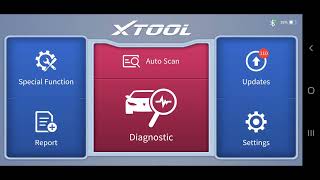
- Programming: After installation, a TCM Adaptive Relearn (AT Learning Mode / Initialization) procedure is mandatory. This clears the old shift data from the vehicle's computer and allows it to learn the characteristics of the replacement unit. Skipping this step will cause harsh shifting, slipping, and can quickly ruin the new transmission. A bi-directional scan tool (such as high-end Autel, Topdon, or OTOFIX models) is needed to perform this relearn.
Installation Gotchas (The "Transmission Killers")
Warning: Failure to follow these steps will likely result in the immediate destruction of your replacement transmission, and will void any warranty.
- Flush the Cooler: The external transmission cooler and lines MUST be thoroughly flushed to remove metal debris from the previously failed unit. Contaminated fluid will circulate directly into the replacement transmission and cause it to fail.
- Seat the Torque Converter: The torque converter must be fully and correctly seated into the transmission's input shaft and internal oil pump gears before installation. If it is not all the way in, bolting the transmission to the engine will crush and crack the internal oil pump, instantly destroying the transmission.
- Use Two Separate Fluids: This transmission has two separate fluid chambers. The main CVT case uses CVTF-II fluid, while the front differential uses 75W-90 GL-5 gear oil. Do not mix them up. Draining or filling the wrong chamber will destroy both components within miles.
- Follow the Fluid Level Procedure: The fluid level is highly temperature-sensitive. The vehicle must be perfectly level on a lift. Check the fluid level only when the CVT fluid temperature is between 95°F and 113°F (35°C to 45°C) with the engine running.
- Clean Dowel Pins: Ensure engine-to-transmission alignment dowel pins are clean, uncorroded, and properly seated to prevent input shaft misalignment and rapid bearing failure.
Common Buyer Mistakes
- Draining the CVT fluid pan by mistake instead of the engine oil drain pan, then overfilling the engine oil and running the CVT dry.
- Mixing up the fluid chambers by putting gear oil in the CVT or CVT fluid in the front differential.
- Using generic or universal automatic transmission fluid (ATF) instead of genuine Subaru CVTF-II.
- Skipping the TCM adaptive relearn procedure, leading to incorrect hydraulic pressures.
- Ordering by visual appearance alone without matching the exact TR580DHTAA transmission ID code, resulting in mismatched final drive ratios.
- Misdiagnosing a faulty valve body as a complete transmission failure.
Frequently Asked Questions (FAQ)
Can I use a CVT from a Subaru Outback in my Forester?
No. Even if it is also a TR580, transmissions from other models like the Outback, Crosstrek, or Legacy have different internal gear ratios (like a 3.90 final drive instead of the Forester's 3.70), wiring, and programming. Using one will cause major drivetrain damage.
Does a used transmission need to be reprogrammed?
Yes. A procedure called a "TCM Adaptive Relearn" is mandatory. It requires a professional-grade bi-directional scan tool and allows the car's computer to adapt to the replacement transmission. Skipping this step leads to poor performance and can cause immediate damage.
What fluid does the 2019-2021 Forester transmission use?
It requires two different fluids. The main CVT portion uses Genuine Subaru CVTF-II or High-Torque CVT Fluid. The separate, integrated front differential requires 75W-90 GL-5 gear oil. Using the wrong fluid in either chamber will cause severe damage.
Is a shudder always a sign of total transmission failure?
Not always. A shudder can be caused by a failing torque converter solenoid or valve body, which can sometimes be replaced without swapping the entire transmission. It can also be related to a software issue that may be correctable with a TCM update. A professional diagnosis is essential.
What is included when I buy a used TR580 transmission assembly?
A standard used assembly includes the main transmission case, all internally lubricated parts, the extension/tail housing, transmission oil pan, torque converter, integrated front differential, and integrated transfer case. It does NOT include external sensors, the Transmission Control Module (TCM), shifter cables, flexplate, or transmission cooler lines.
How long does it take a shop to replace this transmission?
A professional shop will typically bill between 6.0 and 10.0 labor hours to remove the old unit, flush the cooler, install the replacement, fill the fluids correctly, and perform the mandatory TCM relearn.
Helpful Videos

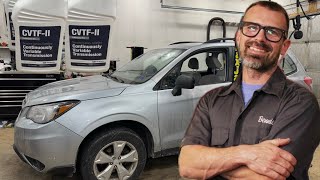
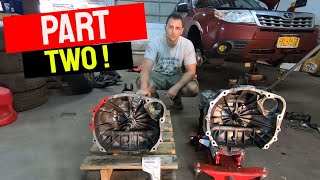
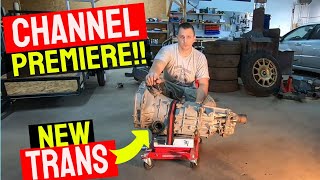
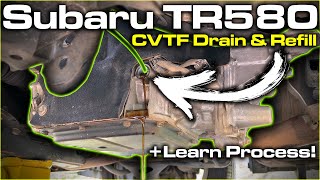
Technical Specifications
OEM Part Numbers: 31000AK150
Transmission Type: TR580; Transmission Code: TR580DHTAA; Engine Compatibility: 2.5L FB25D; Drivetrain: All-Wheel Drive (AWD); VIN Digit 8: 'A' or 'B'; Final Drive Ratio: 3.70; Weight: Approx. 232 lbs; Dimensions: Approx. 35" x 20" x 20"; CVT Fluid: Genuine Subaru CVTF-II or High-Torque CVT Fluid; Differential Fluid: 75W-90 GL-5 Gear Oil
We Have This Part in Stock



The information in this article is provided for general reference and educational purposes only. Vehicle specifications, procedures, and part compatibility can vary by production date, trim level, and region. Always consult your vehicle's factory service manual and verify part numbers before purchasing or performing repairs. Safety-critical components such as airbags, seat belts, and braking systems should be installed by a qualified professional.
- Subaru Forester:
- 🎬 Helpful Videos
- 🛍️ Shop This Part
- Part Identification & Verification
- How to Confirm This is Your Transmission
- Common Failure Symptoms & Diagnosis
- Diagnostic Flowchart
- Known Problems, Recalls, and Warranty Extensions
- CVT Chain Slip / Loss of Power (Recall WRK-21)
- CVT Warranty Extension
- Valve Body / Solenoid Failure (TSB 16-156-25)
- What Fails at Every Mileage Band
- Under 60,000 Miles
- 60,000 - 100,000 Miles
- 100,000 - 150,000 Miles
- Over 150,000 Miles
- Real Owner Experiences
- Repair or Replace?
- When Repair Makes Sense
- When Replacement is Smarter
- Questions to Ask Your Installer
- Replacement Cost Comparison
- Freight & Delivery Reality
- Installation: Critical Steps & Common Mistakes
- Required Parts & Fluids
- Special Tools & Programming
- Installation Gotchas (The "Transmission Killers")
- Common Buyer Mistakes
- Frequently Asked Questions (FAQ)
- 🎟️ Get 5% Off