

2016-2017 Mazda 6 FW6A-EL Transmission: Problems, Identification, and Used Replacement
Identify the correct FZ21/FZ01 transaxle, understand the common whining noise failures, and learn what to check before installing a used OEM replacement.
- A whining noise that increases with vehicle speed is a sign of a serious internal bearing failure (TSB #05-002/19) that requires complete transmission replacement.
- This transmission requires only Mazda Genuine ATF-FZ fluid (blue); using any other type will cause severe damage.
- After installation, a mandatory TCM "Initial Learning" or adaptive relearn procedure must be performed with a professional scan tool to prevent harsh shifting.
- Verify fitment by checking for ID codes 'FZ21' or 'FZ01' on the case, as units from a Mazda 3, CX-5, i-ELOOP, AWD, or Turbo model are not compatible.
- Disregarding Mazda's "lifetime fluid" claim and performing regular fluid and filter changes is the most critical factor for achieving a long service life.
Identifying the Correct Transmission for Your Mazda 6


The 2016-2017 Mazda 6 with the 2.5L SKYACTIV-G engine uses a 6-speed, front-wheel drive (FWD) automatic transmission from the FW6A-EL family. This unit is a transverse-mounted transaxle, meaning the engine and transmission are mounted sideways in the vehicle to power the front wheels. It has been in production since 2012 and features direct injection compatibility.
Before purchasing a used transmission, it's critical to verify it is the correct one for your car. Mismatched parts can lead to installation failure, electronic conflicts, and wasted money.
How to Confirm Fitment
| Method | Detail |
|---|---|
| Check the VIN | The 8th digit of your vehicle's Vehicle Identification Number (VIN) should be a '5' or '6', which designates the naturally aspirated 2.5L engine this transmission is paired with. |
| Find the ID Tag or Casting Stamp | Look for a white paper tag or a physical stamp on the transmission case itself. It is often located on top of the case, near the shifter cable bracket. The code should read 'FZ21' or 'FZ01'. |
What Will Not Fit?
The FW6A-EL is specific in its application. Do not purchase a transmission from these other models, as they will not work:
| Do Not Use Transmissions From | Reason for Incompatibility |
|---|---|
| Mazda 3 or CX-5 | While these models use a similar transmission, their mounting points, internal gear ratios, and electronic programming are different. |
| i-ELOOP Models | Mazda 6 vehicles equipped with the i-ELOOP regenerative braking system use a different wiring harness and Transmission Control Module (TCM) calibration. |
| AWD or Turbo Models | Transmissions from All-Wheel Drive (AWD) models (coded FW6AX-EL) or turbocharged 2.5T vehicles (coded GW6A-EL) are not interchangeable. |
| 2.0L Engine Models | Units paired with the smaller 2.0L engine will not fit. |
Pro Tip: To identify an i-ELOOP vehicle, look for a large silver capacitor module located behind the driver's side of the front bumper or an i-ELOOP status graphic in the instrument cluster.
Common Failure Symptoms and Diagnosis

Failures in the FW6A-EL transmission can manifest in several ways. If you experience any of the following, the transmission may be the culprit.
- Whining Noise: A distinct whining sound that increases with vehicle speed, regardless of engine RPM or gear, is a primary symptom of an internal bearing failure.
- Jerky or Rough Shifting: Harsh shifts, especially at low speeds, or a noticeable delay when shifting from Park into Drive or Reverse can point to fluid issues or a failing valve body.
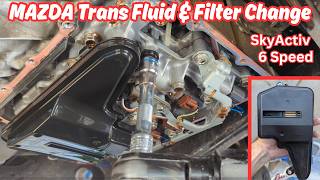
- Slipping or Delayed Engagement: The engine revs up, but the car hesitates to move, feeling sluggish. This often indicates worn internal clutches or incorrect fluid type/level. 🎬 See how to change transmission fluid on a 2.5L Skyactiv
- Check Engine Light: Specific Diagnostic Trouble Codes (DTCs) related to oil pressure switches (e.g., P0842, P0847, P0872, P0877, P0780, P1738) strongly suggest an internal transmission fault.
Warning: A whining noise can also be caused by a bad wheel bearing. A key difference is that a wheel bearing noise often changes pitch or intensity when turning, while the transmission whine typically depends only on vehicle speed. Misdiagnosing this can lead to an expensive and unnecessary transmission replacement.
Diagnostic Flowchart
Known Problems, Recalls, and Technical Service Bulletins (TSBs)
Mazda has issued several TSBs related to this transmission family. There are no widespread safety recalls specifically for the 2016-2017 Mazda 6 transmission itself, though other recalls for the vehicle may exist.
Transmission Whining Noise (TSB #05-002/19 / SA-006-22 / SA-016-19)
This is the most significant known issue, rated as moderate severity. Some vehicles may develop a whining noise due to a damaged internal bearing caused by an improper configuration of the transaxle front casing. The official remedy is to replace the entire transaxle assembly with a modified unit featuring a strengthened front casing. This TSB applies to 2014-2017 Mazda 6 models.
Stuck Oil Pressure Switches A and/or B (TSB #05-003-20-3725)
The check engine light and AT warning light may illuminate with DTCs like P0842, P0847, P0872, P0877, P0780, or P1738. This is caused by contamination causing one or more oil pressure switches on the valve body to stick. The fix involves replacing the affected switches and reprogramming the TCM. This issue affects a wide range of Mazda vehicles from 2014-2021.
Torque Converter Lock-Up Clutch Wear
A severe issue noted in community forums is premature wear of the torque converter's lock-up clutch across all years. This wear contaminates the transmission fluid with fine iron powder, which can clog the sensitive solenoids in the valve body, leading to poor shift quality. It requires a fluid flush and potentially valve body or solenoid replacement.
What Fails at Every Mileage Band
Pro Tip: The mileage bands below describe what typically fails on these transmissions at various stages of their life. If you are buying a used replacement transmission, use the checklists provided to perform critical maintenance before or during the installation of your purchased unit. These are not maintenance guides for your broken transmission, but prep-lists for your replacement.
Under 60,000 Miles
Failures in this early band are almost exclusively related to the known manufacturing defect covered by Mazda TSB #05-002/19. Owners report a whining noise that increases with vehicle speed due to a faulty bearing in the transaxle case. Complete transmission failure requiring replacement can occur, often covered under the 5-year/60,000-mile powertrain warranty. Hesitation and jerky shifting from a stop are also reported.
- ✓Do during install (required): Verify the replacement is an updated unit not susceptible to the TSB-related bearing failure. Use only new, genuine Mazda ATF-FZ fluid for refill. Perform the mandatory TCM Adaptive Relearn (Initial Learning) procedure after installation.
- ✓Do during install (recommended): Flush the case-mounted fluid cooler thoroughly to remove any potential debris.
- ✓Cheap insurance while the engine is out: Replace external axle seals and the torque converter input shaft seal as inexpensive insurance.
60,000 - 100,000 Miles
In this band, the transmission whining noise (per TSB #05-002/19) often appears just outside the warranty period. Owners also experience delayed engagement when shifting from Park to Drive (sometimes taking several seconds), harsh shifting, and transmission slippage between gears. Failure of internal oil pressure switches triggering various DTCs is also common.
- ✓Do during install (required): Perform a full fluid and filter service. This involves dropping the pan, cleaning the magnets of metallic sludge, replacing the internal filter (Mazda Part # FZ01-21-500), and using a new pan gasket or quality RTV sealant. Perform the mandatory TCM Adaptive Relearn procedure.
- ✓Do during install (recommended): Thoroughly flush the case-mounted cooler. Consider replacing the internal oil pressure switches (related to TSB #05-003-20) while the oil pan is off for the filter change.
- ✓Cheap insurance while the engine is out: Replace all external seals (axles, torque converter).
100,000 - 150,000 Miles
Bearing failure causing a whining noise can still occur at this higher mileage. General wear and tear leading to harsh shifting or slipping becomes prevalent if the fluid has not been serviced. While many transmissions are flawless in this range, this is the point where a lack of maintenance often leads to failure.
- ✓Do during install (required): A complete fluid and filter service is mandatory. Do not install a unit with this mileage without assuming the fluid and filter are spent. Replace the internal filter and clean the pan magnets. Perform the mandatory TCM Adaptive Relearn procedure.
- ✓Do during install (recommended): Given the mileage, replacing the case-mounted cooler is safer than attempting to flush it, as trapped debris from the donor vehicle could cause immediate damage.
- ✓Cheap insurance while the engine is out: Replace the torque converter input shaft seal and both axle seals.
Over 150,000 Miles
At this mileage, failures are typically due to the natural end of service life from accumulated wear and tear, often accelerated by a lack of fluid changes. Slipping, delayed engagement, and eventual complete failure are the most likely outcomes for poorly maintained units. However, many well-maintained units continue to operate without issue well beyond this point.
- ✓Do during install (required): Assume all serviceable and wear items need replacement. This is the highest-risk mileage band. Mandatory fluid and filter replacement. Drop the pan and meticulously clean the magnets. Perform the mandatory TCM Adaptive Relearn procedure.
- ✓Do during install (recommended): Strongly recommend replacing the case-mounted cooler. Flushing may not be sufficient to remove all contaminants from a high-mileage unit.
- ✓Cheap insurance while the engine is out: Mandatory replacement of all external seals (axle seals, torque converter seal).
Real Owner Experiences
The expected service life of the FW6A-EL transmission varies significantly. Many owners experience failures between 60,000 and 125,000 miles due to the known TSB-related bearing problem. However, with regular fluid and filter changes (a drain and fill every 30,000 to 60,000 miles, and a filter change every 60,000 to 80,000 miles), a service life of 200,000 to 250,000+ miles is achievable. Disregarding Mazda's "lifetime fluid" claim is the single most critical factor for longevity.
| Source | Mileage | What Happened | Cost |
|---|---|---|---|
| CarComplaints.com | 35,065 | Owner heard a grinding noise when braking and accelerating from an intersection. The dealer diagnosed a transmission issue and replaced the unit under warranty. | $0 (Warranty) |
| CarComplaints.com | 51,600 (average) | A whining noise that starts occasionally while accelerating and becomes more frequent. Dealerships diagnose this as a bad transmission requiring replacement. | Varies, often covered by warranty |
| CarComplaints.com | N/A (5 weeks old) | New car hesitated when accelerating and then jerked violently. The dealership is replacing the transmission. | $0 (Warranty) |
| 49,000 | Contacted Mazda corporate after the dealer was unhelpful. Mazda covered 66% of the repair cost. (Quoted ~$5,000) | ~$1,650 | |
| 55,000 | Transmission failed just out of warranty. | $7,500 | |
| 68,000 | Owner took the car in for a slight whining noise and was told the transmission needed to be replaced due to a bad bearing. The failure occurred just outside the 60k mile warranty. | ~$2,500 (Mazda covered half of the $5,000 bill) | |
| Car Talk Community | 85,000 | Owner noticed the automatic transmission 'jumping' slightly when shifting from 3rd to 4th gear. | N/A (Prognosis was a failing transmission) |
| Mazdas247.com Forum | 90,000 | Transmission experienced a 5-second delay when shifting from Park to Drive when cold, followed by two shudders before engaging. A dealership suspected a TCM fault. | Quoted $2,500 for TCM/Valve Body |
| 90,000+ | Dealer diagnosed whining noise per TSB and quoted for replacement. Owner contacted Mazda corporate. | N/A (Quoted $5,000+) | |
| BobIsTheOilGuy.com Forum | 117,000 | Owner reports the transmission has been 'flawless'. | $0 |
| Car Talk Community | 123,600 | A whining noise prompted a dealer visit, where they confirmed the transmission needed replacement due to the known manufacturing defect described in the TSB. | $1,800 (Mazda/dealer split the $5,400 repair) |
| 130,000 | Owner reports no issues with the original transmission, having only performed routine maintenance like oil changes, brakes, and tires. | $0 | |
| 140,000 | Owner reported their transmission 'croaked' and required a rebuilt unit. | $4,000 | |
| 199,202 | Owner reports replacing the water pump, belt tensioner, and valve cover gasket, but the original transmission is still functioning well. | $0 | |
| Mazdas247.com Forum | 250,000 | Owner replaced the transmission fluid once around 120,000 miles and has had no other transmission issues. | $0 |
| 285,000 | A prospective buyer test-drove a well-maintained Mazda 6 with 285k miles and reported the engine and transmission were still strong and smooth. | N/A | |
| 400,000 (km) | Owner claims to have reached 400,000 km (~250,000 miles) on the original automatic transmission fluid without a change. | $0 |
Repair or Replace?
When facing transmission issues, deciding whether to repair your current unit or replace it entirely depends on the specific failure mode.
- Stuck Oil Pressure Switches (DTCs P0842, P0847, etc.): This is a common, relatively minor electronic failure. The repair involves replacing inexpensive switches and reprogramming the TCM, typically costing $400 - $800. This is far cheaper than replacing the entire unit.
- Leaking Seals or Gaskets: If the transmission is otherwise shifting perfectly and the fluid is clean, addressing external leaks by replacing seals (like axle seals) or the pan gasket is routine maintenance and very cost-effective, usually running $200 - $600.
- Valve Body Failure: If shifting issues are isolated to the valve body and the rest of the transmission's mechanical parts are sound (no metal contamination in the fluid), replacing the remanufactured valve body and performing a fluid flush can resolve the issue for $800 - $1,500.
When Replacement is Smarter: Replacement is the recommended course of action when experiencing the well-documented whining noise (TSB #05-002/19), as this indicates a progressive internal mechanical failure (bearing/casing) that is not practical to repair. It is also smarter to replace the unit if the fluid is black, burnt, or contains significant metallic debris, as this points to widespread internal damage to clutches and hard parts.
Replacement Cost Estimates
The cost to replace a transmission varies widely based on the type of part used. Shop labor for this job is estimated at 6.0 to 9.0 hours, which translates to roughly $750 to $1,600 in labor costs alone.
| Part Type | Estimated Cost (Part Only) | Notes |
|---|---|---|
| New OEM | $4,500 - $7,500+ | Highest cost, brand new from Mazda. |
| Remanufactured | $2,400 - $3,500 | Rebuilt by a third party with new wear items. Often comes with a warranty. |
| Used OEM (Recycled) | $525 - $1,400 | A direct pull from a donor vehicle (e.g., a 2016 Mazda 6 with 78,804 miles). Mileage and condition vary. |
What's Included in a Used Assembly
When buying a used transmission, it's important to know what parts are typically included. Based on industry standards, a used assembly includes:
- Transmission Case and all internally lubricated parts
- Valve Body and internal wiring harness
- Torque Converter
- Oil Pan
- Tail Housing
Parts that are not included and must be transferred from your old unit or purchased new are external sensors, shifter linkage, shifter cables, external cooler lines, external mounting brackets, and the engine flexplate.
Warning: The Transmission Control Module (TCM) is an internal module integrated directly onto the valve body inside the oil pan. While it is physically included with the used assembly, it is a sensitive electronic part that requires special programming upon installation.
Installation: Critical Steps and Common Mistakes

Installing this transmission is an "Expert" level DIY job requiring special tools like an engine support bar/brace, a transmission jack, axle seal protectors, and an advanced OBD-II scan tool. Several "gotchas" can cause immediate failure of the replacement unit if not handled correctly.
Key Installation Procedures
- Torque Converter Seating: The torque converter must be fully seated into the transmission's oil pump before the transmission is bolted to the engine. This usually involves feeling three distinct "clicks" or drops as it engages. Failure to do this will crack the internal oil pump gear upon tightening the bolts.
- The Case Plug Transfer (TSB #SA-053-20): You must transfer a specific plug from the old transmission case to the replacement unit with a new washer.
- Shifter Cable Alignment: The cable must be perfectly aligned at the manual lever to prevent shift codes or a no-start condition.
- Fluid Type and Capacity: This transmission ONLY uses Mazda Genuine ATF-FZ fluid, which is blue. Using any other type of multi-vehicle ATF or Type M fluid will cause immediate slipping and rapid failure. The total capacity is approximately 8.2 quarts, but a standard service refill takes 4.0 to 5.0 quarts.
- Fluid Level Check: There is no engine-bay dipstick. The fluid level must be checked via a short dipstick secured by a 10mm bolt low on the case. The fluid level must be checked with the ATF temperature between 122°F and 140°F (50°C to 60°C) on level ground with the engine idling.
- TCM Calibration: After installation, an "Initial Learning" or adaptive relearn procedure must be performed with an advanced OBD-II scan tool. Skipping this step will result in violent shifting and trouble codes.
- Flush the Cooler: This model uses a case-mounted fluid cooler rather than external lines running to the radiator. It is essential to flush it thoroughly with a transmission cooler-line flush solvent or replace it to remove any metal debris from the previous transmission's failure.
Questions to Ask Your Installer
- Have you worked on Mazda Skyactiv (FW6A-EL) transmissions before?
- Will you be performing the mandatory TCM Initial Learning (adaptive relearn) procedure with a compatible scan tool after installation?
- How will you be flushing the case-mounted transmission cooler to ensure no debris from the old unit contaminates the replacement?
- Can you confirm you will be using only Mazda Genuine ATF-FZ fluid?
- Does your quote include replacing the axle seals (Mazda Part # FZ01-27-238 for the passenger side) and torque converter seal at the time of installation?
- Will you inspect the engine flexplate for any damage before installing the replacement transmission?
Freight & Delivery Reality

If you are ordering a used transmission online, understand that it will not arrive in a standard cardboard box via regular mail. A verified FW6A-EL transmission assembly weighs approximately 215 lbs and measures roughly 32" x 24" x 22" before crating.
Because of this size and weight, it ships as LTL (Less-Than-Truckload) freight on a wooden pallet. If you are having it delivered to a residential address, you must request a truck with a liftgate to lower the pallet to the ground. Always perform a pre-purchase verification interview with the seller to confirm the VIN and casting numbers. When the freight carrier arrives, inspect the transmission for any physical damage to the case, oil pan, or sensors before signing the delivery receipt.
Frequently Asked Questions (FAQ)
What type of fluid does the 2016-2017 Mazda 6 transmission use?
It requires Mazda Genuine Automatic Transmission Fluid (ATF) Type FZ. It is a low-viscosity, blue-colored fluid. Using any other fluid, such as a generic multi-vehicle ATF, will cause severe shifting problems and likely destroy the transmission.
Does a replacement transmission need to be programmed?
Yes. At a minimum, a procedure called "TCM Initial Learning" or adaptive relearn is required. This must be done with a compatible professional scan tool to ensure the transmission shifts smoothly. Some sources suggest the internal TCM may be VIN-locked, potentially requiring dealer-level programming if the valve body/TCM is replaced, so it's wise to confirm this with the yard before installation.
Will a transmission from a Mazda CX-5 fit my Mazda 6?
No. While they are both part of the same FW6A-EL family, the units used in the Mazda 3 and CX-5 have different case mounting points, gear ratios, and software calibrations. They are not interchangeable.
How do I check the transmission fluid level?
There is no traditional dipstick in the engine bay. The level is checked via a small short dipstick secured by a 10mm bolt low on the side of the transmission case. The vehicle must be on level ground, idling, and the transmission fluid temperature must be exactly between 122°F and 140°F (50°C to 60°C) for an accurate reading.
How long should the FW6A-EL transmission last?
The service life varies. Many owners experience failures between 60,000 and 125,000 miles due to a known TSB-related bearing problem. However, if the unit does not suffer from this defect and receives regular fluid and filter changes, a service life of 200,000 to 250,000 miles or more is frequently reported.
Helpful Videos
Technical Specifications
Transmission Family: FW6A-EL; Type: 6-speed automatic transaxle; Drivetrain: Front-Wheel Drive (FWD); Mounting: Transverse; Engine Compatibility: 2.5L SKYACTIV-G; Case ID Codes: FZ21, FZ01; Fluid Type: Mazda Genuine ATF-FZ (Blue); Fluid Capacity (Total): ~8.2 quarts; Fluid Capacity (Service): 4.0 - 5.0 quarts; Weight: ~215 lbs; Dimensions: ~32" x 24" x 22"
We Have This Part in Stock


The information in this article is provided for general reference and educational purposes only. Vehicle specifications, procedures, and part compatibility can vary by production date, trim level, and region. Always consult your vehicle's factory service manual and verify part numbers before purchasing or performing repairs. Safety-critical components such as airbags, seat belts, and braking systems should be installed by a qualified professional.
- Mazda 6:
- 🎬 Helpful Videos
- 🛍️ Shop This Part
- Identifying the Correct Transmission for Your Mazda 6
- How to Confirm Fitment
- What Will Not Fit?
- Common Failure Symptoms and Diagnosis
- Diagnostic Flowchart
- Known Problems, Recalls, and Technical Service Bulletins (TSBs)
- Transmission Whining Noise (TSB #05-002/19 / SA-006-22 / SA-016-19)
- Stuck Oil Pressure Switches A and/or B (TSB #05-003-20-3725)
- Torque Converter Lock-Up Clutch Wear
- What Fails at Every Mileage Band
- Under 60,000 Miles
- 60,000 - 100,000 Miles
- 100,000 - 150,000 Miles
- Over 150,000 Miles
- Real Owner Experiences
- Repair or Replace?
- Replacement Cost Estimates
- What's Included in a Used Assembly
- Installation: Critical Steps and Common Mistakes
- Key Installation Procedures
- Questions to Ask Your Installer
- Freight & Delivery Reality
- Frequently Asked Questions (FAQ)
- 🎟️ Get 5% Off