

2011 Infiniti G37 7-Speed Automatic Transmission: Problems, Identification, and Used Replacement
Identify the exact RE7R01A transmission for your RWD Sedan, understand the P0720 and SMOD failures that kill it, and learn what to check before buying a used replacement assembly.
- Verify the OEM part number (31020-X350E) and vehicle production date (10/10-05/11) before purchase, as transmissions from other G37 models are incompatible.
- The most common severe failures are the internal TCM (often triggering code P0720) and radiator cross-contamination (SMOD), which requires replacing both the transmission and radiator.
- When installing a replacement, it is mandatory to flush the cooler lines and highly recommended to replace the radiator or add an external cooler to prevent repeat failure.
- A replacement transmission's TCM must be programmed to the vehicle's VIN with a dealer-level scan tool, unless the original, functional TCM is swapped over.
- Strictly use Nissan Genuine Matic S ATF; using any other type of fluid will cause shifting problems and permanent damage.
Part Identification: Confirming the Correct RE7R01A Transmission

The automatic transmission for the 2011 Infiniti G37 is a 7-speed, rear-wheel drive (RWD) unit known as the Jatco JR710E or JR711E. By its Infiniti designation, it is the RE7R01A. This specific assembly is for a narrow range of vehicles: the 2011 G37 Sedan with Rear-Wheel Drive, built between October 2010 (10/10) and May 2011 (05/11). It is paired with the 3.7-liter, non-turbocharged, non-direct-injection engine.
To confirm this is the correct part for your vehicle, you must check several key identifiers during a pre-purchase verification interview with your parts supplier:
| Identifier | Verification Method |
|---|---|
| Production Date | Check the safety compliance sticker on the driver-side door jamb. The manufacturing date must fall between 10/10 and 05/11. |
| Transmission Code | The same door jamb sticker should list the transmission type. Confirm it reads 'RE7R01A'. |
| OEM Part Number | Look for a barcode sticker on the right (passenger) side of the transmission case itself. It should feature the OEM part number 31020-X350E. |
| Electrical Connector | Verify whether your original transmission has the early-style 12/13-pin rectangular connector or the late-style 10-pin connector to ensure harness compatibility. |
Warning: Transmissions from other G37 models will NOT fit. This includes units from All-Wheel Drive (AWD or 'x') models, Coupes, and Convertibles. Assemblies from sedans built outside the specified 10/10 to 05/11 production window are also incompatible due to differences in the transmission case design, electrical connectors, solenoid configurations, and internal software calibrations.
What is Included in a Used Assembly
When purchasing a used replacement transmission from a professional auto recycler, industry standards dictate what parts are left on the unit. A standard used RE7R01A assembly includes:
- The main transmission case and all internally lubricated parts.
- The extension/tail housing.
- The transmission oil pan.
- The torque converter.
- The valve body with the integrated Transmission Control Module (TCM).
The assembly will not include external sensors, external wiring harnesses, the shifter, shift linkage/cables, the engine flexplate, or the transmission fluid cooler lines. You must transfer these parts from your original transmission.
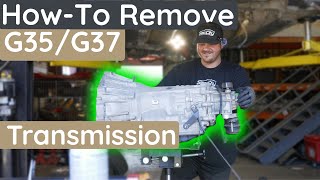
🎬 See this step-by-step automatic transmission removal guideCommon Failure Symptoms
A failing RE7R01A transmission can present several distinct symptoms. You may notice one or more of the following issues:
- Harsh or delayed shifting, especially when downshifting as you coast to a stop.
- A feeling of hesitation or lag when you accelerate from a stop or after coasting.
- The vehicle entering "limp mode," where it gets stuck in a single gear (often 3rd or 4th) and will not shift.
- The Check Engine Light is illuminated, often with transmission-specific Diagnostic Trouble Codes (DTCs) like P0720, P0741, P0705, or U1000.
- A burning smell, which can indicate overheating fluid.
- Whining or grinding noises from the transmission area.
Diagnosing the Failure

Before condemning the transmission, a few diagnostic steps are necessary. The first step is to scan the vehicle's computer for DTCs. A common and severe fault code is P0720, which points to a malfunction in the output speed sensor circuit. In these transmissions, the issue is rarely the sensor itself but rather a failure of the internally-housed Transmission Control Module (TCM) to which it reports.
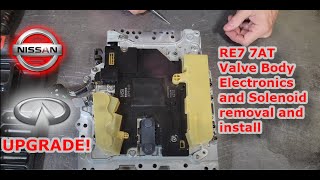
🎬 Watch: How to replace the RE7R01A TCM and solenoidsAnother critical check is the transmission fluid. If the fluid is milky and pinkish, it indicates a catastrophic failure known as the "Strawberry Milkshake of Death" (SMOD). This occurs when the internal wall of the radiator, which contains a chamber for cooling transmission fluid, ruptures. This allows engine coolant and automatic transmission fluid (ATF) to mix, destroying the transmission's internal clutches (specifically the B3 and C1 packs) and electronics.
Pro Tip: Don't be alarmed if the transmission fluid is very dark. Per Infiniti's Technical Service Bulletin (TSB) ITB11-036, the recommended Nissan Matic S ATF naturally darkens to a very dark color within the first 2,000 to 3,000 miles of use. 🎬 Watch: How to check and fill G37 transmission fluid This is normal and not an indicator of failure on its own.
Diagnostic Flowchart
Known Issues, Bulletins, and Recalls
This transmission family is subject to several well-documented issues. No recalls have been issued for this specific assembly, but multiple TSBs address common complaints.
Shift Responsiveness and Harsh Shifting (TSB ITB12-027 / ITB12-027d & ITB10-075)
Owners of 2009-2011 G37 models often reported harsh downshifts when stopping, hesitation, and jerky behavior at rolling stops. This is a software issue, not a mechanical failure. The official remedy is for an Infiniti dealer to reprogram both the Engine Control Module (ECM) and the Transmission Control Module (TCM) with updated software using the Infiniti CONSULT diagnostic tool.
Internal TCM and Speed Sensor Failure (TSB ITB19-040 / DTC P0720)
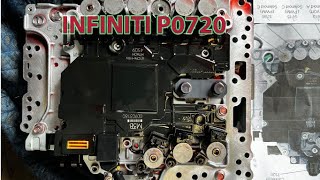
This is one of the most severe common failures. The code P0720 indicates a fault with the output speed sensor, but the true cause is typically the failure of the entire internal control unit (the TCM, which is bolted to the valve body) due to heat. This failure forces the transmission into limp mode. The only remedy is to replace or repair the internal control valve/TCM assembly.
Radiator Cooler Cross-Contamination (SMOD)
As mentioned in the diagnosis section, the integrated transmission cooler inside the radiator can fail, mixing coolant with the ATF. This contamination quickly ruins the friction clutches and sensitive electronics inside the transmission. If this occurs, the transmission and the radiator must be replaced, and the cooler lines must be thoroughly flushed to prevent the new transmission from being contaminated by leftover debris.
Freight and Delivery Reality

A replacement RE7R01A transmission is a massive, heavy component. It does not ship in a cardboard box via standard parcel services. Verified shipping data shows this assembly weighs approximately 210 lbs and measures roughly 38" x 24" x 22" before crating.
It will ship via Less-Than-Truckload (LTL) freight on a wooden pallet. If you are having it delivered to a residential address or a shop without a loading dock, you must request liftgate service so the driver can lower the pallet to the ground. Always inspect the transmission for physical damage (such as cracked bellhousings or broken electrical connectors) before signing the driver's delivery receipt.
What Fails at Every Mileage Band
Pro Tip: The mileage bands below describe what typically fails on USED replacement units at these mileages. The checklists provided are critical steps to perform WHILE INSTALLING the purchased transmission, not general maintenance advice for your current vehicle.
Under 60,000 Miles
Transmissions in this range are generally healthy, but they can suffer from premature fluid degradation ("cooking") due to the transmission's tendency to run hot and the undersized stock cooler integrated into the radiator. Early life valve body/TCM failures are possible but less common. Harsh or jerky shifting (particularly on the 4-3 downshift) is often present but can be fixed with software updates.
- ✓Do during install (required): Perform a full fluid flush and fill with Nissan Matic S ATF. Ensure the replacement unit's TCM has the latest software updates to address known shift quality TSBs. Thoroughly flush all transmission cooler lines to remove any potential debris from the previous unit.
- ✓Do during install (recommended): Replace the transmission pan gasket.
- ✓Cheap insurance while the engine is out: Replace the external input and output shaft seals.
60,000 - 100,000 Miles
This is where internal Valve Body/TCM failures (DTC P0720) become a primary concern, often due to heat stress. Radiator cross-contamination (SMOD) also becomes a significant risk in this window, leading to catastrophic transmission failure.
- ✓Do during install (required): Proactively replace the radiator to prevent future SMOD failure, or bypass the internal cooler and install a dedicated external transmission cooler. Perform a full fluid exchange with Nissan Matic S ATF.
- ✓Do during install (recommended): Replace the internal transmission filter (metal mesh screen) and clean the pan magnets.
- ✓Cheap insurance while the engine is out: Replace the rear main seal on the engine while the transmission is removed. Replace the flexplate if there are any signs of stress or cracking.
100,000 - 150,000 Miles
Valve Body/TCM failures and SMOD remain high risks. Additionally, torque converter failure can occur, which stalls the engine when put into gear and generates significant metal debris (DTC P0741). General wear on internal clutch packs (specifically B3 and C1) is common if the unit was operated with old or contaminated fluid.
- ✓Do during install (required): Replace the radiator if original, or install an external transmission cooler to eliminate the risk of SMOD. Replace the internal filter, pan gasket, and flush cooler lines.
- ✓Do during install (recommended): Strongly consider replacing the torque converter as a preventative measure, especially if the reason for the donor vehicle's salvage status is unknown.
- ✓Cheap insurance while the engine is out: Replace all accessible seals: input shaft, output shaft, and rear main seal. Inspect and consider replacing the driveshaft's center support bearing and flex joint (guibo).
150,000+ Miles
At this stage, there is an increased likelihood of complete mechanical failure due to accumulated wear and tear, especially if fluid maintenance was neglected. The expected service life without fluid changes is around 150,000 to 160,000 miles, though well-maintained units can exceed 200,000 to 270,000 miles.
- ✓Do during install (required): Replace the radiator and install an external transmission cooler without question. Assume the replacement unit will need a new valve body/TCM assembly sooner rather than later; factor this potential cost in.
- ✓Do during install (recommended): Replace the torque converter, internal filter, and pan gasket.
- ✓Cheap insurance while the engine is out: Replace all external seals, the rear main seal, and the transmission and engine mounts, as they are likely worn and stressed during the swap.
Real Owner Experiences
The following table highlights real-world failures, mileages, and costs reported by Infiniti G37 owners.
| Source | Mileage | What Happened | Cost |
|---|---|---|---|
| G35Driver Forum | 27,000 | Dealer diagnosed a failed valve body, requiring a replacement. The dealer noted it was a common failure due to bad castings causing internal passages to clog. | $2,000 |
| Reddit r/G37 | 60,000 | Transmission was slipping and making noise. A shop found magnetic and non-magnetic particles in the brown fluid, diagnosing the transmission as failing. This was attributed to overheated fluid losing its lubricating properties. | Not specified, implies full transmission replacement. |
| Reddit r/G37 | 75,000 | Replace TCM for P0720 code on a 2013 G37x. A dealership quote for a similar job was $4,100 after labor, programming, fluid, and gasket. | $3,812 |
| MyG37 Forum | 78,000 | Owner expressed concern over frequent reports of valve body and TCM failures, prompting preventative maintenance discussions. | N/A (preventative) |
| G35Driver Forum | 80,000 | Vehicle experienced hard shifting and then discharged a mix of coolant and ATF from the coolant reservoir. The transmission fluid was also contaminated. This required a full transmission replacement. | $5,600 (shop quote) |
| Reddit r/G37 | 86,000 | Car threw a P0720 code. A mechanic replaced the valve body, but the car died on the highway 45 minutes later, then showing additional codes (U1000, P0705). The fluid was noted to be black. | Ongoing (multiple valve bodies attempted) |
| MyG37 Forum | 120,000 | Owner bought the car with 105k miles and had no service history. Despite smooth shifting, they were advised to perform a fluid change as preventative maintenance. | N/A (preventative) |
| Carsurvey.org | 126,000 | Experienced 'strawberry milkshake of death' due to radiator failure. The owner flushed the system, replaced the radiator, and added an external cooler, and the transmission was saved. | Cost of radiator, cooler, and fluid. |
| G35Driver Forum | 130,000 | A single vehicle experienced its third valve body failure at this mileage, indicating potential for recurring issues. | Not specified, warranty replacement. |
| Reddit r/G37 | 190,000 | Owner reported original engine and transmission with no major issues. | N/A |
| Reddit r/G37 | 195,000 | Owner reported no transmission problems despite never servicing the fluid. | N/A |
| Reddit r/G37 | 205,000 | Owner with a modified and tuned engine started to notice distinct slipping from 1-2 and 2-3 shifts. | Implies impending failure. |
| Reddit r/G37 | 270,000 | Owner reported original engine and transmission still going strong, attributing longevity to regular maintenance on all fluids. | N/A |
| Reddit r/infiniti | Not Specified | Full transmission swap due to P0720 and metal shavings on a 2012 G37 RWD. Quoted $4,000+. | $1,650 ($700 for used transmission + $950 for installation). |
| Reddit r/G37 | Not Specified | Replace valve body/TCM for P0720 code. Quoted $3,000 - $4,000 (New from Infiniti). | One user paid $800 total ($600 for a used TCM + $200 for installation). |
| G35Driver Forum | Not Specified | Dealer recommended replacing the entire valve body assembly for a P0720 code on a 2010 G37 Convertible. | ~$2,500 |
Repair or Replace?
When faced with a failing RE7R01A, you must decide whether to repair the existing unit or replace the entire assembly.
When Repair Makes Sense: If your transmission is mechanically sound (no slipping, no metal shavings in the pan) but you have a P0720 code, repairing the valve body/TCM makes financial sense. A remanufactured valve body typically costs between $235 and $750. While a dealership might quote over $4,000 for this job, independent shops or DIYers can complete it for $800 to $4,100 depending on labor rates. If your only issue is harsh shifting, a simple software update at the dealership (addressing TSB ITB12-027d) usually costs $150 to $300 and is the most cost-effective first step.
When Replacement is Smarter: Replacement with a used or remanufactured unit is the better option when there is evidence of widespread mechanical failure, such as significant metal shavings in the pan, or in cases of severe radiator cross-contamination (SMOD). Once coolant has circulated throughout the entire unit, it damages the clutches and electronics beyond economical repair. Used replacement units typically run $700 to $1,500, making a full swap cheaper than attempting to rebuild a heavily damaged transmission.
Replacement Cost Expectations
The cost to replace a 2011 G37 transmission varies based on the type of replacement unit. Labor costs for the swap are also significant due to the complexity of the job, which typically takes 5 to 8 hours.
| Part or Service | Estimated Cost (USD) |
|---|---|
| New OEM Transmission Assembly | $4,800 - $9,350 (AutoZone lists a new unit at $5,193.99) |
| Remanufactured Transmission Assembly | $2,500 - $5,300 |
| Used OEM Transmission Assembly | $700 - $1,500 |
| Installation Labor | $800 - $1,600 |
Installation and Programming Essentials

Installing a replacement RE7R01A transmission is an expert-level DIY job or requires a professional shop. Several critical steps must be followed to ensure the replacement unit is not damaged.
Required Tools and Consumables
- Heavy-duty transmission jack.
- Long extensions (30+ inches) with a 19mm swivel socket.
- Infiniti Transmission Fill Adapter (Tool #ATF 180) and a fluid pump.
- Infrared thermometer or professional scan tool.
- Infiniti CONSULT-III Plus scan tool (for programming).
- Nissan Genuine Matic S ATF (approx. 9.7 to 9.75 quarts for a dry fill).
- Internal transmission filter and metal oil pan gasket (OEM Part #31397-1XJ0A).
- Front pump/torque converter input seal.
- Transmission cooler-line flush solvent.
Key Installation Steps & "Gotchas"
- Torque Converter Seating: The torque converter must be rotated until it drops into place three distinct times. Failure to fully seat it will crack the transmission's internal oil pump when the bellhousing is bolted to the engine block.
- Top Bellhousing Bolts: Access is extremely limited. The transmission crossmember must be lowered slightly to tilt the powertrain backward, and very long (30+ inch) socket extensions with a swivel socket are required.
- Fluid Level Check: This transmission has no dipstick. Fluid must be pumped in through an overflow plug on the bottom pan. The engine is then run until the fluid reaches exactly 40°C (104°F), at which point the plug is removed and excess fluid is allowed to drain to a drip.
- Cooler Line Flush: It is mandatory to flush the transmission cooler lines and pressure-test or replace the radiator to prevent debris or coolant from destroying the replacement transmission.
Warning: Never use a multi-vehicle or universal ATF. This transmission strictly requires Nissan Genuine Matic S ATF. Using the wrong fluid can cause shifting problems and permanent damage.
Programming and Calibration
The Transmission Control Module (TCM) is an electronic unit located inside the transmission on the valve body. When the transmission is replaced, the TCM must be electronically "married" to the vehicle's VIN and other control modules. This requires a dealer-level scan tool like the Infiniti CONSULT-III Plus to perform a TCM adaptive relearn and VIN-specific programming. Without proper programming, the car may not start, or the transmission will remain in limp mode.
Pro Tip: A common workaround to avoid dealer programming is to carefully remove the original valve body/TCM assembly from your failed transmission and install it into the replacement unit. This is only possible if your original TCM is still functional and the failure was purely mechanical.
Frequently Asked Questions (FAQ)
What transmission fluid should I use for a 2011 Infiniti G37?
You must use Nissan Genuine Matic S ATF. Do not use universal or other fluid types, as they can cause severe damage. A dry transmission requires approximately 9.7 to 9.75 quarts.
Can I use a transmission from a G37x AWD, Coupe, or a different year?
No. This specific assembly (31020-X350E) is only for the RWD Sedan built between October 2010 and May 2011. Other versions have different physical shapes, electronic controls, and software that make them incompatible.
Does a used G37 transmission need to be programmed?
Yes. The internal Transmission Control Module (TCM) that comes with the used transmission must be programmed to your vehicle's VIN using a specialized scan tool like the Infiniti CONSULT-III Plus. Alternatively, you can swap the TCM from your original transmission if it is still working.
What is the "Strawberry Milkshake of Death" (SMOD)?
This is a slang term for when the car's radiator fails internally, allowing engine coolant (antifreeze) to mix with the automatic transmission fluid. The resulting pink, milky fluid contaminates and destroys the transmission's internal clutches and electronics.
How do I check the fluid level if there is no dipstick?
You must use an Infiniti Transmission Fill Adapter (Tool #ATF 180) and a fluid pump to push fluid through the bottom overflow plug. You then run the engine until the fluid reaches exactly 40°C (104°F) using an infrared thermometer or scan tool, remove the plug, and let the excess fluid drain until it drips.
How can I prevent the TCM from failing again?
The internal TCM often fails due to excessive heat. The best preventative measure is to install a dedicated external transmission cooler. This bypasses the failure-prone internal radiator cooler (preventing SMOD) and keeps the transmission fluid at a lower, safer operating temperature.
Helpful Videos

Technical Specifications
OEM Part Numbers: 31020-X350E
Infiniti Designation: RE7R01A; Jatco Designation: JR710E or JR711E; Drivetrain: Rear-Wheel Drive (RWD); Speeds: 7; Application: 2011 G37 Sedan (RWD); Production Window: October 2010 to May 2011; Engine Pairing: 3.7-liter V6; Shipping Weight: Approx. 210 lbs; Shipping Dimensions: Approx. 38" x 24" x 22"; Required Fluid: Nissan Genuine Matic S ATF; Fluid Capacity (Dry Fill): 9.7 to 9.75 quarts
We Have This Part in Stock


The information in this article is provided for general reference and educational purposes only. Vehicle specifications, procedures, and part compatibility can vary by production date, trim level, and region. Always consult your vehicle's factory service manual and verify part numbers before purchasing or performing repairs. Safety-critical components such as airbags, seat belts, and braking systems should be installed by a qualified professional.
- Infiniti G37:
- 🎬 Helpful Videos
- 🛍️ Shop This Part
- Part Identification: Confirming the Correct RE7R01A Transmission
- What is Included in a Used Assembly
- Common Failure Symptoms
- Diagnosing the Failure
- Diagnostic Flowchart
- Known Issues, Bulletins, and Recalls
- Shift Responsiveness and Harsh Shifting (TSB ITB12-027 / ITB12-027d & ITB10-075)
- Internal TCM and Speed Sensor Failure (TSB ITB19-040 / DTC P0720)
- Radiator Cooler Cross-Contamination (SMOD)
- Freight and Delivery Reality
- What Fails at Every Mileage Band
- Under 60,000 Miles
- 60,000 - 100,000 Miles
- 100,000 - 150,000 Miles
- 150,000+ Miles
- Real Owner Experiences
- Repair or Replace?
- Replacement Cost Expectations
- Installation and Programming Essentials
- Required Tools and Consumables
- Key Installation Steps & "Gotchas"
- Programming and Calibration
- Frequently Asked Questions (FAQ)
- 🎟️ Get 5% Off