

2016-2018 Hyundai Tucson 1.6L Turbo AWD D7UF1 Transmission: Problems, Identification, and Used Replacement
Identifying the D7UF1 7-speed dual-clutch transmission, understanding its common failures, and knowing when to swap it for a quality used OEM assembly.
- After any replacement of the transmission, clutch, or actuators, a mandatory 'DCT Learning Function' must be performed with a dealer-level scan tool to prevent shifting problems and damage.
- Verify exact fitment before purchase; this AWD transmission (43000-2D050/2D055) is not interchangeable with FWD versions (43000-2D010/2D015) or DCTs from other Hyundai/Kia models.
- Ensure the vehicle's computer has all the latest software updates, especially the one from NHTSA Recall 16V628000, as this can resolve common hesitation and drivability issues.
- Always inspect the dual-mass flywheel for wear during replacement, as a failing flywheel can cause noise and damage the new transmission.
- Use only the specified SAE 70W API GL-4 DCT fluid; using standard automatic transmission fluid (ATF) will cause severe internal damage.
Identification: Is This Your Transmission?

This article covers the D7UF1 7-speed dry Dual-Clutch Transmission (DCT) found specifically in the 2016-2018 Hyundai Tucson equipped with the 1.6L turbocharged engine and All-Wheel Drive (AWD). A DCT is an automated manual transmission that uses two separate clutches for odd and even gear sets, allowing for very fast shifts. Unlike a traditional automatic, it does not have a torque converter.
Confirming you have this exact transmission before buying a replacement is critical, as several similar-looking units will not fit or function correctly.
How to Confirm Fitment
- Check Your Engine: Your Tucson must have the 1.6L Turbo engine. You can verify this on the emissions label under the hood or by checking the 8th digit of your vehicle's VIN.
- Confirm Drivetrain: This transmission is only for All-Wheel Drive (AWD) models. Look for a rear differential and a driveshaft running to the back of the vehicle.
- Find the ID Tag: The most reliable method is to locate the metal tag or sticker on the transmission's bellhousing (the part that bolts to the engine). It should be stamped with the identifying codes D7UF1 or D7F34, and one of the OEM part numbers 43000-2D050 or 43000-2D055.
Warning: Do not order this transmission for a Front-Wheel Drive (FWD) Tucson. FWD models use different part numbers (43000-2D010 or 43000-2D015) and their transmission cases lack the necessary mounting points for the AWD system's transfer case. This unit also does not interchange with DCTs from other Hyundai or Kia models like the Elantra Eco, Elantra Sport, Sonata Eco, Veloster Turbo, Kia Soul, or Kia Optima, which have different casings, different gear ratios, or different bellhousing bolt patterns.
Common Symptoms and Failure Points

Widespread complaints about the 1.6L Turbo Tucson's 7-speed DCT often point to issues with drivability, especially at low speeds. 🎬 Watch: Why this dual clutch transmission fails If your transmission is failing, you might experience:
- Severe hesitation or a long delay before the vehicle moves from a complete stop, particularly in hot weather or stop-and-go traffic.
- Shuddering, severe vibration, or jerking when accelerating at low speeds.
- Rough, erratic, or delayed gear shifts.
- The engine revs, but the vehicle fails to accelerate (slipping gears).
- Illuminated dashboard warning lights or a vehicle that refuses to move from Park.
These symptoms are often caused by premature wear of the internal dry clutch pack, issues with the external clutch actuators, or faulty software in the Transmission Control Module (TCM). In some cases, a metallic rattling noise can be caused by a worn dual-mass flywheel, a separate part that should be inspected during transmission replacement.
Diagnostic Flowchart
Known Issues, Recalls, and Technical Service Bulletins (TSBs)
Hyundai has released several software updates and service campaigns to address the common problems with the D7UF1 transmission.
NHTSA Recall 16V628000 (Hyundai Campaign 149)
| Issue | For some 2016 Tucsons, high temperatures combined with certain driving conditions could cause a delay in clutch engagement, making the vehicle unable to move from a stop if the accelerator is pressed repeatedly. This increases the risk of a crash. |
| Affected Years | 2016 Hyundai Tucson models manufactured between May 20, 2015, and May 31, 2016. |
| Remedy | Dealers will update the Transmission Control Module (TCM) and ECM software free of charge. Before purchasing a used unit, ensure this crucial recall has been performed on your vehicle. |
Hyundai TSB 21-AT-014H
| Issue | Abnormal vibration or a "judder" at low speeds when pulling away from a standing start. |
| Affected Years | 2016-2018 Hyundai Tucson with the 1.6L Turbo engine. |
| Remedy | This TSB provides a diagnostic procedure for dealers to follow. The fix involves TCU software updates, and if the judder persists, replacement of the dual-clutch pack using revised clutch materials. |
Hyundai TSB 19-AT-001 / 19-AT-002H
| Issue | A mandatory software update is required for the TCM when an older transmission is replaced with a newer version containing updated clutch materials. |
| Affected Years | 2016-2018 |
| Remedy | The TCU must be updated with the latest software to ensure it is compatible with the revised clutch pack. Failure to do so can cause shifting problems and damage to the new components. |
Premature Clutch and Actuator Wear
| Issue | The dry-clutch design is susceptible to premature wear, especially in heavy, stop-and-go city traffic which causes excessive slipping. |
| Affected Years | 2016-2018 |
| Remedy | Modifying driving habits to avoid "creeping" forward without fully engaging the clutch can help extend its life. Ultimately, a worn clutch pack requires replacement. |
Replacement Cost
The cost to replace a D7UF1 transmission varies significantly based on the type of part used. Shop labor for this job is estimated at 6.0 to 10.0 hours, making labor costs high due to its complexity.
| Part or Service | Estimated Cost (USD) |
|---|---|
| New OEM | $3,500 - $6,500+ |
| Remanufactured OEM | $1,700 - $1,900 (plus approx. $1,000 core charge) |
| Used OEM | $1,700 - $2,600 |
| Installation Labor | $900 - $1,800 |
What's Included in a Used Assembly?
When buying a used transmission, it's important to know which parts are included. Based on ARA (Automotive Recyclers Association) standards, here is what you should expect.
Typically Included:
- Transmission case and all internally lubricated parts (gears, shafts, etc.)
- Internal shift forks and synchronizers
- Dual-clutch pack assembly (installed inside the case)
Typically Not Included:
- External clutch actuator assembly
- External gear selector actuator assembly
- Transmission Control Module (TCM)
- All external sensors, switches, and the wiring harness
- Flexplate / dual-mass flywheel (bolts to the engine)
- AWD Transfer Case, also known as the Power Take-Off Unit (PTU)
- Transmission cooler lines, shifter cables, or linkages
Pro Tip: The external clutch and gear actuators are sometimes included with a used assembly, but often they are not. Always verify with the salvage yard if the actuators are attached before you buy. The AWD transfer case (PTU) is always considered a separate part.
Installation and Programming: Critical Steps

Installing this transmission is an expert-level job requiring specialized tools. It is not recommended for DIY mechanics.
Mandatory Programming and Calibration
Warning: After installing a replacement transmission, clutch, or actuator, the system requires a "DCT Learning Function" or adaptive relearn. This procedure must be done with a dealer-level scan tool (like Hyundai GDS-M or equivalent). It teaches the TCM the exact engagement points of the new clutches and the positions of the gear actuators. Skipping this step will lead to harsh shifting, error codes, and potential damage to the new unit.
Installation Gotchas
- Special Tools Required: Replacement requires a Dual Clutch Remover/Installer (SST 09430-C1180 / 09430-2A240) and an Actuator Fixing Jig & Motor Adjustment tool (SST 09430-2A100 / 09430-2A200).
- Clutch Actuator Rod Adjustment: When installing the clutch actuator, the pushrod lengths must be precisely adjusted. Older manuals specify 72mm, but updated guides warn that on newer/revised actuators, this must be set to 78mm (or 71.5-72.5mm depending on the specific actuator revision) or the TCM relearn will fail.
- Correct Fluid: This is a dry-clutch DCT and uses a specific SAE 70W API GL-4 gear oil (Hyundai/Kia DCTF 70W, SK HK SYN DCTF 70W, or Shell Spirax S6 GHME 70W). Do NOT use standard Automatic Transmission Fluid (ATF), as it will ruin the transmission's internal components.
- Inspect the Flywheel: Before installation, inspect the dual-mass flywheel (DMF) for signs of wear like grease leakage, heat scoring, or excessive rotational play. A bad flywheel will cause metallic rattling and can ruin the new transmission's input shaft and clutch pack.
- Transfer Case Alignment: When reinstalling the AWD transfer case (PTU), ensure its intermediate shaft splines are clean, greased with high-pressure spline grease, and perfectly aligned with the transmission's output to prevent spline stripping.
- Harness Compatibility: Ensure the wiring harness and external sensors are transferred correctly from the original unit if they are not included on the replacement.
What Fails at Every Mileage Band
Pro Tip: The mileage bands below describe the condition and expected wear of USED replacement units of that mileage. The checklists provided are things to do WHILE INSTALLING the purchased transmission, not maintenance for your current broken unit.
Under 60,000 Miles
Transmissions in this range are generally in good condition, but they are still susceptible to the factory software logic issues that cause overheating of the dry clutch pack. Hesitation, shuddering, or jerky shifting at low speeds are the most common early failure signs.
- ✓Do during install (required): Verify the vehicle's TCM has the latest software updates, including the one from NHTSA Campaign 16V628000.
- ✓Do during install (required): Perform the 'DCT Learning Function' or adaptive relearn with a dealer-level scan tool after installation.
- ✓Do during install (recommended): Replace transmission fluid with the correct SAE 70W API GL-4 DCT fluid.
- ✓Cheap insurance while the engine is out: Replace external seals like axle and input shaft seals as preventative maintenance, and inspect the dual-mass flywheel for excessive play.
60,000 - 100,000 Miles
At this mileage, there are increased reports of severe clutch judder requiring clutch pack replacement. Complete transmission failure, sometimes preceded by jerky shifting, becomes more common. The clutch actuator assembly is also a known failure point in this band. Some owner reports suggest the original dry clutch pack may only last about 80,000 miles before needing replacement.
- ✓Do during install (required): Perform all mandatory software updates and the 'DCT Learning Function' upon installation.
- ✓Do during install (recommended): Replace the dual-clutch pack assembly. Since the transmission is already out, this is cost-effective 'insurance' against near-term failure.
- ✓Do during install (recommended): Replace the transmission fluid with the correct SAE 70W API GL-4 DCT fluid.
- ✓Cheap insurance while the engine is out: Inspect and consider replacing the clutch actuator assembly, thoroughly inspect the dual-mass flywheel, and replace all relevant seals and gaskets.
100,000 - 150,000 Miles
The D7UF1 dual-clutch transmission is a known weak point and is not expected to last the life of the vehicle without significant repairs. By this mileage, complete transmission failure or severe clutch slipping is highly likely. Because these failures are often outside of warranty, owners face significant out-of-pocket costs.
- ✓Do during install (required): Replace the dual-clutch pack and clutch actuator assembly. It is highly probable these components are near the end of their service life on a used unit of this mileage.
- ✓Do during install (required): Replace the transmission fluid (SAE 70W GL-4 DCTF) and all external seals.
- ✓Do during install (required): Perform all required software updates and the post-installation 'DCT Learning Function'.
- ✓Cheap insurance while the engine is out: Replace the dual-mass flywheel. Its lifespan is tied to the clutch, and failure can damage the new transmission components.
Real Owner Experiences
| Source | Mileage | What Happened | Cost |
|---|---|---|---|
| Car Talk Community | 13,500 | Owner of a 2017 Tucson reported the vehicle bogged down from a dead stop 4-5 times and refused to move from Park twice. | N/A |
| 20,000 | An owner of a 2018 model had the DCT replaced under warranty due to slipping gears. The replacement unit was an updated version and performed better. | Warranty | |
| 46,000 | An owner reported the onset of shudder/judder when starting from a stop. | N/A, suggested a dealer 'relearn' procedure might help. | |
| 48,000 km (approx. 30,000 miles) | A new owner experienced perfect operation until the transmission fluid was changed and a 'learn' procedure was performed. Afterward, the car developed a harsh, jolting clutch engagement from a stop and when accelerating slowly in 2nd gear. | N/A, dealer recommended clutch and actuator replacement. | |
| 63,000 | Quoted by a dealership for a new DCT clutch, gear oil, and clutch actuator. | $7,000 quote | |
| BobIsTheOilGuy Forums | 76,000 | While focused on an engine issue, the mechanic noted the vehicle's tuning keeps RPMs very low, putting high load on the engine and transmission, which could contribute to wear. | N/A |
| YouTube | 80,400 | Owner was quoted for a full transmission replacement by the dealer. Discovered the gear actuator was just seized and temporarily fixed it with a hammer. Estimated a proper actuator-only repair should be $1,000-$1,500. | $120 for diagnosis ($7,500 quote) |
| 92,000 | A 2017 Tucson's DCT failed completely. The car became jerky, then died and would not restart. The transmission was replaced under the 100k mile powertrain warranty after a 3-month wait. | Warranty | |
| 112,000 | The transmission on a 2016 Tucson Eco failed completely and required replacement. The owner was not the original, so it was not covered by warranty. | Not specified, but implied to be significant. | |
| 115,000 | A 2017 model's DCT started slipping badly out of nowhere. Shops refused to just replace the clutch, quoting a full transmission replacement instead. | Quoted for full replacement, owner traded in the vehicle. | |
| 120,000 | A user on a rental car platform noted that most Hyundais they rent over 100k miles are already showing signs of transmission issues and feel close to failure. | N/A | |
| Unknown | Received a quote in Canada to replace the clutch and actuator on a 2017 model. | $4,500 CAD quote | |
| YouTube | Unknown | A repair shop in Korea detailed the cost of a full clutch and actuator job on a similar DCT. | 1.9-2.1 million KRW (approx. $1,400 - $1,550 USD) |
Repair or Replace?
Deciding whether to repair your existing transmission or replace it with a used assembly depends on exactly what has failed.
When Repair Makes Sense
- Worn Dual-Clutch Pack: If there are no other symptoms of internal damage (like metallic noises or gear engagement failures), replacing just the clutch pack and related components (forks, bearings) is the intended service procedure. This typically costs $1,500 to $3,000. It is highly recommended to replace the clutch actuator at the same time.
- Failed Clutch or Gear Actuator: If the vehicle fails to move or select certain gears and the issue is diagnosed as a faulty external actuator, replacing only the actuator is much more cost-effective ($1,000 to $1,800) than a full transmission swap.
When Replacement is Smarter
Replacement with a complete used or remanufactured unit is smarter when there is evidence of internal damage to the transmission case, gears, shafts, or bearings. Additionally, if the quoted cost of a clutch and actuator repair job exceeds the price of a quality, lower-mileage used assembly (approximately $2,500), a full swap can be more economical. Since the labor to remove and reinstall the transmission is nearly identical for both repair and replacement, swapping in a complete unit is sometimes faster and cheaper.
Questions to Ask Your Installer
- Have you confirmed the failure is the transmission itself and not a software issue that can be fixed with a TCM update?
- Is the failure internal (gears, bearings) or external (clutch pack, actuators)?
- What is the cost difference between replacing the failed components (like the clutch and actuators) versus swapping in a complete used transmission?
- If repairing, will you be using the updated, revised clutch and actuator parts?
- Do you have the dealer-level scan tool (like Hyundai GDS-M) required to perform the mandatory 'DCT Learning Function' and actuator calibration after the install?
- Will you inspect the dual-mass flywheel for excessive play or damage while the transmission is out?
- Can you confirm my vehicle's computer has all the latest software updates, including the one for NHTSA recall 16V628000?
Freight and Delivery Reality

If you are ordering a used D7UF1 transmission online, be prepared for freight delivery. This assembly weighs approximately 196 lbs and measures roughly 32" x 24" x 22" before crating. Because of its size and weight, it ships as LTL (Less-Than-Truckload) freight on a pallet—NOT as a standard parcel.
- Commercial Address Preferred: Freight carriers prefer delivering to commercial addresses with a loading dock or forklift.
- Liftgate Service: If delivering to a residential address or a shop without a forklift, you must request liftgate service so the driver can lower the pallet to the ground.
- Inspect Before Signing: Always inspect the transmission for physical damage (like cracked bellhousings or broken sensor connectors) before signing the delivery receipt. Once you sign, you accept the condition of the freight.
- Pre-Purchase Verification: A reputable seller will conduct a pre-purchase verification interview to confirm your VIN, engine size (1.6L Turbo), and drivetrain (AWD) to ensure they are shipping the correct unit.
Frequently Asked Questions (FAQ)
Can I use a transmission from a Front-Wheel Drive (FWD) Tucson?
No. The FWD version of the D7UF1 transmission (part numbers ending in 2D010 or 2D015) has a different case and lacks the output shaft and mounting points for the AWD transfer case (PTU). It will not bolt into an AWD vehicle.
Does a used transmission need to be reprogrammed?
Yes. Any time a D7UF1 transmission, clutch, or actuator is replaced, a mandatory electronic calibration and relearn procedure (DCT Learning Function) must be performed with a professional Hyundai-compatible scan tool. The vehicle will not shift correctly without it.
What kind of fluid does the 2016-2018 Tucson 1.6T AWD transmission use?
It uses a specific DCT fluid, which is a type of gear oil (SAE 70W, API GL-4). It does not use traditional red Automatic Transmission Fluid (ATF). Using standard ATF will destroy the synchronizers and gears.
Is the AWD transfer case (PTU) included with the transmission?
No. The transfer case, or Power Take-Off Unit (PTU), is a separate component that bolts to the side of the transmission. It is sold separately and must be transferred from your old unit or purchased new.
Why does my Tucson hesitate when I try to accelerate from a stop?
This is a well-documented issue with the 1.6L Turbo's DCT, often caused by overheating of the dry clutch pack or outdated TCM software. Ensure your vehicle has received the software update from NHTSA Recall 16V628000 (Campaign 149). If the software is up to date, the clutch pack or actuators may be worn out and require replacement.
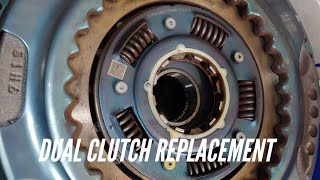
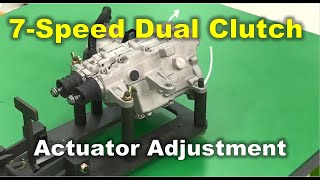
Helpful Videos

Technical Specifications
OEM Part Numbers: 43000-2D050 43000-2D055
Name: D7UF1; Type: 7-speed dry Dual-Clutch Transmission (DCT); Application: 2016-2018 Hyundai Tucson; Engine: 1.6L Turbo; Drivetrain: All-Wheel Drive (AWD); ID Codes: D7UF1, D7F34; Fluid Type: SAE 70W API GL-4 gear oil; Weight: Approx. 196 lbs; Dimensions: Approx. 32" x 24" x 22"
We Have This Part in Stock


The information in this article is provided for general reference and educational purposes only. Vehicle specifications, procedures, and part compatibility can vary by production date, trim level, and region. Always consult your vehicle's factory service manual and verify part numbers before purchasing or performing repairs. Safety-critical components such as airbags, seat belts, and braking systems should be installed by a qualified professional.
- Hyundai Tucson:
- 🎬 Helpful Videos
- 🛍️ Shop This Part
- Identification: Is This Your Transmission?
- How to Confirm Fitment
- Common Symptoms and Failure Points
- Diagnostic Flowchart
- Known Issues, Recalls, and Technical Service Bulletins (TSBs)
- NHTSA Recall 16V628000 (Hyundai Campaign 149)
- Hyundai TSB 21-AT-014H
- Hyundai TSB 19-AT-001 / 19-AT-002H
- Premature Clutch and Actuator Wear
- Replacement Cost
- What's Included in a Used Assembly?
- Typically Included:
- Typically Not Included:
- Installation and Programming: Critical Steps
- Mandatory Programming and Calibration
- Installation Gotchas
- What Fails at Every Mileage Band
- Under 60,000 Miles
- 60,000 - 100,000 Miles
- 100,000 - 150,000 Miles
- Real Owner Experiences
- Repair or Replace?
- When Repair Makes Sense
- When Replacement is Smarter
- Questions to Ask Your Installer
- Freight and Delivery Reality
- Frequently Asked Questions (FAQ)
- 🎟️ Get 5% Off