

2015-2019 Hyundai Sonata 2.4L A6MF2 Transmission: Problems, Identification, and Used Replacement
Identify what kills the 6-speed A6MF2 transaxle, when to rebuild, and how to buy and program a used OEM replacement unit.
- The 68-digit QR code on a replacement transmission must be photographed before installation and programmed into the TCM to prevent severe shifting problems.
- For most internal failures indicated by slipping or gear ratio error codes (P0731-P0736), a full replacement is more economical and reliable than a rebuild.
- This 'Gen2' A6MF2 transmission is electrically and logically incompatible with the earlier 'Gen1' 8-solenoid design and cannot be interchanged.
- Always use genuine Hyundai/Kia SP-IV or SP4-M fluid and thoroughly flush the transmission cooler lines during installation to prevent contamination of the replacement unit.
Identifying the Correct A6MF2 Transmission

The 2015-2019 Hyundai Sonata with a 2.4L engine uses a 6-speed automatic front-wheel-drive transaxle from the A6MF family, specifically the A6MF2 variant. A transaxle is a combination of a transmission and differential in one unit, common in front-wheel-drive vehicles. This transmission was designed for the torque output of the 2.4L Theta II GDI engine.
Vehicle and VIN Confirmation
Before purchasing a replacement, confirm your vehicle's details:
| Model Years | 2015, 2016, 2017, 2018, 2019 |
| Engine | 2.4L GDI (Gasoline Direct Injection). This transmission will not bolt to the 1.6L Turbo or 2.0L Turbo engines. |
| VIN | The 8th digit of your Vehicle Identification Number (VIN) should be 'F' or '7' (for the US market 2.4L Theta II GDI). |
| Drivetrain | The vehicle must be Front-Wheel Drive (FWD). This unit lacks mounting provisions or an output shaft for an All-Wheel Drive (AWD) transfer case. |
Transmission Codes and Markings
Look for identifying codes on the transmission case to ensure a match. These can be found on a metal tag or sticker on the case.
| Family Code | A6MF2 (specifically A6MF2-2) |
| Part Numbers | Look for OEM part numbers like 45000-3B790 or 45000-3B795. |
| Identification Codes | You may also see codes such as 'EA', 'FA', or 'KJ' stamped on the case or on a tag. |
Pro Tip: There is a critical 68-digit QR code sticker on the top of the transmission case. This sticker contains unique calibration data for the solenoids inside. Take a clear, high-resolution photo of this sticker on the replacement unit before installation, as it becomes buried and impossible to read once the transmission is in the vehicle.
🎬 Watch: Step-by-step Hyundai Sonata transmission replacement guideCritical Interchange Notes
Fitment is very specific for this transmission generation.
- Generation Incompatibility: This is a "Gen2" A6MF2 transmission, which uses a 7-solenoid direct-control valve body. It is electrically and logically completely incompatible with the earlier "Gen1" 8-solenoid design wiring harnesses and TCU logic. Do not attempt to use a Gen1 transmission in a Gen2 vehicle or vice-versa.
- Engine Specific: Cast specifically for the Theta II 2.4L GDI engine.
- Other Applications: While this guide focuses on the Sonata, the same core transmission can be found in other Hyundai and Kia models with the 2.4L engine, such as the 2016-2020 Kia Optima, 2016-2021 Hyundai Tucson, 2016-2021 Kia Sportage, and 2016-2018 Hyundai Santa Fe Sport. Always verify part numbers for an exact match.
Common Failure Symptoms

A failing A6MF2 transmission will typically show distinct symptoms. If you experience the following, the transmission may need to be replaced:
- Slipping and Flares: The engine RPMs surge or "flare" up between shifts (especially 3-4 or 4-3) without an increase in speed. This indicates internal clutches are not engaging correctly.
- Harsh or Delayed Shifts: The transmission may hesitate, then slam into gear, especially when cold or under load.
- Dashboard Warning Lights: The check engine light may illuminate, and the gear position indicator on the dash may start blinking.
- Stored Trouble Codes: A scan tool may reveal codes related to gear ratio errors (P0731 through P0736), incorrect gear ratio (P0730), or other transmission-specific faults like P0729 or P076F indicating internal clutch slippage. 🎬 Watch: Hyundai transmission slipping and hard shifting explained
- Inability to Shift: In some cases, a detached shift cable can prevent the transmission from going into the selected gear. 🎬 Watch: How to perform an A6MF2 transmission fluid change
Diagnostic Flowchart
Known Issues, Recalls, and Bulletins

Several documented issues affect this transmission family. Always check with a Hyundai dealer to see if any campaigns apply to your specific VIN.
- Internal Clutch Failure (TSB 24-AT-002H): Affecting 2015-2019 models, this severe issue involves internal slippage that can store multiple gear ratio error codes. The only remedy is a full transmission replacement.
- Solenoid Characterization (TSB TRA067 / TSB 19-AT-010H): For Gen2 transmissions (2015+), each transmission has unique solenoid hydraulic properties. If a replacement transmission is installed without programming these 68-digit QR code values into the Transmission Control Module (TCM) using a bidirectional scan tool, it will cause severe shift problems.
- Harsh/Delayed Shifts (TSB 18-AT-004): This bulletin addresses moderate shift quality issues on Gen2 transmissions. The fix involves a TCM adaptive value relearn procedure and GDS analysis for valve body bore wear or solenoid degradation.
- Shift Cable Detachment (NHTSA Recall 16V-574): This recall was for 2015-2016 models where the shift cable could detach from the shifter, preventing the transmission from shifting into the selected gear. The fix involves securing the cable connection.
- Community-Reported Issues: Owners and technicians have reported other common problems, including internal underdrive support bolts backing out over time (causing clutch drag and burnt clutches), premature wear in the aluminum valve body reducing valve bores (leading to pressure loss when hot), and cracked bellhousings from road impacts due to a low-sitting rear mount.
Replacement Cost Estimates
The cost to replace a 2015-2019 Sonata transmission varies by the type of part used. Shop labor estimates range from 6.0 to 8.0 hours, which typically costs between $800 and $1,600 depending on local labor rates.
| Part Type | Estimated Cost (Part Only) | Notes |
|---|---|---|
| New OEM | $3,800 - $5,792.45 | Brand new from a Hyundai dealer. One dealer quoted a list price of $5,792.45, with a sale price of $4,022.28. |
| Remanufactured OEM | $2,500 - $4,100 | Rebuilt to factory specifications with updated parts, often includes a warranty. |
| Used OEM | $235 - $1,300 | A salvaged unit from a donor vehicle. Mileage and condition vary. |
Warning: These prices are estimates and can change based on supplier, location, and availability. Always get a detailed quote before authorizing repairs.
What Fails at Every Mileage Band
Pro Tip: The mileage bands below describe what typically fails on used replacement units at that age. The checklists provided are critical steps to perform WHILE INSTALLING your purchased replacement transmission, not just general maintenance for your current vehicle.
Under 60,000 Miles
Transmissions in this bracket are generally healthy, but early failures do occur, often related to manufacturing defects or electronic issues.
- Shift Cable Detachment: A recall (NHTSA 16V-574) was issued for 2015-2016 models where the shift cable could detach.
- Harsh/Delayed Shifting: TSB 18-AT-004 addresses issues with harsh shifts or hesitation, often requiring a TCM software update or adaptive relearn.
- Internal Clutch Failure: Though less common at this mileage, TSB 24-AT-002H covers premature internal clutch failure leading to slipping and trouble codes.
- Failed Speed Sensors: Shifting problems accompanied by a Check Engine Light can sometimes be attributed to failed speed sensors.
- ✓Do during install (required): Verify all software-related TSBs and recalls have been performed on the vehicle.
- ✓Do during install (required): Perform a full flush of the transmission cooler and lines to remove any potential manufacturing debris or break-in material.
- ✓Cheap insurance while the engine is out: Replace axle seals and the torque converter (front pump) seal as a low-cost preventative measure.
60,000 to 100,000 Miles
This is the mileage range where more significant failures begin to appear, especially if the transmission fluid has never been changed.
- Transmission Slipping / Failure: Internal failures become more common. A 2015 Sonata at 72,000 miles experienced sudden high revs and failure to shift from 2nd to 3rd gear.
- Valve Body/Solenoid Issues: Wear in the valve body bores or solenoid degradation can lead to pressure drops (especially when hot), causing harsh shifts and hesitation.
- Torque Converter Lock-Up Issues: Problems with the torque converter clutch solenoid can cause shuddering or RPM fluctuations at highway speeds.
- ✓Do during install (required): Perform a drain and fill with new Hyundai SP-IV fluid. If the used transmission has over 75k miles, consider replacing the fluid warmer/cooler unit as it can trap debris.
- ✓Do during install (recommended): Replace the internal transmission filter. This filter is not normally serviceable without splitting the case, making a transmission swap the ideal time to do it.
- ✓Cheap insurance while the engine is out: Replace the engine's rear main seal. The transmission must be removed to access it, so replacing it during the swap is 'cheap insurance' against a future oil leak.
- ✓Cheap insurance while the engine is out: Replace transmission mounts if they show any signs of cracking or wear.
100,000 to 150,000+ Miles
At this stage, accumulated wear from fluid breakdown is the primary killer of the A6MF2.
- Internal Hard Part Failure: This is the most common mileage for catastrophic failure, including burnt clutches and underdrive support bolts backing out.
- Cracked Bellhousing: The low-sitting rear transmission mount can cause the bellhousing to crack upon impact with road obstacles over time.
- Input/Output Speed Sensor Failure: Sensor failure becomes more common with age and heat cycles, leading to erratic shifting and fault codes.
- ✓Do during install (required): All items from the 60-100k band are critical at this mileage (Rear main seal, internal filter, axle seals, mounts).
- ✓Do during install (recommended): Consider replacing the transmission fluid warmer/cooler unit as a precaution, as it's a primary point for debris from the old unit to get trapped and contaminate the replacement.
- ✓Cheap insurance while the engine is out: Carefully inspect the CV axles for torn boots or leaking grease and replace as needed, since they must be removed for the installation.
Real Owner Experiences
The following table highlights real-world failures reported by owners of vehicles equipped with this transmission family.
| Source | Mileage | What Happened | Cost |
|---|---|---|---|
| Hyundai Forums | <40 | Total transmission failure on a brand new car. The dealer was authorized by Hyundai to replace the entire transmission with a new one. Another owner in the same thread had the same P0741 code and also had the transmission replaced under warranty. | $0 under warranty |
| 15,000 | A user reported having a transmission problem at very low mileage, noting they feel it's a common issue with the brand. | N/A | |
| Car Talk Community | 25,000 | Dealer could not duplicate the issue, then claimed the shuddering was 'normal operation'. The owner noted this is for the 7-speed DCT, not the 6-speed A6MF2, but it highlights common diagnostic frustrations. | N/A |
| carcomplaints.com | 28,000 | Owner reported the transmission would not accelerate properly and would jerk. The dealer replaced the transmission under warranty. | $0 (Warranty) |
| 45,000 | A 2017 Sonata owner experienced a complete transmission failure while driving on the highway. The unit was replaced under warranty. | $0 (Warranty) | |
| CarKiller Forums | 72,000 | A 2015 Sonata SE suddenly began to rev high when shifting between 2nd and 3rd gear. The owner had never had any transmission service performed. This was diagnosed as a probable internal transmission failure requiring replacement. | Likely $0 under warranty |
| 95,000 | Owner reported transmission started slipping in August on a 2016 Sonata with 126k miles, but the issue began around the 95k mark. | Not specified | |
| 126,000 | Owner of a 2016 Sonata reported the transmission began slipping. | Not specified | |
| 158,000 | A 2011 Sonata (with the same A6MF family transmission) experienced RPMs jumping and a feeling of a slipping transmission, particularly when warm. | Owner was considering replacing the vehicle rather than repairing it. | |
| 180,000 | Owner of a 2006 Elantra with a similar 6-speed automatic sold it for scrap after the transmission started slipping, noting they had neglected fluid changes. | N/A (scrapped vehicle) |
Repair or Replace?
When facing transmission trouble, deciding whether to repair the existing unit or replace it entirely is crucial.
When Repair Makes Sense
- Shift Cable Detachment: This is always a repair. The transmission itself is not faulty, only the linkage. The recall (16V-574) applies to 2015-2016 models and is a $0 fix if applicable, otherwise it costs roughly $150-$300.
- Minor Fluid Leaks: Leaks from the pan gasket or axle seals typically cost $150 - $400 to fix (a leak inspection alone is about $61-$90). Always repair these routine maintenance issues.
- Worn Valve Body: If the vehicle has lower mileage and the rest of the transmission is in good condition, replacing a worn valve body makes sense. A remanufactured valve body costs $300 - $600, plus 3-5 hours of labor ($400-$800), totaling $700 - $1,400.
When Replacement is Smarter
Pro Tip: Replacement is the recommended course of action for most internal failures, especially those related to slipping clutches or gear ratio error codes (P0731-P0736). Hyundai's own policy under warranty for many internal issues is to replace the entire unit rather than attempting a rebuild. Given the relatively low cost of a used unit, replacement is often more economical and reliable than a costly and time-consuming internal rebuild.
Replacement is the recommended course of action for most internal failures, especially those related to slipping clutches, gear ratio error codes (P0731-P0736), or significant metal debris found in the transmission fluid. Hyundai's own policy under warranty for many internal issues is to replace the entire unit rather than attempting a rebuild. Given the relatively low cost of a used unit (often ranging from $235 to $1,300), replacement is often more economical and reliable than a costly and time-consuming internal rebuild, which can quickly exceed the price of a replacement.
Questions to Ask Your Installer
Before handing over your vehicle, ask your mechanic these specific questions:
- Do you have a bidirectional scan tool capable of performing the 'Hyundai Oil Pressure Characteristics Input' to program the new transmission's QR code values?
- Will you be taking a clear photo of the QR code sticker on the top of the replacement transmission BEFORE you install it?
- What is your procedure for flushing the transmission cooler and lines to prevent debris from contaminating the replacement unit?
- Are you using genuine Hyundai/Kia SP-IV or SP4-M automatic transmission fluid?
- Will you be performing a TCM adaptive value reset after the installation?
- Does your quote include replacing the axle seals and the front pump seal (torque converter seal)?
- How will you verify the torque converter is fully seated before mating the transmission to the engine?
Installation and Programming

Key Installation Steps & Gotchas
Replacing this transmission is a job for advanced DIYers or professional technicians. The DIY difficulty is rated as Advanced to Expert. Several critical steps must be followed to avoid immediate damage to the replacement unit.
Warning: The 68-digit solenoid calibration code from the QR sticker must be programmed into the vehicle's computer (TCM) using a compatible bidirectional scan tool. This is the most common and costly mistake. Skipping this step will cause immediate and severe shifting problems, slipping, and a blinking dashboard gear indicator.
- QR Code Programming: This is the most common and costly mistake. The 68-digit solenoid calibration code from the QR sticker must be programmed into the vehicle's computer (TCM) using a compatible bidirectional scan tool (like an Autel MaxiSys, Launch, or OEM Hyundai GDS). Skipping this step will cause immediate and severe shifting problems, slipping, and a blinking dashboard gear indicator.
- Torque Converter Seating: The torque converter must be fully seated into the transmission's front pump before installation. You should feel it drop into place three distinct times and sit recessed about 1cm. Failure to do this will shatter the front pump gears when the engine and transmission are bolted together.
- Flush Cooler Lines: Debris from the old, failed transmission can get trapped in the external transmission cooler and lines. These must be thoroughly flushed with transmission cooler-line flush solvent before connecting them to the new unit to prevent contamination.
- Use Correct Fluid: This transmission requires Hyundai Genuine ATF SP-IV or SP4-M fluid. Using generic multi-vehicle ATF or older SP-III fluid can cause poor shift quality and long-term damage.
- Reset Adaptives: After installation and programming, the TCM's adaptive learning values must be reset. This clears the old data learned from the worn-out transmission and allows the computer to adapt to the new one.
- Fluid Level Check: The fluid level check must be performed with the engine running in Park, the vehicle perfectly level, and the fluid temperature strictly between 122°F and 140°F (50°C to 60°C). Checking the fluid level with the engine off results in severe underfilling.
Required Parts and Tools
- Specialty Tools: An engine support bar, transmission jack or subframe jack, axle popper tool or heavy-duty pry bars, and a professional-grade bidirectional scan tool are required.
- Required Consumables: Always install a new torque converter seal (front pump/input shaft seal), replacement axle seals, and the correct volume of SP-IV ATF.
Freight & Delivery Reality

If you are purchasing a used A6MF2 transmission online, it is critical to understand how it will arrive. This is a heavy industrial component, not a standard parcel.
- Size and Weight: The bare transmission assembly weighs approximately 210 lbs and measures roughly 30" x 28" x 26" before crating.
- Shipping Method: It will ship as LTL (Less Than Truckload) freight strapped to a wooden pallet. It will arrive on a large semi-truck.
- Delivery Requirements: If you are having it delivered to a residential address, you must request a truck with a liftgate to lower the pallet to the ground.
- Inspection: Always inspect the transmission for physical damage (like a cracked bellhousing or broken sensors) before signing the driver's delivery receipt.
- Pre-Purchase Verification: A reputable supplier will conduct a pre-purchase verification interview. They will ask you to confirm your vehicle is a 2015-2019 Sonata 2.4L, verify the 8th digit of the VIN is 'F' or '7', confirm it is FWD, and ensure your installing mechanic has the scan tool capable of performing the Hyundai Oil Pressure Characteristics Input.
Frequently Asked Questions (FAQ)
Do I absolutely have to program the replacement transmission?
Yes. The QR code programming is not optional for the Gen2 A6MF2 transmission. Each unit's solenoids have slightly different flow rates, and the vehicle's computer must have this exact 68-digit data to control shift pressures correctly. Failure to program it will result in harsh shifts, slipping, and fault codes.
What fluid should I use for a 2017 Sonata 2.4L transmission?
You must use an approved Hyundai Genuine ATF SP-IV or SP4-M automatic transmission fluid. Do not use older SP-III fluid or universal/multi-vehicle fluids, as they are not compatible and can cause damage.
Can I use a transmission from a Sonata 2.0L Turbo?
No. The transmission used with the 2.0L Turbo engine has a different bellhousing pattern and is not interchangeable with the 2.4L unit.
What is a "valve body"?
The valve body is the hydraulic control center of the transmission. It is a complex maze of passages and valves that directs high-pressure fluid to engage the clutches and bands that change gears. The electronic solenoids that control it are mounted directly to it.
What is included when I buy a used transmission assembly?
According to standard auto recycler guidelines, a used assembly includes the transmission case, extension/bellhousing, all internally lubricated parts (gears, shafts, clutches, bands, internal oil pump), the torque converter, the transmission oil pan, and the internal valve body and solenoids. It does not include external sensors, the TCM, shifter assembly, linkage, shift cables, engine flexplate, external cooler lines, the transmission fluid warmer/cooler unit, or the fluid itself.
How long does the A6MF2 transmission typically last?
With proper maintenance, the expected service life for the A6MF2 transmission is generally between 150,000 and 200,000 miles. The single most critical factor for longevity is regular transmission fluid changes. While official schedules may suggest 60,000 miles, mechanics strongly recommend a simple drain-and-fill every 30,000 to 40,000 miles to prevent premature failure.
Helpful Videos


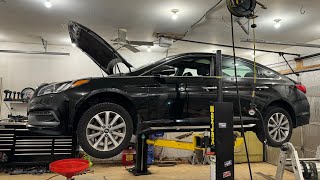
Technical Specifications
OEM Part Numbers: 45000-3B790 45000-3B795
Transmission Family: A6MF; Transmission Variant: A6MF2 (A6MF2-2); Generation: Gen2; Control System: 7-solenoid direct-control valve body; Application Years: 2015-2019; Application Model: Hyundai Sonata; Engine: 2.4L Theta II GDI; Drivetrain: Front-Wheel Drive (FWD); VIN 8th Digit (US): F or 7; Identification Codes: EA, FA, KJ; Required Fluid: Hyundai Genuine ATF SP-IV or SP4-M
We Have This Part in Stock


The information in this article is provided for general reference and educational purposes only. Vehicle specifications, procedures, and part compatibility can vary by production date, trim level, and region. Always consult your vehicle's factory service manual and verify part numbers before purchasing or performing repairs. Safety-critical components such as airbags, seat belts, and braking systems should be installed by a qualified professional.
- Hyundai Sonata:
- 🎬 Helpful Videos
- 🛍️ Shop This Part
- Identifying the Correct A6MF2 Transmission
- Vehicle and VIN Confirmation
- Transmission Codes and Markings
- Critical Interchange Notes
- Common Failure Symptoms
- Diagnostic Flowchart
- Known Issues, Recalls, and Bulletins
- Replacement Cost Estimates
- What Fails at Every Mileage Band
- Under 60,000 Miles
- 60,000 to 100,000 Miles
- 100,000 to 150,000+ Miles
- Real Owner Experiences
- Repair or Replace?
- When Repair Makes Sense
- When Replacement is Smarter
- Questions to Ask Your Installer
- Installation and Programming
- Key Installation Steps & Gotchas
- Required Parts and Tools
- Freight & Delivery Reality
- Frequently Asked Questions (FAQ)
- 🎟️ Get 5% Off