

Mazda CX-3, CX-5 & CX-9 AWD Control Module Failure (2016-2018): Diagnosis and Programming
Diagnose the 'AWD Malfunction' warning light and understand the critical programming steps required when replacing the All-Wheel Drive control module.
- This is NOT a plug-and-play part. A replacement module must be programmed ('configured') to the vehicle using a Mazda-specific or advanced professional scan tool.
- The module is shared between the 2016-17 CX-5, 2016-17 CX-9, and 2016-18 CX-3, but its physical location differs (passenger side for CX-5/CX-3, driver side for CX-9).
- A related major issue is a cracked rear differential housing (Mazda TSB SA-047/20). For the CX-5 and CX-9, this repair may also require replacing the AWD control module.
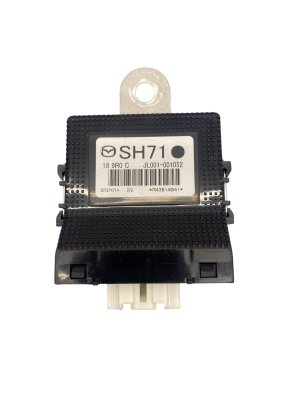
- When buying used, get the latest part number revision possible. The newest part number is PE1B-18-9R0W, which replaces all earlier versions.
Symptoms of a Failing AWD Control Module

When the AWD Control Module fails, the vehicle's primary symptom is the deactivation of the all-wheel drive system. The vehicle will still be drivable, but will operate in front-wheel drive (FWD) only, losing its all-weather and performance traction advantages.
- "AWD Malfunction" Warning Light: The most common symptom is an "AWD Malfunction" message or a similar warning light appearing on the instrument cluster. The system will set a fault code and disable itself as a precaution.
- AWD System Disabled: The vehicle will revert to FWD mode. You may notice a lack of traction when accelerating from a stop in wet, snowy, or loose-gravel conditions.
- Diagnostic Trouble Codes (DTCs): A scan tool is required to read the specific codes. A failing module will often store communication codes (U-codes) or internal error codes (P-codes).
- Communication Codes: Look for codes like U0073 (Control Module Communication Bus Off) or other U-codes that indicate a loss of communication with the AWD module.
- Internal Fault Codes: Codes such as P0601 (Internal Control Module Memory Check Sum Error), P0602 (Control Module Programming Error), or P0606 (ECM/PCM Processor Fault) point directly to an internal failure of the module itself.
Pro Tip: Before condemning the module, check the vehicle's battery and charging system. Low voltage can cause communication errors between modules, mimicking a module failure. Also, inspect the wiring harness and connectors for corrosion or damage, especially the connectors near the rear differential which are exposed to the elements.
Known Issues, TSBs, and Recalls

Service Alert: Cracked Rear Differential Housing
A significant related issue is documented in Mazda Service Alert SA-047/20 (later updated by SA-007/23). This alert applies to 2017-2020 CX-3, CX-5, and CX-9 models. A bearing inside the AWD coupling on the rear differential can seize, causing the pinion shaft to contact and crack the differential case, leading to a major fluid leak and failure of the AWD system.
Crucially, for the 2016-2017 Mazda CX-5 and CX-9, the service procedure requires inspecting the part number on the AWD Control Module and potentially replacing it along with the failed rear differential. This indicates that a mechanical failure in the differential can damage or be linked to older versions of the control module. The CX-3 does not require module replacement for this specific repair.
Recalls
There are no specific recalls for the AWD Control Module on these vehicles. Other recalls for this period, such as for fuel pumps or rearview cameras, are not related to the AWD control module.
Replacement and Programming Requirements

Warning: This is NOT a plug-and-play part. A replacement AWD Control Module must be programmed to the vehicle for the AWD system to function. Failure to perform this procedure will result in the system remaining inoperative and fault codes being stored.
Module Location
The physical location of the module varies by vehicle, which affects the labor involved in replacement:
- 2016-2017 Mazda CX-5: Located on the passenger side, behind the plastic kick panel near the floor.
- 2016-2017 Mazda CX-9: Located on the driver's side, behind the knee bolster panel below the steering column.
- 2016-2018 Mazda CX-3: Located inside the cabin, typically on the passenger side behind the kick panel, similar to the CX-5.
Programming Procedure (Configuration)
Mazda refers to the programming process as "configuration." The correct procedure is critical for a successful repair.
- Connect a diagnostic tool: A Mazda M-MDS tool or a high-level aftermarket scanner (like Autel) with "Programmable Module Installation" (PMI) capabilities is required.
- Read data from the OLD module: Before removing the faulty module, the technician must use the scan tool to read the "coupling component calibration data" and store it in the scan tool.
- Install the new module: Swap the physical hardware.
- Write data to the NEW module: The technician then uses the scan tool to write the saved calibration data to the newly installed module.
If the old module is completely dead and its data cannot be read, a procedure called "Coupling Calibration Data Writing" must be performed, which may involve manually inputting a characteristic value found on the AWD coupling itself. This process can be performed by a Mazda dealer or a well-equipped independent repair shop. It is not feasible for a typical DIY mechanic without the proper diagnostic equipment.
Buying a Used Transfer Case Control Module
A used OEM module is an excellent, cost-effective alternative to a new part, as no reliable aftermarket versions are available. However, you must verify compatibility and inspect the part carefully.
Part Number Compatibility and Supersession
Mazda has updated this part several times. The part numbers are sequential, with later letters in the alphabet indicating newer revisions. The original part numbers you may find are PE1B189R0M, PE1B189R0N, PE1B189R0P, PE1B189R0R, and PE1B189R0S. These have all been superseded by newer versions.
The latest part number is PE1B-18-9R0W. When buying used, try to find the newest revision possible (e.g., an 'S' or 'T' is better than an 'M'). A part with a later letter is a direct, improved replacement for any earlier version. Always match the base number (PE1B-18-9R0) and ensure the seller guarantees the part is for a CX-3, CX-5, or CX-9 from the correct year range.
Physical Inspection
- Check the Connectors: The pins in the electrical connector should be straight, clean, and free of any green or white corrosion. Corrosion is a sign of water intrusion and a primary cause of failure.
- Inspect the Case: Look for any cracks, heat discoloration, or signs that the case has been pried open.
- Source Vehicle: Avoid parts from flood-damaged or heavily wrecked vehicles, as hidden damage is common.
| Part Type | Estimated Cost |
|---|---|
| New OEM (Dealer) | $160 - $230 |
| Used OEM (Recycled) | $40 - $120 |
| New Aftermarket | Not Available |
| Remanufactured | Not Available |
| Shop Labor (Replacement & Programming) | $150 - $300 |
Frequently Asked Questions (FAQ)
Do I absolutely have to program a replacement AWD module?
Yes. The module is programmed with specific calibration data for the AWD coupling in your exact vehicle. Without this programming, the system will not work, and the "AWD Malfunction" light will stay on.
Can I replace the module myself and drive it to a shop for programming?
Yes. Physically swapping the module is possible for a DIYer with basic skills. The vehicle will be safe to drive in front-wheel-drive mode to a dealer or independent shop that has the necessary tools to perform the module configuration.
Is a faulty AWD module related to the cracked rear differential issue?
They are related. A Mazda service alert indicates that when the rear differential fails due to a seized coupling bearing, the AWD control module in the CX-5 and CX-9 should also be inspected and possibly replaced. This suggests a link between the mechanical failure and the electronics, making it important to diagnose the entire system.
Will a module from a CX-5 work in a CX-9 or CX-3?
Yes, as long as the part number is correct. These three vehicles share the same AWD control module part numbers for the specified model years. Always confirm the part number supersession list to ensure compatibility.
Technical Specifications
OEM Part Numbers: PE1B189R0M PE1B189R0N PE1B189R0P PE1B189R0R PE1B189R0S PE1B189R0T PE1B189R0U PE1B189R0V PE1B189R0W
Controls the i-Activ All-Wheel Drive system via CAN bus communication. Requires vehicle-specific calibration data to be programmed upon installation.
We Have This Part in Stock



The information in this article is provided for general reference and educational purposes only. Vehicle specifications, procedures, and part compatibility can vary by production date, trim level, and region. Always consult your vehicle's factory service manual and verify part numbers before purchasing or performing repairs. Safety-critical components such as airbags, seat belts, and braking systems should be installed by a qualified professional.
- Mazda CX-5:
- Mazda CX-9:
- Mazda CX-3:
- 🛍️ Shop This Part
- Symptoms of a Failing AWD Control Module
- Known Issues, TSBs, and Recalls
- Service Alert: Cracked Rear Differential Housing
- Recalls
- Replacement and Programming Requirements
- Module Location
- Programming Procedure (Configuration)
- Buying a Used Transfer Case Control Module
- Part Number Compatibility and Supersession
- Physical Inspection
- Frequently Asked Questions (FAQ)
- 🎟️ Get 5% Off