

2008-2017 Honda Odyssey Front Struts: Clunks, Squeaks, and Replacement Guide
This guide covers common failure symptoms, recalls, technical service bulletins, and replacement costs for front suspension struts on third and fourth-generation Honda Odyssey minivans.
- The 2008-2010 (3rd Gen) and 2011-2017 (4th Gen) Odyssey use different, non-interchangeable front struts.
- Clunking over bumps is the most common failure symptom, often addressed by TSBs for replacing bump stops in 2012-2016 models.
- When buying used, the most critical inspection is checking for any fluid leaks on the strut body; a leaking strut is failed.
- Always replace struts in pairs and get a wheel alignment immediately after installation to prevent unsafe handling and tire wear.
Generational Differences: 2008-2010 vs. 2011-2017

The 2008-2017 Honda Odyssey spans two distinct generations, and it's crucial to identify which one you have before purchasing parts. The front strut assemblies are not interchangeable between these generations.
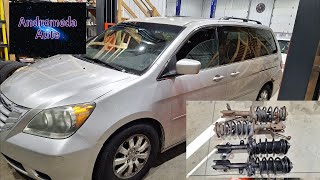
- Third Generation (2008-2010): These models use a different strut design compared to the later generation. When searching for parts, ensure they are specifically listed for these model years. 🎬 Watch: 2008-2010 Odyssey front strut replacement walkthrough
- Fourth Generation (2011-2017): Honda introduced a new chassis and suspension design for this generation. These struts are unique to 2011-2017 models.
Symptoms of Failing Front Struts


Worn or failing struts can compromise your vehicle's safety and comfort. Here are the most common signs that your Odyssey's front struts may need replacement:
1. Unusual Noises
Clunking or Knocking: This is one of the most reported symptoms. A deep clunking or knocking sound when driving over bumps, potholes, or uneven pavement often points to worn strut components. This can be caused by internal wear in the shock absorber or a failing strut mount.
Squeaking or Creaking: A squeaking or creaking noise, especially when turning the steering wheel at low speeds or going over bumps, can indicate a problem with the strut mount or the coil spring shifting. Some owners have also reported a "boing" sound from the spring itself after replacement with aftermarket units.
2. Poor Ride Quality and Handling
Bouncy Ride: If your Odyssey continues to bounce up and down after hitting a bump, the internal shock absorbers within the struts are likely worn out and no longer damping suspension movement effectively. A simple test is to push down firmly on a front corner of the van; if it bounces more than once or twice, the struts are weak.
Nose-Diving and Squatting: When the front struts are worn, the front end of the minivan may dip or "dive" excessively during braking. Conversely, the rear end may squat during acceleration as the worn front struts fail to manage the weight transfer.
Body Roll or Swaying: A feeling of instability or excessive leaning (body roll) when turning or changing lanes is a common symptom. The vehicle may feel less controlled and wander on the highway.
3. Visual Indicators
Fluid Leaks: The shock absorber portion of the strut is filled with hydraulic fluid. If you see oily or wet patches on the body of the strut, it means a seal has failed and the fluid has leaked out, rendering the strut ineffective.
Uneven Tire Wear: Worn struts can cause the tires to bounce slightly as you drive, leading to a distinctive wear pattern called "cupping" or "scalloping," where patches of rubber are gouged out from the tread.
Known Issues, TSBs, and Recalls

While there have been no direct safety recalls for the front struts themselves on 2008-2017 Odysseys, Honda has issued several Technical Service Bulletins (TSBs) related to front suspension noises.
Technical Service Bulletins (TSBs)
- TSB 14-016: Affects 2012-2014 Odyssey models. The symptom is a pop or clunk from the front end when driving over bumps in cold, below-freezing weather. The cause is identified as loose front bump stops moving inside the top mounting cap. The fix is to replace both front bump stops with an updated part (P/N 51722-TK8-A21).
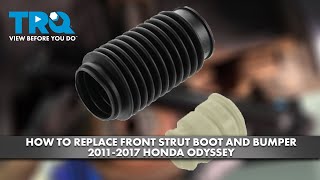
- TSB 16-050: Affects 2015-2016 Odyssey models. The symptom is a squeak from the front suspension when going over bumps. This is caused by damper oil contaminating the rubber bump stop. The corrective action is to replace both front rubber bump stops. 🎬 See how to replace the front strut boot and bumper
Pro Tip: If your Odyssey exhibits a clunking or squeaking noise matching these TSB descriptions, inspect the bump stops. Even if you are replacing the entire strut assembly, it's good to be aware of this known failure point.
Recalls
There are no NHTSA recalls specifically for the front suspension struts on these Odyssey models. Other recalls exist for issues like second-row seats and fuel pumps, but they are unrelated to the struts.
Buying a Used Suspension Strut

Purchasing a used OEM (Original Equipment Manufacturer) strut can be a cost-effective alternative to new parts, often providing better quality than cheap aftermarket options. However, careful inspection is key.
What to Inspect
- Check for Leaks: This is the most critical check. Thoroughly inspect the main body of the strut. There should be no signs of oil residue. A leaking strut has lost its damping ability and is no longer functional.
- Examine the Coil Spring: Look for heavy rust, cracks, or breaks in the coil spring. A broken spring is a major safety hazard. Surface rust is common, but deep, flaking rust is a red flag.
- Inspect the Upper Mount: Check the rubber in the upper strut mount for cracks, separation, or deterioration. A worn mount can cause clunking noises and alignment issues.
- Check for Physical Damage: Look for any bends or significant dents in the strut body or mounting brackets. Any damage from a previous accident can compromise the part's integrity and fit.
- Consider Mileage: Struts are wear-and-tear items. While there's no exact lifespan, most original struts show significant wear after 50,000 miles. Try to source a used strut from a lower-mileage vehicle if possible. A part from a vehicle with over 100,000 miles may not have much service life left.
Compatibility
Always verify the part is from the correct generation of Odyssey. A strut from a 2010 model will not fit a 2011 model. Match OEM part numbers whenever possible to ensure you are getting the correct component for your vehicle's specific trim and year.
Replacement and Installation
Replacing front struts is a job that can be done by an experienced DIY mechanic, but it requires proper tools and safety precautions. If you are not comfortable working with suspension components, it is best to have a professional perform the installation.
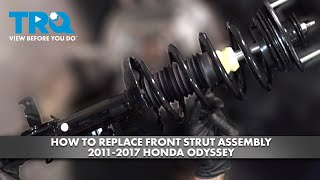
🎬 Watch: Step-by-step 2011-2017 Odyssey front strut installation guideRelated Parts to Replace
It is highly recommended to replace struts in pairs (both front struts at the same time) to ensure balanced handling and performance. Additionally, consider replacing these related components at the same time:
- Sway Bar End Links: These often get worn or damaged during strut replacement and are a common source of clunking noises.
- Strut Mounts and Bearings: If you are not buying a complete "quick strut" assembly, replacing the strut mount and bearing is crucial. These parts are essential for smooth steering and preventing noise.
Torque Specifications
Using a torque wrench is critical for suspension work. Incorrect torque values can lead to noise, premature wear, or catastrophic failure. Always consult a repair manual for your specific year, but here are some common torque specs:
| Fastener | Torque Spec (2011-2017) | Torque Spec (2008-2010) |
|---|---|---|
| Upper Strut-to-Body Nuts | 44 ft-lbs (with damper flange) | 51 ft-lbs |
| Lower Strut-to-Knuckle Bolts | 129 ft-lbs | 116 ft-lbs |
| Sway Bar Link Nuts | Varies by part | 58 ft-lbs |
| Wheel Lug Nuts | 94 ft-lbs | 95 ft-lbs |
Warning: Never use an impact wrench to tighten the center strut shaft nut. This can damage the internal seals. Hold the shaft with a hex wrench and tighten the nut to specification.
Cost Comparison
The cost of replacing front struts can vary significantly based on the parts you choose and whether you do the work yourself.
| Part/Service | Estimated Cost (Per Pair) |
|---|---|
| New OEM (Honda) | $650 - $800 |
| New Aftermarket (Complete Assembly) | $250 - $500 |
| Used OEM | $100 - $250 |
| Shop Labor | $405 - $594 |
| Total Professional Installation (New Aftermarket) | $655 - $1,094 |
| Total Professional Installation (New OEM) | $1,055 - $1,394 |
Frequently Asked Questions
Do I need a wheel alignment after replacing the front struts?
Yes, absolutely. The front struts are a key part of the suspension geometry. Replacing them will alter the camber and toe angles. A professional wheel alignment is required after replacement to ensure proper handling, prevent tire wear, and maintain safety.
What is a 'quick strut' or 'loaded strut' assembly?
A 'quick strut' or 'loaded strut' is a complete, pre-assembled unit that includes the strut, coil spring, upper mount, and boot. This is the safest and easiest option for DIY replacement because it eliminates the need for a dangerous spring compressor tool to swap the old spring onto the new strut.
Can I replace just one strut?
It is strongly advised against. Struts should always be replaced in pairs on the same axle (both front or both rear). A new strut will have different damping characteristics than the old, worn strut on the other side, which can cause unpredictable handling and instability, especially in an emergency maneuver.
Why do my new aftermarket struts make noise?
Some owners report a "boing" or binding noise from new aftermarket quick struts. This can sometimes be caused by the spring not being properly seated in the upper or lower perches. It can also be an issue with the quality of the upper strut mount bearing. If the noise persists, it may indicate a defective part.
Helpful Videos

Technical Specifications
OEM Part Numbers: 51601-SHJ-A04 51602-SHJ-L01 51605-TK8-A03 51606-TK8-A03 51606-TK8-A04 51621-THR-A02 51621-THR-A92 51722-TK8-A21 51726-TK8-A51
Uses a MacPherson strut front suspension design. Torque specs are critical for proper installation and safety.
We Have This Part in Stock



The information in this article is provided for general reference and educational purposes only. Vehicle specifications, procedures, and part compatibility can vary by production date, trim level, and region. Always consult your vehicle's factory service manual and verify part numbers before purchasing or performing repairs. Safety-critical components such as airbags, seat belts, and braking systems should be installed by a qualified professional.
- Honda Odyssey:
- 🎬 Helpful Videos
- 🛍️ Shop This Part
- Generational Differences: 2008-2010 vs. 2011-2017
- Symptoms of Failing Front Struts
- 1. Unusual Noises
- 2. Poor Ride Quality and Handling
- 3. Visual Indicators
- Known Issues, TSBs, and Recalls
- Technical Service Bulletins (TSBs)
- Recalls
- Buying a Used Suspension Strut
- What to Inspect
- Compatibility
- Replacement and Installation
- Related Parts to Replace
- Torque Specifications
- Cost Comparison
- Frequently Asked Questions
- 🎟️ Get 5% Off