

2012-2026 Tesla Model S & Model X Control Arm Failure: Decoding the Clunks and Squeaks
This guide covers common failure symptoms, replacement costs, and crucial compatibility differences for the front suspension control arms on all 2012-2026 Tesla Model S and 2016-2026 Tesla Model X vehicles.
- A clunking or knocking sound over bumps is the most common sign of a failing control arm on a Model S or Model X.
- There is a critical compatibility difference between control arms for pre-2021 models and the 2021+ 'Refreshed' models; they are not interchangeable.
- A full four-wheel alignment is mandatory after replacing any control arm to prevent dangerous handling and rapid tire wear.
- When buying a used control arm, carefully inspect the rubber bushings for cracks and the ball joint for any looseness or play.
Known Issues, Service Bulletins, and Investigations

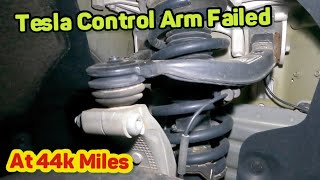
The front suspension on early Model S and Model X vehicles has been a known point of concern. In November 2020, the National Highway Traffic Safety Administration (NHTSA) opened an investigation into front suspension fore link failures on 2015-2017 Model S and 2016-2017 Model X vehicles. The investigation identified hundreds of instances of these links failing, though most occurred at low speeds, such as during parking maneuvers, without leading to a loss of vehicle control. While the investigation was closed without a formal recall, NHTSA noted that Tesla had previously issued a service bulletin in 2017 (SB-17-31-001) to replace the fore links on some vehicles and recommended that Tesla expand this program.
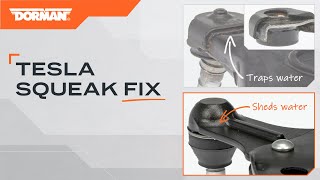
Another service bulletin, SB-20-31-006, addresses a creaking sound from the front upper control arm ball joints on certain Model X, Model 3, and Model Y vehicles. The bulletin states that water can get into the ball joint, causing surface corrosion and noise. The prescribed fix is to reseal the area around the ball joints to prevent water entry, and it is classified as a noise, vibration, and harshness (NVH) issue, not a premature failure.
🎬 Watch: How to fix a creaky, corroded Tesla control armSymptoms of a Failing Control Arm

Because Teslas are so quiet without an internal combustion engine, suspension noises are much more noticeable. A failing control arm will almost always provide audible or physical warnings.
Clunking, Knocking, or Popping Noises
This is the most common symptom. You may hear a distinct 'clunk' or 'knock' from the front of the vehicle, especially when driving over bumps, speed bumps, or uneven pavement at low speeds. 🎬 Watch: Hear what a failing front suspension clunk sounds like The noise is caused by excessive play in a worn ball joint or bushing, which allows for metal-on-metal contact as the suspension moves.
Squeaking or Creaking Sounds
A sound like a creaky door or an old wooden ship, often heard when turning the steering wheel or going over speed bumps, typically points to worn or dried-out rubber bushings or a corroded ball joint.
Steering and Handling Issues
- Steering Wheel Vibration: A shimmy or vibration felt in the steering wheel, which may get worse with speed, can be caused by a worn control arm ball joint.
- Wandering or Loose Steering: The vehicle may feel less responsive or 'loose,' requiring constant small corrections to keep it driving straight. This indicates that a worn component is allowing the wheel alignment to shift during driving.
- Pulling to One Side: A bad control arm can cause the vehicle to pull to the left or right, as the worn components are unable to hold the wheel in the correct alignment.
Uneven Tire Wear
A worn control arm allows for unwanted movement in the suspension, which changes the wheel alignment dynamically. This often leads to accelerated wear on the inner or outer edges of the front tires, a classic sign of an alignment problem rooted in a failing suspension part.
Compatibility Warning: Tesla updated the front suspension design for the Model S and Model X in 2021 with the 'Refreshed' or 'Palladium' generation. Control arms for 2012-2020 models are generally not compatible with 2021 and newer vehicles. Always verify the part number and production date of your vehicle before ordering.
Buying a Used Suspension Control Arm

A used OEM control arm from a low-mileage vehicle can be an excellent value, offering the same fit and quality as a new part. However, a thorough inspection is crucial.
- Inspect the Bushings: The rubber bushings where the arm mounts to the subframe should be intact. Look for any signs of cracking, tearing, or separation of the rubber from the metal sleeve. Degraded bushings are a primary cause of failure.
- Check the Ball Joint: The ball joint is the pivot point that connects to the wheel knuckle. Try to move the ball joint stud by hand. There should be no looseness or 'play.' The rubber boot covering the ball joint must be free of rips or tears. A torn boot allows grease to escape and contaminants to enter, causing rapid wear.
- Examine the Arm Itself: Check the metal body of the control arm for any cracks, heavy corrosion, or signs of being bent from an accident. Pay close attention to the areas around the welds and mounting points.
- Verify Part Numbers: Double-check that the part number on the used arm matches the required part for your vehicle's year, model, and specific position (e.g., front left lower forward vs. front right upper).
Replacement Overview and Special Considerations

Replacing a control arm is a job for an experienced DIY mechanic or a professional shop. It requires safely lifting and supporting the vehicle and having the correct tools.
Related Parts
It is highly recommended to replace control arms in pairs (left and right) to ensure balanced handling and suspension performance. While you are working on the suspension, it is a good time to inspect other nearby components like the sway bar links, tie rod ends, and the other control arms/links for wear.
Mandatory Wheel Alignment
After replacing any control arm, a full four-wheel alignment is not optional—it is mandatory. Failure to get an alignment will result in poor handling, unsafe driving characteristics, and rapid, uneven tire wear.
Torque Specifications
Following proper torque specifications is critical for safety and performance. Some bolts must be tightened to their final torque value only when the vehicle's full weight is on the suspension (at normal ride height). Failure to do this can preload the rubber bushings, causing them to fail prematurely.
| Fastener Description | Torque Value (Model S/X) |
|---|---|
| Upper control arm ball joint to knuckle | 60 Nm (44.2 lb-ft) |
| Upper control arm to vehicle body (x2 bolts) | 68 Nm (50.1 lb-ft) |
| Lower control arm (fore and aft links) to subframe | 130 Nm (95.9 lb-ft) |
| Lower control arm (fore link) ball joint to knuckle | 180 Nm (132.7 lb-ft) or 195 Nm (144 lb-ft) |
| Lower control arm (aft link) ball joint to knuckle | 180 Nm (132.7 lb-ft) |
Pro Tip: On some models, the pinch bolt for the front upper control arm can seize inside the steering knuckle, especially in areas with road salt. Applying penetrating oil beforehand and using heat if necessary can aid in removal.
Cost Comparison
The cost to replace a Tesla control arm can vary significantly based on the specific part, vehicle model, and labor rates. Owners have reported total repair costs ranging from approximately $1,000 to over $3,000 for replacing control arms at a service center or independent shop.
| Item | Estimated Cost |
|---|---|
| New OEM (Tesla Service) | $1100+ (Parts for a pair) |
| New Aftermarket | $150 - $350 (Per arm/link) |
| Used OEM | $90 - $250 (Per arm/link) |
| Shop Labor | $500 - $800 (For a pair) |
OEM Part Numbers
This list includes known OEM part numbers for various front control arms and links that fit the Model S and Model X. Part numbers are frequently superseded, so always verify compatibility with your vehicle's VIN. The final letter in the part number often indicates a revision.
- Front Lower Forward Link (Fore Link): 6007998-00-C, 1041570-00-A, 1041570-00-B, 1420341-00-B, 1420341-00-C, 1620341-00-A, 1620341-00-B
- Other Known Numbers: 1027322-00-F, 1027322-00-G, 1027327-00-B, 1027327-00-C, 1027327-00-D, 1027327-00-E, 1027327-00-F, 1027351-00-C, 1048951-00-C, 1420346-00-C, 1421321-00-B
Frequently Asked Questions (FAQ)
Do I have to replace both the left and right control arms at the same time?
It is strongly recommended. Control arms wear at similar rates. Replacing only one can result in uneven handling, unpredictable steering, and the other side failing soon after. Replacing them in pairs ensures the suspension is balanced.
Is a wheel alignment really necessary after replacing a control arm?
Yes, it is absolutely essential. Replacing a control arm will change the vehicle's wheel alignment settings (camber, caster, and toe). Driving without an alignment will cause severe and rapid tire wear, poor handling, and potential safety issues.
Can I just replace the bushings or ball joint instead of the whole arm?
While some aftermarket companies sell individual bushings, it is generally not practical or cost-effective. The labor required to press out old bushings and press in new ones often exceeds the cost of a complete, new control arm assembly which includes a new ball joint and new bushings already installed.
What is the difference between the pre-2021 and 2021+ 'Refreshed' control arms?
In 2021, Tesla significantly updated the chassis and suspension of the Model S and Model X. The control arms and other suspension components for these 'Refreshed' or 'Palladium' models have different part numbers and are not interchangeable with the earlier 2012-2020 vehicles. You must use the correct parts for your specific vehicle generation.
Helpful Videos
![[EN] How to replace the upper arm on a Tesla Model S | Masters of Motion](https://img.youtube.com/vi/6lLx6Wl1_Ts/mqdefault.jpg)
Technical Specifications
OEM Part Numbers: 1027322-00-F 1027322-00-G 1027327-00-B 1027327-00-C 1027327-00-D 1027327-00-E 1027327-00-F 1027351-00-C 1041570-00-B 1048951-00-C 1420341-00-b 1420346-00-C 1421321-00-B 162034100A 1620346-00-A 6007998-00-C 1041570-00-A
The front suspension is a multi-link design, featuring one upper control arm and two lower links (fore and aft) per side. Torque specs are critical, especially the procedure of final-torquing bolts with the suspension at ride height.
We Have This Part in Stock


The information in this article is provided for general reference and educational purposes only. Vehicle specifications, procedures, and part compatibility can vary by production date, trim level, and region. Always consult your vehicle's factory service manual and verify part numbers before purchasing or performing repairs. Safety-critical components such as airbags, seat belts, and braking systems should be installed by a qualified professional.
- TESLA Model X:
- Tesla Model S:
- 🎬 Helpful Videos
- 🛍️ Shop This Part
- Known Issues, Service Bulletins, and Investigations
- Symptoms of a Failing Control Arm
- Clunking, Knocking, or Popping Noises
- Squeaking or Creaking Sounds
- Steering and Handling Issues
- Uneven Tire Wear
- Buying a Used Suspension Control Arm
- Replacement Overview and Special Considerations
- Related Parts
- Mandatory Wheel Alignment
- Torque Specifications
- Cost Comparison
- OEM Part Numbers
- Frequently Asked Questions (FAQ)
- 🎟️ Get 5% Off