

2017-2026 Tesla Model 3 & Model Y Rear Control Arm: Diagnosing the Infamous Squeak
This guide covers the common failure of the rear upper aft control arm that causes persistent squeaking and clunking noises in the Tesla Model 3 and Model Y.
- The most common sign of failure is a loud squeaking or creaking from the rear suspension over bumps, especially in Model 3 and Model Y vehicles.
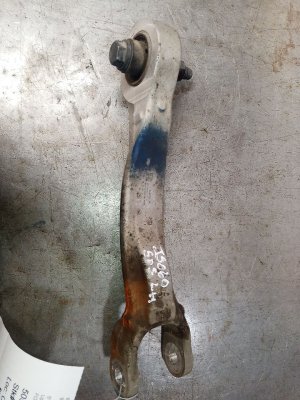
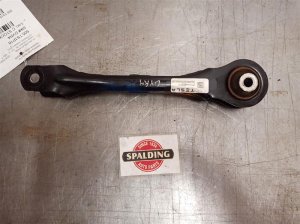
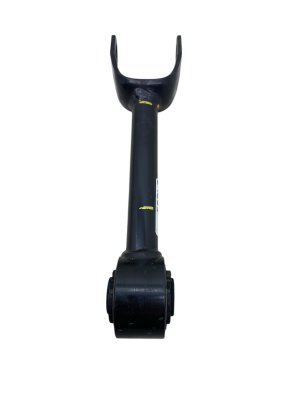
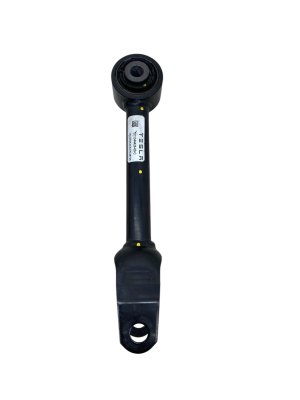
- This issue is caused by the rear upper AFT (rearward) control arm, also known as the camber link. Do not confuse it with the FORE (forward) link.
- While not an official recall, Tesla Service Centers may offer a 'goodwill' repair at a reduced cost even if you are out of warranty.
- When replacing, it is critical to only perform the final torque on the mounting bolts when the car is at its normal ride height to avoid premature bushing failure.
Symptoms of a Failing Rear Upper Control Arm

A failing rear upper control arm on a 2017-2026 Tesla Model 3 or 2020-2026 Tesla Model Y will make its presence known through distinct noises and changes in handling. Because the cabin is so quiet, these suspension noises are often more noticeable than in a gasoline-powered car.
1. Squeaking or Creaking Noises
This is the most notorious symptom. Owners typically report a loud squeaking, creaking, or groaning sound from the rear of the car, often compared to an old door hinge or a wooden ship. The noise is most prominent at lower speeds, especially when going over bumps, speed bumps, or uneven driveways. It can be worse in cold or wet weather as moisture gets into the failing bushing. The failure is often caused by water penetrating the seal of the ball joint or bushing, which displaces the grease and leads to corrosion and noise.
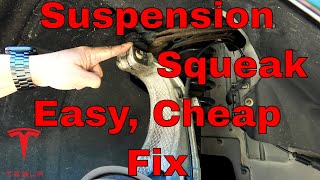
🎬 Watch: How to identify and fix that annoying suspension squeak.2. Clunking or Knocking Sounds
As the bushing or ball joint wears out completely, the metal components can make contact, resulting in a clunking or knocking sound. This is a sign of significant wear and indicates the arm has excessive play. You'll hear this most often when the suspension compresses or rebounds over bumps.
3. Unstable Steering and Uneven Tire Wear
A worn rear upper control arm can no longer hold the wheel at the correct angle. This can lead to a feeling of instability from the rear of the car, sometimes described as 'wandering' at highway speeds. Because the arm's primary job is to set the camber angle, a failure will cause the wheel alignment to be off, leading to accelerated and uneven tire wear, typically on the inner edge of the tire.
Known Issues, Recalls, and Technical Service Bulletins (TSBs)

While the failure of the rear upper aft control arm is a widely documented problem among Model 3 and Model Y owners, there is no formal recall for this specific part. However, Tesla is aware of the issue, and many owners have reported that service centers will replace the arms as a "goodwill" gesture, sometimes charging only for the parts even if the vehicle is out of its basic warranty.
Pro Tip: If you are experiencing the common squeaking noise, it is worth contacting a Tesla Service Center and describing the issue, even if your vehicle is out of warranty. They may offer a reduced-cost repair due to the known nature of this problem.
Related Suspension Recalls
It is important not to confuse this issue with other Tesla suspension recalls. In late 2021, Tesla issued a recall (NHTSA ID: 21V-835) for certain 2019-2021 Model 3 and 2020-2021 Model Y vehicles. This recall was for front suspension lateral link fasteners that could loosen and allow the link to separate from the subframe. This is a different part in a different location from the rear upper control arm discussed in this guide.
Vehicle & Part Compatibility: Model 3, Model Y, and 'Highland' Refresh

The Tesla Model 3 and Model Y are built on the same platform and share many suspension components, including this control arm. However, there are critical distinctions to be aware of before purchasing a replacement.
Warning: The rear suspension has two different upper control arms per side: a forward (fore) link and a rearward (aft) link. This guide and the most common squeaking issue relate to the REARWARD (AFT) link, which is also called the camber link. Verify this is the specific link you need before ordering. The fore link has a different shape and part number (e.g., 1044425-00-D).
Model 3 'Highland' (2024+) and Updated Model Y (2025+)
Starting with the 2024 model year, the refreshed Tesla Model 3 (code-named 'Highland') features a revised suspension designed for a more comfortable ride. These changes include new dampers, bushings, and potentially different control arm designs. Parts for 2017-2023 Model 3s are generally not compatible with 2024 and newer 'Highland' models. Always verify your vehicle's production year and the OEM part number before purchasing.
Buying a Used Suspension Control Arm: What to Check

Purchasing a used OEM control arm can be a cost-effective solution, but for this specific part, careful inspection is crucial due to the high rate of bushing failure. A used part with a worn bushing will develop the same squeak soon after installation.
Physical Inspection Checklist:
- Inspect the Bushings: This is the most critical check. Look at the rubber bushings on both ends of the arm. Look for any cracks, tears, splitting, or deformation of the rubber. The rubber should be solid and firmly bonded to the metal sleeve. Any separation between the rubber and metal means the bushing has failed.
- Check for Play: If possible, try to move the inner metal sleeve of the bushing by hand. There should be no significant play or movement. Some experts suggest that 1/8 inch of movement or more indicates a worn bushing.
- Examine the Arm Body: Inspect the entire metal arm for any signs of damage. Look for cracks, deep rust, or any indication that the arm is bent or distorted. A bent arm will make it impossible to align the vehicle correctly.
- Ball Joint Condition: The outer end of the arm connects to the knuckle via a ball joint. Check that the rubber boot covering the ball joint is not torn or leaking grease. A torn boot allows dirt and water to enter, causing the joint to wear out quickly.
Buyer Beware: Because the original bushing design is prone to failure, buying a used arm from an early model year vehicle carries risk. If possible, seek out a used part with a later revision number (see part numbers below) or consider a new OEM or high-quality aftermarket part with an improved bushing design.
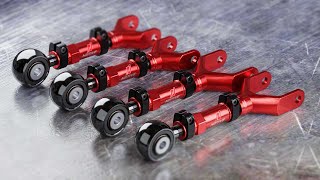
🎬 Watch: How to install adjustable aftermarket arms for better alignment.Replacement Overview & Difficulty
Replacing the rear upper control arm is a moderately difficult job that a skilled DIY mechanic can perform. Access to the bolts can be tight, especially the inner bolt on the subframe.
- Difficulty Rating: 3 out of 5
- Estimated Time: 1.5 - 2.5 hours per side 🎬 See this step-by-step walkthrough for replacing the rear upper arm.
- DIY Feasible: Yes, for those with mechanical experience and proper tools.
Pro Tip: Do not fully tighten the control arm mounting bolts until the vehicle's suspension is loaded to its normal ride height. To do this, loosely install the bolts, put the wheel back on, and lower the car onto ramps or blocks. Then, access the bolts from underneath to perform the final torque. Tightening the bolts while the suspension is hanging down will pre-load the new bushings and cause them to fail prematurely.
After replacing any suspension component, a four-wheel alignment check is highly recommended to ensure proper handling and prevent premature tire wear.
Cost of Replacement
The cost can vary significantly depending on whether you use a Tesla Service Center, an independent shop, or do the work yourself.
| Part/Service | Estimated Cost | Notes |
|---|---|---|
| New OEM Part | $90 - $150 per arm | Purchased from Tesla or an OEM parts reseller. |
| New Aftermarket Part | $60 - $120 per arm | Prices vary by brand. Some offer improved bushing designs. |
| Used OEM Part | $40 - $75 per arm | Price from online sellers and salvage yards. Requires careful inspection. |
| Shop Labor | $200 - $400 per side | Includes labor for replacement and wheel alignment. Tesla may offer 'goodwill' pricing on labor for this specific issue. |
Frequently Asked Questions (FAQ)
Can I drive with a squeaky control arm?
Yes, but it should be addressed promptly. While the initial squeaking is an annoyance, it indicates the bushing is failing. If left untreated, it can progress to a clunking noise and eventually lead to poor handling, alignment issues, and accelerated tire wear, which can become a safety concern.
Do I need to replace both the left and right arms at the same time?
It is highly recommended. Control arms wear at similar rates. If one side has failed, the other side is likely not far behind. Replacing them in pairs ensures consistent handling and suspension performance from side to side.
How do I know if I need the 'fore' or 'aft' rear upper control arm?
The 'aft' (rearward) link is the one most commonly associated with the squeaking noise and is often called the camber link. It is positioned toward the rear bumper. The 'fore' (forward) link is positioned toward the front of the car. Visually compare the part on your vehicle to photos online before ordering to ensure you are purchasing the correct arm.
Will Tesla fix this for free?
If your vehicle is still under the 4-year/50,000-mile Basic Vehicle Limited Warranty, this repair should be covered. If you are out of warranty, Tesla may still offer to perform the repair at a reduced cost (e.g., parts only) as a goodwill gesture due to the common nature of the failure. This is not guaranteed and is handled on a case-by-case basis.
Technical Specifications & Part Numbers
Part numbers for Tesla components are often revised. The numbers below are commonly associated with the rear upper aft (camber) link for the pre-Highland Model 3 and Model Y. Always verify compatibility with your vehicle's VIN.
- Common OEM Part Numbers (Pre-Highland): 1044427-00-C, 1188423-00-A
- Related Fore Link Part Numbers (for reference only): 1044425-00-D, 1188427-00-B, 1288427-00-A
- Tools Required: Jack, jack stands, wheel chocks, socket set (18mm is common), torque wrench, pry bar.
- Torque Specs: Suspension bolts must be torqued to specification at ride height. While specific values can vary by model year and fastener, common torque values for similar Tesla suspension components are in the range of 70 Nm to 190 Nm. Always refer to the official service manual for your specific vehicle.
Helpful Videos
Technical Specifications
OEM Part Numbers: 1044427-00-C 1188423-00-A
This is the rear upper AFT (rearward) control arm, also known as the camber link. It is not interchangeable with the rear upper FORE link.
We Have This Part in Stock



The information in this article is provided for general reference and educational purposes only. Vehicle specifications, procedures, and part compatibility can vary by production date, trim level, and region. Always consult your vehicle's factory service manual and verify part numbers before purchasing or performing repairs. Safety-critical components such as airbags, seat belts, and braking systems should be installed by a qualified professional.
- Tesla Model 3:
- Tesla Model Y:
- 🎬 Helpful Videos
- 🛍️ Shop This Part
- Symptoms of a Failing Rear Upper Control Arm
- 1. Squeaking or Creaking Noises
- 2. Clunking or Knocking Sounds
- 3. Unstable Steering and Uneven Tire Wear
- Known Issues, Recalls, and Technical Service Bulletins (TSBs)
- Related Suspension Recalls
- Vehicle & Part Compatibility: Model 3, Model Y, and 'Highland' Refresh
- Model 3 'Highland' (2024+) and Updated Model Y (2025+)
- Buying a Used Suspension Control Arm: What to Check
- Physical Inspection Checklist:
- Replacement Overview & Difficulty
- Cost of Replacement
- Frequently Asked Questions (FAQ)
- Technical Specifications & Part Numbers
- 🎟️ Get 5% Off