

Tesla Model 3 & Y Front Upper Control Arm Squeak: A Buyer's Guide (2017-2026)
This guide explains the common and annoying front-end squeak, details part revisions, and provides replacement costs for the Tesla Model 3 and Model Y.
- The most common failure is the front upper control arm, causing a squeak due to water entering the ball joint.
- When buying used, get the latest part revision (e.g., 1044423-00-G or newer) and inspect the ball joint boot for tears.
- Tesla Service Centers often perform this repair as a 'goodwill' gesture, charging only for parts (~$180) and covering labor, even out of warranty.
- A four-wheel alignment is mandatory after replacement to prevent unsafe handling and rapid tire wear.
Symptoms of a Failing Control Arm

The most infamous symptom of a failing front upper control arm on a 2017-2026 Tesla Model 3 or 2020-2026 Tesla Model Y is a distinct squeaking or creaking noise. This sound is often compared to a duck call or an old wooden ship and is most noticeable when turning the steering wheel at low speeds or when going over bumps.
- Creaking and Squeaking: This is the number one sign. The noise comes from the ball joint in the arm, which has lost its lubrication due to water getting past the protective boot.
- Clunking or Knocking: As the wear progresses, the noise can evolve into a clunk or rattle when driving over any road imperfection. This indicates more significant play in the ball joint.
- Steering Wander: A worn control arm can cause the steering to feel vague or loose, requiring constant small corrections to keep the car driving straight at highway speeds.
- Uneven Tire Wear: Since the control arm is essential for maintaining alignment, a failing one can cause the inside edge of the front tires to wear out prematurely.
Known Issues, Recalls, and Part Revisions

This is not just a simple wear-and-tear item; the front upper control arms on early Model 3 and Model Y vehicles have a known design issue. Tesla has addressed this through multiple part revisions and service actions.
The Root Cause: Water Intrusion
The primary cause of the squeaking is water penetrating the ball joint boot. This water displaces the grease, leading to corrosion and metal-on-metal contact inside the joint, which creates the noise. Tesla acknowledged this in Technical Service Bulletin (TSB) SB-20-31-006, which describes a procedure to reseal the ball joint area with urethane as a temporary fix, though many owners and shops prefer to replace the entire arm.
Safety Recalls
While the squeaking is often considered a non-safety noise issue, there have been related safety recalls for control arm fasteners:
- NHTSA Campaign 20V709000: This recall affected some 2020 Model Y vehicles. The bolts connecting the front upper control arm to the steering knuckle may not have been torqued correctly at the factory. A loose bolt could allow the arm to separate, leading to a loss of steering control.
- NHTSA Campaign 21V835000: This recall was for certain 2019-2021 Model 3 and 2020-2021 Model Y vehicles. It addressed fasteners for the front lower control arm (lateral link) that could be loose, potentially allowing the arm to detach from the subframe.
Pro Tip: When checking a vehicle's history, it's crucial to verify that these recall services have been completed. You can check this on the NHTSA website using the vehicle's VIN.
Part Number Revisions
Tesla has released several updated versions of the front upper control arms to improve the ball joint seal. When buying a used part, it is critical to get the latest revision possible. For example, the front right upper arm has gone through revisions like 1044423-00-A up to 1044423-00-G and beyond. Newer revisions are designed to be more robust against water intrusion.
Which Control Arm Do You Need? A Quick Guide

A Tesla's suspension has multiple arms per corner. It's easy to get confused. Here's a simple breakdown:
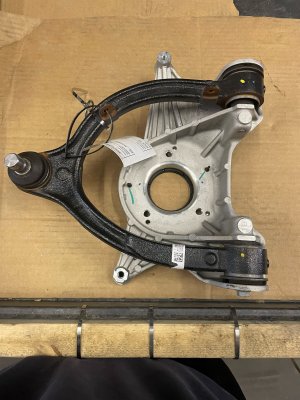
- Front Upper Control Arm: The most common failure point causing the squeak. Often called the "FUCA". Part numbers often start with 1044423 (Right) and 1044425 (Left).
- Front Lower Control Arm (Fore Link / Compliance Arm): Connects to the front of the subframe. Failure can cause clunking during acceleration or braking.
- Front Lower Control Arm (Aft Link / Lateral Link): The subject of recall 21V835000 for loose bolts.
- Rear Upper Control Arm (Forward/Fore Link): One of two upper links in the rear.
- Rear Upper Control Arm (Rearward/Aft Link): Also called the camber link. The initial prompt data included part numbers for this, such as 1044431-00-H.
Warning: The 2024+ Model 3 'Highland' and corresponding 2025+ Model Y 'Juniper' feature a redesigned suspension for improved ride comfort. Parts like dampers, control arms, and bushings are different and are generally NOT interchangeable with pre-refresh models. Always verify the part number and vehicle production date before purchasing.
Buying a Used Suspension Control Arm
A used OEM control arm can be a great value, especially since Tesla often covers labor as a 'goodwill' gesture, even out of warranty, if you supply the part. Here’s what to look for:
- Check the Ball Joint Boot: This is the most critical inspection. The black rubber boot around the ball joint must be perfectly intact. Look for any rips, tears, or signs of cracking. A compromised boot means the joint is likely contaminated and will fail soon.
- Verify the Part Number Revision: Ask the seller for the full part number, including the revision letter at the end (e.g., '-G'). Aim for the highest letter possible, as this indicates a newer, improved design.
- Inspect the Bushings: Check the rubber bushings at the inboard mounting points. The rubber should be firm and free of cracks or tearing.
- Look for Corrosion: Heavy surface rust, especially on parts from areas with heavy road salt use, can be a red flag. While some surface rust is normal, deep pitting or flaking is a concern.
- Why Used OEM is a Good Choice: Unlike many cheap aftermarket arms, a used OEM part maintains the original suspension geometry and includes design features like the cast-in vibration-damping weight, which some aftermarket parts omit.
Replacement Information

Replacing the front upper control arm is a moderately difficult job that a skilled DIY mechanic can perform.
- Difficulty: 3 out of 5.
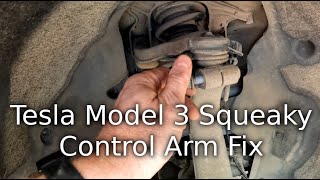
- Estimated Time: 1.5 - 2.5 hours per side. 🎬 See this step-by-step DIY replacement walkthrough
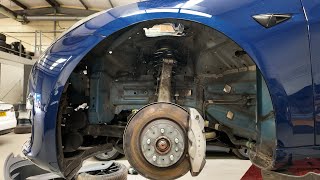
- Key Steps: The process involves removing the front wheel, the frunk tub and associated trim to access the upper strut mount bolts, detaching the upper arm from the steering knuckle, and unbolting the arm's mount from the chassis. The mount must be lowered to get clearance to remove the long inner bolts.
- Special Tools: A torque wrench is essential. No other highly specialized tools are required, but a good socket set (including Torx sockets), and pry bars are necessary.
- Torque Specs: It is critical to tighten bolts to the correct specification, and some must be torqued with the suspension at ride height. Key specs include:
- Upper control arm to knuckle pinch bolt: 56 Nm (41.3 lb-ft)
- Upper control arm to mount bolts: 50 Nm (36.9 lb-ft)
- Upper control arm mount to body (larger bolts): 62 Nm (45.7 lb-ft)
- Upper control arm mount to body (smaller bolts): 35 Nm (25.8 lb-ft)
Important: A four-wheel alignment is required after replacing any control arm to ensure proper handling, safety, and to prevent rapid tire wear.
Cost to Replace Tesla Model 3 & Y Control Arms
| Item | Cost Range | Notes |
|---|---|---|
| New OEM (Tesla Service) | $200 - $400 (per side) | Tesla often provides 'goodwill' coverage for labor, meaning customers may only pay for the parts, which are around $90 each. |
| New Aftermarket | $75 - $150 (per arm) | Prices vary by brand. Quality can be inconsistent compared to OEM. |
| Used OEM | $50 - $125 (per arm) | A cost-effective option, provided you can find a part with the latest revision and in good condition. |
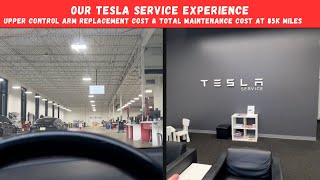
| Shop Labor | $200 - $500 (per side) | Independent shop labor rates vary. A full replacement of multiple arms can cost over $1,700. | 🎬 Watch: Real Tesla service cost and maintenance breakdown
| Wheel Alignment | $150 - $250 | Mandatory after the repair. |
Can I just lubricate the squeaky joint?
No. Attempting to inject grease into the sealed ball joint is a very temporary fix at best. The damage is already done once the noise starts, as the internal surfaces are corroded. The only permanent solution is replacement.
Do I need to replace both sides at the same time?
It is highly recommended. Control arms wear at similar rates, so if one side has failed, the other is likely not far behind. Replacing them in pairs ensures balanced handling and saves you from having to do the job twice and pay for a second alignment.
Is the squeaking control arm dangerous?
Tesla's official position is that the noise is a comfort (NVH) issue and not a safety defect, unless a fastener is loose as described in the recalls. However, any worn suspension component can affect handling and tire wear. If the noise changes to a loud clunking or the steering feels loose, the vehicle should be inspected immediately.
Will Tesla fix this for free out of warranty?
Sometimes. Due to the well-known nature of this issue, Tesla service centers frequently offer a 'goodwill' repair where they cover the cost of labor, and the customer only pays for the parts, even on cars outside the basic warranty. This makes going to an official service center an unusually affordable option for this specific repair.
Helpful Videos
Technical Specifications
OEM Part Numbers: 1044423-00-G 1044425-00-D 1044427-00-C 1044431-00-G 1044431-00-H 1188423-00-A 1188431-00-A 1344426-00-C 1344427-00-B 1344427-00-c 1344427-10-C 1344431-10-B
Torque, Upper Arm to Knuckle: 56 Nm (41.3 lb-ft). Torque, Upper Arm to Mount: 50 Nm (36.9 lb-ft). Torque, Mount to Body: 62 Nm (large bolts), 35 Nm (small bolts).
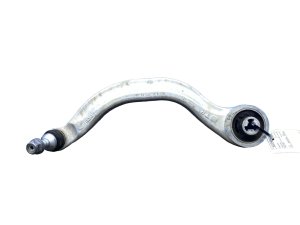
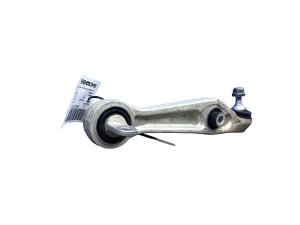
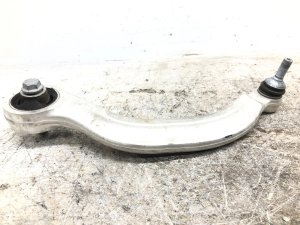
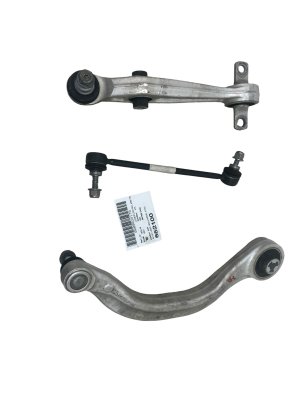
We Have This Part in Stock


The information in this article is provided for general reference and educational purposes only. Vehicle specifications, procedures, and part compatibility can vary by production date, trim level, and region. Always consult your vehicle's factory service manual and verify part numbers before purchasing or performing repairs. Safety-critical components such as airbags, seat belts, and braking systems should be installed by a qualified professional.
- Tesla 3:
- Tesla Y:
- 🎬 Helpful Videos
- 🛍️ Shop This Part
- Symptoms of a Failing Control Arm
- Known Issues, Recalls, and Part Revisions
- The Root Cause: Water Intrusion
- Safety Recalls
- Part Number Revisions
- Which Control Arm Do You Need? A Quick Guide
- Buying a Used Suspension Control Arm
- Replacement Information
- Cost to Replace Tesla Model 3 & Y Control Arms
- 🎟️ Get 5% Off