

1996-2001 Taurus & Sable Rear Control Arm Guide: Clunks, Rust, and Replacement
This in-depth guide covers the common failures, compatibility issues, and replacement costs for the rear suspension control arms on the 1996-2001 Ford Taurus and Mercury Sable.
- Compatibility is critical: Parts differ between Sedan and Station Wagon models, by year (1996-99 vs 2000-01), and by position (forward vs. rearward). Verify the exact part needed.
- Rust is the main enemy. Expect seized bolts and inspect the entire suspension, especially the coil springs which are known to fail from corrosion on these vehicles.
- A four-wheel alignment is mandatory after replacement to prevent poor handling and rapid tire wear.
- When replacing, do not tighten the main pivot bolts until the car's full weight is on the suspension to avoid premature bushing failure.
Symptoms of a Failing Rear Control Arm
A bad rear control arm on a 1996-2001 Ford Taurus or Mercury Sable will usually make its presence known through distinct noises and changes in how the car drives. Because the bushings are made of rubber, they wear out over time, and the metal arms themselves can rust and weaken, especially in regions that use road salt.
- Clunking or Knocking Noises: This is the most common symptom. You'll hear a clunking, popping, or banging sound from the rear of the car, especially when going over bumps, potholes, or making turns. This noise is caused by excessive play in the worn-out bushings, allowing metal components to hit each other.
- Unstable or Wandering Rear End: The car may feel loose or unstable from the rear, almost like it's trying to steer itself. This happens because a worn control arm can no longer hold the wheel in its proper alignment, causing it to shift unpredictably. You might find yourself making constant small steering corrections to keep the car straight.
- Vibrations: Worn bushings lose their ability to absorb road vibrations, which can be felt in the seats or floor. If the arm is bent or the bushings are severely worn, it can also cause uneven tire wear, which creates its own vibrations at higher speeds.
- Uneven Tire Wear: Inspect your rear tires. A bad control arm can throw the wheel alignment out of specification, causing tires to wear unevenly on the inner or outer edges. This is a sign that the wheel is not being held at the correct angle to the road.
Known Issues, Recalls, and Technical Service Bulletins (TSBs)
While there are no specific recalls for the rear control arms on the 1996-2001 Taurus and Sable, the entire suspension system on these vehicles is highly susceptible to a common enemy: rust.
Widespread Rust and Spring Failure
The most significant known issue for this generation is the failure of the coil springs due to corrosion. Ford issued a recall (NHTSA Campaign ID: 04V332000) for front coil springs on 1999-2001 models in cold-weather states, as a fractured spring could puncture the tire. However, owners report that the rear springs are just as likely to break from rust, even though they were never recalled. A broken rear spring can cause the car to sag dramatically and can damage surrounding components, including the control arms. When inspecting your control arms, always check the condition of your coil springs and strut assemblies.
Warning: A broken coil spring is a serious safety hazard. It can contact the tire, causing a blowout and a potential loss of vehicle control. If you see that your car is sagging in one corner or hear a loud bang followed by a change in handling, have the vehicle inspected immediately.
Buying a Used Suspension Control Arm
For a vehicle of this age, a quality used OEM control arm can be a smart, cost-effective choice. Original Ford parts often have better fitment and material quality than cheap aftermarket alternatives. Here’s what to look for when buying used:
- Inspect the Bushings: The rubber bushings are the most common failure point. Check them for any cracks, tearing, or signs of dry rot. The rubber should be firm and intact. If the bushings are shot, you'll have to replace them, which can be difficult without a hydraulic press.
- Check for Rust and Cracks: Thoroughly inspect the entire arm for heavy rust, scaling, or cracks. Surface rust is normal, but avoid any arm that is deeply pitted or has rust swelling up from the seams. A rusted arm is a weak arm.
- Verify Straightness: Look down the length of the arm to ensure it is not bent or twisted. Compare it to photos of a new part if possible. An arm that was in a collision may be damaged in a way that's hard to see but will prevent proper alignment.
- Confirm Compatibility: This is the most critical step. The rear suspension on these cars is complex. You must get the correct part for your vehicle's year, body style, and the specific position on the car.
Compatibility: The Biggest Challenge
Getting the right control arm is tricky. Pay close attention to these four factors:
- Sedan vs. Station Wagon: The rear suspension is different between the sedan and the wagon. Parts are generally not interchangeable. The wagon is heavier and designed to carry more load, so it uses different components.
- Year Range: There was a parts change during this generation. Parts for 1996-1999 models (like OEM part number F6DZ-5500-AF) are often different from parts for 2000-2001 models (like OEM part number 1F1Z-5500-RR). Always verify the part fits your specific year.
- Position (Forward vs. Rearward): The multi-link suspension has multiple lower arms. There is a "forward" arm and a "rearward" (or trailing) arm. They are not the same. The warnings in our database confirm this distinction.
- Position (Driver vs. Passenger): Some arms are symmetrical and can be used on either side, while others are side-specific. Always confirm before purchasing.
Pro Tip: Before ordering, take a clear photo of the control arm you need to replace while it's still on the car. Compare its shape and the orientation of its bushings to the photos of the used part you intend to buy. This can save you from a major headache.
Cost to Replace a Rear Control Arm
The cost can vary widely based on who does the work and what parts are used. Rust can significantly increase labor time if bolts are seized and need to be cut off.
| Part/Service | Estimated Cost |
|---|---|
| New OEM Part | $100 - $150+ |
| New Aftermarket Part | $40 - $120 |
| Used OEM Part | $30 - $75 |
| Shop Labor | $120 - $250 per side |
| Total Professional Job | $250 - $500+ per side |
| Wheel Alignment (Required) | $100 - $150 |
Replacement Overview & Special Procedures
Replacing a rear control arm on a 1996-2001 Taurus or Sable is a moderately difficult job that can be done by a skilled DIY mechanic. The biggest obstacle is often rust. The general steps are as follows:
- Safely lift and support the vehicle on jack stands and remove the rear wheel.
- Liberally apply penetrating oil to all nuts and bolts on the control arm and let it soak.
- Disconnect the stabilizer bar link from the control arm if necessary.
- Remove the bolt connecting the control arm to the wheel knuckle (hub assembly).
- Remove the bolt connecting the control arm to the subframe.
- Maneuver the old arm out and install the new one.
- Important: Do not fully tighten the pivot bolts until the vehicle's full weight is resting on the suspension. To do this, loosely install the bolts, put the wheel back on, and lower the car onto ramps or use a jack to lift the knuckle to its normal ride height. Then, tighten the bolts to their final torque specification. Failure to do this will preload the bushings, causing them to fail very quickly.
- Once the job is complete, you must get a professional four-wheel alignment. Replacing a control arm will alter the alignment, and skipping this step will lead to poor handling and rapid tire wear.
Torque Specifications
Finding exact torque specs for this specific model's rear suspension is difficult. The following values are from related Ford models or general specifications and should be used as a guideline only. Always consult a vehicle-specific service manual for precise figures.
- Control Arm to Knuckle Nut (General Taurus/Sable): 40-55 ft-lbs (54-75 Nm)
- Strut to Knuckle Nut (General Taurus/Sable): 70-95 ft-lbs (95-129 Nm)
Note: These values are for reference only. Verify with a proper service manual for your exact year and model.
Frequently Asked Questions (FAQ)
Do I need an alignment after replacing a rear control arm?
Yes, absolutely. A control arm is a key part of your suspension's geometry. Replacing it will change the alignment angles (camber, toe, and thrust angle). Driving without an alignment will cause poor handling and destroy your tires.
Can I just replace the bushings instead of the whole control arm?
While technically possible, it is often not practical. The old bushings must be removed with a hydraulic press or special tools, and new ones pressed in. Given the high likelihood of the arm itself being rusted and the affordable cost of a complete new or used arm, replacing the entire assembly is the recommended and most common repair.
How do I know if I need the Sedan or Station Wagon part?
The rear suspension components are different. You must order the part that is specified for your car's body style. A part for a sedan will not fit or function correctly on a wagon, and vice-versa.
My whole rear suspension is rusted. What should I replace at the same time?
If one control arm has failed due to rust, others are likely in poor condition. It's wise to inspect all suspension components. Common parts to replace at the same time include the other control arms, the stabilizer bar links, and the complete strut/spring assemblies, especially given the known issue with spring failure on these cars.
Technical Specifications
OEM Part Numbers: 1F1Z-5500-RR 1F1Z-5A649-AA 1F1Z5500RR 1F1Z5A649LW F6DZ-5500-AF F6DZ-5A952-A F6DZ5500AF F6DZ5A952A F7DZ-5A649-BA XF1Z-5A952-AA YF1Z-5500-RR YF1Z5500RR
The rear suspension is a multi-link independent design. Control arms are specific to Sedan or Station Wagon body styles and forward or rearward mounting positions.
We Have This Part in Stock


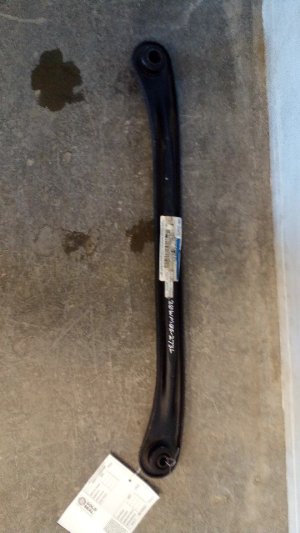



The information in this article is provided for general reference and educational purposes only. Vehicle specifications, procedures, and part compatibility can vary by production date, trim level, and region. Always consult your vehicle's factory service manual and verify part numbers before purchasing or performing repairs. Safety-critical components such as airbags, seat belts, and braking systems should be installed by a qualified professional.
- Ford Taurus:
- Mercury Sable:
- 🛍️ Shop This Part
- Symptoms of a Failing Rear Control Arm
- Known Issues, Recalls, and Technical Service Bulletins (TSBs)
- Widespread Rust and Spring Failure
- Buying a Used Suspension Control Arm
- Compatibility: The Biggest Challenge
- Cost to Replace a Rear Control Arm
- Replacement Overview & Special Procedures
- Torque Specifications
- Frequently Asked Questions (FAQ)
- 🎟️ Get 5% Off