

2009-2020 Dodge Journey Steering Knuckle: Decoding Noises, Failures, and Replacements
This guide explains the common failures, noises, and replacement costs associated with the steering knuckle on the 2009-2020 Dodge Journey.
- The knuckle itself rarely fails; it's usually replaced due to impact damage (bending/cracking) or because a wheel bearing or ball joint has seized within it.
- Symptoms like humming/grinding are typically a bad wheel bearing, while clunking is often a bad ball joint. A pull that can't be aligned is the key symptom of a bent knuckle.
- Replacing the lower ball joint in the knuckle is known to be very difficult on the Journey, making a complete used knuckle assembly a common time-saving repair.
- A four-wheel alignment is mandatory after replacing a steering knuckle to prevent dangerous handling and rapid tire wear.
Symptoms of a Bad Steering Knuckle
The steering knuckle is a very durable part that is designed to last the life of the vehicle. However, it can be damaged by impacts like hitting a deep pothole, sliding into a curb, or a collision. When a knuckle fails, it's typically by bending or cracking. The symptoms are often related to wheel alignment and suspension noises.
Symptoms of a Bent or Cracked Knuckle
- Vehicle Pulling to One Side: A bent steering knuckle will alter the suspension geometry, causing the vehicle to pull to the left or right. This often cannot be corrected with a standard wheel alignment.
- Uneven or Rapid Tire Wear: Because the wheel is no longer held at the correct angle, you'll notice the inside or outside edge of one of the front tires wearing down much faster than the others.
- Off-Center Steering Wheel: The steering wheel may be crooked or not return to center properly after a turn, even when driving straight.
Noises and Vibrations Often Mistaken for Knuckle Failure
More often than not, the noises you hear are from components attached to the knuckle, not the knuckle itself. These parts often wear out and can be the primary reason for replacing the knuckle assembly.
- Humming or Grinding Noise: A constant humming, growling, or grinding noise that gets louder with speed and changes pitch when turning is a classic symptom of a bad wheel bearing.
- Clunking or Popping Sounds: Clunking, popping, or creaking noises, especially over bumps or during low-speed turns, usually point to a worn lower ball joint or bad sway bar links. Worn struts can also cause clunking over bumps.
- Steering Wheel Vibration: A shaking steering wheel can be caused by a bad wheel bearing, but also by unbalanced tires or warped brake rotors.
Pro Tip: A common reason to replace the entire knuckle is when the wheel bearing or lower ball joint has seized into it due to rust. Technicians report that pressing the lower ball joint out of the Journey's knuckle is notoriously difficult, making a 🎬 Watch: How to handle a difficult ball joint replacement complete used knuckle assembly a much faster repair.
Known Issues, TSBs, and Recalls for 2009-2020 Dodge Journey
While there are no specific recalls or Technical Service Bulletins (TSBs) for the steering knuckle itself, several related issues and owner complaints are relevant.
- Common Complaint - Front End Clunks: Many Journey owners report persistent clunking noises from the front suspension. These are often traced back to worn sway bar links, control arm 🎬 See how to replace sway bar bushings to stop clunking bushings, or struts, but a thorough inspection of the knuckle and its connections is wise if the noise is hard to diagnose.
- Recall S08 / NHTSA 16V-273 - Power Steering Hose Leak: Affects 2009-2016 models equipped with an engine block heater. In extreme cold, the power steering return hose could leak at startup, leading to a sudden increase in steering effort. While not a knuckle failure, it is a critical steering system issue to be aware of.
- Recall for ABS Module: Some 2012-2015 models were recalled because water could enter the Anti-lock Brake System (ABS) module, potentially disabling ABS and stability control. This is relevant as the wheel speed sensor, which is critical for ABS, mounts directly to the steering knuckle.
Buying a Used Steering Knuckle: What to Look For
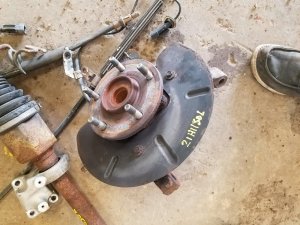
A recycled OEM steering knuckle is an excellent, cost-effective alternative to an expensive new part. Since knuckles are not a typical wear item, a used part from a vehicle that has not been in a major collision is often just as reliable as a new one. Here’s what to inspect:
- Visual Inspection: Carefully check the entire knuckle for cracks, especially around the mounting points for the strut, ball joint, and tie rod. 🎬 Watch this walkthrough on replacing the front strut and spring Look for any signs of bending or stress marks in the cast iron.
- Mounting Holes and Threads: Ensure all threaded holes, particularly for the brake caliper bracket, are clean and not stripped. Damaged threads mean the knuckle is unusable.
- Ball Joint and Bearing Condition: A used knuckle may come with the wheel bearing and/or ball joint. Consider these bonus parts. If the wheel bearing feels rough or makes noise when spun, or if the ball joint boot is torn, plan on replacing them. The main value is in the knuckle itself.
- Verify Compatibility: Front-Wheel Drive (FWD) and All-Wheel Drive (AWD) models may use different knuckles. Always verify the part is correct for your specific vehicle configuration. The provided OEM part numbers (e.g., 5171101AC) often fit a range of years and trims, but checking against your VIN is the best practice.
Cost Breakdown for Dodge Journey Steering Knuckle Replacement
Prices can vary based on your location and chosen parts. A wheel alignment is required after this repair, which adds to the total cost.
| Part/Service | Estimated Cost |
|---|---|
| New OEM (Mopar) | $300 - $420 |
| New Aftermarket | $70 - $150 |
| Used OEM | $75 - $200 |
| Shop Labor | $200 - $400 (2-4 hours) |
| Wheel Alignment | $100 - $200 |
| Total Estimated Cost (Installed) | $575 - $1,020+ |
Installation Tips and Torque Specs
Replacing a steering knuckle is an advanced DIY job. It requires disconnecting major brake and suspension components. If you are performing the repair, always use a torque wrench and follow the correct specifications to ensure safety.
Warning: A wheel alignment is mandatory after replacing a steering knuckle. Skipping this step will result in poor handling, unsafe driving characteristics, and rapid tire wear.
Key Torque Specifications
Note: These values are for reference. Always confirm the specs for your specific model year and engine.
| Component | Torque Spec (ft-lbs) | Torque Spec (N·m) |
|---|---|---|
| Axle Hub Nut | 118 ft-lbs | 160 N·m |
| Strut-to-Knuckle Nuts | 103 ft-lbs | 140 N·m |
| Lower Ball Joint Stud Nut | 70 ft-lbs | 95 N·m |
| Outer Tie Rod End Nut | 63 ft-lbs | 85 N·m |
| Caliper Bracket-to-Knuckle Bolts | 125 ft-lbs | 169 N·m |
| Wheel Lug Nuts | 100 ft-lbs | 135 N·m |
Frequently Asked Questions (FAQ)
Can I drive with a bad steering knuckle?
No. A bent or cracked steering knuckle is a critical safety failure. It compromises your steering control, braking, and suspension integrity. The vehicle should not be driven until it is repaired.
Is it the knuckle or the wheel bearing making noise?
If you hear a humming or grinding noise that changes with speed and while turning, the wheel bearing is the most likely culprit. If the vehicle pulls hard to one side or has uneven tire wear that an alignment can't fix, the knuckle itself may be bent.
Do I have to get an alignment after replacing the knuckle?
Yes, an alignment is absolutely required. The steering knuckle is a primary component that determines the wheel's alignment angles (camber and toe). Failure to perform an alignment will lead to poor handling and destroy your tires.
Why buy a used knuckle if the bearing or ball joint might be bad?
The knuckle itself is a durable piece of metal that rarely fails unless damaged by an impact. A used OEM knuckle is often significantly cheaper than a new one. Many technicians choose a used knuckle assembly because pressing the old ball joint out of the original knuckle on a Dodge Journey is known to be very difficult. It can be faster and easier to install a clean used knuckle and replace the bolt-in wheel bearing if needed.
Helpful Videos

Technical Specifications
OEM Part Numbers: 5006211AA 5006212AA 5171101AB 5171101AC 5171102AB 5171102AC 68083245AE 68083245AB 68083245AC 68083245AD 68104665AA
Material: Cast Iron. Location: Front or Rear Axle. Note: Different part numbers for Front-Wheel Drive (FWD) vs. All-Wheel Drive (AWD) models.
We Have This Part in Stock



The information in this article is provided for general reference and educational purposes only. Vehicle specifications, procedures, and part compatibility can vary by production date, trim level, and region. Always consult your vehicle's factory service manual and verify part numbers before purchasing or performing repairs. Safety-critical components such as airbags, seat belts, and braking systems should be installed by a qualified professional.
- Dodge Journey:
- 🎬 Helpful Videos
- 🛍️ Shop This Part
- Symptoms of a Bad Steering Knuckle
- Symptoms of a Bent or Cracked Knuckle
- Noises and Vibrations Often Mistaken for Knuckle Failure
- Known Issues, TSBs, and Recalls for 2009-2020 Dodge Journey
- Buying a Used Steering Knuckle: What to Look For
- Cost Breakdown for Dodge Journey Steering Knuckle Replacement
- Installation Tips and Torque Specs
- Key Torque Specifications
- Frequently Asked Questions (FAQ)
- 🎟️ Get 5% Off