

2004-2010 Audi A8 & 2007-2009 S8 Steering Knuckle: Clunks, Compatibility, and Replacement
This guide covers the common failure points, noises, and critical part number details for the D3 platform Audi A8 and S8 front steering knuckle.
- This part is specific to the D3 platform (2004-2010 A8, 2007-2009 S8); do not confuse it with the D4 platform (2011+ A8).
- For 2004 A8 models, this part only fits vehicles from VIN 012701 and later.
- Failure is almost always from impact (potholes, curbs). A used OEM knuckle from a non-wrecked car is a safe and highly cost-effective option.
- Replacement is an advanced job that requires replacing the one-time-use axle bolt and performing a mandatory wheel alignment.
Critical Compatibility: D3 vs. D4 Platform and VIN Splits
Before diagnosing or buying a steering knuckle for an Audi A8, you must identify your vehicle's platform. This is the most common point of error for this part.
Warning: The 2010 model year was a transition period for the Audi A8. Some 2010 models are the older D3 platform, while others are the newer D4 platform. They do not use the same steering knuckle. You must verify which chassis you have.
- D3 Platform Vehicles: This guide focuses on the D3 chassis, which includes the 2004-2010 Audi A8 and the 2007-2009 Audi S8. The correct OEM part numbers for these vehicles typically begin with 4E0, such as 4E0407258M (right side).
- D4 Platform Vehicles: The 2011 and newer Audi A8 use the D4 chassis. Part numbers for these knuckles begin with 4H0. These parts are NOT interchangeable with D3 models.
Special Note for 2004 Audi A8 Owners
For the 2004 model year, there was a mid-year production change. This steering knuckle only fits vehicles with a VIN ending in 012701 or higher. If you have a 2004 A8, you must verify your VIN before purchasing this part.
Symptoms of a Failing Steering Knuckle
A steering knuckle is a solid piece of metal and does not have internal moving parts that wear out. Failure is almost always caused by an external event like hitting a curb or a severe pothole, or by wear in the mounting points for other suspension components. The symptoms are often confused with a bad wheel bearing, control arm, or tie rod.
Noises
- Clunking or Popping: A clunking or popping sound when turning at low speeds or going over bumps can indicate that the tapered hole where a ball joint sits has become worn or oval-shaped, allowing for excessive movement.
- Grinding or Humming: A constant grinding or humming noise that changes with vehicle speed is a classic sign of a bad wheel bearing. Since the bearing is pressed into the knuckle, the two are often replaced together.
- Squealing When Turning: This can sometimes be caused by a bent knuckle that misaligns the brake dust shield, causing it to contact the brake rotor.
Steering and Handling Issues
- Vehicle Pulling to One Side: If the knuckle is bent, it will alter the suspension geometry (specifically camber and toe angles). This can cause the car to pull to one side, a problem that a wheel alignment cannot correct.
- Vague or Loose Steering: Wear in the knuckle's mounting points can create slack in the suspension, leading to a less precise steering feel.
- Uneven Tire Wear: A bent knuckle is a common cause of rapid and uneven tire wear, especially on the inner or outer edges, because the wheel is no longer held at the correct angle.
Known Issues, Recalls, and TSBs
There are no specific recalls or Technical Service Bulletins (TSBs) from Audi for steering knuckle failure on the 2004-2010 A8 or 2007-2009 S8. Failures are typically isolated incidents resulting from impact damage.
However, these vehicles are known for complex front suspension noises that can be difficult to diagnose. Owners often chase clunking sounds by replacing control arms, sway bar links, and tie rods, only to find the issue persists. While the knuckle itself is rarely the source of noise unless damaged, other related components like the air suspension struts are a common cause of knocking sounds.
A recall was issued for 2007-2009 Audi A8 and S8 models for sunroof glass that could detach, but this is unrelated to the suspension.
Buying a Used Steering Knuckle: A Smart Repair
Because a steering knuckle is a solid piece of metal with no wear parts, a used OEM knuckle from a vehicle that has not suffered collision damage is an excellent and cost-effective alternative to an expensive new part.
Pro Tip: Unlike parts with rubber bushings or bearings that degrade over time, a used aluminum knuckle's integrity is not affected by mileage. Its value comes from being dimensionally correct and free of cracks.
Inspection Checklist for a Used Knuckle
- Check for Cracks: Carefully inspect the entire part for hairline cracks, especially around the mounting bosses for the control arms, brake caliper, and tie rod. Pay close attention to the area where the wheel bearing is pressed in.
- Inspect Mounting Holes: Look at the tapered holes for the ball joints. They should be perfectly round and free of significant scoring or distortion. An oval-shaped hole means the knuckle is junk.
- Verify Threads: Ensure all threaded holes, especially for the brake caliper bolts, are clean and not stripped or damaged.
- Confirm Part Numbers: Double-check that the part number matches what is required for your vehicle's year, model, and side (left or right). The part numbers are side-specific.
- Assume the Bearing is Bad: Even if a used knuckle comes with a wheel bearing installed, it is wise to assume the bearing is old. It is highly recommended to press in a new wheel bearing before installation.
Replacement Information
Replacing the steering knuckle is an advanced DIY job that requires specialized tools. If you are not comfortable working with major suspension components, this job is best left to a professional technician.
Related Parts to Replace at the Same Time
Given the labor involved, it is highly recommended to replace several related parts simultaneously:
- Wheel Bearing: The bearing must be pressed out of the old knuckle and into the new one (or a new bearing pressed in). It is almost always replaced with the knuckle.
- Axle Bolt: This is a one-time-use, torque-to-yield bolt and must be replaced.
- Control Arms: The front suspension on the A8/S8 has multiple upper and lower control arms. Inspect all ball joints and bushings for wear and replace as needed while everything is accessible.
- Tie Rod End: Inspect for any play and replace if necessary.
Special Procedures & Torque Specs
A professional wheel alignment is mandatory after replacing a steering knuckle to ensure safety and prevent tire damage.
| Component | Torque Specification | Notes |
|---|---|---|
| Front Axle Bolt (to Hub) | 200 Nm (147 ft-lbs) + 180° turn | CRITICAL: This is a torque-to-yield bolt and must be replaced. The final 180° turn requires a very long breaker bar and significant force. |
| Inner CV Joint Bolts (to Flange) | 80 Nm (59 ft-lbs) | For M10 bolts. |
| Control Arm Pinch Bolt | 50 Nm (37 ft-lbs) + 90° turn | This bolt is also often replaced. |
Cost Comparison
The cost for a new OEM steering knuckle from an Audi dealer can be extremely high, making a used OEM part a very attractive option.
| Part/Service | Estimated Cost | Notes |
|---|---|---|
| New OEM | $500 - $1,700 | Price varies significantly by dealer and specific part number. |
| New Aftermarket | $150 - $350 | Quality can vary. Ensure it's from a reputable brand. |
| Used OEM | $80 - $150 | Offers the best value, providing OEM quality for a fraction of the price. |
| Shop Labor | $370 - $550 | Typically 3-4 hours of labor, plus the cost of an alignment. |
| Wheel Alignment | $150 - $250 | Mandatory after replacement. |
Frequently Asked Questions (FAQ)
Do I have to replace the wheel bearing with the steering knuckle?
Yes, it is highly recommended. The old bearing has to be pressed out of the old knuckle, which can damage it. Since the labor is already done, installing a new wheel bearing at the same time is a smart and preventative repair.
Is the left (driver's side) knuckle the same as the right (passenger's side)?
No, they are not interchangeable. Steering knuckles are side-specific parts. You must order the correct part for the side of the vehicle you are repairing.
Can a bad steering knuckle cause ABS or traction control lights?
The knuckle itself does not have electronics. However, the wheel speed sensor, which is critical for ABS and traction control, mounts to the knuckle. If the sensor or its wiring is damaged during a knuckle failure or replacement, it can trigger warning lights.
What is the difference between a steering knuckle and a spindle?
The terms are often used interchangeably. Technically, a spindle is a shaft that the wheel hub rides on, common in older rear-wheel-drive cars. A knuckle is a more complex housing that contains a pressed-in wheel bearing assembly, which is what these Audi models use. For these vehicles, 'knuckle' or 'wheel bearing housing' are the most accurate terms.
Technical Specifications
OEM Part Numbers: 4E0407258M 4E0407257M 4E0407253M
Material: Aluminum. Axle Bolt Torque: 200 Nm (147 ft-lbs) + 180 degrees (Torque-to-yield, must replace bolt).
We Have This Part in Stock
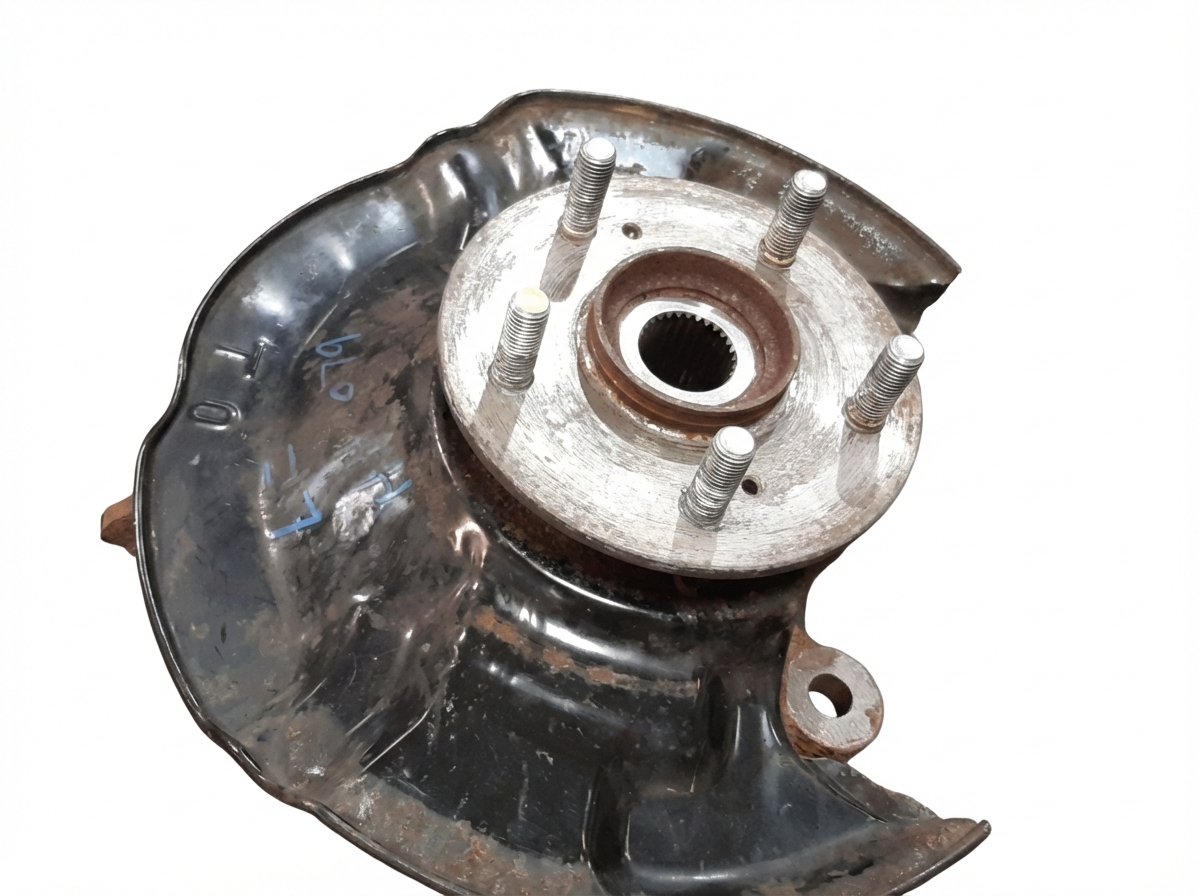

The information in this article is provided for general reference and educational purposes only. Vehicle specifications, procedures, and part compatibility can vary by production date, trim level, and region. Always consult your vehicle's factory service manual and verify part numbers before purchasing or performing repairs. Safety-critical components such as airbags, seat belts, and braking systems should be installed by a qualified professional.
- Audi S8:
- Audi A8:
- 🛍️ Shop This Part
- Critical Compatibility: D3 vs. D4 Platform and VIN Splits
- Special Note for 2004 Audi A8 Owners
- Symptoms of a Failing Steering Knuckle
- Noises
- Steering and Handling Issues
- Known Issues, Recalls, and TSBs
- Buying a Used Steering Knuckle: A Smart Repair
- Inspection Checklist for a Used Knuckle
- Replacement Information
- Related Parts to Replace at the Same Time
- Special Procedures & Torque Specs
- Cost Comparison
- Frequently Asked Questions (FAQ)
- 🎟️ Get 5% Off