

2011-2014 Edge & 2011-2015 MKX Steering Knuckle: Diagnosing Clunks, Pops, and Steering Wander
Your definitive guide to identifying steering knuckle failure, choosing a replacement, and understanding related repairs for your Ford Edge or Lincoln MKX.
- The knuckle itself rarely fails without impact; symptoms are often due to a bent part or worn mounting points for the wheel bearing or ball joint.
- This part is for the FRONT PASSENGER side only. It fits both FWD and AWD models of the 2011-14 Edge and 2011-15 MKX.
- It is critical to replace the wheel hub/bearing assembly and the one-time-use axle nut when replacing the knuckle.
- A professional wheel alignment is MANDATORY after installation to prevent unsafe handling and rapid tire wear.
Symptoms of a Bad Steering Knuckle
The steering knuckle itself is a robust piece of metal that rarely fails without a significant impact, like hitting a curb, a deep pothole, or being in a collision. More often, the symptoms owners notice are caused by wear or damage to the knuckle's mounting points or by the failure of connected parts like the wheel bearing or ball joint. If you hear noises or feel changes in your steering, it's important to inspect this entire corner of the suspension.
Noises and Vibrations
- Clunking or Popping Sounds: A distinct clunk or pop when turning at low speeds, such as in a parking lot, is a common symptom. This can indicate that the hole for the ball joint stud has become worn or 'ovaled,' allowing for excessive movement.
- Grinding or Squealing When Turning: A grinding or squealing noise that changes with wheel rotation can point to a failing wheel bearing, which is pressed into the knuckle. If the bearing fails catastrophically, it can damage the bore of the knuckle itself, requiring replacement of both parts.
- Steering Wheel Vibration: A shimmy or vibration felt in the steering wheel, especially at highway speeds, can be caused by a bent knuckle or a bad wheel bearing housed within it.
Steering and Handling Issues
- Vehicle Pulling to One Side: If your Ford Edge or Lincoln MKX constantly pulls to one side even after a proper wheel alignment, the knuckle could be bent. This throws off the camber or caster angles in a way that normal adjustments can't correct.
- Loose or Wandering Steering: A feeling of looseness in the steering, requiring constant small corrections to keep the vehicle straight, can be a sign of a worn ball joint connection at the knuckle.
- Off-Center Steering Wheel: A crooked steering wheel when driving straight is a classic sign of an alignment problem, which can be caused by a damaged knuckle.
Visual Signs
- Uneven Tire Wear: A bent knuckle will cause incorrect wheel alignment, leading to rapid and uneven wear on the inner or outer edge of one specific tire.
- Visible Damage: After any impact, visually inspect the knuckle for cracks, especially around the mounting points for the strut, ball joint, and tie rod. Also check for any signs of bending or deformation by comparing it to the knuckle on the other side of the vehicle.
Warning: A damaged steering knuckle is a critical safety issue. If you suspect the knuckle is bent or cracked, the vehicle should not be driven until it has been inspected and repaired. Failure of this part can lead to a loss of steering control.
Known Issues, Recalls, and Technical Service Bulletins (TSBs)
While there are no specific recalls or TSBs for the steering knuckle itself on the 2011-2014 Ford Edge and 2011-2015 Lincoln MKX, several related steering system issues are important for owners to be aware of.
- NHTSA Recall 19S26 (Ford 15S14): Affects some 2015-2016 Edge and 2016 MKX models in salt-belt states. Bolts for the electric power steering gear motor can corrode and fracture, leading to a sudden loss of power steering assist. The vehicle will revert to manual steering, which requires significantly more effort.
- NHTSA Recall 15S18 (Ford 14S06): Affects some 2011-2013 models. A software fault in the Power Steering Control Module (PSCM) could cause the system to default to manual steering mode, increasing steering effort. The fix often involves a software update, but in some cases, the entire steering gear is replaced.
- NHTSA Recall 14V282000: Pertains to 2012-2014 Edge and MKX models. An improperly installed circlip on the front halfshaft (CV axle) could allow it to disengage from the transmission, resulting in a loss of power to the wheels.
These issues can cause symptoms like increased steering effort that might be confused with a binding ball joint or bearing attached to the knuckle. It's important to rule out these recalls when diagnosing steering problems.
Buying a Used Steering Knuckle Assembly
A used OEM steering knuckle is an excellent, cost-effective alternative to a new part, often outperforming cheap aftermarket replacements in terms of fit and durability. Since the knuckle is a solid piece of cast iron, a non-accident, low-mileage part is just as good as a new one. Here’s what to look for.
Inspection Checklist
- Check for Cracks: Carefully inspect the entire part for hairline cracks, especially around the strut mounting ears, the ball joint pinch-bolt area, and the tie rod end taper. Any crack means the part is junk.
- Inspect the Ball Joint Taper: Look inside the tapered hole where the lower ball joint stud sits. The surface should be smooth and free of distortion, corrosion, or excessive wear. An 'ovaled' or damaged hole will never allow the ball joint to seat properly.
- Examine the Wheel Bearing Bore: If you are buying a bare knuckle, inspect the large, machined bore where the wheel bearing/hub assembly presses in. Look for deep scoring, rust pitting, or signs of damage from someone trying to hammer out the old bearing. A damaged bore can cause the new bearing to fit loosely, leading to premature failure.
- Verify Straightness: Look down the strut mounting points and across the hub face. It's difficult to spot a minor bend by eye, but avoid any knuckle with obvious signs of impact or deformation. Buying from a reputable recycler that sources parts from non-collision vehicles is your best protection.
- Confirm Part Numbers: Match the OEM part number to ensure you are getting the correct part for your vehicle and, most importantly, for the correct side (passenger vs. driver).
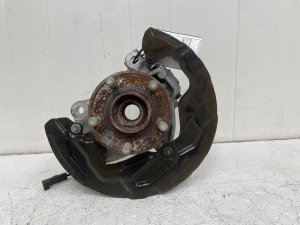
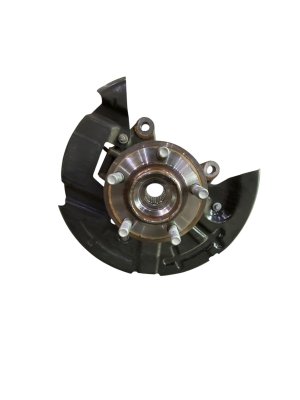
Pro Tip: Consider buying a 'loaded' or 'complete' knuckle assembly from a low-mileage donor vehicle. These often come with the OEM wheel hub/bearing and dust shield already installed, saving you the cost and hassle of having a new bearing pressed in.
Replacement Overview and Related Parts
Replacing the steering knuckle is a job for an experienced DIY mechanic or a professional shop, as it involves disassembling most of the front suspension and requires a final wheel alignment.
Parts to Replace at the Same Time:
- Wheel Hub and Bearing Assembly: It is highly recommended to install a new wheel hub/bearing assembly with a replacement knuckle. The old bearing will likely be damaged during removal from the old knuckle anyway.
- Axle Nut: This is a one-time-use, torque-to-yield nut and MUST be replaced. Many new hub assemblies include one.
- Lower Ball Joint: On these vehicles, the ball joint is pressed into the lower control arm, not the knuckle. Inspect it for any play or torn boots. Since you have everything apart, this is the ideal time to replace it if it shows any signs of wear.
- Outer Tie Rod End: Inspect for wear and replace if necessary.
Alignment is Mandatory: Replacing the steering knuckle will significantly alter the front-end alignment. A professional four-wheel alignment is required immediately after the repair to ensure vehicle safety, proper handling, and to prevent rapid tire wear.
Key Torque Specifications
Using correct torque specs is critical for safety. Always use a torque wrench and replace any one-time-use fasteners. Note that some specs found in searches conflict; these are the most commonly cited values.
| Component | Torque Spec | Notes |
|---|---|---|
| Axle Hub Nut | 258 lb-ft (350 Nm) | Must be a new nut. Do not reuse. |
| Lower Ball Joint Pinch Bolt Nut | 41 lb-ft (55 Nm) | Connects knuckle to lower control arm ball joint. |
| Strut-to-Knuckle Bolts | 85-166 lb-ft | Sources conflict. 85 lb-ft is a common value, but consult a factory service manual if possible. |
| Outer Tie Rod End Nut | 35 lb-ft | Tighten further only to align cotter pin slot. |
| Brake Caliper Bracket Bolts | 129 lb-ft | |
| Wheel Lug Nuts | 100 lb-ft |
Cost of Replacement
The cost can vary significantly depending on whether you buy a bare knuckle, a loaded assembly, and whether you perform the labor yourself.
| Part/Service | Estimated Cost | Notes |
|---|---|---|
| New OEM Knuckle (Bare) | $140 - $240 | Part only, from a dealer. |
| New Aftermarket Knuckle (Bare) | $85 - $120 | Part only, from retail auto parts stores. |
| New Aftermarket Loaded Knuckle (with Hub/Bearing) | $130 - $400 | Offers convenience and value. |
| Used OEM Knuckle | $75 - $150 | A good value, especially if it includes the hub. |
| Shop Labor (Knuckle Replacement) | $160 - $270 | Does not include alignment or cost of related parts like the bearing. |
| Wheel Alignment | $100 - $200 | Mandatory after replacement. |
Frequently Asked Questions (FAQ)
Do I have to replace the wheel bearing with the knuckle?
Yes, it is strongly recommended. The old wheel bearing is pressed into the knuckle and will almost certainly be damaged during removal. Installing a new bearing into your replacement knuckle ensures longevity and prevents having to do the job twice. Many aftermarket knuckles are sold as 'loaded' units with a new bearing pre-installed for this reason.
Is the lower ball joint part of the knuckle on these vehicles?
No. On the 2011-2014 Ford Edge and 2011-2015 Lincoln MKX, the lower ball joint is pressed into the lower control arm. The steering knuckle then attaches to the tapered stud of the ball joint and is secured with a pinch bolt.
Does this part fit the driver's side?
No, the part numbers listed (7T4Z-3K185-A, BT4Z-3K185-A, etc.) are for the front passenger side only. The driver's side has a different part number, typically ending in '6' instead of '5', such as BT4Z-3K186-A. They are not interchangeable.
Will this knuckle fit both All-Wheel Drive (AWD) and Front-Wheel Drive (FWD) models?
Yes, the front steering knuckle is the same for both FWD and AWD versions of the Ford Edge and Lincoln MKX in these model years. The difference between the drivetrains is the presence of a CV axle shaft, which passes through the hub but does not change the knuckle itself.
Technical Specifications
OEM Part Numbers: 7T4Z-3K185-A 7T4Z-3K185-AR BT4Z-3K185-A BT4Z-3K185-B BT4Z3K185A
Fits front passenger side. Compatible with both FWD and AWD models. The lower ball joint is not integral; it is part of the lower control arm and attaches via a pinch bolt.
We Have This Part in Stock



The information in this article is provided for general reference and educational purposes only. Vehicle specifications, procedures, and part compatibility can vary by production date, trim level, and region. Always consult your vehicle's factory service manual and verify part numbers before purchasing or performing repairs. Safety-critical components such as airbags, seat belts, and braking systems should be installed by a qualified professional.
- Ford Edge:
- Lincoln MKX:
- 🛍️ Shop This Part
- Symptoms of a Bad Steering Knuckle
- Noises and Vibrations
- Steering and Handling Issues
- Visual Signs
- Known Issues, Recalls, and Technical Service Bulletins (TSBs)
- Buying a Used Steering Knuckle Assembly
- Inspection Checklist
- Replacement Overview and Related Parts
- Parts to Replace at the Same Time:
- Key Torque Specifications
- Cost of Replacement
- Frequently Asked Questions (FAQ)
- 🎟️ Get 5% Off