

2001-2004 Chevrolet Impala Steering Knuckle: Solving the JA9 vs. JB9 Brake Code Puzzle
This guide clarifies the critical differences between heavy-duty (JA9) and light-duty (JB9) knuckles to ensure you get the right part for your Impala.
- The most critical step is identifying your brake system via the RPO code (JA9 for Heavy-Duty, JB9 for Light-Duty) on the glove box sticker before buying.
- A mandatory four-wheel alignment is required after replacement to prevent unsafe handling and rapid tire wear.
- When buying used, meticulously inspect the knuckle for hairline cracks or bends, as failure is almost always due to impact damage.
- It is highly recommended to replace the wheel hub and bearing assembly at the same time as the knuckle, as it must be removed anyway.
Symptoms of a Failing Steering Knuckle
A steering knuckle has no moving parts and typically only fails from a sudden impact (like hitting a curb or a major pothole) or when a wheel bearing seizes. The symptoms are often confused with other suspension problems, so careful diagnosis is key.
- Vehicle Pulls to One Side: The most common symptom is a persistent pull to the left or right that cannot be corrected with a wheel alignment. This happens because a bent knuckle permanently alters the suspension geometry.
- Uneven Tire Wear: A bent knuckle will cause the wheel to lean in or out, resulting in rapid wear on the inner or outer edge of one specific tire.
- Steering Wheel Off-Center: If you have to hold your steering wheel at an angle to drive straight, a bent knuckle could be the cause.
- Noises While Turning: Listen for clunking, popping, or grinding sounds, especially at low speeds like in a parking lot. These sounds can indicate that the knuckle is cracked or that the mounting points for the ball joint or bearing are worn.
- Vibrations in Steering Wheel: A shimmy or vibration that you can feel in the steering wheel, which may get worse with speed, can be a sign of a damaged knuckle or a failing wheel bearing housed within it.
Pro Tip: Differentiating noises can be tricky. A rhythmic grinding or humming that changes with wheel speed is typically a wheel bearing. A clicking or popping sound that happens specifically while accelerating in a turn often points to a bad CV axle. A clunk from a bent or cracked knuckle is usually more distinct and related to the steering angle or going over bumps.
Critical: Match Your Brake Option Code (JA9 vs. JB9)
For the 2001-2004 Impala, Chevrolet used two different front brake systems, which require two different steering knuckles. Ordering the wrong one will prevent your brake caliper from mounting correctly. You must identify which system your car has before buying a replacement.
These options are identified by a three-digit Regular Production Option (RPO) code. You can find these codes on the Service Parts Identification sticker, which is typically located on the inside of the glove box door or sometimes in the trunk on the spare tire cover.
| RPO Code | Brake System | Description |
|---|---|---|
| JB9 | Light Duty Brakes | This is the standard brake system for most Impala models. |
| JA9 | Heavy Duty Brakes | This system was often equipped on police package (9C1) or high-performance models and features larger brake components. |
Warning: You cannot visually tell the difference between the knuckles easily. You must check your RPO code sticker to ensure compatibility. A part for a JA9 car will not fit a JB9 car, and vice-versa.
Buying a Used 2001-2004 Impala Steering Knuckle
A used OEM knuckle is an excellent value, as it's a durable part that doesn't wear out on its own. However, since failure is almost always caused by impact, careful inspection is essential.
- Verify the RPO Code: First and foremost, confirm with the seller that the part comes from a vehicle with the same brake code (JA9 or JB9) as yours.
- Inspect for Cracks: Carefully check the entire part for hairline cracks, especially around the mounting points for the strut, ball joint, and tie rod. Pay close attention to the area where the wheel hub bolts on.
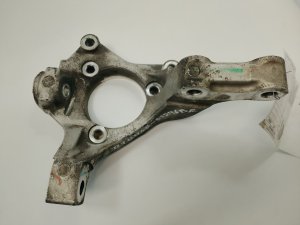
- Check for Bends: A bent knuckle is useless. Compare the used part to photos of a new one online. Look at the steering arm (where the tie rod connects) and the strut mounting tabs. If anything looks even slightly bent or twisted, reject the part.
- Examine the Hub Bore: Look at the large hole where the wheel bearing/hub assembly sits. If a bearing failed catastrophically, it could have damaged or warped this surface, which would prevent a new bearing from seating correctly.
- Condition of Threads: Check the threads for the caliper mounting bolts. They should be clean and free of damage.
- Avoid High-Mileage Parts from Rust Belt: While mileage isn't a direct concern for the knuckle itself, high mileage in a region that uses road salt can make associated parts (like the hub) extremely difficult to remove, potentially leading to damage during disassembly.
Cost Comparison
Replacing a steering knuckle involves significant labor, but choosing a quality used OEM part can offer substantial savings.
| Part/Service | Estimated Cost | Notes |
|---|---|---|
| New OEM | $275 - $520 | Price varies by dealer. The original part 18060652 is superseded by 23127629. |
| New Aftermarket | $340 - $525 | Prices from major auto parts retailers for brands like Dorman. |
| Used OEM | $60 - $150 | Based on online marketplace listings. Price depends on condition and included components. |
| Shop Labor | $165 - $245 | Represents the cost to install the part. |
| Mandatory Wheel Alignment | $100 - $200 | An alignment is always required after knuckle replacement. |
Replacement Overview & Torque Specs
Replacing a steering knuckle is an advanced DIY job that requires disassembly of the entire wheel, brake, and hub assembly. A wheel alignment is mandatory after the job is complete.
Basic Steps:
- Safely lift and support the vehicle and remove the wheel.
- Remove the brake caliper and bracket, and hang them securely out of the way without stressing the brake hose. Remove the brake rotor.
- Remove the axle spindle nut.
- Disconnect the ABS sensor wire from the knuckle.
- Separate the outer tie rod end and the lower ball joint from the knuckle. This may require a pickle fork or ball joint separator tool.
- Remove the two large bolts connecting the knuckle to the bottom of the strut assembly.
- Wiggle the knuckle free from the strut and slide it off the end of the CV axle shaft.
- The wheel hub/bearing assembly must be unbolted and transferred to the new knuckle. It is highly recommended to install a new hub assembly at this time.
Key Torque Specifications:
| Component | Torque Spec | Source |
|---|---|---|
| Front Axle (Spindle) Nut | 155 lb-ft (210 Nm) | |
| Strut-to-Knuckle Bolts | 59 lb-ft + 180 degrees | General spec |
| Tie Rod End-to-Knuckle Nut | 18 lb-ft + 120 degrees | General spec |
Known Issues, Recalls, and TSBs
There are no official GM recalls for the steering knuckle on the 2001-2004 Impala. However, there are two related issues that are often confused with knuckle problems:
- Intermediate Steering Shaft Clunk: A very common issue on these cars is a clunking noise or feeling in the steering wheel, caused by a 'stick-slip' condition in the intermediate steering shaft that connects the steering column to the steering rack. GM released a Technical Service Bulletin (TSB) and an updated part to fix this. This noise can be mistaken for a bad knuckle or ball joint.
- Aftermarket Steering Shaft Recall: In 2008, Dorman Products issued a recall (NHTSA 08E063000) for aftermarket intermediate steering shafts due to a defective weld. This recall does not apply to original GM parts or to the steering knuckle itself.
Frequently Asked Questions (FAQ)
Do I need a wheel alignment after replacing a steering knuckle?
Yes, absolutely. The steering knuckle is the primary component that determines alignment angles. A four-wheel alignment is mandatory after replacement to ensure proper handling, safety, and to prevent premature tire wear.
Can I replace just one side?
Yes. Steering knuckles are replaced individually as they fail. Unlike some suspension parts, there is no need to replace them in pairs unless both have been damaged.
What's the difference between a steering knuckle and a spindle?
The terms are often used interchangeably, but they are technically different. A spindle is a shaft that the wheel bearings ride on. A knuckle is a component with multiple mounting points that connects to the control arms and steering linkage. On the 2001-2004 Impala, the part is a steering knuckle that houses a separate, bolt-in wheel hub/bearing assembly.
How do I find my RPO code to know if I have JA9 or JB9 brakes?
Open your glove box. Look for a silver or white sticker titled "Service Parts Identification." This sticker contains a list of all the three-digit RPO codes for your specific vehicle. Scan the list for either JA9 or JB9. If it's not in the glove box, check the spare tire cover in the trunk.
Technical Specifications
OEM Part Numbers: 18061055 18060652 23127629
Compatibility is determined by the vehicle's brake option RPO code: JA9 (Heavy Duty) or JB9 (Light Duty). The front axle nut torque is 155 lb-ft.
We Have This Part in Stock





The information in this article is provided for general reference and educational purposes only. Vehicle specifications, procedures, and part compatibility can vary by production date, trim level, and region. Always consult your vehicle's factory service manual and verify part numbers before purchasing or performing repairs. Safety-critical components such as airbags, seat belts, and braking systems should be installed by a qualified professional.
- Chevrolet Impala: