

1996-2000 Toyota RAV4 Front Spindle Knuckle: Decoding Noises, ABS, and Replacement
Learn to distinguish a bad wheel bearing from other suspension issues and choose the right used knuckle for your 1st Gen RAV4.
- The most common 'knuckle' failures are actually bad wheel bearings (grinding/humming noise) or bad ball joints (clunking noise).
- The single most important compatibility check is ABS vs. non-ABS; the knuckles are different and not interchangeable.
- Replacing the wheel bearing requires a hydraulic press; for DIY, replacing the entire used knuckle assembly is often easier.
- A professional wheel alignment is mandatory after replacing the knuckle to prevent unsafe handling and rapid tire wear.
Is It the Knuckle, the Bearing, or a Ball Joint?

When you hear noises from the front wheel area of your 1996-2000 RAV4, it's easy to get confused about the source. The knuckle itself is a solid piece of metal and rarely fails unless it's physically cracked in a collision or bent by hitting a curb. The sounds people often blame on a "bad knuckle" almost always come from two parts connected to it: the wheel bearing or the lower ball joint.
- Wheel Bearing Noise: A failing wheel bearing typically produces a humming, roaring, or grinding sound. This noise is rotational, meaning it starts as you begin to roll and gets louder and higher-pitched as your speed increases. A key diagnostic clue is that the noise often changes when you turn; for example, a bad left-side bearing may get louder when you steer right, as more vehicle weight shifts onto it.
- Ball Joint Noise: A worn-out lower ball joint causes a different sound. Look for clunking, popping, or rattling noises, especially at lower speeds when going over bumps, dips, or turning into a driveway. These sounds are caused by excessive play in the joint, where the metal components are knocking against each other.
Understanding this difference is the first step to a correct diagnosis. While both parts require removing the knuckle for service, knowing which one has failed helps you buy the right components for the repair.
Symptoms of a Failing Front Knuckle Assembly

While the knuckle itself is durable, the components it houses and connects to are wear items. Here are the symptoms to watch for that indicate a problem in this area:
- Grinding or Humming Noises: As described above, this is the classic sign of a worn wheel bearing pressed into the knuckle.
- Clunking or Popping Sounds: This points directly to a worn lower ball joint that attaches to the bottom of the knuckle.
- Steering Wander or Looseness: If the car feels unstable, drifts to one side, or the steering feels vague, it can be caused by a severely worn ball joint allowing the wheel to move improperly.
- Vibration in Steering Wheel: A worn wheel bearing can cause the wheel to wobble slightly, transmitting a vibration you can feel through the steering wheel.
- Uneven Tire Wear: A bent knuckle or a worn ball joint will throw off the vehicle's wheel alignment, causing the inner or outer edges of your front tires to wear down much faster than the rest of the tread.
- ABS Light On: On models equipped with an Anti-lock Braking System (ABS), the wheel speed sensor is mounted to the knuckle. A severely worn and wobbling wheel bearing can sometimes damage the sensor or disrupt its reading, triggering the ABS warning light on your dashboard.
Buying a Used 1996-2000 RAV4 Spindle Knuckle

Since new OEM knuckles for this generation are often discontinued and the repair involves specialized tools, buying a complete, used OEM knuckle assembly can be a smart, cost-effective choice. Here’s what to look for.
The #1 Priority: ABS vs. Non-ABS
The most critical compatibility check is whether your RAV4 has ABS. Knuckles for vehicles with ABS have a machined hole for the wheel speed sensor to pass through. Non-ABS knuckles do not have this hole. You cannot install an ABS sensor on a non-ABS knuckle. Before ordering, visually inspect your current knuckle to see if a sensor is present.
Physical Inspection Checklist
- Check for Cracks: Carefully inspect the entire part for hairline cracks, especially around the wheel bearing bore and the mounting points for the strut and ball joint. A cracked knuckle is unsafe and unusable.
- Examine Mounting Holes: Ensure the threaded holes for the brake caliper bracket are clean and not stripped. Check that the strut and ball joint mounting holes are not elongated or damaged.
- Look for Bends or Warping: A bent knuckle will cause permanent alignment issues. Look for signs of impact or compare it to photos of a known-good part.
- Condition of Included Parts: If the used knuckle comes with a hub, bearing, or ball joint, consider them a bonus. Assume the wheel bearing may need to be replaced. Spin the hub by hand; it should be smooth and silent. Any grinding or roughness means the bearing is bad.
A Note on Mileage and Included Bearings
The iron knuckle itself is not a mileage-sensitive part. A knuckle from a 150,000-mile vehicle is perfectly fine if it passes a physical inspection. The wheel bearing, however, is a wear item that typically lasts 70,000 to 150,000 miles. When buying a used knuckle, it's wise to budget for a new wheel bearing and seals, or to press in a new bearing before installation to avoid doing the job twice.
Replacement Considerations

Replacing the front spindle knuckle is an advanced DIY job due to the tools and forces involved.
Warning: The wheel bearing is pressed into the knuckle with thousands of pounds of force. Attempting to remove or install it without a hydraulic shop press can damage the knuckle, the new bearing, or cause serious injury.
Related Parts to Replace
Since you'll have the entire assembly apart, it's highly recommended to replace these related parts at the same time:
- Wheel Bearing and Seals: Always replace the bearing if you are swapping your old hub into the new knuckle, or if the bearing in the used knuckle feels rough.
- Lower Ball Joint: This part is inexpensive and subject to wear. Replacing it is easy once the knuckle is removed.
- Axle Nut: This is a one-time-use lock nut and should always be replaced with a new one.
Key Torque Specs and Procedures
Proper torque is critical for safety and performance. Always use a torque wrench for installation.
| Component | Torque Specification | Notes |
|---|---|---|
| Lower Ball Joint to Steering Knuckle (Castle Nut) | 94 ft-lbs (127 Nm) | Tighten to spec, then continue tightening only enough to align the cotter pin hole. |
| Lower Ball Joint to Control Arm (Bolts/Nuts) | 94 ft-lbs (127 Nm) | See Pro Tip below. |
| Axle Hub Nut | ~160 ft-lbs (217 Nm) | Always use a new nut. Stake the nut into the axle shaft keyway after torquing. |
| Strut to Knuckle Bolts | See service manual | Mark the position of the bolts before removal to maintain alignment settings. |
| Wheel Lug Nuts | 76 ft-lbs (103 Nm) |
Pro Tip: While the official Toyota spec for the ball joint-to-control arm bolts is 94 ft-lbs, some mechanics have reported that this can strip the threads on aftermarket ball joints. When using non-OEM parts, consider a more conservative torque of 85 ft-lbs with thread locker to be safe.
After replacing the knuckle or any related suspension components, you must get a professional front-end alignment. Failure to do so will result in poor handling and rapid tire wear.
Cost Comparison: New vs. Used vs. Aftermarket
| Part Type | Estimated Cost | Notes |
|---|---|---|
| New OEM | $350 - $550+ | Often discontinued or special order from Japan. |
| New Aftermarket | $180 - $225 | Commonly available from brands like Dorman or Duralast. Often includes a new bearing. |
| Used OEM | $75 - $150 | Best value, but inspect carefully and verify ABS compatibility. |
| Shop Labor | $250 - $370 | For knuckle replacement only. Does not include cost of alignment or pressing a new bearing. |
Known Issues, Recalls, and TSBs
For the 1996-2000 model years, there are no specific recalls or Technical Service Bulletins (TSBs) from Toyota related to the front spindle knuckle itself. However, a major safety recall was issued for the driver-side airbag inflator on 1998-2000 RAV4 and 1998-1999 RAV4 EV models (NHTSA ID: 00V211000 / Toyota Recall ID: 20TB01, 20TA01). This is unrelated to the suspension but is an important safety check for any owner.
Frequently Asked Questions (FAQ)
Do I need an alignment after replacing a front knuckle?
Yes, absolutely. The knuckle is the central component that determines alignment angles (camber, caster, and toe). Replacing it will alter these settings, and a professional alignment is required to ensure proper handling, safety, and to prevent premature tire wear.
What is the difference between the left (driver) and right (passenger) side knuckle?
The left and right knuckles are mirror images of each other and are not interchangeable. The steering arm, caliper mounting points, and strut bolt pattern are specific to each side. OEM part numbers will differentiate them; for Toyota, a part number ending in an even digit (like 43212-XXXXX) is typically for the left side, while an odd digit (43211-XXXXX) is for the right side.
Can I just replace the wheel bearing instead of the whole knuckle?
Yes, but it requires special equipment. The wheel bearing is pressed into the knuckle. To replace it, the knuckle must be removed from the vehicle and taken to a machine shop or a well-equipped auto shop with a hydraulic press to push the old bearing out and the new one in. For many DIY mechanics, swapping the entire knuckle assembly is faster and easier.
Does the knuckle for the RAV4 EV model differ from the gas model?
Yes, there can be differences, particularly for the 1998-2000 models. The initial buyer warnings and some part listings indicate that knuckles for the early RAV4 EV may differ from the standard gasoline models. Always verify compatibility using a VIN or by matching your exact original part to the replacement.
Technical Specifications
OEM Part Numbers: 43211-42010 (RH, w/o ABS) 43211-42020 43211-42021 (RH, w/ ABS) 43211-42050 (RH) 43212-42010 (LH, w/o ABS) 43212-42020 43212-42021 (LH, w/ ABS) 43212-42050 (LH)
Ball Joint to Knuckle Torque: 94 ft-lbs (127 Nm). Axle Nut Torque: Approx. 160 ft-lbs (217 Nm). Wheel Lug Nut Torque: 76 ft-lbs (103 Nm).
We Have This Part in Stock
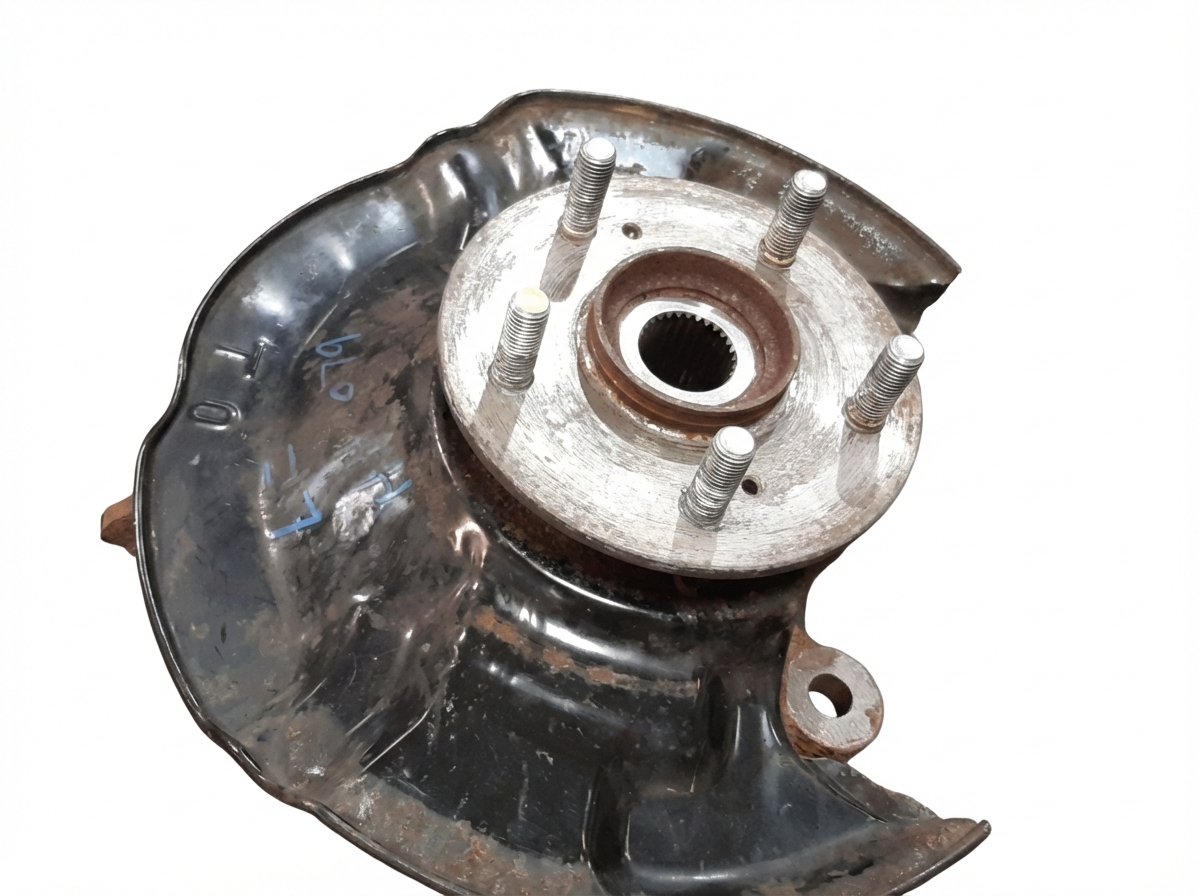

The information in this article is provided for general reference and educational purposes only. Vehicle specifications, procedures, and part compatibility can vary by production date, trim level, and region. Always consult your vehicle's factory service manual and verify part numbers before purchasing or performing repairs. Safety-critical components such as airbags, seat belts, and braking systems should be installed by a qualified professional.
- Toyota RAV4:
- 🛍️ Shop This Part
- Is It the Knuckle, the Bearing, or a Ball Joint?
- Symptoms of a Failing Front Knuckle Assembly
- Buying a Used 1996-2000 RAV4 Spindle Knuckle
- The #1 Priority: ABS vs. Non-ABS
- Physical Inspection Checklist
- A Note on Mileage and Included Bearings
- Replacement Considerations
- Related Parts to Replace
- Key Torque Specs and Procedures
- Cost Comparison: New vs. Used vs. Aftermarket
- Known Issues, Recalls, and TSBs
- Frequently Asked Questions (FAQ)
- 🎟️ Get 5% Off