

2011-2020 Dodge Journey Front Knuckle: Diagnosing Clunks, Grinds, and Bearing Failure
This guide explains how to diagnose front-end noises and failures related to the spindle knuckle, wheel bearing, and ball joint on the 2011-2020 Dodge Journey.
- The knuckle itself rarely fails; symptoms like humming, grinding, or clunking are almost always due to a bad wheel bearing or ball joint.
- When replacing a spindle knuckle, it is critical to also install a new wheel bearing/hub assembly and a new lower ball joint.
- A wheel alignment is mandatory after replacing the knuckle to prevent tire damage and ensure safe handling.
- A failed ball joint or wheel bearing is a major safety issue that can lead to wheel separation. Do not drive the vehicle if you suspect a severe failure.
Symptoms of Spindle Knuckle-Related Failure

The steering knuckle itself is a very durable component that rarely fails unless subjected to a collision or severe impact. However, the parts it connects to—the wheel bearing and the lower ball joint—are common wear items. The symptoms you experience are almost always caused by these related parts failing.
Wheel Bearing and Hub Assembly Failure
The most common failure associated with the knuckle area is a bad wheel bearing. The bearing is housed within the knuckle and is what the wheel spins on. When it wears out, it will produce very distinct noises.
- Humming or Growling Noise: The classic sign of a bad wheel bearing is a humming, growling, or roaring sound that starts faint and gets louder over time. This noise is directly related to vehicle speed—the faster you go, the louder it gets.
- Noise Changes While Turning: A key diagnostic trick is to notice if the noise changes when you turn. For example, if you turn right, the vehicle's weight shifts to the left side. If the noise gets louder, it often indicates the left wheel bearing is the problem. If it gets quieter, the right bearing is likely the culprit.
- Vibration: As the bearing wears, it can develop play, leading to a vibration felt in the steering wheel or the floor.
- ABS / Traction Control Lights: The wheel bearing hub assembly includes a magnetic tone ring that the ABS sensor reads. If this ring gets damaged or covered in debris, or if excessive bearing play damages the sensor, it can trigger the ABS and traction control warning lights on your dashboard.
Lower Ball Joint Failure
The lower ball joint connects the bottom of the knuckle to the lower control arm, acting as a pivot. When it fails, the symptoms are different from a bad bearing.
- Clunking or Knocking Sounds: A worn ball joint will often make a distinct clunking or knocking sound, especially when going over bumps, speed bumps, or uneven pavement at low speeds.
- Steering Wander or Shaky Steering: A loose ball joint can cause the steering to feel vague or shaky, and may cause the vehicle to wander or pull to one side.
- Uneven Tire Wear: A bad ball joint can alter the wheel's alignment, leading to premature and uneven wear on the inside or outside edge of the tire.
Warning: A completely failed ball joint can separate, causing the suspension to collapse and the wheel to fold outwards. This results in a total loss of steering control and is extremely dangerous. If you hear clunking, have it inspected immediately.
Buying a Used 2011-2020 Dodge Journey Front Spindle Knuckle

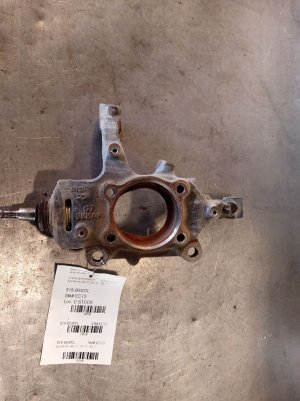
Since a new OEM knuckle can be expensive, a used OEM part from a low-mileage, accident-free vehicle is an excellent value. OEM parts are built to a higher standard of material quality and dimensional tolerance than many cheap aftermarket alternatives. Here’s what to look for:
- Visual Inspection for Cracks: Carefully inspect the entire knuckle, especially around the mounting points for the strut, ball joint, and caliper. Look for any hairline cracks. A knuckle from a vehicle in a collision could have hidden damage.
- Check Machined Surfaces: The hole where the wheel bearing bolts in and the tapered hole where the ball joint presses in must be perfectly round and free of damage, deep rust, or scoring. An out-of-round bore can prevent a new bearing or ball joint from seating correctly.
- Verify Straightness: It is nearly impossible to see a slight bend with the naked eye, but a bent knuckle will cause persistent alignment issues and tire wear. The best way to avoid this is to source the part from a reputable seller who guarantees it came from a non-collision vehicle.
- Mileage Isn't a Major Factor: Unlike a moving part, the knuckle itself doesn't wear out with mileage. The condition is far more important. However, a part from a lower-mileage vehicle is generally preferable as it has seen less stress and exposure to the elements.
- Part Number Verification: Dodge used several part numbers that supersede each other. It is critical to get the correct part for the left (driver) or right (passenger) side. Always provide the seller with your vehicle's VIN to ensure an exact match.
Pro Tip: Even if the used knuckle comes with an old wheel bearing or ball joint, discard them. Always install a new wheel bearing/hub assembly and a new lower ball joint into your replacement knuckle before installation. The labor involved is significant, and you don't want to do it twice.
Known Issues, Recalls, and TSBs
There are no specific recalls or Technical Service Bulletins (TSBs) issued by Dodge for the front spindle knuckle itself on the 2011-2020 Journey. However, several recalls exist for related systems:
- Recall T47 (NHTSA 17V-435): For 2011-2015 models, the driver's airbag wiring could chafe within the steering wheel, potentially causing an unexpected deployment.
- Recall S08 (NHTSA 16V-273): For some 2011-2015 models, power steering lines could leak, causing a loss of power steering assist.
- NHTSA 11V-315: On some 2011 models, a steering column pivot rivet may have been improperly installed, reducing crash protection.
- Recall U86 (NHTSA 18V-523): On some 2018-2019 models, rear brake caliper pistons could have an insufficient coating, potentially reducing rear brake performance.
While these do not directly involve the knuckle, they highlight areas of the steering and suspension systems that may warrant inspection.
Cost Comparison for Front Spindle Knuckle Replacement
The cost can vary significantly based on the parts you choose and local labor rates. This table provides an estimated breakdown:
| Part/Service | Estimated Cost |
|---|---|
| New OEM (Mopar) | $220 - $280 |
| New Aftermarket | $60 - $380 |
| Used OEM | $50 - $120 |
| Shop Labor (Knuckle Replacement) | $200 - $300 |
| Related Part: Wheel Hub Assembly | $50 - $150 |
| Related Part: Lower Ball Joint | $30 - $80 |
Installation Tips and Torque Specs

Replacing the knuckle is a job for an experienced DIYer or a professional, as it involves disassembling most of the front suspension. Special tools like a ball joint press may be required.
Key Related Parts to Replace:
- Wheel Hub & Bearing Assembly: This is a must. It bolts into the new knuckle.
- Lower Ball Joint: This is pressed into the knuckle. It's wise to replace it at the same time.
- Axle Nut: This is a one-time-use nut and must be replaced.
Torque Specifications: These are critical for safety. The values below are commonly cited for this platform, but you should always verify with a model-year specific service manual.
| Component | Torque Spec |
|---|---|
| Hub/Bearing to Knuckle Bolts (x4) | 45 ft-lbs |
| Caliper Adapter to Knuckle Bolts | 125 ft-lbs |
| Strut to Knuckle Nuts | Hold bolt stationary, tighten nut to 59 ft-lbs + 180 degrees |
| Tie Rod End Nut | 37 ft-lbs + 120 degrees |
| Lower Ball Joint to Knuckle Pinch Bolt/Nut | 18 ft-lbs + 120 degrees |
| Axle Hub Nut | 180 ft-lbs (Varies by source, verify) |
Caution: The two bolts connecting the strut to the knuckle are serrated and should not be turned during removal or installation. Hold the bolt head stationary and only turn the nut.
Frequently Asked Questions (FAQ)
Do I need to replace the left and right knuckles at the same time?
No. Unlike brake pads or struts, knuckles are not replaced in pairs. You only need to replace the side that is damaged or has a failed component (like a seized ball joint) that cannot be removed.
Do I need a wheel alignment after replacing a knuckle?
Yes, absolutely. The knuckle is a key part of the suspension geometry. Replacing it will affect the camber and toe settings. A professional wheel alignment is required to ensure proper handling and prevent rapid tire wear.
Can I just replace the wheel bearing instead of the whole knuckle?
Yes. In most cases, only the wheel bearing/hub assembly needs to be replaced. The knuckle is only replaced if it is physically damaged from an accident or if a component like the ball joint is seized so badly it cannot be removed without damaging the knuckle.
Are the knuckles for Front-Wheel Drive (FWD) and All-Wheel Drive (AWD) the same?
For the 2011-2020 Dodge Journey, the front knuckles are generally the same for both FWD and AWD models. The primary difference in the drivetrain is the CV axle that passes through the knuckle. However, always confirm the part number with your VIN to be certain.
Technical Specifications
OEM Part Numbers: 5006211AA 5171101AB 5006212AA 5171102AB 5171102AC
The knuckle is a non-electronic, cast metal component. Key specifications relate to the parts that attach to it. The wheel bearing hub uses four 15mm bolts. The axle nut is typically 32mm. The strut attaches with two large bolts, and the caliper adapter attaches with two 21mm bolts.
We Have This Part in Stock


The information in this article is provided for general reference and educational purposes only. Vehicle specifications, procedures, and part compatibility can vary by production date, trim level, and region. Always consult your vehicle's factory service manual and verify part numbers before purchasing or performing repairs. Safety-critical components such as airbags, seat belts, and braking systems should be installed by a qualified professional.
- Dodge Journey:
- 🛍️ Shop This Part
- Symptoms of Spindle Knuckle-Related Failure
- Wheel Bearing and Hub Assembly Failure
- Lower Ball Joint Failure
- Buying a Used 2011-2020 Dodge Journey Front Spindle Knuckle
- Known Issues, Recalls, and TSBs
- Cost Comparison for Front Spindle Knuckle Replacement
- Installation Tips and Torque Specs
- Frequently Asked Questions (FAQ)
- 🎟️ Get 5% Off