

1992-1994 Toyota 4Runner Speedometer Head: Capacitor Failure, Diagnosis, and Swaps
This guide covers the common failures of the electronic speedometer in 2nd Gen 4Runners, how to tell if it's the speedo or the sensor, and what you need to know before buying a used one.
- The most common cause of failure is leaking capacitors on the internal circuit board, which damages the board's traces.
- If both the speedometer and odometer stop working at the same time, the speedometer head is the most likely culprit, not the vehicle speed sensor (VSS).
- This part does NOT require any programming or flashing. It is a direct replacement.
- A used speedometer head will have the mileage of the donor car, creating a mileage discrepancy that you may be legally required to disclose.
Diagnosing a Faulty 1992-1994 4Runner Speedometer


When your speedometer stops working, it's crucial to determine the root cause. The issue is often with the speedometer head itself, but it could also be the Vehicle Speed Sensor (VSS) or the wiring between them. Since these vehicles are pre-OBD-II, diagnosis relies on observing symptoms and some basic tests.
Symptoms of a Bad Speedometer Head
- Speedometer needle is dead or erratic: The needle may not move at all, or it might bounce around randomly.
- Odometer has stopped counting miles: Since the odometer is driven by the speedometer head, a failure in the head will stop the odometer.
- Both speedometer and odometer fail at the same time: This is a strong indicator that the speedometer head unit is the problem, not an external sensor.
- Check Engine Light with Code 42: A faulty speedometer head can fail to send a speed signal to the ECU, triggering a code 42 (No. 1 Speed Sensor Signal). This can be confusing, as the code points to the sensor, but the problem is often the cluster itself which processes the signal.
Symptoms of a Bad Vehicle Speed Sensor (VSS)
- Erratic automatic transmission shifting: The transmission may shift hard, late, or hunt for gears because it isn't receiving an accurate speed reading.
- Cruise control doesn't work: The cruise control system relies on the VSS signal to maintain speed.
- Speedometer works intermittently: 🎬 Watch this guide to diagnose a non-working Toyota speedometer A failing VSS might send a signal sometimes but not others, causing the speedometer to drop to zero and then spring back to life.
Pro Tip: A common diagnostic step is to rule out the VSS. A mechanic can use an oscilloscope to check for a clean square wave signal from the VSS. If the VSS is producing a good signal, but the speedometer and odometer are dead, the speedometer head is almost certainly the culprit.
Common Failure Modes and Known Issues

These electronic speedometers from the early 90s are known for a specific, common failure: bad capacitors on the circuit board.
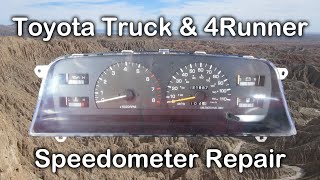
🎬 Watch this video to see how to repair the capacitorsCapacitor Plague
The most frequent cause of failure for these speedometer heads is leaking electrolytic capacitors. Over time, these components degrade and leak an acidic fluid onto the circuit board. This fluid corrodes the delicate copper traces on the board, causing open circuits. Often, one capacitor is responsible for the speedometer function and another for the odometer, but a leak from one can damage traces for both. If your speedometer is still working, it's considered a good preventative measure to replace these capacitors before they fail and cause irreversible board damage.
Recalls and TSBs
While there are no specific recalls for the speedometer cluster itself, several major recalls and service campaigns were issued for the 1992-1994 4Runner that are important for owners to be aware of:
- Steering Relay Rod: A safety recall was issued for certain 1990-1995 4Runners because a crack could develop in the steering relay rod, potentially leading to a loss of steering control.
- Head Gasket: A massive Special Service Campaign (V06) and warranty extension were offered for the 3VZ-E V6 engine due to head gasket failures.
No Technical Service Bulletins (TSBs) directly related to speedometer head failure were found during research, as the common capacitor issue is typically addressed by repair shops or DIY enthusiasts.
Buying a Used 1992-1994 4Runner Speedometer Head
Warning: This part is the internal speedometer/odometer mechanism only, often called the "speedo head." It is not the entire instrument cluster assembly with the plastic housing and other gauges.
Compatibility: Tachometer and Drive Type are Key
Verifying compatibility is the most critical step before buying a used speedometer head.
- Tachometer vs. No Tachometer: The most significant difference is between clusters made for SR5 models (with a tachometer) and base models (without). The speedometer heads are part of these specific cluster assemblies. Ensure the donor vehicle's cluster matches yours. The SR5 cluster is a popular swap for base models, but requires additional wiring for the tachometer and oil pressure gauge.
- Electronic vs. Cable Driven: Most 1992-1994 4Runners use an electronic speedometer that works with a VSS. However, some sources indicate Toyota may have switched back to a mechanical cable-driven speedometer on some very late production models. It is essential to confirm if your cluster has a port for an electrical connector or a square drive for a physical cable.
- Trip Meter: Ensure the replacement unit has a trip meter if your original did. This was typically standard on SR5 models.
Understanding Mileage Discrepancies
The odometer is part of the speedometer head, so a replacement unit will show the mileage from the donor vehicle, not your own. This will cause a mileage discrepancy on your vehicle's title history. It is often legally required to document this change. Some repair services can transfer your original mileage to the repaired or replacement unit.
Programming and Installation
Does this part require programming?
No. A speedometer head from this era is a direct, plug-and-play component. It does not need to be programmed, flashed, or coded to the vehicle. There is no immobilizer or anti-theft link.
Installation Overview
Replacing the speedometer head requires removing the entire instrument cluster from the dashboard. The difficulty is moderate and can take 1-2 hours.
- Disconnect the negative battery terminal.
- Remove the lower dash trim panels and steering column covers to gain access.
- Remove the screws holding the instrument cluster bezel (the black plastic trim around the gauges).
- Unscrew the instrument cluster assembly itself.
- Carefully pull the cluster forward and disconnect the electrical connectors from the back.
- Once the cluster is on a workbench, you can remove the clear plastic front cover and unscrew the speedometer head from the main cluster body.
- Installation is the reverse of removal.
Cost Comparison
| Part Option | Estimated Cost |
|---|---|
| New OEM | $400+ (Likely discontinued, price from early 2000s) |
| New Aftermarket | Not commonly available |
| Used OEM | $100 - $250 |
| Remanufactured / Repair Service | $150 - $250 |
| Shop Labor to Replace | $150 - $300 |
Frequently Asked Questions (FAQ)
My speedometer needle is dead and the odometer isn't moving. Will replacing this part fix it?
Yes, this is the classic symptom of a failed speedometer head, most likely due to bad capacitors. While you should first rule out a bad fuse or wiring connection, if both the speedometer and odometer fail together, the head unit is the primary suspect.
Do I need to program this speedometer after installation?
No, programming is not required for this part on a 1992-1994 4Runner. It is a simple plug-and-play replacement.
What do I do about the incorrect mileage on the used speedometer?
The used part will display the mileage from the vehicle it came from. This is a legal issue, and you may be required to place a sticker on the door jamb noting the mileage at the time of the swap. Alternatively, you can send your original cluster or a replacement to a specialty repair service that can set the odometer to your vehicle's correct mileage.
Can I install a cluster with a tachometer (from an SR5) into my base model 4Runner?
Yes, this is a very common and popular upgrade. However, it is not entirely plug-and-play. You will need to replace the oil pressure sending unit on the engine with one designed for a gauge (not a light) and may need to run a new wire for the tachometer signal.
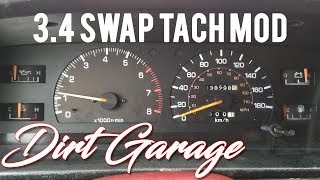
🎬 Watch how to complete an SR5 cluster swapHelpful Videos

Technical Specifications
OEM Part Numbers: 83110-04040 83110-0W030 83110-35380 83110-35390 83010-35590
Fits SR5 trim levels with factory tachometer and electronic speed sensor. This is the internal head unit, not the full cluster housing.

The information in this article is provided for general reference and educational purposes only. Vehicle specifications, procedures, and part compatibility can vary by production date, trim level, and region. Always consult your vehicle's factory service manual and verify part numbers before purchasing or performing repairs. Safety-critical components such as airbags, seat belts, and braking systems should be installed by a qualified professional.
- Toyota 4Runner:
- 🎬 Helpful Videos
- Diagnosing a Faulty 1992-1994 4Runner Speedometer
- Symptoms of a Bad Speedometer Head
- Symptoms of a Bad Vehicle Speed Sensor (VSS)
- Common Failure Modes and Known Issues
- Capacitor Plague
- Recalls and TSBs
- Buying a Used 1992-1994 4Runner Speedometer Head
- Compatibility: Tachometer and Drive Type are Key
- Understanding Mileage Discrepancies
- Programming and Installation
- Does this part require programming?
- Installation Overview
- Cost Comparison
- Frequently Asked Questions (FAQ)
- 🎟️ Get 5% Off