

Bentley Continental & Flying Spur W12 Radiator Fan Failure: Diagnosis and Replacement (2004-2013)
Address overheating in your 6.0L W12 Bentley by diagnosing and replacing the common-to-fail radiator cooling fan assembly.
- The primary cause of overheating at idle in a W12 Bentley is a failed radiator cooling fan assembly.
- This part is for the 6.0L W12 engine ONLY and is not compatible with the 4.0L V8.
- Replacement is a complex job (4/5 difficulty) because the front bumper must be removed for access.
- A new OEM assembly is very expensive (over $1,900), making a quality tested used OEM part a cost-effective solution.
Understanding the W12 Cooling Fan and Shutter Assembly
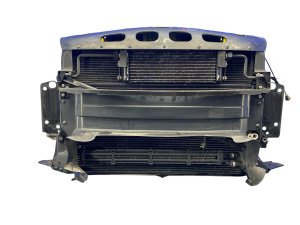
The part commonly referred to as the radiator support or shutter assembly is more accurately the Radiator Cooling Fan Assembly. On the W12-powered Bentley Continental and Flying Spur, this is a large, integrated unit containing the fan shroud, powerful electric fan motors, and the electronic fan control modules that regulate their speed. Early models typically use a twin-fan setup, while models from around 2008 onwards often use a large, single-fan design. Failure of any part of this assembly can quickly lead to engine overheating.
Separately, these vehicles may be equipped with Active Grille Shutters. These are flaps mounted behind the main grille that automatically open or close. When closed at cruising speed, they improve aerodynamics and fuel economy. When open, they allow maximum airflow to the radiator for cooling. While a shutter failure can contribute to cooling issues, the most common and serious problems stem from the fan assembly itself.
Compatibility Warning: This guide and the associated part numbers are for models equipped with the 6.0L W12 engine only. These fan assemblies will not fit vehicles with the 4.0L V8 engine, which use a different part (e.g., 3W0121205D). Always confirm your engine size before ordering.
Symptoms of a Failing Radiator Fan or Shutter Assembly
A failing fan assembly will make itself known quickly, especially in warm weather or city driving. Watch for these specific signs:
- Engine Overheating at Idle: This is the most common symptom. The temperature gauge will climb towards the red zone when you're stopped in traffic but may return to normal when you're moving at higher speeds.
- Loud or Inoperative Fans: You may notice the fans, which are normally audible when running, are completely silent when the engine is hot. Conversely, a failed control module can cause the fans to run at maximum speed constantly, even after the car is turned off, draining the battery.
- Poor Air Conditioning Performance: The A/C system relies on airflow through the condenser (which sits with the radiator). If the fans aren't working, the A/C will blow warm or cool—but not cold—air when the car is stationary.
- Check Engine Light: A fault in the active grille shutter system or the fan control circuit can trigger a check engine light. Codes like P0480 (Cooling Fan Control Circuit) may be present.
- Unusual Noises: Worn fan motor bearings can cause a grinding or whining noise. A malfunctioning active shutter can create a rattling or clicking sound from the front of the car.
- Corrosion-Related Intermittent Failure: On some early models, a critical power wire splice in the engine bay can corrode, leading to intermittent power loss for the fans and the interior blower motor. This may cause the fans to work one day and not the next.
Known Issues, TSBs, and Recalls
While no specific recalls target the fan assembly for these model years, the cooling system is a known area for attention.
- Fan Control Module (FCM) Failure: The electronic modules that control fan speed are a very common failure point. They are exposed to significant heat and vibration, which can cause them to burn out. This can result in fans that don't run at all or run at full speed continuously.
- Corroded Power Splice: A known issue on some 2004 models involves a corroded wire splice that supplies power to both the radiator fans and the HVAC blower motor. Symptoms include both systems failing intermittently or simultaneously. The splice is often found covered in tape and suffering from water intrusion.
- Related Recalls: While not directly for the fans, related recalls for these vehicles include potential corrosion of the fuel filter housing and loose battery cable connections at the firewall, which could theoretically impact electrical system stability.
Buying a Used Radiator Fan Assembly: What to Check
Given that a new OEM fan assembly from Bentley can cost over $1,900, a quality used OEM part is an excellent value. Aftermarket options exist but may not have the same durability or precise fit as a genuine part. Here’s what to inspect on a used unit:
- Verify the Part Number: Double-check that the part number is correct for your W12 engine. Part numbers like 3W0121191C are for earlier twin-fan setups, while 3W0121205E is for later single-fan units. Do not purchase a V8 fan assembly.
- Inspect the Shroud for Damage: The plastic shroud is large and can be brittle. Check carefully for any cracks, especially around the mounting points. A cracked shroud can cause vibrations and may not hold the fans securely.
- Spin the Fan Blades: Turn each fan blade by hand. They should spin smoothly with minimal resistance and no grinding or scraping sounds. A fan that is difficult to turn or feels gritty has a failing motor bearing.
- Check Electrical Connectors: Look closely at all electrical plugs and pins on the assembly and control modules. There should be no signs of green or white corrosion, melted plastic, or bent pins.
- Look for Heat Damage: Inspect the fan control modules (the small electronic boxes attached to the shroud). Look for any signs of warped plastic or discoloration, which could indicate a past overheating event.
Pro Tip: When buying used, prioritize an assembly from a lower-mileage, accident-free vehicle. Physical damage from a front-end collision is a major red flag, even if it looks minor.
Cost of Replacement
Replacing the radiator fan assembly is a significant expense, primarily driven by high OEM part costs and the labor required to access it.
| Part/Service | Estimated Cost |
|---|---|
| New OEM Fan Assembly | $1,800 - $2,500 |
| New Aftermarket Assembly | $700 - $1,200 |
| Used OEM Assembly | $400 - $1,000 |
| Shop Labor | $600 - $1,000 (est. 4-6 hours) |
Installation Overview & Difficulty
This is an advanced DIY job or a straightforward task for an experienced technician. Accessing the fan assembly requires the complete removal of the front bumper cover.
- Difficulty Rating: 4 out of 5
- Estimated Time: 4-6 hours
- Process Summary: The process involves jacking up the front of the vehicle, removing the front wheels, detaching the fender liners, and removing the engine undertray. There are several T-25 and 8mm fasteners, including tricky ones located inside the headlight washer openings that may require a special thin or modified wrench. After disconnecting parking sensor and fog light wiring, the bumper cover can be carefully removed. With the bumper off, the fan assembly is directly accessible for removal and replacement.
Frequently Asked Questions (FAQ)
Can I drive my Bentley if the radiator fan is broken?
It is not recommended. While you might be able to drive at highway speeds where natural airflow keeps the engine cool, stopping in traffic will cause the engine to overheat very quickly, risking catastrophic engine damage like a warped cylinder head or blown head gasket.
My fans run for 10 minutes after I shut the car off. Is this normal?
No, this is a classic symptom of a failed fan control module. The fans should only run for a short period after shutdown if the engine is extremely hot. If they run at full speed for many minutes every time, the control module is likely faulty and will drain your battery.
Why did my radiator fan and my interior heat stop working at the same time?
This is a strong indicator of a corroded main power splice, particularly on 2004 models. A single corroded connection under the hood can cut power to both the radiator fan relays and the HVAC blower motor relay. The splice must be located and repaired.
Do I need to program a new fan assembly?
No, the fan assembly is a plug-and-play component. The fan control modules are self-contained and do not require coding or programming after installation.
Technical Specifications
OEM Part Numbers: 3W0121191A 3W0121191B 3W0121191C 3W0121205 3W0121205A 3W0121205B 3W0121205E 3W0121207A
Assembly includes fan shroud, electric motor(s), fan blades, and integrated fan control module(s). Early models use a twin-fan design; later models (approx. 2008+) use a single, larger fan.
We Have This Part in Stock

The information in this article is provided for general reference and educational purposes only. Vehicle specifications, procedures, and part compatibility can vary by production date, trim level, and region. Always consult your vehicle's factory service manual and verify part numbers before purchasing or performing repairs. Safety-critical components such as airbags, seat belts, and braking systems should be installed by a qualified professional.
- Bentley Continental:
- Bentley Flying Spur:
- 🛍️ Shop This Part
- Understanding the W12 Cooling Fan and Shutter Assembly
- Symptoms of a Failing Radiator Fan or Shutter Assembly
- Known Issues, TSBs, and Recalls
- Buying a Used Radiator Fan Assembly: What to Check
- Cost of Replacement
- Installation Overview & Difficulty
- Frequently Asked Questions (FAQ)
- 🎟️ Get 5% Off