

Guide to the 2014-2021 GMC Sierra 1500 Coolant Temperature Sensor
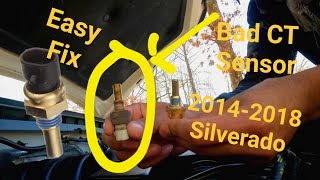
Answering why your temperature gauge is wrong and your cooling fans won't shut off.
- Common symptoms include a check engine light, cooling fans that won't turn off, and an incorrect temperature gauge.
- Replacement is a simple DIY job that takes less than an hour with a 19mm socket or wrench.
- For 2019-2020 models, check TSB 20-NA-167 for code P0128, as it may only require a computer update.
- Since the OEM (ACDelco) sensor is affordable and reliable, it is the recommended choice for this repair.
Is Your Sierra's Coolant Sensor Failing?

When the coolant temperature sensor in a 2014-2021 GMC Sierra 1500 begins to fail, it sends incorrect information to the engine's computer. This can make the truck behave as if it's hot when it's cold, or cold when it's fully warmed up. The signs are often easy to spot if you know what to look for.
Key Failure Symptoms
- Check Engine Light: This is often the first warning. The sensor will trigger codes like P0117, P0118, or P0128.
- Cooling Fans Run Constantly: As a fail-safe, the truck's computer may run the cooling fans at full speed continuously if it gets a bad signal from the sensor. This can happen even when starting the engine cold and can cause the fans to stay on after the truck is turned off.
- Inaccurate Temperature Gauge: The gauge on your dashboard may stop working, stay on cold, or swing back and forth erratically.
- Poor Fuel Economy: If the sensor tells the computer the engine is always cold, the computer will enrich the fuel mixture, causing you to use more gas.
- Black Smoke from Exhaust: In severe cases, a very rich fuel mixture can result in unburnt fuel producing black smoke from the tailpipe.
Known Issues & Bulletins
TSB 20-NA-167: For some 2019-2020 Sierra 1500 models with the LV3 engine, a P0128 trouble code may not be caused by a bad sensor. GM noted this can be a false code, and the official fix is to have a dealer reprogram the Engine Control Module (ECM), not replace the part.
PI1513E: On some 2014-2016 models, excessive thermostat cycling could cause radiator leaks. While not a sensor issue, it is a related cooling system problem that can also be associated with a P0128 code.
Choosing the Right Aftermarket Sensor

When replacing the coolant temperature sensor, you have a choice between OEM (Original Equipment Manufacturer) and aftermarket parts. For many parts, aftermarket options provide a good balance of quality and cost savings. However, for this specific sensor on the 2014-2021 Sierra, the OEM part (ACDelco) is widely available and very affordable. Some mechanics report that they prefer to stick with the GM or ACDelco part for this repair to ensure reliability, as they have experienced issues with some aftermarket alternatives. Given that a standard aftermarket sensor is priced similarly to the OEM version, choosing the ACDelco part is a reliable choice for a DIY or professional repair.
Pro Tip: Many mechanics recommend replacing the thermostat at the same time as the coolant temperature sensor, especially on higher-mileage trucks or if you are getting a P0128 code. The parts are located next to each other and it saves you from having to do a similar job twice.
Cost to Replace the Coolant Temperature Sensor
| Part Type | Price Range |
|---|---|
| New Aftermarket | $20 - $25 |
| New OEM (ACDelco) | $18 - $25 |
| Shop Labor | $95 - $150 |
| Total Professional Repair | $115 - $175 |
Frequently Asked Questions (FAQ)

Where is the coolant temperature sensor located on the 2014-2021 Sierra?
The sensor is located on the driver's side of the engine, near the front. You can find it by following the upper radiator hose to where it connects to the thermostat housing; the sensor is typically screwed into the cylinder head right next to this housing. You will likely need to remove the plastic engine cover and air intake tube for clear access.
Can I replace this sensor myself?
Yes, this is a very DIY-friendly repair that can be done in under an hour with basic tools. The main tool required is a 19mm (or 3/4 inch) deep socket or wrench. It is best to perform the replacement when the engine is completely cool to avoid being burned by hot coolant. A small amount of coolant will leak out when the old sensor is removed, so have the new sensor ready to install quickly.
What happens if I don't replace a bad coolant sensor?
Ignoring a bad sensor will lead to persistent problems. You will experience poor fuel economy, rough engine performance, and a constantly running cooling fan which wears out the fan motors. In a worst-case scenario, the sensor could fail to report an overheating condition, putting your engine at risk of serious damage.
Do I need to drain the coolant to replace the sensor?
You do not need to fully drain the cooling system. Only a small amount of coolant will be lost when you unscrew the sensor, as it is located high up on the engine. You can minimize the mess by placing a rag underneath the sensor and being ready to thread the new one in as soon as the old one is out. Always check your coolant level in the overflow tank after the job is done and top it off if needed.
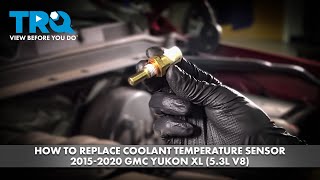
Helpful Videos

Technical Specifications
OEM Part Numbers: 19236568 213-4514 12608814
Thread Size: M12 x 1.5

The information in this article is provided for general reference and educational purposes only. Vehicle specifications, procedures, and part compatibility can vary by production date, trim level, and region. Always consult your vehicle's factory service manual and verify part numbers before purchasing or performing repairs. Safety-critical components such as airbags, seat belts, and braking systems should be installed by a qualified professional.
- GMC Sierra 1500: