

Ford F-150 (2008-2017) MAP Sensor: Symptoms and Replacement Guide
Experiencing poor fuel economy, rough idle, or a check engine light in your F-150? A faulty MAP sensor could be the problem.
- A bad MAP sensor commonly causes a check engine light, poor fuel economy, rough idle, and hesitation.
- Replacement is a simple, DIY-friendly job on most F-150 engines, often taking less than 30 minutes.
- EcoBoost engines have multiple pressure sensors; proper diagnosis is key to replacing the correct one.
- A quality aftermarket sensor is a cost-effective alternative to the more expensive OEM part for this repair.
Is Your F-150's MAP Sensor Failing?

A MAP sensor failure can disrupt your truck's performance, but the signs are usually clear. Because the sensor provides vital data for fuel and timing, a bad reading can cause a range of noticeable problems. If the sensor sends incorrect data, the engine's computer may add too much or too little fuel, leading to poor performance and potentially higher emissions.
Common Symptoms of a Bad MAP Sensor
- Check Engine Light: This is often the first sign. The ECU will store trouble codes like P0106, P0107, or P0108. 🎬 Watch: How to diagnose these MAP sensor trouble codes.
- Poor Fuel Economy: If the ECU thinks there is low pressure (high vacuum), it may enrich the fuel mixture, causing you to use more gas.
- Rough Idle: The engine may shake, surge, or struggle to maintain a steady RPM at a stop.
- Lack of Power & Hesitation: During acceleration, your truck may feel sluggish or hesitate because the computer can't properly adjust the fuel delivery.
- Black Smoke from Exhaust: This is a sign of a rich fuel mixture, where unburned fuel exits through the exhaust.
- Hard Starting or Stalling: A completely failed sensor can prevent the ECU from knowing how much fuel is needed to start the engine.
Choosing a New Aftermarket MAP Sensor

When replacing the MAP sensor on your 2008-2017 F-150, you have the choice between an Original Equipment Manufacturer (OEM) part from Ford (Motorcraft) and various aftermarket brands. While some mechanics prefer OEM for critical sensors, a quality aftermarket part can offer a reliable and cost-effective solution for this component.
Aftermarket brands like Bosch, Delphi, and Standard Motor Products have a reputation for producing quality components that function as reliable alternatives to OEM parts. A standard aftermarket part, such as one from the "Replacement" brand, provides a functional, budget-friendly option. For a simple sensor like the MAP, which is easy to access and replace, an aftermarket part is a practical choice for many owners, saving significant cost compared to the OEM dealer part. However, it is generally wise to avoid the absolute cheapest, unbranded options, as their calibration and longevity can be questionable.
A Note for EcoBoost Owners
The 3.5L and 2.7L EcoBoost engines often have three separate pressure sensors in the intake system. One is typically on the intake manifold itself, another near the air filter box, and a third on the charge pipe after the intercooler. If you have an EcoBoost, it's important to correctly diagnose which sensor has failed before ordering a replacement.
MAP Sensor Replacement Cost
Replacing the MAP sensor is an affordable repair. The part itself is not expensive, and the labor is minimal for a professional mechanic. Many owners with basic tools can also perform the replacement at home.
| Part/Service | Estimated Cost |
|---|---|
| New OEM (Motorcraft) Part | $85 - $140 |
| New Aftermarket Part | $35 - $75 |
| Shop Labor | $40 - $80 |
| Total Professional Replacement | $160 - $230 |
Frequently Asked Questions (FAQ)

Can I clean my F-150's MAP sensor instead of replacing it?
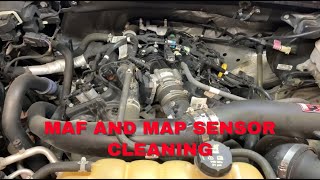
Sometimes, yes. The sensor can get dirty with oil or carbon buildup, which can be cleaned with a dedicated Mass Airflow (MAF) sensor cleaner. 🎬 See this walkthrough on cleaning your EcoBoost sensors. Do not touch the internal sensing element with a cotton swab or any tool. If cleaning doesn't resolve the symptoms or trouble codes, replacement is necessary.
Where is the MAP sensor located on my 2008-2017 F-150?
The location varies by engine. On EcoBoost models like the 2.7L and 3.5L, a primary MAP sensor is usually found on top of the intake manifold, held in by a single bolt. On the 5.0L V8, the sensor is located on the rear of the intake manifold, which can be more difficult to access.
Are there any recalls for the MAP sensor on these trucks?
No. Searches of the National Highway Traffic Safety Administration (NHTSA) database show no specific recalls or technical service bulletins (TSBs) for MAP sensor failure on the 2008-2017 Ford F-150.
Is replacing the MAP sensor a difficult DIY job?
For most F-150 engines in this year range, it is a very easy job. It typically involves removing an engine cover, disconnecting an electrical connector, and removing one or two small bolts. The entire process can often be done in under 30 minutes with basic hand tools.
Helpful Videos
Technical Specifications
OEM Part Numbers: CX-2401 BL3Z-9F479-C
The MAP sensor for the Ford F-150 (2008-2017) is a solid-state electronic sensor that converts intake manifold pressure into a voltage signal. It typically operates on a 5-volt reference from the ECU. The sensor is mounted directly to the intake manifold or connected via a vacuum hose, secured with one or two bolts, and uses a sealed electrical connector.

The information in this article is provided for general reference and educational purposes only. Vehicle specifications, procedures, and part compatibility can vary by production date, trim level, and region. Always consult your vehicle's factory service manual and verify part numbers before purchasing or performing repairs. Safety-critical components such as airbags, seat belts, and braking systems should be installed by a qualified professional.
- Ford F-150: