

A Guide to Replacing the Transmission Speed Sensor on a 2008-2014 Nissan Rogue
Experiencing shifting problems or a faulty speedometer? Your Rogue's transmission speed sensor could be the culprit.
- The 2008-2014 Rogue has two transmission speed sensors (input and output) that are common failure points.
- Symptoms include harsh shifting, a dead or erratic speedometer, and the Check Engine Light with codes P0720 or P0725.
- Replacement is a DIY-friendly task for many owners, with the output sensor being particularly easy to access behind the driver's side wheel.
- While there are no specific recalls for the sensors, CVT issues are well-known for this Rogue generation.
Understanding Speed Sensor Failures in the Nissan Rogue

If your 2008-2014 Nissan Rogue starts to shift erratically, hesitates, or the speedometer stops working, a failing transmission speed sensor is a likely cause. These sensors provide essential data to your vehicle's computer to control the CVT. When one fails, the transmission doesn't know how to adjust properly, leading to noticeable driving issues. This is a common issue that can also trigger the Check Engine Light.
Don't Confuse with ABS Wheel Speed Sensors
Your Rogue also has wheel speed sensors at each wheel for the Anti-lock Braking System (ABS). A failing ABS sensor will typically trigger the ABS or traction control warning light, not cause the transmission shifting problems described here. This guide focuses specifically on the transmission speed sensors.
Symptoms of a Failing Transmission Speed Sensor

A bad input or output transmission speed sensor can cause several problems. You might notice one or more of the following:
- Harsh or Erratic Shifting: The transmission may jerk, shift at the wrong times, or feel like it's slipping.
- Malfunctioning Speedometer: The speedometer needle may jump around or drop to zero while driving.
- Check Engine Light: A failing sensor will often trigger a Diagnostic Trouble Code (DTC), illuminating the light. Common codes include P0720 (Output Speed Sensor) and P0725 (Input Speed Sensor).
- Loss of Cruise Control: The cruise control system relies on accurate speed data and may stop working if the sensor fails.
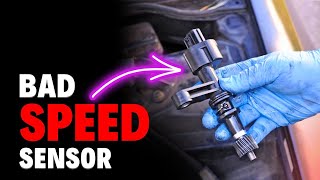
- Hesitation or Stalling: In some cases, the vehicle may hesitate, stall, or feel like it has reduced power. One owner reported the engine RPM would not go above 1,500 when a P0720 code was present. 🎬 See a visual guide on common signs of sensor failure.
Choosing a Replacement Aftermarket Sensor

When replacing a critical electronic part like a transmission speed sensor, the choice between Original Equipment Manufacturer (OEM) and aftermarket can be tough. For sensors that are vital to how the vehicle drives, OEM parts are often recommended for their proven reliability and longevity. However, for a vehicle like the 2008-2014 Rogue, a quality aftermarket part can offer significant cost savings. Brands like SKP, NGK, Delphi, and TRQ are commonly available and can be a reliable alternative to more expensive OEM parts. Since the labor to replace these sensors is relatively low, using an aftermarket part presents a lower financial risk if it were to fail prematurely compared to a part that is very difficult to access.
🎬 Learn more about the differences between OEM and aftermarket sensors.| Part | Estimated Cost |
|---|---|
| New OEM Speed Sensor | $160 - $298 |
| New Aftermarket Speed Sensor | $25 - $120 |
| Shop Labor | $77 - $114 |
Pro Tip: Replace the O-Ring
The speed sensors are sealed with a small O-ring. Always use the new O-ring that comes with your replacement sensor and apply a small amount of clean transmission fluid to it before installation to ensure a proper seal.
Frequently Asked Questions

How many transmission speed sensors does my 2008-2014 Rogue have?
Your Rogue's CVT has two main speed sensors: an input (primary) speed sensor and an output (secondary) speed sensor. They are separate parts and can be replaced individually.
Where are the transmission speed sensors located?
Both sensors are located on the outside of the transmission case. The output speed sensor is typically located on the side of the transmission, near where the driver's side axle (driveaxle) enters the transmission. The input speed sensor is often on the front side of the transmission, facing the radiator, and may require removing the battery and battery tray to access.
Can I replace the speed sensor myself?
Yes, this is a feasible DIY job for someone with basic mechanical skills. The output sensor is generally easier to access, often only requiring the removal of the driver's side front wheel and inner fender liner. The input sensor can be more challenging due to its location. Both are typically held in by a single 10mm bolt.
Are there any recalls for the speed sensor on my Rogue?
There are no specific recalls for the transmission speed sensors on the 2008-2014 Nissan Rogue. While Nissan did extend the warranty on the CVT for some model years (2008-2010) due to reliability issues, this did not specifically target the sensors. There was a recall for a wiring harness connector that could short due to water intrusion in the driver's footwell, but this was not directly related to the speed sensors.
Helpful Videos


Technical Specifications
The 2008-2014 Nissan Rogue uses a Continuously Variable Transmission (CVT) with two primary speed sensors: an input (primary) sensor and an output (secondary) sensor. They are magnetic hall-effect sensors held in place by a single 10mm bolt.

The information in this article is provided for general reference and educational purposes only. Vehicle specifications, procedures, and part compatibility can vary by production date, trim level, and region. Always consult your vehicle's factory service manual and verify part numbers before purchasing or performing repairs. Safety-critical components such as airbags, seat belts, and braking systems should be installed by a qualified professional.
- Nissan Rogue: