

Guide to the Variable Timing Solenoid for the 2007-2020 Nissan Altima
Fixing rough idle, poor performance, and check engine lights in your Altima often starts with this critical part.
- Dirty engine oil is the primary cause of VVT solenoid failure; always perform an oil change with the replacement.
- Symptoms include a check engine light (P0011, P0014), rough idle, poor acceleration, and decreased gas mileage.
- For a reliable repair, consider an OEM-equivalent brand like Hitachi, which is the likely original supplier for Nissan.
- It is best practice to replace the solenoids as a set (e.g., both intake and exhaust) as they fail at a similar rate.
Symptoms of a Failing VVT Solenoid in a Nissan Altima

When a VVT solenoid begins to fail, it can't properly regulate oil flow, throwing your engine's timing out of sync. The most common cause of failure is old or dirty engine oil, which clogs the tiny passages inside the solenoid. Keeping up with your Altima's recommended oil change schedule is the best way to prevent this issue. If you notice the following symptoms, a bad VVT solenoid is a likely culprit.
- Check Engine Light: This is the most common sign. The system will detect incorrect camshaft timing and trigger a fault code. Common codes for this issue on an Altima include P0011 (Intake Valve Timing) 🎬 Watch: How to diagnose and fix the P0011 code., P0014 (Exhaust Valve Timing), and P0015.
- Rough Idle and Stalling: Your Altima's engine may shake, run unevenly, or even stall when you're stopped at a light. 🎬 See how a bad solenoid causes rough idling and stalling. This happens because the solenoid can get stuck, causing incorrect valve timing at low engine speeds.
- Poor Acceleration: The car may feel sluggish or hesitate when you try to accelerate. The engine isn't able to adjust its timing to produce more power when you need it.
- Reduced Fuel Economy: If you find yourself visiting the gas station more often, a faulty solenoid could be to blame. The engine gets stuck in a less efficient timing position, causing it to burn more fuel.
- Engine Noises: In some cases, you might hear a rattling or ticking noise coming from the top of the engine.
Choosing the Right Aftermarket Solenoid

When replacing a VVT solenoid on your Altima, you have a choice between OEM (Original Equipment Manufacturer) and aftermarket parts. While OEM parts from a Nissan dealer offer a guaranteed fit and quality, they come at a significantly higher price. Aftermarket parts can provide excellent value, but quality varies between brands.
Brand Quality Tiers
| Tier | Brands | Notes |
|---|---|---|
| OEM / OEM-Equivalent | Nissan, Hitachi | Hitachi is widely considered to be the original manufacturer for Nissan's VVT solenoids. Choosing Hitachi offers OEM quality without the dealership price tag. |
| Quality Aftermarket | Standard Motor Products (SMP), NTK, Beck/Arnley, Gates | These brands have a strong reputation in the aftermarket for producing reliable electronic components and engine parts that meet or exceed OEM specifications. |
| Value-Oriented Aftermarket | Dorman, Replacement, various store brands | These brands offer a cost-effective solution. However, some users and mechanics report mixed results with lower-cost electronic parts, sometimes leading to recurring check engine light codes. While they can be a good budget option, they may carry a higher risk of premature failure compared to OEM-equivalent brands. |
A Note on Engine Differences
Your Altima's engine determines how many solenoids you have. The 2.5L 4-cylinder engine has at least two solenoids (one for intake, one for exhaust). The 3.5L V6 engine will have more. It is highly recommended to replace the solenoids in pairs or as a complete set, as they wear at a similar rate. If one has failed due to oil contamination, the others are likely not far behind.
Known Issues: TSB for 2019-2020 Altima (P0015)

Nissan issued a Technical Service Bulletin (TSB), NTB20-064, for some 2019-2020 Altima models with the 2.5L (PR25DD) engine. This bulletin addresses a specific issue where the car stores a P0015 trouble code. 🎬 Watch: Understanding the causes and fixes for the P0015 code. The fix is to replace the exhaust valve timing control solenoid valve. The TSB also notes that diagrams in the official service manual may have the intake and exhaust solenoids incorrectly labeled, so careful identification is important during replacement.
Frequently Asked Questions (FAQ)

Is it difficult to replace a VVT solenoid on an Altima?
No, this is a job most DIYers can handle. It typically involves removing the engine cover, disconnecting an electrical plug, and removing a single 10mm bolt that holds the solenoid in place. On some 2.5L models, access can be tight and may require loosening a motor mount bracket to create enough space.
Should I change my oil when I replace the solenoid?
Yes, absolutely. Dirty, sludgy oil is the number one cause of VVT solenoid failure. Replacing the solenoid without changing the oil means the new part will immediately be exposed to the same contaminants that caused the original to fail. An oil and filter change is critical for a lasting repair.
What's the difference between an intake and exhaust solenoid?
They perform the same function but control different camshafts. The intake solenoid controls the timing of the intake valves (air and fuel entering the cylinder), while the exhaust solenoid controls the exhaust valves (gases leaving the cylinder). They often have different part numbers and are not interchangeable, so be sure to order the correct one for the code your car is showing (e.g., P0011 for intake, P0014 for exhaust).
Is there a recall for this part on my Altima?
There are no specific recalls for the VVT solenoids on 2007-2020 Nissan Altimas. There is a recall for some 2019-2020 Altimas with VC-Turbo engines, but it concerns internal engine bearings, not the solenoids. The most relevant official document is the TSB for the P0015 code on 2019-2020 models.
Helpful Videos
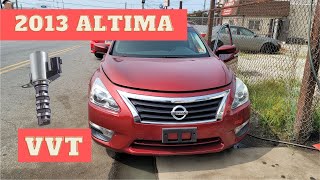
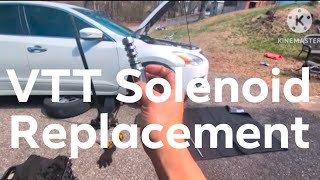
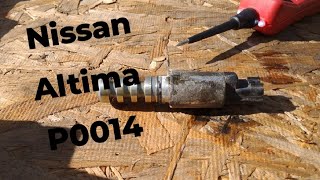
![2013-2018 Nissan Altima 2.5L P0011 Diagnosis & Fix! [2.5L QR25DE]](https://img.youtube.com/vi/fc7nq9cw1yM/mqdefault.jpg)

Technical Specifications
OEM Part Numbers: 23796-3TA1A 23796-3TA4A 23796-3JV2A 23796-JA10B 23796-EA20B
The VVT solenoid is an electronically controlled, 12V solenoid that uses oil pressure to actuate the camshaft phasers. The 2.5L QR25DE engine uses at least two solenoids (intake and exhaust), while the 3.5L VQ35DE uses two or four depending on the year. Each solenoid is secured by a single 10mm bolt and sealed with an O-ring.

The information in this article is provided for general reference and educational purposes only. Vehicle specifications, procedures, and part compatibility can vary by production date, trim level, and region. Always consult your vehicle's factory service manual and verify part numbers before purchasing or performing repairs. Safety-critical components such as airbags, seat belts, and braking systems should be installed by a qualified professional.
- Nissan Altima: