

Honda CR-V Crankshaft Position Sensor: A Guide for 1997-2014 Models
Understand the symptoms, replacement costs, and part choices for your CR-V's crankshaft position sensor.
- A failing sensor will cause stalling or no-start issues and should be replaced promptly.
- For Honda electronics, using OEM or a high-quality OE-supplier brand is strongly recommended for reliability.
- The sensor's location and replacement difficulty vary significantly between CR-V generations.
- Always check the wiring and connector for damage or corrosion before assuming the sensor is bad.
Is Your CR-V's Crankshaft Position Sensor Failing?

A bad crankshaft position sensor can cause problems ranging from annoying to leaving you stranded on the side of the road. Because this sensor is vital for engine timing, a failure will almost always turn on the Check Engine Light and can make your CR-V difficult or impossible to drive. Common signs include the engine cranking but not starting, 🎬 Watch this guide on diagnosing a CR-V crank-no-start condition. stalling unexpectedly (especially when warm), a rough idle, poor acceleration, and a decrease in fuel economy.
Generational Differences in Sensor Location

Finding the sensor is often the most challenging part of the replacement. Its location varies by your CR-V's generation:
- 1st Gen (1997-2001): The sensor is located on the back of the engine block, near the crank pulley and oil pump. On some of these models, the sensor is located inside the distributor, which means the entire distributor assembly may need to be replaced to fix the issue. Access can be difficult and may require removing other components.
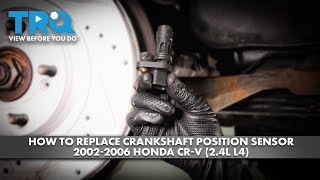
- 2nd Gen (2002-2006): The sensor is found on the engine block, behind the crankshaft pulley. It is typically accessed by removing the passenger-side front wheel and a plastic splash shield.
- 3rd & 4th Gen (2007-2014): The sensor is on the lower part of the engine where it meets the transmission. It is sometimes hidden below the starter and is accessed from underneath the vehicle. 🎬 Watch this video to locate the sensor on 2007-2014 CR-Vs.
Choosing an Aftermarket Sensor: Quality Matters

When replacing a critical electronic part on a Honda, quality is key. While budget-friendly aftermarket sensors are widely available, mechanics and experienced owners strongly recommend using either a genuine Honda part or a sensor from an Original Equipment (OE) manufacturer like Denso, Hitachi, or NTK. Cheaper, unbranded sensors have a reputation for failing prematurely, which means you might have to do the job all over again. Given the labor involved, choosing a higher-quality part from the start is a wise investment.
Cost to Replace Honda CR-V Crankshaft Position Sensor (1997-2014)
| Part/Service | Estimated Cost |
|---|---|
| New OEM Part | $94 - $182 |
| New Aftermarket Part | $31.90 - $39.16 |
| Shop Labor | $82 - $140 |
| Total Professional Replacement (Aftermarket) | $114 - $180 |
| Total Professional Replacement (OEM) | $176 - $322 |
Frequently Asked Questions

What are the most common trouble codes for a bad crank sensor?
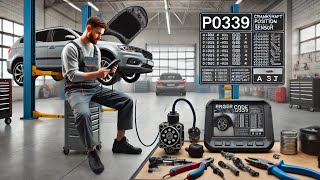
The most common OBD-II codes are P0335 (Crankshaft Position Sensor 'A' Circuit Malfunction/No Signal), P0336 (Circuit Range/Performance), and P0339 (Circuit Intermittent). A code reader can confirm which issue your vehicle's computer has detected.
Can I drive my CR-V with a bad crankshaft sensor?
It is not recommended. A failing sensor can cause your engine to stall at any time, which is a significant safety risk, especially in traffic. If the engine won't start, you could be left stranded. It is best to have the vehicle repaired as soon as possible.
Can I replace the crankshaft sensor myself?
For many home mechanics, this is a DIY-feasible job, especially on 2nd, 3rd, and 4th generation models where access is from the wheel well or underneath. However, on the 1st generation, it can be much more involved, sometimes requiring the removal of the timing belt cover. Always assess the location on your specific vehicle and ensure you have the right tools before starting.
Are there any recalls for this part on my CR-V?
No active recalls were found for the crankshaft position sensor for 1997-2014 Honda CR-V models. However, a Technical Service Bulletin (TSB 16-011) was issued for some 2015-2016 models, indicating that corrosion in the wiring harness could cause the same symptoms and codes (P0335, P0339). While this TSB is for later models, it highlights the importance of checking the wiring and connector for corrosion or damage before replacing the sensor itself.
Helpful Videos



Technical Specifications
OEM Part Numbers: 37500-P72-A01 37500-PNB-003 37500-R40-A01 37500-R60-U01
The sensor's connector type and terminal count vary by generation. First-generation (1997-2001) models typically use a 2-pin connector. Second-generation (2002-2006) and later models commonly use a 3-pin connector. Always verify the part is correct for your specific year and engine.

The information in this article is provided for general reference and educational purposes only. Vehicle specifications, procedures, and part compatibility can vary by production date, trim level, and region. Always consult your vehicle's factory service manual and verify part numbers before purchasing or performing repairs. Safety-critical components such as airbags, seat belts, and braking systems should be installed by a qualified professional.
- Honda CR-V: