

Ignition Contact Set Guide for 1955-1956 Studebaker E16 Trucks
Keep your classic Studebaker running strong with the right ignition points.
- The ignition contact set, or points, is a critical wear item that needs periodic replacement for your Studebaker to run well.
- Symptoms of failure include hard starting, rough idle, and engine misfires.
- Always replace the condenser at the same time as the points to prevent premature failure.
- Setting the correct point gap with a feeler gauge is essential for proper engine operation.
Understanding Ignition Points in Your Studebaker
For owners of a 1955-1956 Studebaker E16, the ignition system is a straightforward and reliable design. At its heart is the ignition contact set, or points. These are a mechanical set of contacts that act as a switch. As the distributor shaft rotates, a cam pushes the points open. When they open, it triggers the ignition coil to send a high-voltage spark to the correct spark plug. The timing of this spark is critical for your engine to run properly. Because they are a mechanical part with a rubbing block that rides on the distributor cam, points wear down over time and need to be replaced as part of a regular tune-up.
Symptoms of Failing Ignition Points
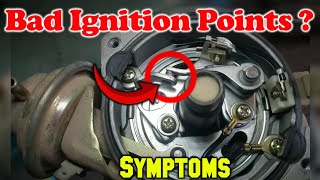
When the ignition points in your E16 start to fail, the symptoms are usually noticeable 🎬 See a visual guide to common symptoms of failing ignition points.. Worn or improperly gapped points can cause a variety of engine problems. You might experience:
- Difficulty Starting: The engine may crank but won't start, or it takes a long time to fire up.
- Engine Misfires: The truck may stutter or hesitate during acceleration.
- Rough Idle: The engine may run unevenly or stall when stopped.
- Poor Performance: A general lack of power and reduced fuel efficiency can also be signs of worn points.
- Backfiring: Incorrect timing from worn points can sometimes cause the engine to backfire.
These issues happen because the points are either not opening and closing at the right time, or the contact surfaces have become pitted and burned, preventing a clean electrical break.
A Note on Quality
The quality of modern replacement points and condensers can vary. Some classic car owners report issues with premature wear on the rubbing block or faulty condensers right out of the box. It's wise to inspect new parts carefully before installation.
Choosing the Right Aftermarket Part
For a vehicle like the 1955-1956 Studebaker, finding New Old Stock (NOS) OEM parts is difficult and often expensive. Aftermarket parts are the most practical and available option. The good news is that the basic design of ignition points is shared across many vehicles from this era, and quality aftermarket brands have been making them for decades.
Standard Ignition (Blue Streak): Standard Motor Products is a well-known and established brand in the aftermarket world. Their Blue Streak line, in particular, is often regarded as a higher-quality or performance option. For a stock Studebaker E16 engine, a standard replacement set from this brand is a reliable choice. Given the limited options, focusing on a reputable brand like Standard Ignition is your best bet.
| Part | Brand Tier | Typical Cost | Notes |
|---|---|---|---|
| Ignition Contact Set | Standard Aftermarket (Standard Ignition) | $21.53 - $27.65 | This is the most common and accessible option. Ensure it is listed as compatible with your 1955-1956 E16. |
| Ignition Tune-Up Kit (Points, Condenser, Rotor) | Standard Aftermarket | $30 - $50 | Often a better value. It's best practice to replace the points, condenser, and rotor at the same time. |
Pro Tip: Replace the Condenser Too
The condenser works with the points to prevent excessive arcing across the contacts as they open. A failing condenser will cause the points to burn out very quickly. Always replace the condenser when you replace the points; they are often sold together in a kit.
Frequently Asked Questions (FAQ)
Do I need special tools to replace the ignition points?
You will need basic hand tools like a screwdriver and wrenches. The most important special tool is a feeler gauge to set the point gap correctly. A dwell meter is a more accurate tool for setting points, but a feeler gauge will get the job done. The point gap for a similar Studebaker 259 V8 engine is noted as .018 inches, which is a good starting point, but always check the specification for your specific engine.
What is the difference between point gap and dwell?
Point gap is the physical distance the points open, measured with a feeler gauge. Dwell is the amount of time, measured in degrees of distributor rotation, that the points remain closed. The two are directly related; a wider gap decreases dwell, and a narrower gap increases it. Setting the correct dwell allows the ignition coil enough time 🎬 Learn how to accurately set your distributor dwell for better performance. to build a full charge for a strong spark.
Can I convert my Studebaker to electronic ignition?
Yes, electronic ignition conversion kits are available for many classic vehicles, including Studebakers. These kits replace the points and condenser with a solid-state module, eliminating the need for regular adjustment. While they offer reduced maintenance, a properly functioning points system is very reliable and easy to fix on the side of the road if needed.
Are there any recalls on the 1955-1956 Studebaker E16 ignition system?
There are no specific recalls found for the ignition contact set on the 1955-1956 Studebaker E16 in the NHTSA database. Given the age of the vehicle, any recalls would have been issued decades ago.
Helpful Videos

Technical Specifications
Point Gap: ~0.016" - 0.018" (Verify with service manual for your specific distributor). Dwell Angle: 28-32 degrees (for a similar V8).
We Have This Part in Stock


The information in this article is provided for general reference and educational purposes only. Vehicle specifications, procedures, and part compatibility can vary by production date, trim level, and region. Always consult your vehicle's factory service manual and verify part numbers before purchasing or performing repairs. Safety-critical components such as airbags, seat belts, and braking systems should be installed by a qualified professional.