

Ignition Contact Set Guide for the 1950-1958 Buick Super
Keep your classic Buick's V8 engine firing on all cylinders with the right ignition points.
- The ignition contact set (points) is a normal wear item that requires replacement every 15,000-20,000 miles.
- Symptoms of failure include hard starting, rough running, stalling, and loss of power.
- Always replace the condenser at the same time as the points to prevent premature failure.
- Setting the correct point gap (0.016") and dwell angle is critical for your Buick's performance.
Understanding the Ignition System in Your Classic Buick
The ignition system in your 1950-1958 Buick Super is a classic breaker-point design. At its core are the ignition contact set (the points) and a condenser, both housed inside the distributor. These parts work together to create and send a precisely timed spark to each spark plug. Unlike modern cars with electronic ignition, these components are normal wear items. The contact surfaces of the points can burn or pit over time, and the small rubbing block that rides on the distributor cam wears down. Regular inspection and replacement are necessary to maintain engine performance and reliability.
Symptoms of a Failing Ignition Contact Set
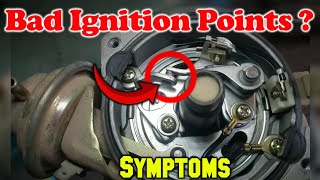
When your ignition points start to fail, your Buick will give you clear signs. Ignoring them can leave you stranded, as a complete failure will prevent the engine from starting at all. Look out for these common symptoms:
🎬 Watch this video to identify common signs of failing ignition points.- Difficulty Starting: The engine cranks but struggles to fire up. This is often due to a weak or inconsistent spark from worn or dirty points.
- Engine Misfires and Rough Running: You may feel a stutter or hesitation during acceleration, or a shaky, lumpy idle. This happens when pitted or incorrectly gapped points fail to deliver the spark at the right moment.
- Engine Stalling: The engine may die unexpectedly, especially at low speeds like when coming to a stop. This can be a safety hazard.
- Reduced Power and Poor Acceleration: A failing contact set leads to inefficient combustion, which means your engine isn't producing full power. Your car may feel sluggish and unresponsive.
A Note on Recalls and TSBs
Due to the age of the 1950-1958 Buick Super, there are no official manufacturer recalls or Technical Service Bulletins (TSBs) from the NHTSA for the ignition contact set. The modern recall system was not established until the mid-1960s.
Choosing the Right Aftermarket Ignition Contact Set
Since original OEM (New Old Stock) parts are extremely rare and expensive, aftermarket brands are the go-to choice for nearly all owners. For your Buick Super, the main options are Standard Ignition and Accel.
- Standard Ignition (Standard Motor Products): This is a long-standing brand known for producing reliable, OE-quality replacement parts. For a stock Buick Super used for regular driving, Standard Ignition points are a dependable and appropriate choice. They are designed to meet or exceed original specifications.
- Accel: Accel is often associated with high-performance applications. While some classic car owners use them, especially in modified engines, they may be unnecessary for a stock Nailhead V8. Some forum discussions mention that the quality of modern points, in general, can be inconsistent, but both Standard and Accel are established names in the market.
Pro Tip: Always replace the condenser when you replace the ignition points. A faulty condenser can cause new points to burn out very quickly. Most contact sets are sold in a kit that includes a new condenser.
Aftermarket Ignition Contact Set Cost for 1950-1958 Buick Super
| Part Type | Price Range |
|---|---|
| New Aftermarket Ignition Contact Set | $26.77 - $37.15 |
| Estimated Shop Labor | $90 - $150 |
Frequently Asked Questions (FAQ)
How often should I replace my ignition points?
As a general rule, ignition points should be inspected at every tune-up and replaced every 15,000 to 20,000 miles. However, it's a good practice to check their condition and gap annually.
What does 'gapping the points' mean?
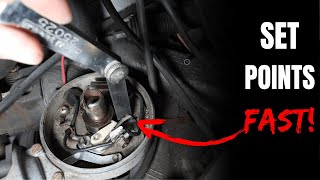
Gapping the points means setting the small air gap between the two electrical contacts to the correct specification when they are fully open. For 1950-1958 Buick V8s, the point gap should be set to 0.016 inches. 🎬 See the easy way to adjust points on a Buick distributor. This is done with a feeler gauge and is critical for correct ignition timing and dwell angle.
What is a dwell angle?
Dwell angle is the amount of time, measured in degrees of distributor rotation, that the points are closed. This is when the ignition coil builds up its charge. For 1955-1958 Buick V8s, the dwell angle should be between 26 and 33 degrees (30 is ideal). An incorrect dwell angle can lead to a weak spark or overheating of the coil.
Should I convert to an electronic ignition?
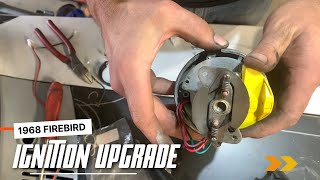
Many owners of classic cars replace their points with an electronic ignition conversion kit for better reliability and less maintenance. These kits provide a more consistent spark and eliminate the need for periodic adjustments. However, a well-maintained points system is very reliable and keeps the car original. The choice comes down to personal preference for originality versus modern convenience.
🎬 Learn how to upgrade your ignition with an Accel kit.Helpful Videos

Technical Specifications
Point Gap: 0.016 inches. Dwell Angle: 26-33 degrees (1955-56), 30 degrees (1958).
We Have This Part in Stock


The information in this article is provided for general reference and educational purposes only. Vehicle specifications, procedures, and part compatibility can vary by production date, trim level, and region. Always consult your vehicle's factory service manual and verify part numbers before purchasing or performing repairs. Safety-critical components such as airbags, seat belts, and braking systems should be installed by a qualified professional.